
Women’s genitals ‘systemically mutilated’ in Hamas attack, says Israeli reservist who dealt with bodies

A reservist who dealt with the aftermath of the Hamas terror attack says there was a “systematic genital mutilation” of women as multiple victims were shot in the crotch, breasts and head.
Warning – contains graphic details of injuries
Shari Mendes was part of an Israeli army reserve unit whose role was to identify and prepare female soldiers for burial.
She told Sky News’ The World With Yalda Hakim she was at the Shura base on 8 October, where victims were brought the day after the attack that killed more than 1,200 people.
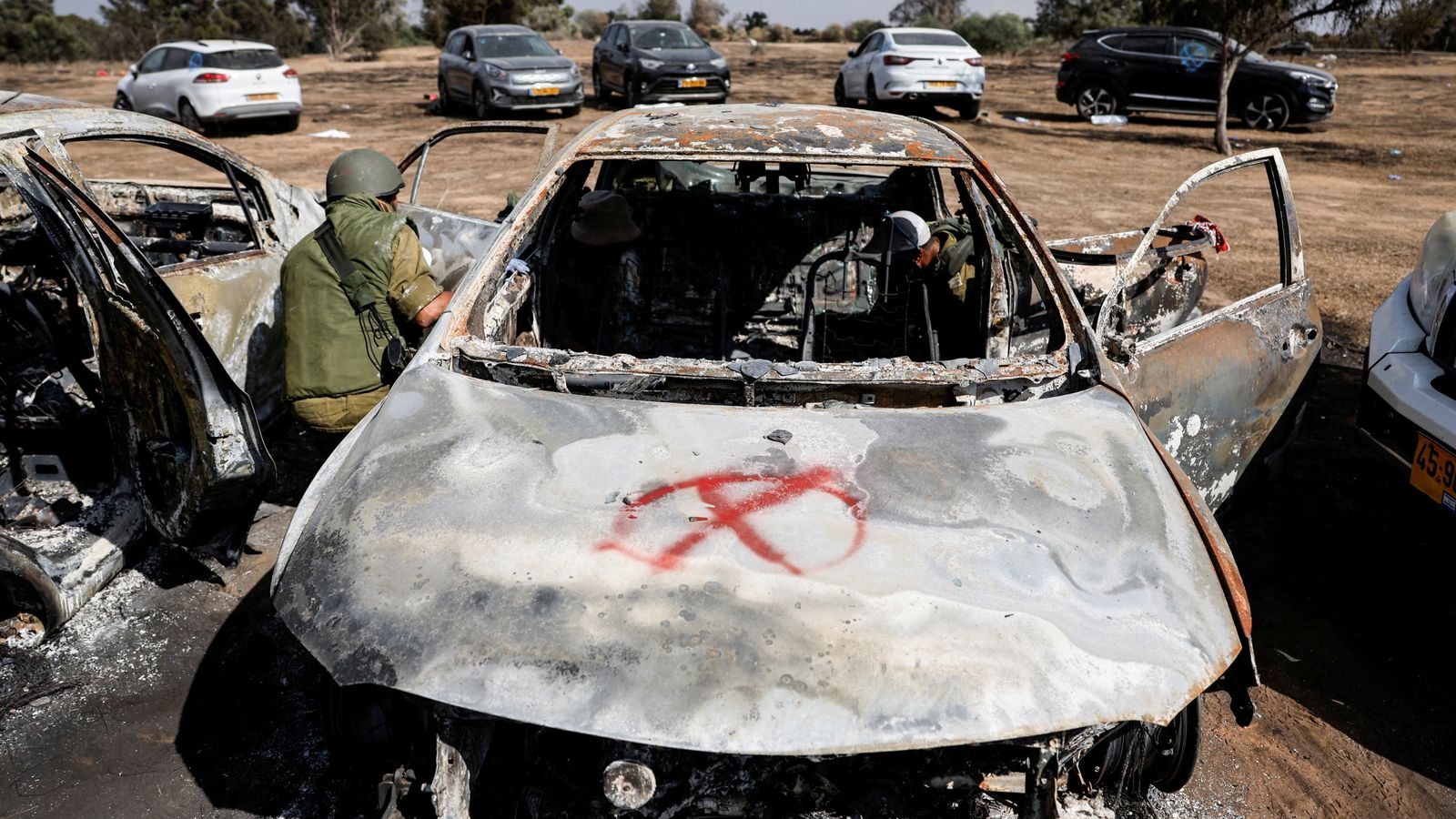
Israeli soldiers inspect a burnt car at the Nova Festival on 13 October. Pic: Reuters
“The halls were lined to the ceiling with body bags, the smell was unimaginable. I can’t tell you the shock and despair that struck all of us,” said Ms Mendes.
Her unit performed a religious role, “accompanying” the female victims and preparing them for burial in white linen.
Middle East latest: US destroys Houthi missile ‘preparing to launch’
“It was our job to honour them, they could have been our daughters – they were the same ages as our children… Just for a moment we loved them,” she told Sky News.
Ms Mendes said women came in barely dressed, some with bloody underwear, and their injuries were something none of her team was prepared for.
Did Hamas use rape as a weapon?
“Women were shot many times in the face… Their mouths were in grimaces, their eyes were open, their fists were clenched,” she said.
“They were shot so many times in the head, in many cases it was like there was purposeful obliteration of women’s faces.
“Our team has seen women shot in the crotch, in the genitals. Women were shot in the breast… Our team saw this.”
She added: “Women had legs cut off. It seemed like there was a systematic genital mutilation of women in the women we saw.”
Hamas has denied its fighters raped anyone during the attack, saying it would contradict Islamic teaching, but the UN has begun investigating the claims.
‘Booby-trapped bodies’
Ms Mendes said many victims were so badly damaged that she and her colleagues struggled to dress them for burial in the customary white linen.
She told Sky News: “One woman had her arm and her leg broken in so many places it was like handling marbles or sand, and at a certain point we said we would just put a white sheet on top of her.”
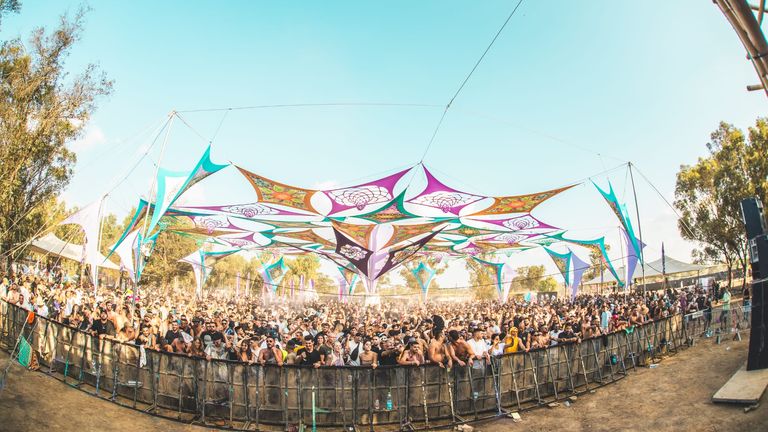
Witnesses and others who dealt with the attack, particularly the massacre at the Nova music festival, have also described terrible injuries to women and said rape appeared to have been used as a tactic.
Ms Mendes also said the base had to be evacuated on occasion because some victims arrived “booby trapped”.
She said other women who may have been subjected to sexual violence during the attack could be staying silent, fearful of not being believed.
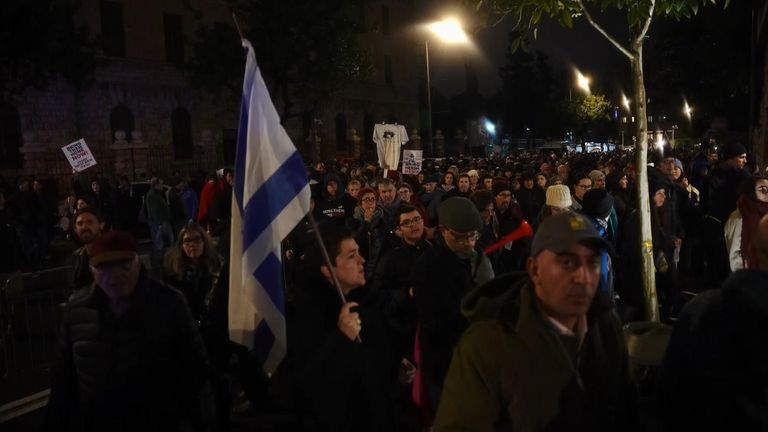
Israelis call for hostage-release deal
“If these women are being questioned about the veracity of their claims, why should they come forward?” she said.
“I think we have to be patient: they’re very traumatised… It may take time for these women to speak out, if they ever do.”
“It re-victimises the victim to not believe them.”

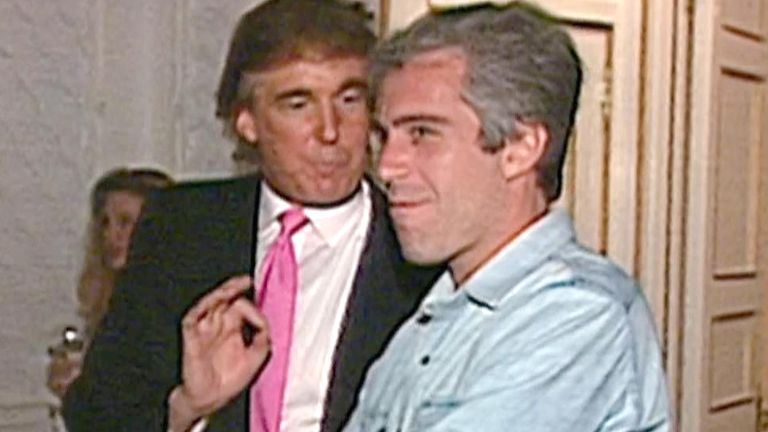
Can it be a coincidence that US planes attacked Syria around the very time the Epstein files were released?
It would be cynical – but then again, it would be how politics works.
The deadline-day release of the Epstein files had White House media management written all over it, unredacted.
Initial searches for Trump’s name within the Department of Justice search function returned nothing, while the presence of former president Bill Clinton, on the other hand, was everywhere.
It is PR strategy 101 – front-load the release of documents with the Democrat stuff and save any possible Trump content for a soft landing sometime between Christmas and New Year.
Donald Trump and Jeffrey Epstein. Pic: NBC
Epstein files latest: What we found inside – as critics accuse ‘document dump’ of breaking law
By that time, the public will have softened its focus on the story – it’s what the festive season does.
The presence of celebrity in the latest release might also feather Trump’s bed.
It’s clear that iconic superstars like Mick Jagger and Diana Ross were courted by Epstein as innocents, ignorant of his criminality. To see them in the files cements a narrative of a monster who lured the unsuspecting into his orbit.
We support Jagger and Ross as treasured icons, so we remind ourselves that simply being included in the files doesn’t equate to wrongdoing or knowledge of it. In turn, it shapes an empathy around the predicament that will extend to Trump and, perhaps, the benefit of any doubt.
Of course, not everyone will see it that way – the people who see a cynical exercise in delay and obfuscation, constituting a gross insult to the Epstein survivors at the heart of the story.
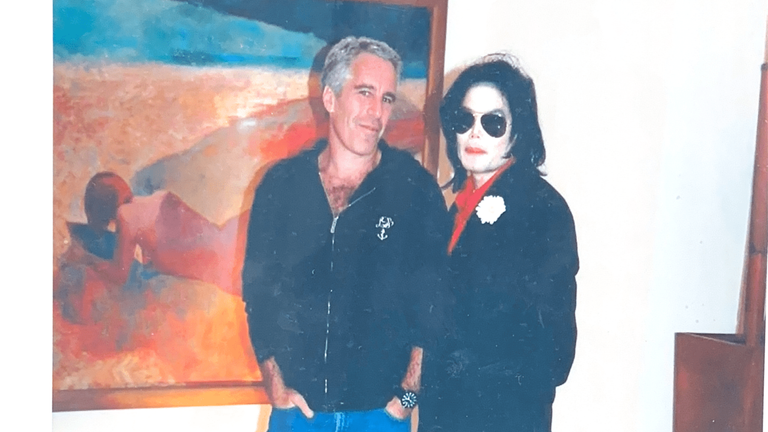
Jeffrey Epstein and Michael Jackson. Pic: US DoJ
Read more:
Mystery text quoting price for ‘girl’ included in new pictures
Trump administration criticised over partial Epstein files release
For all the talk (by the Trump administration) of a tight time scale and a willingness to act transparently, survivors and their supporters point out that Donald Trump could have published all the Epstein files long ago, never mind drip feed them with wide-ranging redactions.
Not to have done so is an affront to them and an attempt to evade accountability.
For all the talk about the release of the files, their significance is undermined by the lack of context. We are shown pictures and documents that reflect the life of a thoroughly unpleasant individual who inflicted suffering on an industrial scale. But with redactions, and without explanations, we are left having to join the dots in an effort to establish criminal behaviour and blame.
It is a level of uncertainty surrounding the Epstein files and a source of dissatisfaction to survivors, for whom justice further delayed is justice further denied.
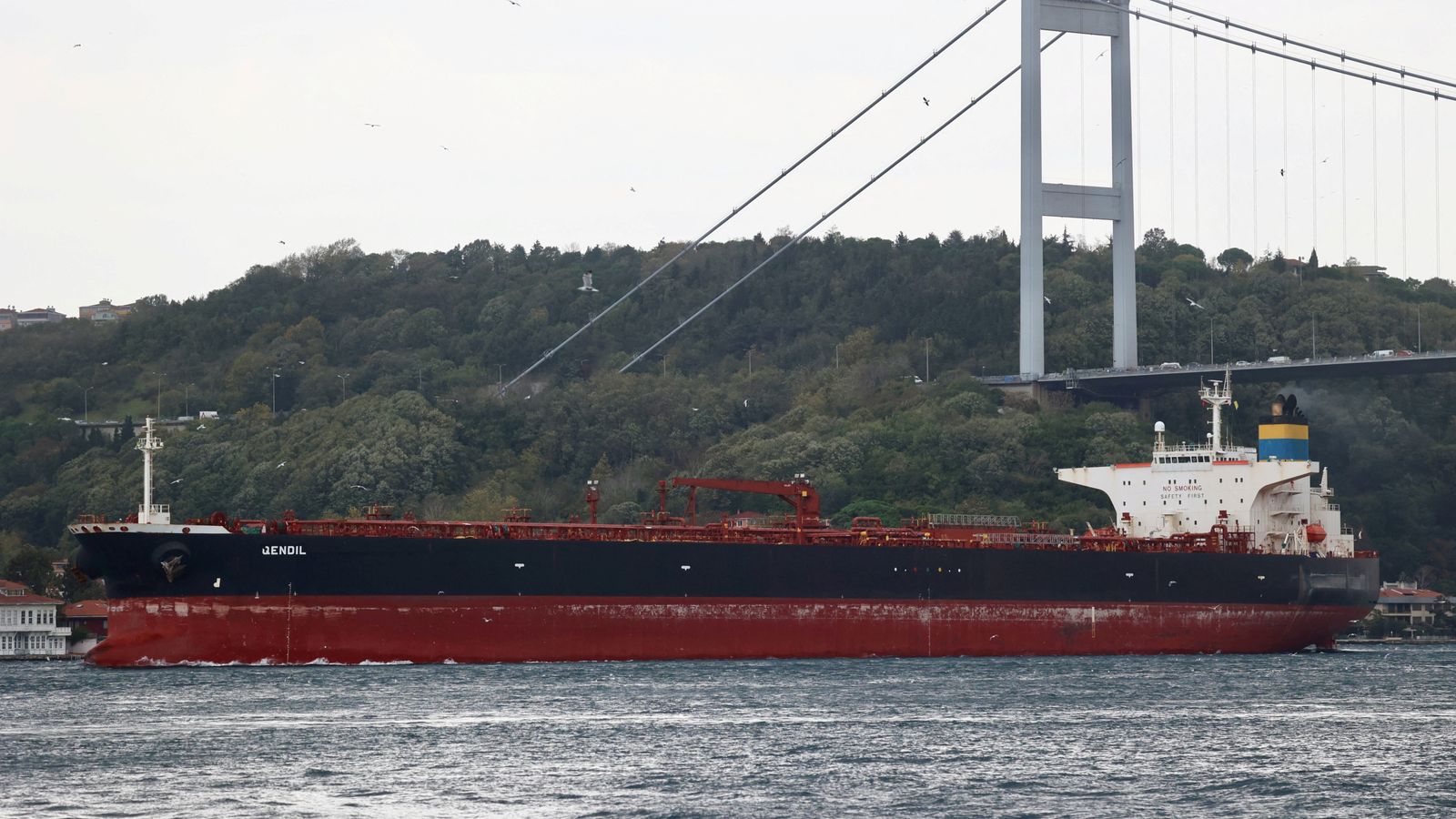
Ukraine has struck a Russian tanker in the Mediterranean Sea for the first time, a Kyiv intelligence source has said.
The ship, called the Qendil, suffered “critical damage” in the attack, according to a member of the SBU, Ukraine’s internal security agency.
The tanker is said to be part of Russia’s so-called “shadow fleet” – a group of ageing vessels that Kyiv alleges helps Moscow exports large quantities of crude oil despite Western sanctions.
The SBU source said Ukrainian drones hit the ship in neutral waters more than 2,000 kilometres (1,243 miles) from Ukraine.
They said: “Russia used this tanker to circumvent sanctions and earn money that went to the war against Ukraine.
“Therefore, from the point of view of international law and the laws and customs of war, this is an absolutely legitimate target for the SBU.
“The enemy must understand that Ukraine will not stop and will strike it anywhere in the world, wherever it may be.”
The vessel was empty at the time of the attack, the Ukrainian source added.
Speaking during a live TV event, Vladimir Putin, the Russian president, claimed the attack would not disrupt supplies, but vowed that Russia would retaliate nonetheless.
He added that Russia regularly responded with “much stronger strikes” against Ukraine.
Putin also warned against any threat to blockade Russia’s coastal exclave Kaliningrad, which he said would “just lead to unseen escalation of the conflict” and could trigger a “large-scale international conflict”.
Read more:
The mercenaries fighting for Russia
British man who fought for Ukraine jailed
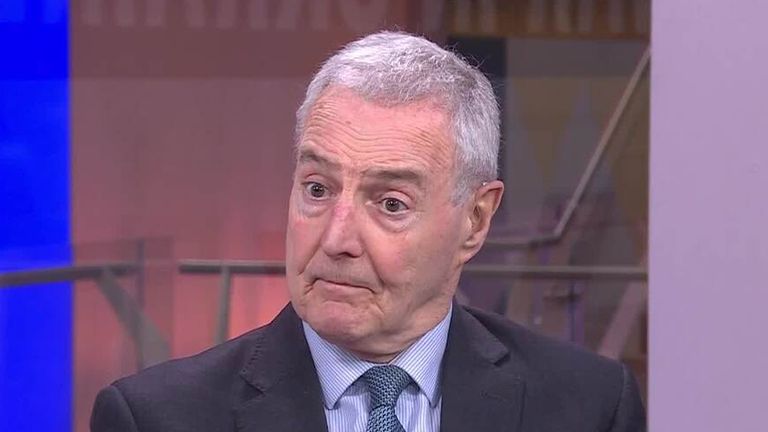
Sky military analyst Michael Clarke said Ukraine’s claim about causing significant damage to the ship was “probably true”.
He added: “The Ukrainians obviously feel that they can legitimise this sort of operation.”

The Qendil, pictured near Istanbul last month. Pic: Reuters
The attack comes after the European Union announced it would provide a €90bn (£79bn) interest-free loan to Ukraine.
Oleksandr Merezhko, the chairman of the foreign affairs committee in the Ukrainian parliament, told Sky News that the money would “tremendously enhance” Kyiv’s defensive capabilities.
However, he said the International Monetary Fund estimated that Ukraine needed $137bn to “keep running”.
“The aggressor should be punished”, Mr Merezhko added, as he argued that frozen Russian assets in Europe should be used to help fund his country’s defence.
He vowed that Ukraine would “continue to fight” for the move, adding that it was “a matter of justice”.
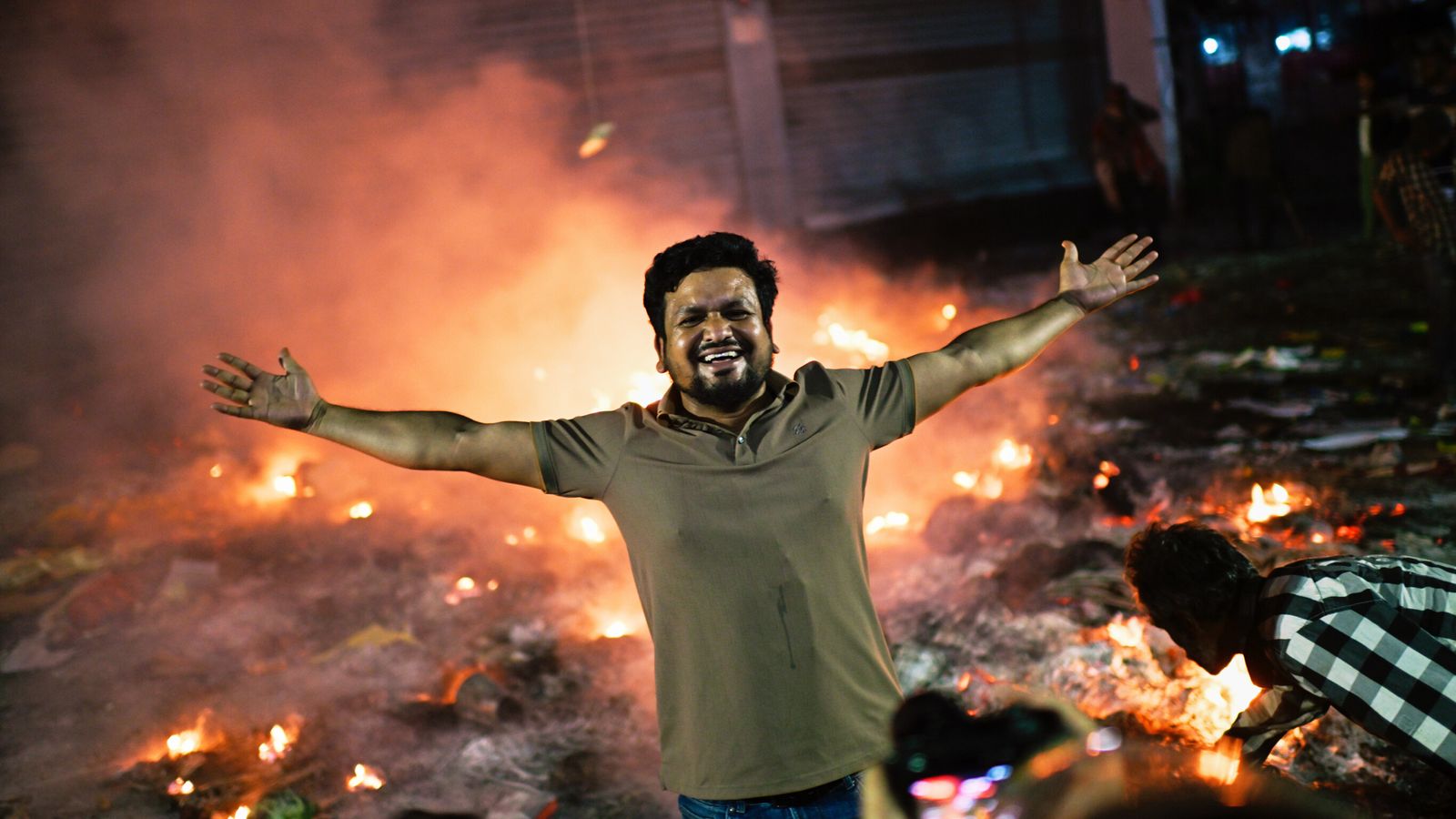
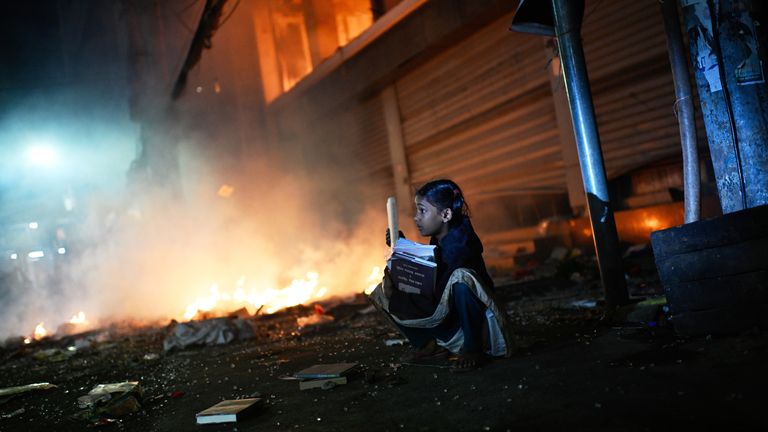
Protesters have stormed the headquarters of two major newspapers in Bangladesh, amid widespread unrest following the death of a political activist.
A mob set fire to the offices of the Bengali-language Prothom Alo daily newspaper and the English-language Daily Star in the capital Dhaka, leaving journalists and other staff stuck inside.
The Bengali-language Prothom Alo daily was one of the two newspapers that were targeted. Pic: AP.
One of the Daily Star’s journalists, Zyma Islam, wrote on Facebook: “I can’t breathe anymore. There’s too much smoke.”
Both dailies stopped updating their online editions after the attacks and did not publish broadsheets on Friday.
Troops were deployed to the Star building and firefighters had to rescue the journalists trapped inside. The blaze was brought under control early on Friday.
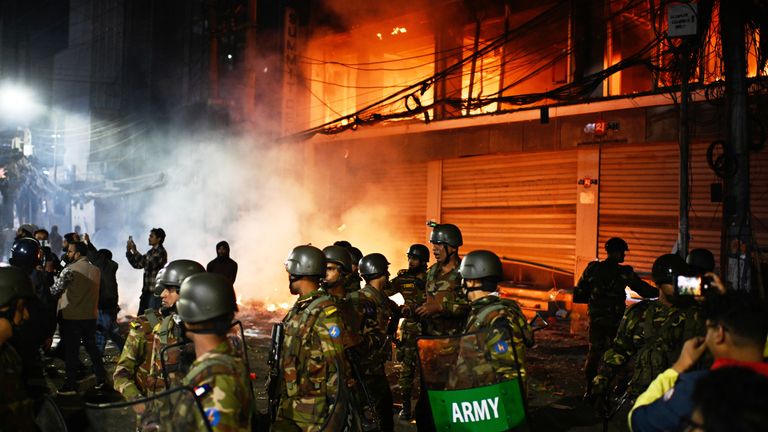
The latest protests erupted a year after the July Revolution ousted PM Sheikh Hasina. Pic: PA.
Political activist Sharif Osman Hadi died in hospital late on Thursday, six days after the youth leader was shot while riding on a rickshaw in Dhaka.
Bangladesh’s interim government urged people on Friday to resist violence as police and paramilitary troops fanned out
across the capital and other cities following the protests overnight. They have sparked concerns of fresh unrest ahead of national elections, which Mr Hadi had been due to stand in.
He was a prominent activist in the political uprising last year that forced the then Prime Minister Sheikh Hasina to flee the country. Mr Hadi spent six days on life support in a hospital in Singapore before he succumbed to his injuries.
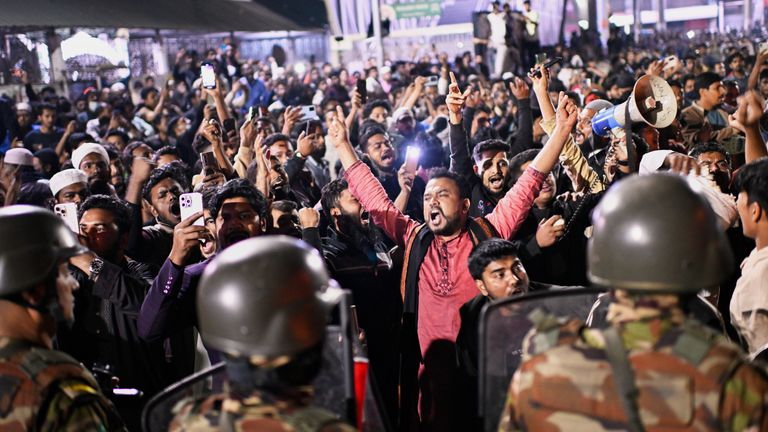
Mr Hadi died a week after he was shot by a man on a motorbike. Pic: PA.
Hundreds of protesters took to the streets following news of Mr Hadi’s death on Thursday night, where they rallied at Shahbagh Square near the Dhaka University campus, according to media reports.
A group of demonstrators gathered outside the head office of the Muslim-majority country’s leading Bengali-language Prothom Alo daily, before vandalising the building and setting it on fire.
A few hundred yards away, another group of protesters pushed into the Daily Star offices and set fire to the building. The protesters are believed to have targeted the papers for their alleged links with India and closeness to Bangladesh‘s interim leader, Nobel Peace Prize laureate Muhammad Yunus.
Read more:
Ex-Bangladesh PM Sheikh Hasina sentenced to death
UK MP Tulip Siddiq sentenced by Bangladeshi court
Although calm had returned to much of the country on Friday morning, protesters carrying national flags and placards
continued demonstrating at Shahbagh Square in Dhaka, chanting slogans and vowing not to return until justice was served.
👉 Tap here to follow The World with Richard Engel and Yalda Hakim wherever you get your podcasts 👈
Last year’s mass uprising erupted from student protests against a quota system that awarded 30% of government jobs to relatives of veterans.
The July 2024 protest, which resulted in as many as 1,400 deaths according to the United Nations, was dubbed the first “Gen Z” revolution.
Bangladesh’s former prime minister Sheikh Hasina Wazed was forced to resign in August 2024 and fled to India. She was later sentenced to death in absentia.
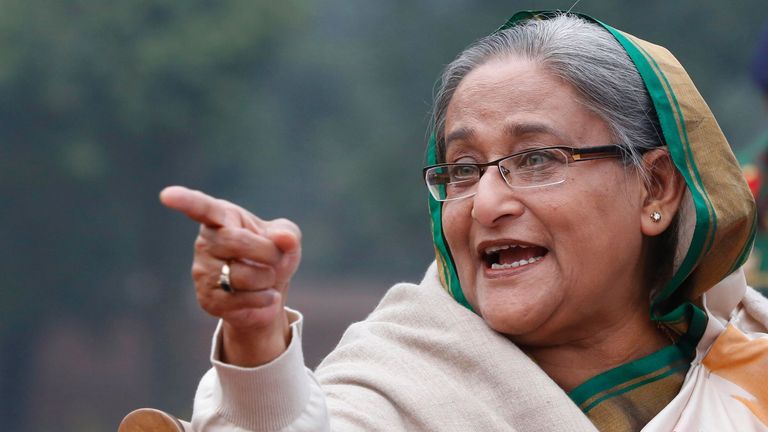
Sheikh Hasina was sentenced to death in absentia. Pic: AP
Dr Yunus was then sworn in as interim leader.
The country’s Islamists and other opponents of Ms Hasida have accused her government for being subservient to India.
Mr Hadi was a fierce critic of Ms Hasina and neighbouring India.
He had planned to run as an independent candidate in a constituency in Dhaka at the next national elections due to be held in February.
Authorities said they had identified the suspects in Mr Hadi’s shooting, and the assassin was also likely to have fled to India. Two men on a motorbike followed Hadi and one opened fire before they fled the scene.
-
 Sports2 years ago
Story injured on diving stop, exits Red Sox game
-
 Sports3 years ago
‘Storybook stuff’: Inside the night Bryce Harper sent the Phillies to the World Series
-
 Sports2 years ago
Game 1 of WS least-watched in recorded history
-
 Sports3 years ago
Button battles heat exhaustion in NASCAR debut
-
 Sports3 years ago
MLB Rank 2023: Ranking baseball’s top 100 players
-
Sports4 years ago
Team Europe easily wins 4th straight Laver Cup
-
 Environment3 years ago
Japan and South Korea have a lot at stake in a free and open South China Sea
-
 Environment1 year ago
Here are the best electric bikes you can buy at every price level in October 2024