
Meta plans to identify more AI-generated images ahead of upcoming elections

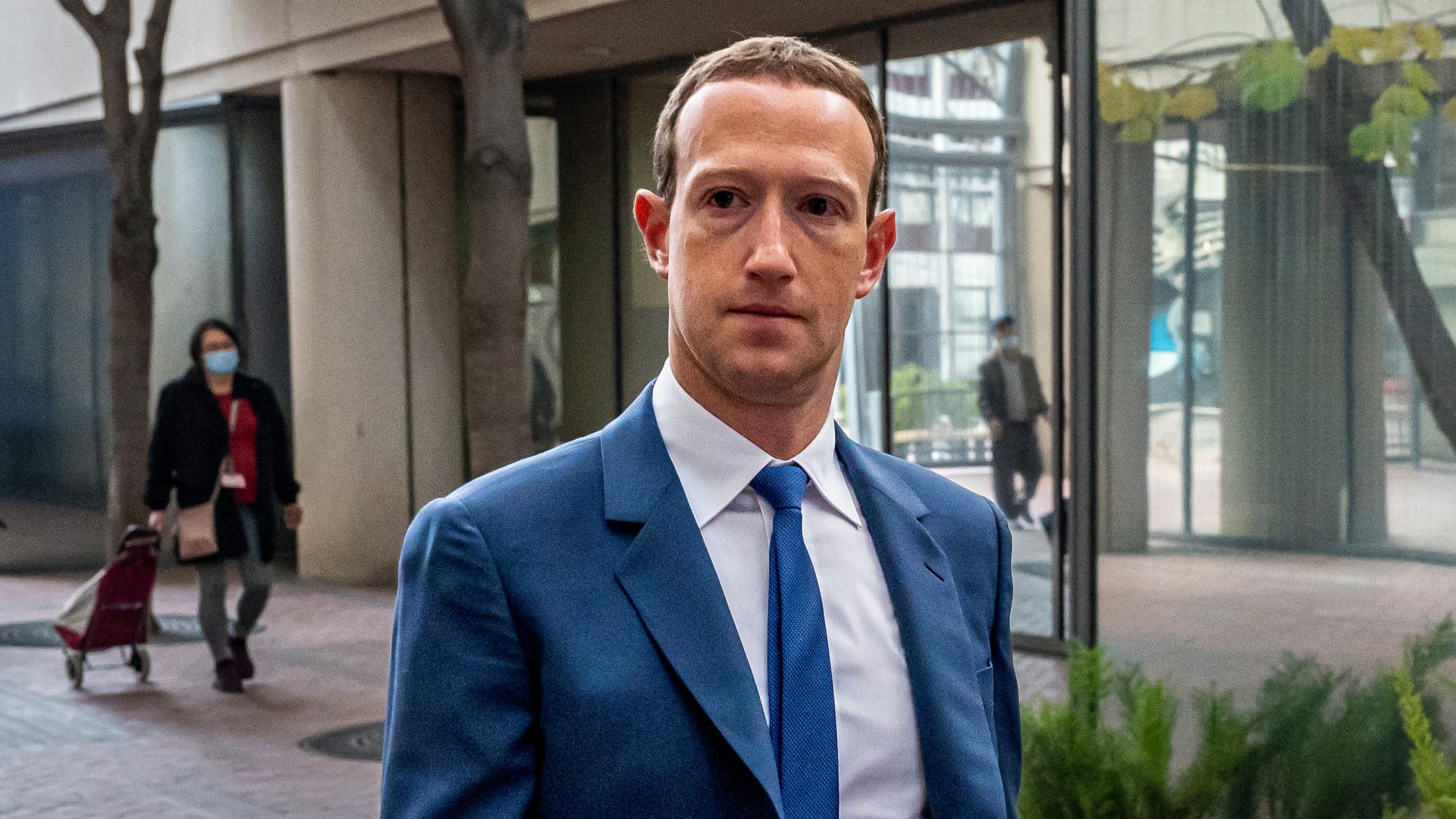
Meta Platforms CEO Mark Zuckerberg arrives at federal court in San Jose, California, on Dec. 20, 2022.
David Paul Morris | Bloomberg | Getty Images
Meta is expanding its effort to identify images doctored by artificial intelligence as it seeks to weed out misinformation and deepfakes ahead of upcoming elections around the world.
The company is building tools to identify AI-generated content at scale when it appears on Facebook, Instagram and Threads, it announced Tuesday.
Until now, Meta only labeled AI-generated images developed using its own AI tools. Now, the company says it will seek to apply those labels on content from Google, OpenAI, Microsoft, Adobe, Midjourney and Shutterstock.
The labels will appear in all the languages available on each app. But the shift won’t be immediate.
In the blog post, Nick Clegg, Meta’s president of global affairs, wrote that the company will begin to label AI-generated images originating from external sources “in the coming months” and continue working on the problem “through the next year.”
The added time is needed to work with other AI companies to “align on common technical standards that signal when a piece of content has been created using AI,” Clegg wrote.
Election-related misinformation caused a crisis for Facebook after the 2016 presidential election because of the way foreign actors, largely from Russia, were able to create and spread highly charged and inaccurate content. The platform was repeatedly exploited in the ensuing years, most notably during the Covid pandemic, when people used the platform to spread vast amounts of misinformation. Holocaust deniers and QAnon conspiracy theorists also ran rampant on the site.
Meta is trying to show that it’s prepared for bad actors to use more advanced forms of technology in the 2024 cycle.
While some AI-generated content is easily detected, that’s not always the case. Services that claim to identify AI-generated text, such as essays, have been shown to exhibit bias against non-native English speakers. It’s not much easier for images and videos, though there are often signs.
Meta is looking to minimize uncertainty by working mainly with other AI companies that use invisible watermarks and certain types of metadata in the images created on their platforms. However, there are ways to remove watermarks, a problem that Meta plans to address.
“We’re working hard to develop classifiers that can help us to automatically detect AI-generated content, even if the content lacks invisible markers,” Clegg wrote. “At the same time, we’re looking for ways to make it more difficult to remove or alter invisible watermarks.”
Audio and video can be even harder to monitor than images, because there’s not yet an industry standard for AI companies to add any invisible identifiers.
“We can’t yet detect those signals and label this content from other companies,” Clegg wrote.
Meta will add a way for users to voluntarily disclose when they upload AI-generated video or audio. If they share a deepfake or other form of AI-generated content without disclosing it, the company “may apply penalties,” the post says.
“If we determine that digitally created or altered image, video or audio content creates a particularly high risk of materially deceiving the public on a matter of importance, we may add a more prominent label if appropriate,” Clegg wrote.


Microsoft pushed back on a report Wednesday that the company lowered growth targets for artificial intelligence software sales after many of its salespeople missed those goals in the last fiscal year.
The company’s stock sank more than 2% on The Information report.
A Microsoft spokesperson said the company has not lowered sales quotas or targets for its salespeople.
The sales lag occurred for Microsoft’s Foundry product, an Azure enterprise platform where companies can build and manage AI agents, according to The Information, which cited two salespeople in Azure’s cloud unit.
AI agents can carry out a series of actions for a user or organization autonomously.
Less than a fifth of salespeople in one U.S. Azure unit met the Foundry sales growth target of 50%, according to The Information.
In another unit, the quota was set to double Foundry sales, The Information reported. The quota was dropped to 50% after most salespeople didn’t meet it.
In a statement, the company said the news outlet inaccurately combined the concepts of growth and quotas.
“Aggregate sales quotas for AI products have not been lowered, as we informed them prior to publication,” a Microsoft Spokesperson said.
The AI boom has presented opportunities for businesses to add efficiencies and streamline tasks, with the companies that build these agents touting the power of the tools to take on work and allow workers to do more.
OpenAI, Google, Anthropic, Salesforce, Amazon and others all have their own tools to create and manage these AI assistants.
But the adoption of these tools by traditional businesses hasn’t seen the same surge as other parts of the AI ecosystem.
The Information noted AI adoption struggles at private equity firm Carlyle last year, in which the tools wouldn’t reliably connect data from other places. The company later reduced how much it spent on the tools.
Read the full story from The Information here.


Waymo partners with Uber to bring robotaxi service to Atlanta and Austin.
Uber Technologies Inc.
Waymo on Wednesday said humans will begin test driving the Alphabet-owned company’s robotaxi vehicles in Baltimore, Pittsburgh and St. Louis.
The three cities represent the latest additions to Waymo’s quickly growing list of cities where the Google sister company is either operating its robotaxis, planning to launch service or starting to test its vehicles. That list now stands at 26 markets.
Waymo will begin manual drives in the trio of new cities this week with hopes to eventually begin serving fully-autonomous rides there, spokesperson Ethan Teicher told CNBC.
Over the past month, Waymo has been aggressively making announcements for new markets and developments at the Google sister company. This comes as tech rivals Amazon and Tesla made advancements in the robotaxi market in 2025. Amazon’s Zoox began offering free rides in Las Vegas and San Francisco, and Tesla this year launched ride-hailing service with human supervisors in the Austin and San Francisco markets.
In November, Waymo announced that it will soon begin manually driving in Minneapolis, Tampa and New Orleans. The company also added Houston, San Antonio and Orlando to its list of cities where it’ll launch service in 2026. Waymo also began offering rides on freeways in the San Francisco, Los Angeles and Phoenix markets, and it named a new finance chief.
With more than 250,000 weekly paid trips, Waymo’s robotaxi service currently operates in Austin, the San Francisco Bay Area, Phoenix, Atlanta and Los Angeles markets. The company in May said it had provided more than 10 million paid rides since launching in 2020.
The new cities further signal that Waymo is increasingly confident its service can work well in locations with colder weather conditions.
Technology
Security startup Verkada hits $5.8 billion valuation in latest funding round led by CapitalG


Filip Kaliszan, CEO of Verkada.
Courtesy: Verkada
Security technology startup Verkada has reached a $5.8 billion valuation after a new funding round led by CapitalG, Alphabet’s venture capital arm, announced Wednesday.
“I think Google saw the opportunity with us in the application of AI and everything we’re driving to apply AI to the physical security industry,” CEO Filip Kaliszan told CNBC’s Deirdre Bosa.
The company said in a release that the investment will be used to bolster its artificial intelligence capabilities and provide liquidity.
The financing totaled $100 million, a person familiar with the terms of the round told CNBC, raising the company’s valuation by $1.3 billion from its Series E funding in February. The person asked not to be named in order to discuss details of the funding.
CapitalG also recently contributed to a $435 million fundraise for cybersecurity startup Armis in November.
The new funding comes as Verkada surpasses $1 billion in annualized bookings across 30,000 customers globally.
The company develops physical security products, including cameras, alarms and sensors, that are connected under a single cloud-based software platform.
Kaliszan said his company serves a broad span of businesses, such as retailers, government properties, schools, and transportation.
For example, TeraWatt Infrastructure, which supplies charging sites to electric vehicles like Google’s Waymo, uses Verkada technology to protect EV facilities.
In September, the company rolled out over 60 new AI features and platform updates, including tools like “AI-Powered Unified Timeline.”
The tool can automatically synthesize videos and images from several cameras into a single visual timeline, rather than requiring security teams to dig through multiple videos during an investigation.
“The genius of Filip and the team of Verkada is that they’re leveraging AI as a Rosetta Stone to really help unlock insights from cameras to help companies become safer and more efficient,” CapitalG general partner Derek Zanutto told Bosa.
By capturing over 20 million images per hour, Verkada can provide notable data like foot traffic, occupancy rates, security violations and other trends, Zanutto said.
He added that the physical security is a sleeping $60 billion market that is led by legacy hardware like “cameras that just record, not cameras that think” — a gap that Verkada is hoping to fill.
However, AI-powered technology will not necessarily replace human security guards any time soon.
“I think humans will be providing security to other humans for as long as I can think,” Kaliszan said. “But AI can empower these first responders to be more aware, to have situational knowledge, to know what to do, and in some cases, actually prevent the problems from happening.”
He pointed to the Louvre heist in October, where multiple crown jewels were robbed from the museum, as an opportunity where AI-assisted devices that could actively monitor, then immediately alert security forces, would be more effective than only physical personnel.
“If you could intervene right then, if you could know in real time that that’s happening, the potential for savings and preventing damage is tremendous,” he said.
-
 Sports2 years ago
Story injured on diving stop, exits Red Sox game
-
 Sports3 years ago
‘Storybook stuff’: Inside the night Bryce Harper sent the Phillies to the World Series
-
 Sports2 years ago
Game 1 of WS least-watched in recorded history
-
 Sports3 years ago
Button battles heat exhaustion in NASCAR debut
-
 Sports3 years ago
MLB Rank 2023: Ranking baseball’s top 100 players
-
Sports4 years ago
Team Europe easily wins 4th straight Laver Cup
-
 Environment3 years ago
Japan and South Korea have a lot at stake in a free and open South China Sea
-
 Environment1 year ago
Here are the best electric bikes you can buy at every price level in October 2024