
Palantir shares rocket 25% after revenue beat, strong demand for AI

The logo of U.S. software company Palantir Technologies is seen in Davos, Switzerland Januar 22, 2020.
Arnd Wiegmann | Reuters
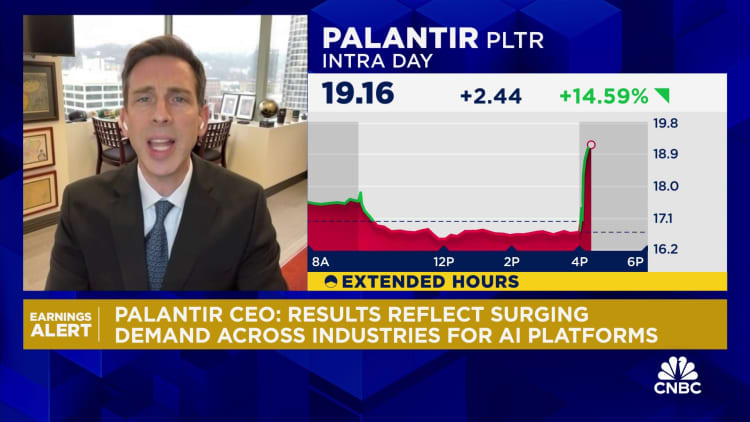
Shares of Palantir popped more than 25% Tuesday, a day after the company released fourth-quarter earnings that surpassed analysts’ expectations for revenue and showed strong demand for its artificial intelligence offerings.
Palantir, known for its defense and intelligence work with the U.S. government, reported that revenue in the quarter increased 20% to $608.4 million, up from the $602.4 million expected by Wall Street. Palantir said it expects to report between $612 million and $616 million in revenue during its first quarter, shy of the $617 million analysts were anticipating.
In a letter to shareholders, CEO Alex Karp said demand for large language models in the U.S. “continues to be unrelenting.” Palantir has been scaling its Artificial Intelligence Platform, or AIP, and Karp said the company carried out nearly 600 pilots with the technology last year.
Analysts at Citi upgraded Palantir shares to neutral from sell and raised their target price from $10 to $20. They said Palantir delivered a “stronger-than-expected” fourth quarter driven by “breakthrough momentum” in the company’s commercial unit, but they still have some reservations about its conservative full-year guidance for its non-U.S. commercial sectors.
“We see these risks balanced by potential call options on new AI Monetization (AIP) and improving U.S. Government contracts into 2024,” the analysts wrote in a note Tuesday.
Jefferies analysts also upgraded the stock and said Palantir delivered an “impressive” quarter led in part by its commercial growth in the U.S.
Jefferies analysts said they had downgraded shares of Palantir at the beginning of the year because they believed it would take time for its AI platform to have a real impact, but now, they think the company is at an “inflection point.”
“We are impressed with AI Platform (AIP) ramping faster than our initial expectations and believe it’s appropriate to upgrade shares to reflect the momentum,” the analysts wrote in a Tuesday note. “We were wrong, but we’re not stubborn.”
However, the Jefferies analysts said they still have some concerns about Palantir’s valuation since shares are trading at a “23% premium to the large cap average,” so the analysts will “remain on the sidelines.”
Bank of America analysts reiterated their buy rating on the stock and said that while AIP is still in its early days, it is already impacting the company in a “meaningful way.” The analysts said they expect Palantir’s momentum with AI to continue, and they also see “significant opportunities” for the company’s software within the U.S. government.
“We think this remarkable growth is a sign of Palantir’s unique position as an enabler of AI-powered data-driven decision-making in a tangible, accessible, and operational way,” the analysts wrote Tuesday.
CNBC’s Michael Bloom contributed to this report.


Beta Technologies shares surged more than 9% after air taxi maker Eve Air Mobility announced an up to $1 billion deal to buy motors from the Vermont-based company.
Eve, which was started by Brazilian airplane maker Embraer and is now under Eve Holding, said the manufacturing deal could equal as much as $1 billion over 10 years. The Florida-based company said it has a backlog of 2,800 vehicles.
Shares of Eve Holding gained 14%.
Eve CEO Johann Bordais called the deal a “pivotal milestone” in the advancement of the company’s electric vertical takeoff and landing, or eVTOL, technology.
“Their electric motor technology will play a critical role in powering our aircraft during cruise, supporting the maturity of our propulsion architecture as we progress toward entry into service,” he said in a release.


Mateusz Slodkowski | SOPA Images | Lightrocket | Getty Images
Amazon’s cloud unit on Tuesday announced AI-enabled software designed to help clients better understand and recover from outages.
DevOps Agent, as the artificial intelligence tool from Amazon Web Services is called, predicts the cause of technical hiccups using input from third-party tools such as Datadog and Dynatrace. AWS said customers can sign up to use the tool Tuesday in a preview, before Amazon starts charging for the service.
The AI outage tool from AWS is intended to help companies more quickly figure out what caused an outage and implement fixes, Swami Sivasubramanian, vice president of agentic AI at AWS, told CNBC. It’s what site reliability engineers, or SREs, do at many companies that provide online services.
SREs try to prevent downtime and jump into action during live incidents. Startups such as Resolve and Traversal have started marketing AI assistants for these experts. Microsoft’s Azure cloud group introduced an SRE Agent in May.
Rather than waiting for on-call staff members to figure out what happened, the AWS DevOps Agent automatically assigns work to agents that look into different hypotheses, Sivasubramanian said.
“By the time the on-call ops team member dials in, they have an incident report with preliminary investigation of what could be the likely outcome, and then suggest what could be the remediation as well,” Sivasubramanian told CNBC ahead of AWS’ Reinvent conference in Las Vegas this week.
Commonwealth Bank of Australia has tested the AWS DevOps Agent. In under 15 minutes, the software found the root cause of an issue that would have taken a veteran engineer hours, AWS said in a statement.
The tool relies on Amazon’s in-house AI models and those from other providers, a spokesperson said.
AWS has been selling software in addition to raw infrastructure for many years. Amazon was early to start renting out server space and storage to developers since the mid-2000s, and technology companies such as Google, Microsoft and Oracle have followed.
Since the launch of ChatGPT in 2022, these cloud infrastructure providers have been trying to demonstrate how generative AI models, which are often training in large cloud computing data centers, can speed up work for software developers.
Over the summer, Amazon announced Kiro, a so-called vibe coding tool that produces and modifies source code based on user text prompts. In November, Google debuted similar software for individual software developers called Antigravity, and Microsoft sells subscriptions to GitHub Copilot.
WATCH: Amazon rolls out AI-powered tools to help big AWS customers update old software
Technology
Amazon to let cloud clients customize AI models midway through training for $100,000 a year


Attendees pass an Amazon Web Services logo during AWS re:Invent 2024, a conference hosted by Amazon Web Services, at The Venetian hotel in Las Vegas on Dec. 3, 2024.
Noah Berger | Getty Images
Amazon has found a way to let cloud clients extensively customize generative AI models. The catch is that the system costs $100,000 per year.
The Nova Forge offering from Amazon Web Services gives organizations access to Amazon’s AI models in various stages of training so they can incorporate their own data earlier in the process.
Already, companies can fine-tune large language models after they’ve been trained. The results with Nova Forge will lean more heavily on the data that customers supply. Nova Forge customers will also have the option to refine open-weight models, but training data and computing infrastructure are not included.
Organizations that assemble their own models might end up spending hundreds of millions or billions of dollars, which means using Nova Forge is more affordable, Amazon said.
AWS released its own models under the Nova brand in 2024, but they aren’t the first choice for most software developers. A July survey from Menlo Ventures said that by the middle of this year, Amazon-backed Anthropic controlled 32% of the market for enterprise LLMs, followed by OpenAI with 25%, Google with 20% and Meta with 9% — Amazon Nova had a less than 5% share, a Menlo spokesperson said.
The Nova models are available through AWS’ Bedrock service for running models on Amazon cloud infrastructure, as are Anthropic’s Claude 4.5 models.
“We are a frontier lab that has focused on customers,” Rohit Prasad, Amazon head scientist for artificial general intelligence, told CNBC in an interview. “Our customers wanted it. We have invented on their behalf to make this happen.”
Nova Forge is also in use by internal Amazon customers, including teams that work on the company’s stores and the Alexa AI assistant, Prasad said.
Reddit needed an AI model for moderating content that would be sophisticated about the many subjects people discuss on the social network. Engineers found that a Nova model enhanced with Reddit data through Forge performed better than commercially available large-scale models, Prasad said. Booking.com, Nimbus Therapeutics, the Nomura Research Institute and Sony are also building models with Forge, Amazon said.
Organizations can request that Amazon engineers help them build their Forge models, but that assistance is not included in the new service’s $100,000 annual fee.
AWS is also introducing new models for developers at its Reinvent conference in Las Vegas this week.
Nova 2 Pro is a reasoning model whose tests show it performs at least as well as Anthropic’s Claude Sonnet 4.5, OpenAI’s GPT-5 and GPT-5.1, and Google’s Gemini 3.0 Pro Preview, Amazon said. Reasoning involves running a series of computations that might take extra time in response to requests to produce better answers. Nova 2 Pro will be available in early access to AWS customers with Forge subscriptions, Prasad said. That means Forge customers and Amazon engineers will be able to try Nova 2 Pro at the same time.
Nova 2 Omni is another reasoning model that can process incoming images, speech, text and videos, and it generates images and text. It’s the first reasoning model with that range of capability, Amazon said. Amazon hopes that, by delivering a multifaceted model, it can lower the cost and complexity of incorporating AI models into applications.
Tens of thousands of organizations are using Nova models each week, Prasad said. AWS has said it has millions of customers. Nova is the second-most popular family of models in Bedrock, Prasad said. The top group of models are from Anthropic.
WATCH: Amazon set to kick off AI conference next week: Maxim’s Tom Forte on what to expect
-
 Sports2 years ago
Story injured on diving stop, exits Red Sox game
-
 Sports3 years ago
‘Storybook stuff’: Inside the night Bryce Harper sent the Phillies to the World Series
-
 Sports2 years ago
Game 1 of WS least-watched in recorded history
-
 Sports3 years ago
Button battles heat exhaustion in NASCAR debut
-
 Sports3 years ago
MLB Rank 2023: Ranking baseball’s top 100 players
-
Sports4 years ago
Team Europe easily wins 4th straight Laver Cup
-
 Environment3 years ago
Japan and South Korea have a lot at stake in a free and open South China Sea
-
 Environment1 year ago
Here are the best electric bikes you can buy at every price level in October 2024