Connect with us

Published

on

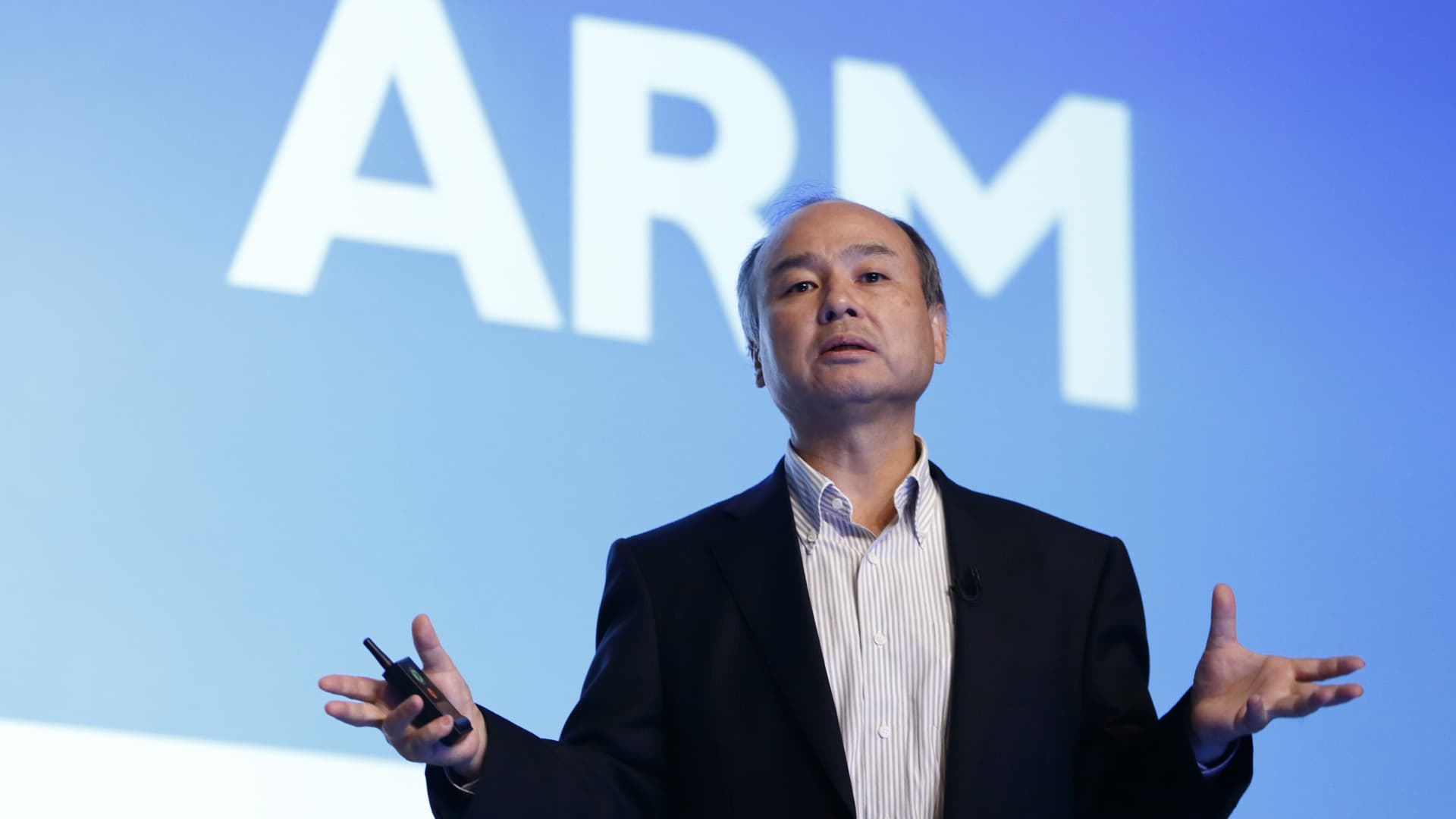
Billionaire Masayoshi Son, chairman and chief executive officer of SoftBank, which owns Arm, speaks during a news conference in Tokyo, July 28, 2016.

Tomohiro Ohsumi | Bloomberg | Getty Images

Masayoshi Son’s SoftBank made more in Arm’s after-hours trading on Wednesday than the total amount the company lost from its disastrous bet on now-bankrupt WeWork.

Arm shares rocketed as much as 41% late Wednesday after the chip designer reported revenue and earnings that sailed past analysts’ estimates. SoftBank took Arm public in September and still owns about 930 million shares, or roughly 90% of the chip designer’s outstanding stock.

Arm pared its initial gains, but SoftBank’s stake still jumped by almost $16 billion — from close to $71.6 billion to $87.4 billion — after the earnings report. Softbank acquired Arm in 2016 for $32 billion, and its shares were worth just over $47 billion at the time of the IPO last year.

The Arm windfall follows a rough stretch for SoftBank’s investment portfolio.

The company’s most high-profile wager was in WeWork, which spiraled into bankruptcy in November after the office-sharing company spent years burning through billions of dollars in cash from SoftBank at sky-high valuations. The Vision Fund, SoftBank’s venture arm, posted a $6.2 billion loss in the second quarter of 2023, tied to WeWork and other soured bets.

SoftBank told investors in November that its cumulative loss on WeWork exceeded $14 billion. In 2022, after a $32 billion loss in the Vision Fund, Son suggested that SoftBank would shift away from aggressive investments and into “defense” mode, selling down stakes in Alibaba and preparing to take Arm public. A little more than a year later, as hype over artificial intelligence mounted, Son said Softbank would switch back into “offense” mode, pursuing investments in AI.

Son can’t yet cash in on his company’s gains from Arm.

SoftBank is under a lock-up provision which prevents it from selling its Arm shares, with certain exceptions, for 180 days after the stock market debut. Arm went public in September, meaning that the lock-up restriction expires in mid-March.

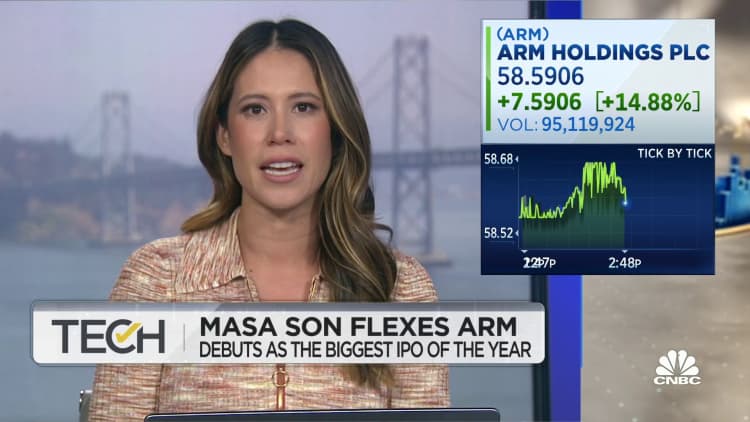
WATCH: Masa Son flexes Arm

Masa Son flexes Arm as the company debuts as the biggest IPO of the year

Continue Reading

Technology

Instacart ends AI-driven pricing tests that drove up costs for some shoppers

Published

on

By

Instacart ends AI-driven pricing tests that drove up costs for some shoppers

FILE PHOTO: Instacart shopper, Loralyn Geggatt makes a delivery to a customer’s home in Falmouth, MA on April 7, 2020.

David L. Ryan | Boston Globe | Getty Images

Instacart said Monday it will cease the use of artificial intelligence-driven pricing tests on its grocery delivery platform after the practice was scrutinized in a wide-ranging study and rebuked by lawmakers.

The company said in a blog post that retailers will no longer be able to use its Eversight technology to run pricing experiments on its platform, effective immediately.

“We understand that the tests we ran with a small number of retail partners that resulted in different prices for the same item at the same store missed the mark for some customers,” the company wrote. “At a time when families are working exceptionally hard to stretch every grocery dollar, those tests raised concerns, leaving some people questioning the prices they see on Instacart. That’s not okay – especially for a company built on trust, transparency, and affordability.”

Instacart acquired Eversight for $59 million in 2022. Eversight’s software allows retailers to carry out pricing tests to gauge shoppers’ reactions to higher or lower prices on certain items.

Instacart said at the time that the technology would help retailers improve sales and growth, while “also surfacing the best deals for customers.”

Read more CNBC tech news

Earlier this month, a study by Consumer Reports and other organizations found that Instacart’s algorithmic pricing tools caused shoppers to pay different prices for identical items from the same store.

The total cost for the same basket of goods at a single store varied by about 7%, which can result in over $1,000 in extra annual costs for customers. Instacart responded by saying that retailers determine prices listed on the app.

The company also rejected characterizations of the technology as surveillance pricing or dynamic pricing, and said the tests were never based on personal, demographic or individual-level user data.

Reuters reported last week that the Federal Trade Commission had sent a civil investigative demand to Instacart about its pricing practices.

Separately, Instacart last week was ordered to pay $60 million in refunds to customers to settle claims raised by the FTC that it used deceptive tactics in its subscription sign-up, “satisfaction guarantee” advertising and other processes.

Instacart denied any allegations of wrongdoing. The company said it answered questions from the FTC about its AI pricing tools as part of that settlement.

Study finds Instacart uses AI pricing tools causing various prices for identical products

Continue Reading

Technology

Tech stocks rebound, Google’s boomerang strategy, Xbox’s slump and more in Morning Squawk

Published

on

By

Tech stocks rebound, Google's boomerang strategy, Xbox's slump and more in Morning Squawk

Wall Street and Broad St. signs are seen as New York Stock Exchange building decorated for Christmas at the Financial District in New York City, United States on December 16, 2020.

Tayfun Coskun | Anadolu Agency | Getty Images

This is CNBC’s Morning Squawk newsletter. Subscribe here to receive future editions in your inbox.

Here are five key things investors need to know to start the trading day:

1. Here comes Santa Claus?

Technology stocks rebounded to end last week, helping assuage the latest worries about the artificial intelligence trade. The question now is if Santa is coming to town — which, in this case, means Wall Street.

Here’s what to know:

2. Epstein files

This photo illustration taken in Washington, DC, on December 19, 2025 shows redacted documents after the US Justice Department began releasing the long-awaited records from the investigation into the politically explosive case of convicted sex offender Jeffrey Epstein.

Mandel Ngan | AFP | Getty Images

The Justice Department released some of its investigative files tied to sexual predator Jeffrey Epstein on Friday. The release came on the deadline set by the Epstein Files Transparency Act, but it did not include all files as was instructed by the legislation.

The DOJ’s website now has an “Epstein Library” with a search box for keywords in the newly released files. However, CNBC found the search box did not immediately work as intended.

A number of documents were reportedly removed from the Justice Department’s site. A photo featuring President Donald Trump was later reposted after backlash.

3. Job search

Josh Woodward, VP of Google Labs, addresses the crowd during Google’s annual I/O developers conference in Mountain View, California on May 20, 2025.

Camille Cohen | AFP | Getty Images

Google hasn’t been looking far to staff up its AI teams. CNBC’s Jennifer Elias reported that about one-fifth of all AI software engineers hired by the tech giant this year were boomerangs, a term used for ex-employees who return.

That comes as 16-year Google veteran Josh Woodward has taken the helm of Gemini, the crown jewel of Alphabet’s AI ambitions, this year. The 42-year-old Oklahoma native also kept his role managing Google Labs.

Alphabet also made the news this weekend for a different business: its driverless ride-hailing service Waymo. The company had temporarily suspended operations in the San Francisco Bay Area following power outages.

Get Morning Squawk directly in your inbox

4. (Dis)like

In this photo illustration, iPhone screens display various social media apps on the screens on February 9, 2025 in Bath, England.

Anna Barclay | Getty Images News | Getty Images

C-suite leaders are learning a lesson that their younger, rank-and-file staffers grew up knowing: There’s a dark side to social media.

Executives and founders have been told that active social media usage is good for their personal brands and company awareness. But a growing body of anecdotes over recent years has shown that missteps can leave them — and sometimes the businesses they represent — in hot water.

Still, that doesn’t mean there aren’t benefits to being online, even if the reaction can be negative. How one founder put it to CNBC: “As long as your name is in their mouth, you’re doing something right.”

5. Glow up

While supplements tend to be more popular around New Year’s resolution season, Gruns is hoping its sales get a holiday bump. It’s selling some packs of gummies with a holiday flair, including a Grinch-inspired sour punch flavor.

Courtesy of Gruns

Make room, candy bars. Supplements may be making their way into stockings this year.

The wellness category is slated to gain ground this shopping season, with retailers giving this sector shelf space as consumers make resolutions for the new year. CNBC’s Melissa Repko reported that brands like Grüns and Neom Wellbeing are aiming to win shoppers’ interest this season by selling holiday-themed items.

On the other hand, Microsoft‘s Xbox may not be a hot item under trees as the gaming console remains in a slump. Between company layoffs, studio closures and price increases, CNBC’s Jaures Yip found that some are wondering if the Xbox is finally dead.

The Daily Dividend

Here’s some of the events we’re keeping an eye on this holiday-shortened week:

  • Tuesday: Real GDP and consumer confidence data
  • Wednesday: Early stock market close for Christmas Eve
  • Thursday: Stock market closed for Christmas

CNBC Pro subscribers can see a calendar and rundown for the week here.

CNBC’s Jonathan Vanian, Julia Boorstin, Laya Neelakandan, Chloe Taylor, Liz Napolitano, Dan Mangan, Sean Conlon, Jennifer Elias, Lora Kolodny, Mike Winters, Melissa Repko and Jaures Yip contributed to this report. Melodie Warner edited this edition.

Continue Reading

Technology

Uber, Lyft set to trial robotaxis in the UK in partnership with China’s Baidu

Published

on

By

Uber, Lyft set to trial robotaxis in the UK in partnership with China's Baidu

A Baidu Apollo RT6 robotaxi during Baidu’s Apollo Day in Wuhan, China, on Wednesday, May 15, 2024.

Bloomberg | Bloomberg | Getty Images

Chinese tech giant Baidu has announced plans to bring robotaxis to London starting next year through its partnerships with Lyft and Uber, as the UK emerges as a growing autonomous vehicle battleground.

The announced collaborations will bring Baidu’s Apollo Go autonomous vehicles to the British capital through the Uber and Lyft platforms, the companies said on their respective social media accounts. 

Lyft’s testing of Baidu’s initial fleet of dozens of vehicles will begin in 2026, pending regulatory approval, “with plans to scale to hundreds from there,” Lyft CEO David Risher said in a post on social media platform X on Monday.

Meanwhile, Uber said that its first pilot is expected to start in the first half of 2026. “We’re excited to accelerate Britain’s leadership in the future of mobility, bringing another safe and reliable travel option to Londoners next year,” the company added.

The moves add to Baidu’s growing global footprint, which it says includes 22 cities and more than 250,000 weekly trips, as it races against other Chinese players like WeRide and Western giants like Alphabet‘s Waymo. 

The UK, in particular, has seen a wave of interest from driverless taxi companies, following the government’s announcement in June that it would accelerate its plans to allow autonomous vehicle tech on public roads. 

The government now aims to begin permitting robotaxis to operate in small-scale pilots starting in spring 2026, with Baidu likely aiming to be amongst the first. 

The city of London has also established a “Vision Zero” goal to eliminate all serious injuries and deaths in its transportation systems by 2041, with autonomous driving technology expected to play a large role. 

News of Baidu pilots comes as its competitor Waymo also looks to begin testing in London, with plans for a full service launch in 2026. Waymo currently operates or plans to launch a service or test its fleet in 26 markets, including major cities like Tokyo and New York City.

Baidu, for its part, has been aggressively expanding globally, with testing rolling out in international markets like the United Arab Emirates and Switzerland

Continue Reading

Trending