

Cloudflare stock jumps 21% on earnings beat as the company wins larger deals

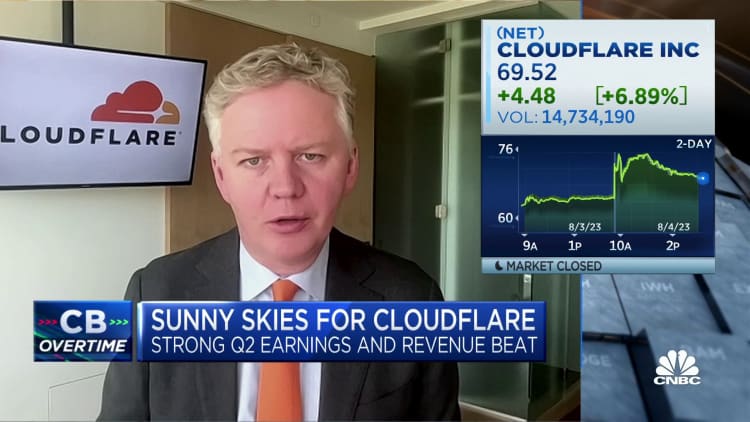
Matthew Prince, co-founder and chief executive officer of Cloudflare Inc., during the Fortune Brainstorm AI conference in San Francisco, California, US, on Monday, Dec. 11, 2023. The conference gathers leaders in machine learning and artificial intelligence to assess the industry and examine new business cases for AI. Photographer: David Paul Morris/Bloomberg via Getty Images
Bloomberg | Bloomberg | Getty Images
Cloudflare shares rose 21% in extended trading on Thursday after the web security and content distribution network provider issued results and quarterly guidance that proved more robust than analysts had projected.
Here’s how the company did, in comparison with estimates from analysts polled by LSEG, formerly known as Refinitiv:
- Earnings per share: 15 cents, adjusted, vs. 12 cents expected
- Revenue: $362.5 million, vs. $353.1 million expected
Cloudflare’s revenue rose about 32%, consistent with growth in the third quarter, according to a statement. The company’s net loss of $27.9 million, or 8 cents per share, narrowed from $45.9 million in the year-ago quarter.
Matthew Prince, Cloudflare’s co-founder and CEO, said in the statement that Cloudflare signed its largest new customer deal and biggest renewal to date during the quarter, resulting in the highest annual contract value in corporate history. On a conference call with analysts, Prince mentioned business from the U.S. Commerce Department.
Cloudflare is working to supply software developers with graphics processing units that they can use for artificial intelligence. The company had installed GPUs in 120 cities by the end of 2023, higher than an internal target of 100, Prince said.
“By the end of 2024, we plan to have inference to GPUs deployed in nearly every city that makes up Cloudflare’s global network and within milliseconds of nearly every device connected to the Internet worldwide,” Prince said. The network had presence in over 310 cities as of Dec. 31.
The company also wants to grow by selling security services to companies and government agencies. Cyberattacks have become more common since Hamas carried out a terrorist attack in Israel in October, Prince said.
Also on Thursday, Cloudflare said Mark Anderson, a board member who was formerly CEO of Alteryx, has joined Cloudflare as president, replacing Marc Boroditsky. Private equity firms Clearlake Capital Group and Insight Partners announced in December that they would acquire Alteryx for $4.4 billion. Prince said he and co-founder and operating chief Michelle Zatlyn wouldn’t be going anywhere.
With respect to guidance, Cloudflare called for 13 cents in adjusted net earnings per share on $372.5 million to $373.5 million in revenue in the first quarter. Analysts surveyed by LSEG had expected 12 cents per share in adjusted earnings and revenue of $372.3 million.
For all of 2024, Cloudflare’s earnings outlook was higher than consensus, but the middle of the revenue range missed slightly. The company sees 58 cents to 59 cents in adjusted earnings per share and revenue from $1.648 billion to $1.652 billion. Analysts polled by LSEG were looking for 56 cents in adjusted earnings per share and $1.652 billion in revenue.
Excluding the after-hours move, Cloudflare stock is up about 8% so far this year, while the S&P 500 has gained about 5% during the same period.
WATCH: A.I. is a trend that will stick with us for quite some time, says CloudFlare CEO Matthew Prince
Technology
Australia is trying to enforce the first teen social media ban. Governments worldwide are watching.


In this photo illustration, iPhone screens display various social media apps on the screens on February 9, 2025 in Bath, England.
Anna Barclay | Getty Images News | Getty Images
Australia on Wednesday became the first country to formally bar users under the age of 16 from accessing major social media platforms, a move expected to be closely monitored by global tech companies and policymakers around the world.
Canberra’s ban, which came into effect from midnight local time, targets 10 major services, including Alphabet‘s YouTube, Meta’s Instagram, ByteDance’s TikTok, Reddit, Snapchat and Elon Musk’s X.
The controversial rule requires these platforms to take “reasonable steps” to prevent underage access, using age–verification methods such as inference from online activity, facial estimation via selfies, uploaded IDs, or linked bank details.
All targeted platforms had agreed to comply with the policy to some extent. Elon Musk’s X had been one of the last holdouts, but signaled on Wednesday that it would comply.
The policy means millions of Australian children are expected to have lost access to their social accounts.
However, the impact of the policy could be even wider, as it will set a benchmark for other governments considering teen social media bans, including Denmark, Norway, France, Spain, Malaysia and New Zealand.
Controversial rollout
Ahead of the legislation’s passage last year, a YouGov survey found that 77% of Australians backed the under-16 social media ban. Still, the rollout has faced some resistance since becoming law.
Supporters of the bill have argued it safeguards children from social media-linked harms, including cyberbullying, mental health issues, and exposure to predators and pornography.
Among those welcoming the official ban on Wednesday was Jonathan Haidt, social psychologist and author of The Anxious Generation, a 2024 best-selling book that linked a growing mental health crisis to smartphone and social media usage, especially for the young.
In a post on social media platform X, Haidt commended policymakers in Australia for “freeing kids under 16 from the social media trap.”
“There will surely be difficulties in the early months, but the world is rooting for your success, and many other nations will follow,” he added.
On the other hand, opponents contend that the ban infringes on freedoms of expression and access to information, raises privacy concerns through invasive age verification, and represents excessive government intervention that undermines parental responsibility.
Those critics include groups like Amnesty Tech, which said in a statement Tuesday that the ban was an ineffective fix that ignored the rights and realities of younger generations.
“The most effective way to protect children and young people online is by protecting all social media users through better regulation, stronger data protection laws and better platform design,” said Amnesty Tech Programme Director Damini Satija.

Meanwhile, David Inserra, a fellow for free expression and technology at the Cato Institute, warned in a blog post that children would evade the new policy by shifting to new platforms, private apps like Telegram, or VPNs, driving them to “more isolated communities and platforms with fewer protections” where monitoring is harder.
Tech companies like Google have also warned that the policy could be extremely difficult to enforce, while government-commissioned reports have pointed to inaccuracies in age–verification technology, such as selfie-based age–guessing software.
Indeed, on Wednesday, local reports in Australia indicated that many children had already bypassed the ban, with age-assurance tools misclassifying users, and workarounds such as VPNs proving effective.
However, Australian Prime Minister Anthony Albanese had attempted to preempt these issues, acknowledging in an opinion piece on Sunday that the system would not work flawlessly from the start, likening it to liquor laws.
“The fact that teenagers occasionally find a way to have a drink doesn’t diminish the value of having a clear national standard,” he added.
Experts told CNBC that the rollout is expected to continue to face challenges and that regulators would need to take a trial-and-error approach.
“There’s a fair amount of teething problems around it. Many young people have been posting on TikTok that they successfully evaded the age limitations and that’s to be expected,” said Terry Flew, a professor of digital communication and culture at the University of Sydney.
“You were never going to get 100% disappearance of every person under the age of 16 from every one of the designated platforms on day one,” he added.
Global implications
Experts told CNBC that the policy rollout in Australia will be closely watched by tech firms and lawmakers worldwide, as other countries consider their own moves to ban or restrict teen social media usage.
“Governments are responding to how public expectations have changed about the internet and social media, and the companies have not been particularly responsive to moral suasion,” said Flew.
“We see similar pressures are emerging, particularly, but not exclusively in Europe,” he added.
The European Parliament passed a non-binding resolution in November advocating a minimum age of 16 for social media access, allowing parental consent for 13 to 15-year-olds.
The bloc has also proposed banning addictive features such as infinite scrolling and auto-play for minors, which could lead to EU-wide enforcement against non-compliant platforms.

Outside Europe, Malaysia and New Zealand have also been advancing proposals to ban social media for children under 16.
However, laws elsewhere are expected to differ from Australia’s, whether that be regarding age restrictions or age verification processes.
“My hope is that countries that are looking at implementing similar policies will monitor for what doesn’t work in Australia and learn from our mistakes,” said Tama Leaver, professor at the Department of Internet Studies at Curtin University and a Chief Investigator in the ARC Centre of Excellence for the Digital Child.
“I think platforms and tech companies are also starting to realize that if they don’t want age-gating policies everywhere, they’re going to have to do much better at providing safer, appropriate experiences for young users.”


Park Dae-jun, CEO of South Korean online retail giant Coupang has resigned, three weeks after the company became aware of a massive data breach that affected nearly 34 million customers.
Coupang
The CEO of South Korean online retail giant Coupang Corp. resigned Wednesday, three weeks after the company became aware of a massive data breach that affected nearly 34 million customers.
Coupang said CEO Park Dae-jun resigned due to the data breach incident — which was revealed on Nov. 18 — according to a Google translation of the statement in Korean.
“I am deeply sorry for disappointing the public with the recent personal information incident,” Park said, adding, “I feel a deep sense of responsibility for the outbreak and the subsequent recovery process, and I have decided to step down from all positions.”
Following his resignation, parent company Coupang Inc. appointed Harold Rogers, the Chief Administrative Officer and General Counsel, as interim CEO.
Coupang said that Rogers plans to “focus on alleviating customer anxiety caused by the personal information leak” and to stabilize the organisation.
Park, who joined the company in 2012, became Coupang’s sole CEO in May, after the company transitioned away from a dual-CEO system.
According to Coupang, he was responsible for the company’s innovative new business and regional infrastructure development, and led projects to expand sales channels for small and medium enterprises, among others.
South Korean companies are known for being “very, very cost-efficient,” which may have led to neglecting areas like cybersecurity, Peter Kim, managing director at KB Securities, told CNBC’s “Squawk Box Asia” Wednesday.
“I think the core issue here is that we’ve had a number of other breaches, not just Coupang, but previously, telecom companies in Korea,” Kim added. “I understand some data companies consider Korea to be [the] top three or four most breached on a data, on an IT security basis in the world.”
South Korean companies have been hit by cybersecurity breaches before, including an April incident at mobile carrier SK Telecom that affected 23.24 million people. The country previously saw one of its largest cybersecurity incidents in 2011, when attackers stole over 35 million user details from internet platforms Nate and Cyworld.
Nate is one of the most popular search engines in South Korea, while Cyworld was one of the country’s largest social networking sites in the early 2000s.
Prime Minister Kim Min-seok reportedly said Wednesday that strict action would be taken against the company if violations of the law were found, according to South Korean media outlet Yonhap.
Police also raided the Coupang headquarters for a second day on Wednesday, continuing their investigation into the data breach.
Yonhap also reported, citing sources, that the police search warrant “specifies a Chinese national who formerly worked for Coupang as a suspect on charges of breaching the information and communications network and leaking confidential data.”
Last week, South Korean President Lee Jae Myung called for increased penalties on data breaches, saying that the Coupang data breach had served as a wake-up call.
— CNBC’s Chery Kang contributed to this report.

-
 Sports2 years ago
Story injured on diving stop, exits Red Sox game
-
 Sports3 years ago
‘Storybook stuff’: Inside the night Bryce Harper sent the Phillies to the World Series
-
 Sports2 years ago
Game 1 of WS least-watched in recorded history
-
 Sports3 years ago
Button battles heat exhaustion in NASCAR debut
-
 Sports3 years ago
MLB Rank 2023: Ranking baseball’s top 100 players
-
Sports4 years ago
Team Europe easily wins 4th straight Laver Cup
-
 Environment3 years ago
Japan and South Korea have a lot at stake in a free and open South China Sea
-
 Environment1 year ago
Here are the best electric bikes you can buy at every price level in October 2024