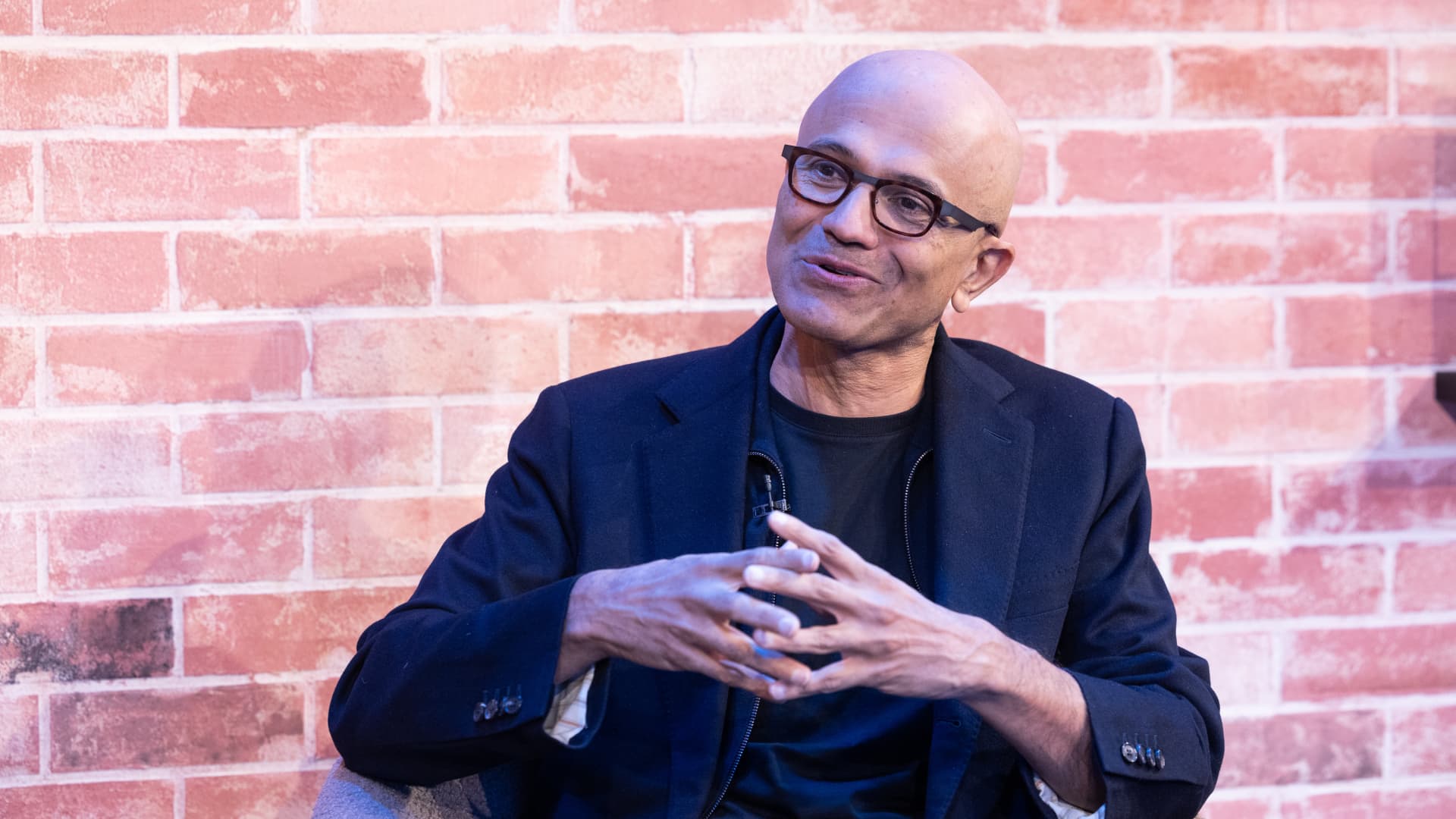
Microsoft CEO Satya Nadella appears at the World Economic Forum in Davos, Switzerland, on Jan. 16, 2024.
Chris Ratcliffe | Bloomberg | Getty Images
Amazon Web Services is still the cloud leader. But Microsoft is quickly closing the gap.
While Microsoft doesn’t disclose revenue figures for its Azure cloud infrastructure, analyst figures suggest that five years ago it was half as big as AWS. Now, it’s about three-quarters the size of its top rival, analysts estimate.
Part of Microsoft’s recent momentum is because of artificial intelligence.
Amy Hood, the company’s finance chief, said on Microsoft’s Jan. 30 earnings call that 6 points of revenue growth in the Azure and cloud services division came from AI in the latest period, up from 3 points the prior quarter.
In total, revenue at Azure increased 30% in the quarter, compared with 13% year-over-year growth at AWS.
Microsoft has been adding graphics processing units (GPUs) to its data centers so that clients can run AI models in Azure. That includes GPT-4, a large language model that enables text conversations with OpenAI’s ChatGPT chatbot. Many businesses have been adding similar generative AI capabilities to their products.
“We now have 53,000 Azure AI customers,” CEO Satya Nadella told analysts on the company’s earnings call.
Jamin Ball, partner at investment firm Altimeter Capital, said it seems that some companies are considering Azure specifically because of the excitement surrounding AI and Microsoft’s perceived lead in the market due to its close relationship with OpenAI.
AWS took months to come out with a model that could go up against GPT-4. The company is now offering a number of models in addition to its own, including one from Anthropic, which Amazon backed. On the company’s fourth-quarter earnings call, Amazon CEO Andy Jassy said that AWS offers “the most expansive collection of compute instances with Nvidia chips,” and that customers including Airbnb and Snap are using its homegrown AI processors.
An AWS spokesperson didn’t respond to a request for comment.
As it stands now, Azure is growing much faster.
And as cloud infrastructure has become a bigger part of Microsoft, making up around 29% of the company’s total revenue, it’s also become a meaningful contributor of profit.
Microsoft, which recently surpassedApple to become the world’s most valuable public company, generated almost $83 billion in net income in 2023, up from $67 billion the previous year. The Intelligent Cloud segment containing Azure generated 46% of Microsoft’s total operating income, up from about 27% in 2016.
In addition to providing basic computing and storage, Microsoft offers a variety of services for developers, including high-margin databases and monitoring tools.
Gross margin in Microsoft’s cloud group widened from 42% in 2016 to 72% in the most recent quarter. The division includes commercial Office subscriptions, the commercial part of LinkedIn and Dynamics 365 enterprise software as well as Azure. Hood has said efficiency gains can come from improvements in power, cooling, data center design, chips and software.
Yun Kim, an analyst at Loop Capital, said in a note that Azure’s revenue growth could pick up.
“We expect its Azure business to accelerate starting next FY (or C2H) as tailwinds from new workloads from both new cloud deployments and GenAI initiatives ramp meaningfully,” he wrote.
The S & P 500 ran into a brick wall Friday and finished the week lower, just one day after closing at a record high. The rotation out of tech stocks, which supported the Dow , was on full display. The across-the-board rally on Wednesday after the Federal Reserve cut interest rates for the third time this year was long forgotten. .SPX .IXIC,.DJI 5D mountain S & P 500, Nasdaq and Dow last week For the week, the broad-market S & P 500 lost roughly 0.6%, while the tech-heavy Nasdaq fell 1.6%, breaking a two-week win streak. The sector shuffle that made materials, financials, and industrials weekly winners — and communications services and information technology weekly losers — pushed the Dow 1% higher last week, its third consecutive weekly gain. Despite December historically being a strong month, the S & P 500 and Nasdaq are down 0.3% and 0.7%, respectively. The Dow is up nearly 1.6%. Perhaps the big man will bail out Wall Street. The so-called Santa Claus rally , a seasonal pattern that occurs in the final five trading days of the year and the first two of the new year, would begin on Dec. 19. Until then, here are four significant moments that drove the market last week. 1. Broad(com) worries Friday’s market was slammed by tech selling, led by Broadcom ‘s 11.5% plunge. The chipmaker’s quarterly beat and raise on Thursday were overshadowed by misinterpreted remarks from management during the earnings call. The Broadcom hit stoked AI-stock valuation worries that have been simmering. During the sell-off on Friday morning, Jim Cramer said the custom chipmaker’s business was “on fire,” and that the decline could be a buying opportunity. Broadcom was our worst performer of the week, followed by Meta Platforms and Nvidia . 2. Tarnished Oracle The second session sell-off of Oracle on Friday didn’t help. The stock was crushed nearly 11% on Thursday following a quarterly sales miss, a disappointing guidance update, and an increased spending outlook. The magnitude of the stock decline was compounded by what management did not address on Wednesday evening’s conference call: OpenAI’s ability to fulfill its massive commitments to purchase AI computing power from Oracle. On Friday, shares sank another 4.5% after Bloomberg reported that Oracle was pushing back the completion dates for some data centers it is completing for OpenAI. Oracle pushed back , asserting “all milestones remain on track.” 3. Nvidia gets China OK While Nvidia caught shrapnel from AI trade worries, the all-purpose artificial intelligence chip king received long-awaited good news last week. After Monday’s close, President Donald Trump said on social media that Nvidia will be allowed to ship its second-best H200 chips to “approved customers in China,” and the U.S. government would take a 25% cut. Nvidia reached a deal in August with the U.S. government to provide 15% of made-for-China, throttled-down H20 sales in exchange for export licenses. It turns out China did not want the H20s. The question of whether China will want H200s was debated all week. 4. Powerful guidance On the industrial side of the AI trade, GE Vernova was our top performer despite Friday’s 4.6% decline. The energy equipment company, whose products and services help power AI data centers, closed at a record high Wednesday on incredibly positive guidance all the way out to fiscal 2028. CEO Scott Strazik, on CNBC, amplified the compelling near- and long-term growth story that management outlined at Tuesday evening’s investor meeting. On Wednesday, we raised our GE Vernova price target to $800 per share from $700, and reiterated our buy-equivalent 1 rating. The Honeywell spinoff, Solstice Advanced Materials , and Dover were also weekly winners. (Jim Cramer’s Charitable Trust is long AVOG, META, NVDA, GEV, SOLS, DOV. See here for a full list of the stocks.) As a subscriber to the CNBC Investing Club with Jim Cramer, you will receive a trade alert before Jim makes a trade. Jim waits 45 minutes after sending a trade alert before buying or selling a stock in his charitable trust’s portfolio. If Jim has talked about a stock on CNBC TV, he waits 72 hours after issuing the trade alert before executing the trade. THE ABOVE INVESTING CLUB INFORMATION IS SUBJECT TO OUR TERMS AND CONDITIONS AND PRIVACY POLICY , TOGETHER WITH OUR DISCLAIMER . NO FIDUCIARY OBLIGATION OR DUTY EXISTS, OR IS CREATED, BY VIRTUE OF YOUR RECEIPT OF ANY INFORMATION PROVIDED IN CONNECTION WITH THE INVESTING CLUB. NO SPECIFIC OUTCOME OR PROFIT IS GUARANTEED.
Oracle CEO Clay Magouyrk appears on a media tour of the Stargate AI data center in Abilene, Texas, on Sept. 23, 2025.
Kyle Grillot | Bloomberg | Getty Images
Oracle on Friday pushed back against a report that said the company will complete data centers for OpenAI, one of its major customers, in 2028, rather than 2027.
The delay is due to a shortage of labor and materials, according to the Friday report from Bloomberg, which cited unnamed people. Oracle shares fell to a session low of $185.98, down 6.5% from Thursday’s close.
“Site selection and delivery timelines were established in close coordination with OpenAI following execution of the agreement and were jointly agreed,” an Oracle spokesperson said in an email to CNBC. “There have been no delays to any sites required to meet our contractual commitments, and all milestones remain on track.”
The Oracle spokesperson did not specify a timeline for turning on cloud computing infrastructure for OpenAI. In September, OpenAI said it had a partnership with Oracle worth more than $300 billion over the next five years.
“We have a good relationship with OpenAI,” Clay Magouyrk, one of Oracle’s two newly appointed CEOs, said at an October analyst meeting.
Doing business with OpenAI is relatively new to 48-year-old Oracle. Historically, Oracle grew through sales of its database software and business applications. Its cloud infrastructure business now contributes over one-fourth of revenue, although Oracle remains a smaller hyperscaler than Amazon, Microsoft and Google.
OpenAI has also made commitments to other companies as it looks to meet expected capacity needs.
In September, Nvidia said it had signed a letter of intent with OpenAI to deploy at least 10 gigawatts of Nvidia equipment for the San Francisco artificial intelligence startup. The first phase of that project is expected in the second half of 2026.
Nvidia and OpenAI said in a September statement that they “look forward to finalizing the details of this new phase of strategic partnership in the coming weeks.”
But no announcement has come yet.
In a November filing, Nvidia said “there is no assurance that we will enter into definitive agreements with respect to the OpenAI opportunity.”
OpenAI has historically relied on Nvidia graphics processing units to operate ChatGPT and other products, and now it’s also looking at designing custom chips in a collaboration with Broadcom.
On Thursday, Broadcom CEO Hock Tan laid out a timeline for the OpenAI work, which was announced in October. Broadcom and OpenAI said they had signed a term sheet.
“It’s more like 2027, 2028, 2029, 10 gigawatts, that was the OpenAI discussion,” Tan said on Broadcom’s earnings call. “And that’s, I call it, an agreement, an alignment of where we’re headed with respect to a very respected and valued customer, OpenAI. But we do not expect much in 2026.”
“This is the wrong approach — and most likely illegal,” Sen. Amy Klobuchar, D-Minn., said in a post on X Thursday.
“We need a strong federal safety standard, but we should not remove the few protections Americans currently have from the downsides of AI,” Klobuchar said.
Trump’s executive order directs Attorney General Pam Bondi to create a task force to challenge state laws regulating AI.
The Commerce Department was also directed to identify “onerous” state regulations aimed at AI.
The order is a win for tech companies such as OpenAI and Google and the venture firm Andreessen Horowitz, which have all lobbied against state regulations they view as burdensome.
It follows a push by some Republicans in Congress to impose a moratorium on state AI laws. A recent plan to tack on that moratorium to the National Defense Authorization Act was scuttled.
Collin McCune, head of government affairs at Andreessen Horowitz, celebrated Trump’s order, calling it “an important first step” to boost American competition and innovation. But McCune urged Congress to codify a national AI framework.
“States have an important role in addressing harms and protecting people, but they can’t provide the long-term clarity or national direction that only Congress can deliver,” McCune said in a statement.
Sriram Krishnan, a White House AI advisor and former general partner at Andreessen Horowitz, during an interview Friday on CNBC’s “Squawk Box,” said that Trump is was looking to partner with Congress to pass such legislation.
“The White House is now taking a firm stance where we want to push back on ‘doomer’ laws that exist in a bunch of states around the country,” Krishnan said.
He also said that the goal of the executive order is to give the White House tools to go after state laws that it believes make America less competitive, such as recently passed legislation in Democratic-led states like California and Colorado.
The White House will not use the executive order to target state laws that protect the safety of children, Krishnan said.
Robert Weissman, co-president of the consumer advocacy group Public Citizen, called Trump’s order “mostly bluster” and said the president “cannot unilaterally preempt state law.”
“We expect the EO to be challenged in court and defeated,” Weissman said in a statement. “In the meantime, states should continue their efforts to protect their residents from the mounting dangers of unregulated AI.”
Weissman said about the order, “This reward to Big Tech is a disgraceful invitation to reckless behavior by the world’s largest corporations and a complete override of the federalist principles that Trump and MAGA claim to venerate.”
In the short term, the order could affect a handful of states that have already passed legislation targeting AI. The order says that states whose laws are considered onerous could lose federal funding.
One Colorado law, set to take effect in June, will require AI developers to protect consumers from reasonably foreseeable risks of algorithmic discrimination.
Some say Trump’s order will have no real impact on that law or other state regulations.
“I’m pretty much ignoring it, because an executive order cannot tell a state what to do,” said Colorado state Rep. Brianna Titone, a Democrat who co-sponsored the anti-discrimination law.
In California, Gov. Gavin Newsom recently signed a law that, starting in January, will require major AI companies to publicly disclose their safety protocols.
That law’s author, state Sen. Scott Wiener, said that Trump’s stated goal of having the United States dominate the AI sector is undercut by his recent moves.
“Of course, he just authorized chip sales to China & Saudi Arabia: the exact opposite of ensuring U.S. dominance,” Wiener wrote in an X post on Thursday night. The Bay Area Democrat is seeking to succeed Speaker-emerita Nancy Pelosi in the U.S. House of Representatives.
Trump on Monday said he will Nvidia to sell its advanced H200 chips to “approved customers” in China, provided that U.S. gets a 25% cut of revenues.