

Rwanda bill ‘fundamentally incompatible’ with human rights law, MPs and peers warn

The government’s Rwanda bill is “fundamentally incompatible” with human rights law, MPs and peers have warned.
A report from parliament’s Joint Committee on Human Rights, published on Monday, said the proposed legislation “risks untold damage” to the UK’s reputation as an international leader on the issue.
Politics live: Tough week for Sunak as by-elections loom
Rishi Sunak’s flagship policy to “stop the boats” would result in asylum seekers coming to the UK via Channel crossings being deported to the African nation.
But his plan has been dogged with delays and controversy, from splitting the Conservative Party over those who want to toughen or scale back the plan, to condemnation from charities and opposition parties.
It was ruled unlawful by the Supreme Court at the end of last year. However, the government has been determined to push ahead, signing a new treaty with Rwanda and adjusting the legislation to define the nation as a “safe country”.
The bill has passed its first parliamentary stage in the House of Commons, but will be heading to the Lords this afternoon, where it is expected to face fierce criticism from peers.
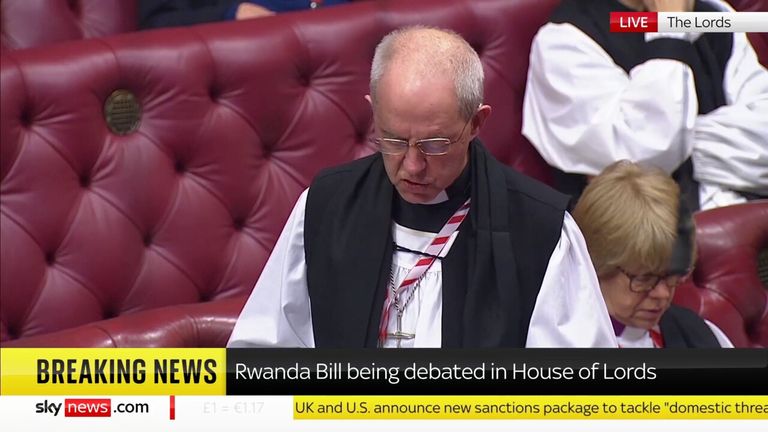
Archbishop of Canterbury Justin Welby is one of many peers to speak out against the bill
In the committee report, the membership took particular issue with plans to limit appeals against deportations, saying it breached the UK’s legal obligations – most obviously Article 13 of the European Convention on Human Rights (ECHR), the right to an effective remedy.
Read more:
UK has ‘legal obligation’ to stick to human rights law over Rwanda
Labour candidate ‘fell for online conspiracy theory’ about Hamas attacks
Two ‘unexpected bodies’ found as police search River Thames
They also attacked the move to allow ministers to decide whether or not to adhere to rulings of the European Court of Human Rights over deportations, saying the measure “openly invites the possibility of the UK breaching international law”.
And they said they were “not persuaded” parliament could be “confident” in naming Rwanda as a safe country, adding: “We consider that the courts are best placed to resolve such contested issues of fact.”
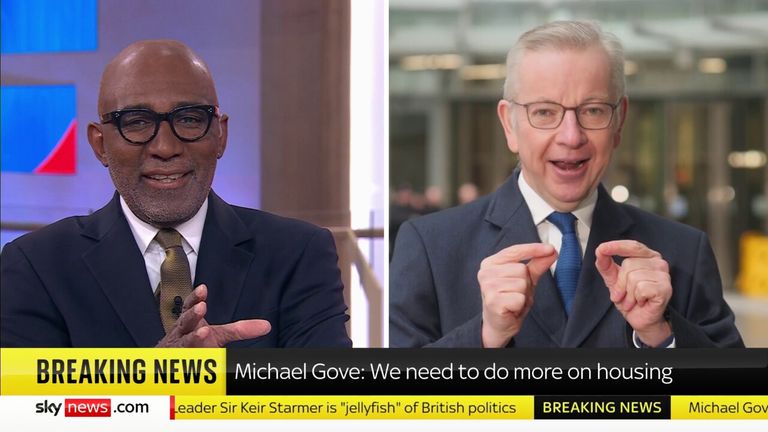
Michael Gove on whether flights will take off to Rwanda
Chair of the joint committee, the SNP’s Joanna Cherry, said: “This bill is designed to remove vital safeguards against persecution and human rights abuses, including the fundamental right to access a court. Hostility to human rights is at its heart and no amendments can salvage it.
Click to subscribe to Politics at Jack and Sam’s wherever you get your podcasts
“This isn’t just about the rights and wrongs of the Rwanda policy itself. By taking this approach, the bill risks untold damage to the UK’s reputation as a proponent of human rights internationally.
“Human rights aren’t inconvenient barriers that must be overcome to reach policy goals, they are fundamental protections that ensure individuals are not harmed by government action. If a policy is sound it should be able to withstand judicial scrutiny, not run away from it.”
But the government continues to stand by the bill, with a Home Office spokesperson saying: “We are committed to tackling this major global challenge with bold and innovative solutions, and the Rwanda scheme is doing just that.
“The bill we have introduced, and the treaty alongside it, are the best way of getting flights off to Rwanda as soon as possible.
“Rwanda is clearly a safe country that cares deeply about supporting refugees. It hosts more than 135,000 asylum seekers and stands ready to relocate people and help them rebuild their lives.”


Ghana has legalized cryptocurrency trading by establishing a regulatory framework targeting the industry.
Ghana’s parliament has passed the Virtual Asset Service Providers Bill into law, Bank of Ghana (BoG) Governor Johnson Asiama said, according to a report on Sunday by the state-owned Daily Graphic news agency.
“Virtual asset trading is now legal, and no one will be arrested for engaging in cryptocurrency, but we now have a framework to manage the risks involved,” Asiama said on Friday at the BoG’s annual Nine Lessons, Carols and Thanksgiving Service.
The timing aligns with earlier central bank communications, as Asiama had previously indicated Ghana was targeting the introduction of crypto regulation by the end of 2025.
Ghana’s central bank gains supervisory powers
Under the legislation, the Bank of Ghana becomes the primary regulator for cryptocurrency activity, with powers to license and supervise crypto asset service providers (CASPs).
The law positions Ghana to better protect consumers from fraud, money laundering and systemic risks, while removing uncertainty over the legal status of cryptocurrency, Asiama said, adding:
“What this means is that now we have the framework to manage it and to manage the risks that can involve that kind of activity […] These are not just legal milestones; they are enablers of better policies, stronger supervision and more effective regulation.”
The governor also mentioned that the crypto law is intended to support innovation and expand Ghana’s financial inclusion, particularly among young people and tech-driven entrepreneurs.
Ghana ranks among Sub-Saharan Africa’s top five crypto economies
Ghana’s move to regulate cryptocurrency activity comes as the country emerges as a significant player in crypto adoption across the region.
According to Chainalysis’ 2025 Geography of Cryptocurrency Report, Ghana ranked among the top five Sub-Saharan African countries by total crypto value received between July 2024 and June 2025.
In the meantime, Nigeria continued to dominate the region, receiving at least $92 billion in crypto value over the period, or nearly three times the amount recorded by South Africa, the report showed.
Related: CAR’s crypto push fueled ‘state capture’ by elites, criminal networks: Report
The Sub-Saharan region received over $205 billion in on-chain value, up about 52% from the previous year. This growth makes it the third-fastest growing region in the world, just behind Asia-Pacific and Latin America, according to Chainalysis.


Crypto investment products saw $952 million in outflows, marking the first red week in four, as investor sentiment took a hit due to delays to a key US crypto regulatory bill.
Crypto exchange-traded products (ETPs) recorded $952 million in outflows, led by $555 million for Ether (ETH) funds and $460 million for Bitcoin (BTC) funds.
The large-scale outflows were mainly attributed to delays to the Digital Asset Market Clarity Act, or Clarity Act, a matter that prolonged “regulatory uncertainty and concerns over whale selling,” according to a CoinShares report published Monday.
“As a result, it now appears highly unlikely that ETPs will exceed last year’s inflows, with total assets under management standing at $46.7bn compared with $48.7bn in 2024,” CoinShares said.
The lion’s share, or $990 million of the outflows, came from the US, marginally offset by $46 million in inflows from Canadian investors and $15.6 million from Germany.
Related: Fidelity macro lead calls $65K Bitcoin bottom in 2026, end of bull cycle
Clarity Act delays were the main catalyst for crypto fund outflows: Analyst
On Thursday, White House AI and crypto czar David Sacks said that the Senate markup for the long-awaited Clarity Act will occur in January 2026, as opposed to previous expectations that the bill would get to President Donald Trump’s desk before the end of 2025.
”We are closer than ever to passing the landmark crypto market structure legislation that President Trump has called for. We look forward to finishing the job in January,” Sacks wrote in a Thursday X post.
CoinShares’ head of research, James Butterfill, attributed the erosion in investor sentiment to the delays related to the bill.
“Ethereum saw the largest outflows, totaling $555m, this is understandable given it has the most to gain or lose from the Clarity Act,” wrote Butterfill.

The Clarity Act seeks to define crypto securities and commodities, providing much-awaited clarity on the jurisdictions of the Securities and Exchange Commission and the Commodity Futures Trading Commission relating to digital assets.
Related: Bitcoin dips below $85K as DATs face ‘mNAV rollercoaster’: Finance Redefined
Despite the delays, the crypto industry’s best-performing traders by returns, who are tracked as “smart money” traders on Nansen’s blockchain intelligence platform, continued betting on Ether’s short-term price increase.

Smart money traders were net long on Ether with a cumulative $476 million worth of leveraged long positions, while being net short on Bitcoin for $109 million, according to Nansen.
Magazine: Solana vs Ethereum ETFs, Facebook’s influence on Bitwise — Hunter Horsley

Binance reportedly continued to allow suspicious accounts to move funds in crypto even after the exchange pledged to tighten controls as part of its $4.3 billion US criminal settlement in 2023.
According to internal data reviewed by the Financial Times, a network of 13 user accounts processed about $1.7 billion in transactions from 2021, including roughly $144 million after the November 2023 plea agreement.
The files reportedly include Know-Your-Customer (KYC) documents, IP and device logs, and transaction histories for users in countries including Venezuela, Brazil, Syria, Niger and China.
Regulatory and AML specialists cited by the Financial Times said that the findings raise fresh questions about how effectively Binance has implemented the governance and surveillance upgrades promised US authorities after the settlement.
Binance did not provide a comment to Cointelegraph by press time.
Related: Binance alleges fake listing agents, offers up to $5M whistleblower reward
Suspicious account behaviors
In one case, a Binance account linked to a 25-year-old Venezuelan woman received more than $177 million over two years and changed its linked bank details 647 times in 14 months.
Former prosecutors told the Financial Times that such activity would normally be treated as highly suspicious and potentially consistent with an unregistered money-transmitting business.
Another account, held by a junior bank employee living in a poor district of Caracas, saw about $93 million flow in and out between 2022 and May 2025. Internal logs showed the account was accessed from Caracas one afternoon and from Osaka, Japan, less than 10 hours later, a sequence experts told the FT was physically impossible and the type of anomaly that should automatically trigger review at a regulated institution.
Nick Heather, head of trading at ONE.io, a financial services company providing digital asset trading services, told Cointelegraph that such cases underline the importance of adaptive governance frameworks in digital asset markets.
“When accounts displaying repeated red flags remain active, that points to an escalation and oversight challenge rather than one of market structure. Robust governance, sanctions screening, and post-trade surveillance are of critical importance, and institutional and retail traders operating in regulated markets are already accustomed to these requirements,” Heather said.
All 13 accounts shared markers of suspicious behavior and collectively received about $29 million in stablecoin USDt (USDT) from wallets later frozen by Israel under anti-terrorism laws.
Related: CZ pardon was considered with ‘utmost seriousness,’ White House says
Plea deal promises and Trump pardon backdrop
Binance in its 2023 plea deal promised to implement real-time monitoring, enhanced due diligence and regular customer reviews to detect suspicious activities.
At the time, US authorities said Binance had failed to report more than 100,000 suspicious transactions involving activities including ransomware, child sexual abuse, narcotics trafficking and transfers linked to groups including al-Qaeda and ISIS.
The Financial Times report comes after US President Donald Trump pardoned Binance founder Changpeng Zhao in October.
-
 Sports2 years ago
Story injured on diving stop, exits Red Sox game
-
 Sports3 years ago
‘Storybook stuff’: Inside the night Bryce Harper sent the Phillies to the World Series
-
 Sports2 years ago
Game 1 of WS least-watched in recorded history
-
 Sports3 years ago
Button battles heat exhaustion in NASCAR debut
-
 Sports3 years ago
MLB Rank 2023: Ranking baseball’s top 100 players
-
Sports4 years ago
Team Europe easily wins 4th straight Laver Cup
-
 Environment3 years ago
Japan and South Korea have a lot at stake in a free and open South China Sea
-
 Environment1 year ago
Here are the best electric bikes you can buy at every price level in October 2024