

Wish’s deep discount sale to Singapore’s Qoo10 ramps up competition for Temu and Shein

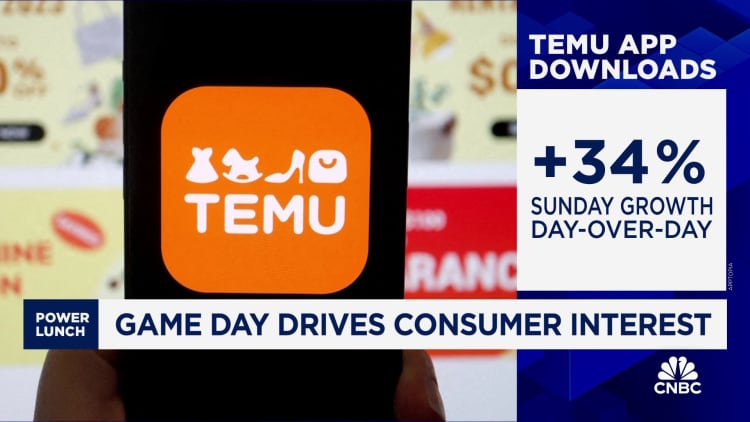
Global online shopping platform Temu is already climbing the ranks in the U.S. Apple Store.
Bloomberg | Bloomberg | Getty Images
Hours after Super Bowl viewers were inundated with ads from discount retailer Temu, an online dollar store that used to have similar buzz was acquired at a price that shows the difficulty of sustaining growth in e-commerce.
Wish, which was valued at $14 billion at the time of its IPO in 2020, said Monday that it’s being acquired by Singapore’s Qoo10 for $173 million in cash, 99% below its peak price.
Founded in 2010 and based in San Francisco, Wish made a name for itself with ultracheap goods primarily sold by Chinese manufacturers. Co-founder Peter Szulczewski bet shoppers would be willing to accept weeks-long delivery times in exchange for bargain basement prices.
The Temu marketing blitz, which blanketed Facebook and Instagram well before Sunday’s Super Bowl, is also familiar to anyone who followed Wish. The company spent heavily on Facebook’s platforms to attract shoppers, and struck a deal to put its logo on Los Angeles Lakers jerseys.
But the company was bleeding cash, and last November, after ousting Szulczewski as its CEO, said it was exploring strategic alternatives.
Qoo10 will now be taking on Temu and Shein, which both originated in China and still have strong ties to the world’s second-biggest economy. TikTok, owned by China’s ByteDance, also launched an online marketplace in the U.S. last year. The companies have shown they’re willing to spend heavily to attract shoppers, as well as lose money on sales of cheap products by offering free shipping and hefty discounts.
Their ad spend provided a big boost to Meta’s top line, but it’s hurt retailers like handmade goods purveyor Etsy, which acknowledged last year that Temu and Shein are “taking a little bit of share from everyone.”
During and shortly after the Super Bowl, Temu ran a handful of “shop like a billionaire” ads and touted $15 million in giveaways. For the second year in a row, brands shelled out roughly $7 million for 30 seconds of ad time during the game.
Temu is estimated to have spent between $600 million and $1.4 billion on ads during the first nine months of 2023, Stifel analysts wrote in a note last November. The firm projects Temu had an average of 70 million monthly active users over the same stretch last year.
Temu, which launched in late 2022, has deep pockets thanks to its parent company PDD Holdings. Shein, founded in 2012, started aggressively advertising on social media in the past couple years.
Wish’s new owner may be joining the party as the hype is waning. Analysts at Morgan Stanley wrote in a note late last month that the number of U.S. households shopping on Temu continues to fall, while web traffic and app usage data “also shows stalling/moderating uptake since October, even through the Holiday period.”


The logos of Google Gemini, ChatGPT, Microsoft Copilot, Claude by Anthropic, Perplexity, and Bing apps are displayed on the screen of a smartphone in Reno, United States, on November 21, 2024.
Jaque Silva | Nurphoto | Getty Images
Merriam-Webster declared “slop” its 2025 word of the year on Monday, a sign of growing wariness around artificial intelligence.
Slop is now defined as “digital content of low quality that is produced usually in quantity by means of artificial intelligence,” according to Merriam-Webster’s dictionary. The word has previously been used primarily to connote a “product of little value” or “food waste fed to animals”
Mainstream social networks saw a flood of AI-generated content, including what 404 Media described as a “video of a bizarre creature turning into a spider, turning into a nightmare giraffe inside of a busy mall,” that the publication reported had been viewed more than 362 million times on Meta apps.
In September, Meta launched Vibes, a separate feed for AI-generated videos. Days later, OpenAI released its Sora app. Those services, along with TikTok, YouTube and others, are increasingly rife with AI slop, which can often generate revenue with enough engagement.
Spotify said in September that it had to remove over 75 million AI-generated, “spammy tracks” from its service, and roll out formal policies to protect artists from AI impersonation and deception. The streaming company faced widespread criticism after The Velvet Sundown racked up 1 million monthly listeners on without initially making it clear they produced their songs with generative AI. The artist later clarified on its bio page that it’s a “synthetic music project.”
According to CNBC’s latest All-America Economic Survey, published Dec. 15, fewer respondents have been using AI platforms, such as ChatGPT, Microsoft Copilot and Google Gemini, in the last two to three months compared to the summer months.
Just 48% of those surveyed said they had used AI platforms recently, down from 53% in August.


PayPal CEO Alex Chriss speaks at the Global Fintech Fest in Mumbai, India, on Oct. 7, 2025.
Indranil Aditya | Nurphoto | Getty Images
PayPal said Monday that it has applied for approval to form PayPal Bank, which would be able to offer loans to small businesses.
“Establishing PayPal Bank will strengthen our business and improve our efficiency, enabling us to better support small business growth and economic opportunities across the U.S.,” PayPal CEO Alex Chriss said in a statement.
The U.S. Federal Deposit Insurance Corporation will review an application proposing the establishment of PayPal Bank, along with Utah’s Department of Financial Institutions, PayPal said.
The company, which owns popular payment app Venmo, hopes to also offer interest-bearing savings accounts to its customers, the statement said. PayPal already makes credit lines available to consumers and has been trying to expand its roster of banking-like services as it competes with a growing number of fintech companies that are aiming to take business from traditional brick-and-mortar banks.
Shares of PayPal rose 1.5% in extended trading following the announcement.
In October, PayPal said quarterly revenue increased 7% year over year to $8.42 billion, more than analysts had expected. But in 2025 the stock has slumped about 29%, while the S&P 500 index has gained almost 16% in the same period.
WATCH: E-commerce consumption could bump 20% because of agentic AI, says Mizuho’s Dan Dolev
-
 Sports2 years ago
Story injured on diving stop, exits Red Sox game
-
 Sports3 years ago
‘Storybook stuff’: Inside the night Bryce Harper sent the Phillies to the World Series
-
 Sports2 years ago
Game 1 of WS least-watched in recorded history
-
 Sports3 years ago
Button battles heat exhaustion in NASCAR debut
-
 Sports3 years ago
MLB Rank 2023: Ranking baseball’s top 100 players
-
Sports4 years ago
Team Europe easily wins 4th straight Laver Cup
-
 Environment3 years ago
Japan and South Korea have a lot at stake in a free and open South China Sea
-
 Environment1 year ago
Here are the best electric bikes you can buy at every price level in October 2024