



-
Dan Wetzel
Close
Dan Wetzel
ESPN
- Dan Wetzel is a senior writer focused on investigative reporting, news analysis and feature storytelling.
Sherrone Moore was in custody in the Washtenaw (Michigan) County Jail on Wednesday night as a suspect in an alleged assault, just hours after he was fired as Michigan’s football coach for having what the school said was an “inappropriate relationship with a staff member.”
Moore was initially detained by police in Saline, Michigan, on Wednesday and turned over to authorities in Pittsfield Township “for investigation into potential charges.”
Pittsfield police released a statement Wednesday night saying they responded at 4:10 p.m. to the 3000 block of Ann Arbor Saline Road “for the purposes of investigating an alleged assault. … A suspect in this case was taken into custody. This incident does not appear to be random in nature, and there appears to be no ongoing threat to the community.
“The suspect was lodged at the Washtenaw County Jail pending review of charges by the Washtenaw County Prosecutor,” the statement continued. “At this time, the investigation is ongoing. Given the nature of the allegations, the need to maintain the integrity of the investigation, and its current status at this time, we are prohibited from releasing additional details.”
Pittsfield police did not name the suspect in its statement.
Earlier, Saline police stated they “assisted in locating and detaining former University of Michigan football coach Sherrone Moore. Mr. Moore was turned over to the Pittsfield Township Police Department for investigation into potential charges.”
Michigan fired Moore on Wednesday following an investigation into his conduct with a staff member.
“U-M head football coach Sherrone Moore has been terminated, with cause, effective immediately,” the school said in a statement. “Following a University investigation, credible evidence was found that Coach Moore engaged in an inappropriate relationship with a staff member.”
Moore, 39, spent two seasons as Michigan’s coach, after serving as the team’s offensive coordinator.


Homelessness charities have warned that ministers are “falling short of what is desperately needed to end Britain’s homelessness crisis”.
It comes as the government published its new plan to tackle rough sleeping in Britain, which pledges £3.5bn of funding to crackdown on the issue.
But charities have said Labour’s National Plan to End Homelessness “falls short” and contains “important gaps”, meaning the party will not be able to achieve their stated goal of halving the number of homeless people by 2029/30.
Crisis, an organisation that supports the homeless, also argues that only £100m of the funding announced in the strategy is new.
Meanwhile, Labour MP Paula Barker, who co-chairs the All-Party Parliamentary Group (APPG) for ending homelessness, has told Sky News that the strategy has a “depressing lack of meat on the bone”, looks like it has been “rushed out”, and has left her “disappointed”.
It comes as Shelter warns that 382,618 people in England – including a record 175,025 children – will be homeless this Christmas, equivalent to one in every 153 people.
Working but homeless: Daniel’s story
What does the government’s plan to reduce rough sleeping involve?
The government has made three key pledges in its new plan, unveiled on Wednesday evening.
It says that it is aiming to halve the number of long-term rough sleepers by the end of the parliament, reduce the time families spend living in bed and breakfasts (B&Bs), and prevent more people from becoming homeless in the first place.
To achieve this, the party has set out numerous new measures, schemes and extra funding.
A new £124m supported housing scheme is also being established, and the government hopes that it will help get 2,500 people in England off the streets.
Housing Secretary Steve Reed said homelessness is “one of the most profound challenges we face”, and suggested that the strategy will build “a future where homelessness is rare, brief, and not repeated”.
How has the plan been received?
Ms Barker told Sky News she welcomes “the scale of investment”, but is “disappointed by what I have seen”.
The Labour MP explained: “From what I have seen so far, it leaves more questions than it answers – where are the clear measures around prevention? Where is the accommodation for people sleeping rough coming from – has it already been built? What about specialised provision for those fleeing domestic abuse?
“We needed this strategy to be bold.”
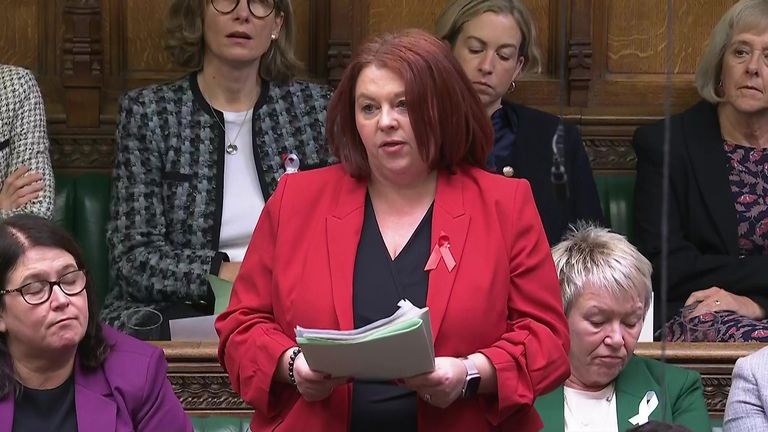
MP Paula Barker is ‘disappointed’ by what she has seen
Meanwhile, organisations working to support those on the streets have welcomed the plan for its focus on the issue, but warn it leaves it “almost impossible” for many families to avoid homelessness.
Matt Downie, the chief executive of Crisis, said: “Housing benefit remains frozen until at least 2030; there is no coherent approach for supporting refugees and stopping them becoming homeless; and we hear no assurances that the new homes government has pledged to build will be allocated to households experiencing homelessness at the scale required.
“There is a long way to go. Ministers are taking steps in the right direction, but falling short of what’s desperately needed to end Britain’s homelessness crisis.”

An exhibit organised to highlight the contrast between the Christmas period and an estimated 23,500 young people who will homeless. Pic: PA
Sarah Elliott, head of Shelter, also warned the proposals do not go far enough, saying: “Until a lot more of these social homes are built, one of the only ways to escape homelessness is if you can afford to pay a private rent.
“We know from our frontline services this is almost impossible to do when housing benefit remains frozen, and that is where the homelessness strategy falls short.”
Centrepoint, a charity that supports young people facing homelessness, said that the strategy is “an important step”, and could be “transformative”. But it added that “gaps in the government’s approach remain”, and said increases in funding “don’t face up to the scale of homelessness”.
The Conservatives have said that the strategy means Labour “has completely failed on homelessness”.
Paul Holmes, shadow housing minister, said the number of households and children in temporary accommodation has risen to “record levels”, and pointed to the government’s “abysmal record on house-building” and tackling immigration.

Australia’s securities regulator has finalized exemptions that will make it easier for businesses to distribute stablecoins and wrapped tokens.
The Australian Securities and Investments Commission (ASIC) on Tuesday announced the new measures, aimed at fostering innovation and growth in the digital assets and payment sectors.
It stated that it was “granting class relief” for intermediaries engaging in the secondary distribution of certain stablecoins and wrapped tokens.
This means that companies no longer need separate, and often expensive, licenses to act as intermediaries in these markets, and they can now use “omnibus accounts” with proper record-keeping.
The new exemptions extend the earlier stablecoin relief by removing the requirement for intermediaries to hold separate Australian Financial Services (AFS) licenses when providing services related to stablecoins or wrapped tokens.
Leveling the playing field for stablecoin issuers
The regulator stated that these omnibus structures were widely used in the industry, offering efficiencies in speed and transaction costs, and helping some entities manage risk and cybersecurity.
“ASIC’s announcement helps level the playing field for stablecoin innovation in Australia,” said Drew Bradford, CEO of Australian stablecoin issuer Macropod.
“By giving both new and established players a clearer, more flexible framework, particularly around reserve and asset-management requirements, it removes friction and gives the sector confidence to build,” he continued.
Related: Australia risks ‘missed opportunity’ by shirking tokenization: top regulator
The old licensing requirements were costly and created compliance headaches, particularly for an industry awaiting broader digital asset reforms.
“This kind of measured clarity is essential for scaling real-world use cases, payments, treasury management, cross-border flows, and onchain settlement,” added Bradford.
“It signals that Australia intends to be competitive globally, while still maintaining the regulatory guardrails that institutions and consumers expect.”
Angela Ang, head of policy and strategic partnerships at TRM Labs, also welcomed the development, stating, “Things are looking up for Australia, and we look forward to digital assets regulation crystallizing further in the coming year — bringing greater clarity to the sector and driving growth and innovation.”
Global stablecoin growth surges
Total stablecoin market capitalization is at a record high of just over $300 billion, according to RWA.xyz.
It has grown by 48% since the beginning of this year, and Tether remains the dominant issuer with a 63% market share.

Magazine: XRP’s ‘now or never’ moment, Kalshi taps Solana: Hodler’s Digest
-
 Sports2 years ago
Story injured on diving stop, exits Red Sox game
-
 Sports3 years ago
‘Storybook stuff’: Inside the night Bryce Harper sent the Phillies to the World Series
-
 Sports2 years ago
Game 1 of WS least-watched in recorded history
-
 Sports3 years ago
Button battles heat exhaustion in NASCAR debut
-
 Sports3 years ago
MLB Rank 2023: Ranking baseball’s top 100 players
-
Sports4 years ago
Team Europe easily wins 4th straight Laver Cup
-
 Environment3 years ago
Japan and South Korea have a lot at stake in a free and open South China Sea
-
 Environment1 year ago
Here are the best electric bikes you can buy at every price level in October 2024