

Lucid Motors cuts thousands off 2024 Air prices and adds new charging, maintenance perks

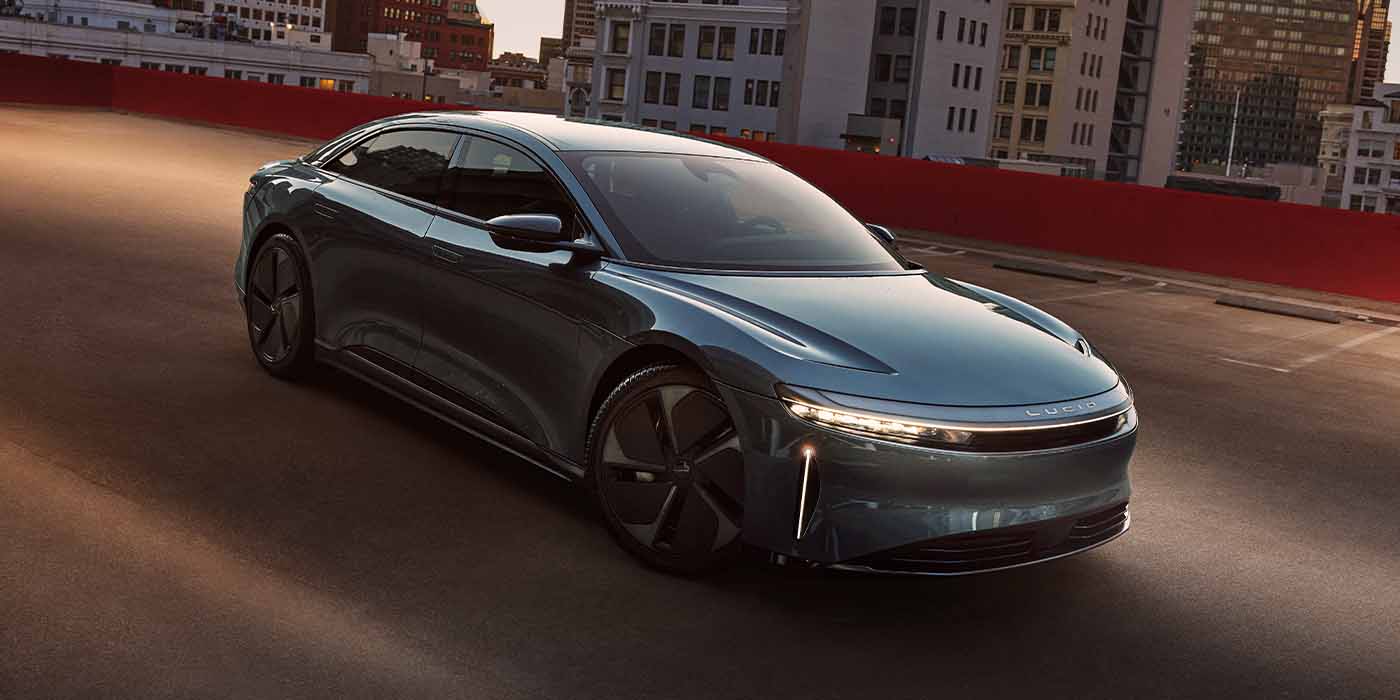
With its second all-electric model hitting the market this year, Lucid Motors wants to ensure consumers don’t forget about its flagship sedan – the Air. Having just launched its 2024 Air models a couple of months ago, slashing prices, Lucid has lowered its MSRPs once again, incentivizing potential customers with additional charging and maintenance bonuses as well.
Lucid Motors ($LCID) looks to bounce back in 2024 following a Q4 2023 report that detailed a drop in YOY deliveries. The Air sedan has fared decently, but Lucid was still left sitting with a surplus of EV inventory, provoking demand levers like a referral program.
Beyond Air, there is much to be excited about regarding the American automaker. Its Gravity SUV has the makings to make a dent in the all-electric SUV market later this year, and the company has already shared plans for a third mass-market EV targeting would-be Tesla Model 3 or Model Y customers.
Currently, however, Lucid only offers the Air – a relatively young electric sedan that saw its prices significantly reduced with the launch of its 2024 models. Still, the luxury EV offering the best range in the industry remains expensive to many.
To further entice prospective customers, Lucid Motors is targeting two main pain points for EV purchases – price and ease of ownership. To do so, it has once again lowered the prices of three of its four Air trims, including a massive reduction on the RWD Air Pure.
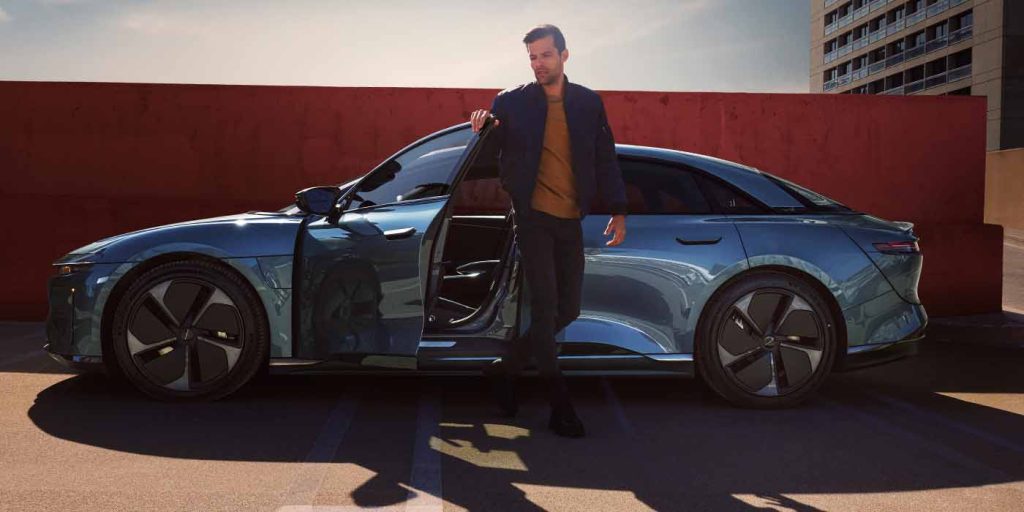
Lucid cuts 2024 Air prices by up to $7,500
Lucid Motors shared its revamped Air prices in a press release this morning, led by the lowest trim RWD Pure, which now starts at an MSRP below $70,000 (the automaker’s original price target before production began).
Even as Lucid’s most affordable EV on the current market, the RWD Air Pure delivers an alluring 410 miles of EPA range (with 19″ wheels). The two proceeding Air trims above Pure – Touring and Grand Touring – have also been cut to lower prices. Here’s how it breaks down in comparison:
| Air Trim | Pure | Touring (AWD) |
Grand Touring (AWD) |
| 2023 MY MSRPs | $82,400 (AWD) | $95,000 | $125,600 |
| 2024 MY MSRPs (Dec 2023) |
$77,400 (RWD) | $85,900 | $110,900 |
| 2024 MY MSRPs (Feb 2024) |
$69,900 (RWD) | $77,900 | $109,900 |
The only Lucid Air model not seeing lower prices is the tri-motor Sapphire, which is understandable considering it’s just starting to roll off Lucid’s assembly lines at AMP-1. It’s also the American automaker’s top-tier model and one of the fastest mass-produced passenger EVs on the planet. That’s a whole other echelon for buyers (meaning if you’re buying a $249,000 Sapphire, a few thousand dollars off isn’t going to make a big difference).
In addition to cuts to Air prices, Lucid says it is tackling another consumer headache when shopping for a new EV – ease of ownership. Starting today, new Air customers will receive a $1,000 allowance towards purchasing a charging accessory, like Lucid’s Connected Home Charging Station. That charger currently costs $1,200, so owners can get one for a mere $200 after the credit.
Lastly, Lucid is providing customers with free scheduled maintenance with each Air purchase, good for two years or 24,000 miles. Lucid Motors CEO and CTO Peter Rawlinson spoke to the Air’s reduced prices and the added perks for new customers:
We are optimistic about the future of EVs and believe strongly that increased adoption is a necessary path towards reducing the impact of climate change. We have worked tirelessly to enable the Lucid Air lineup to deliver unsurpassed range and performance from less energy, and so I’m delighted that today we are able to share this benefit with our customers.
FTC: We use income earning auto affiliate links. More.

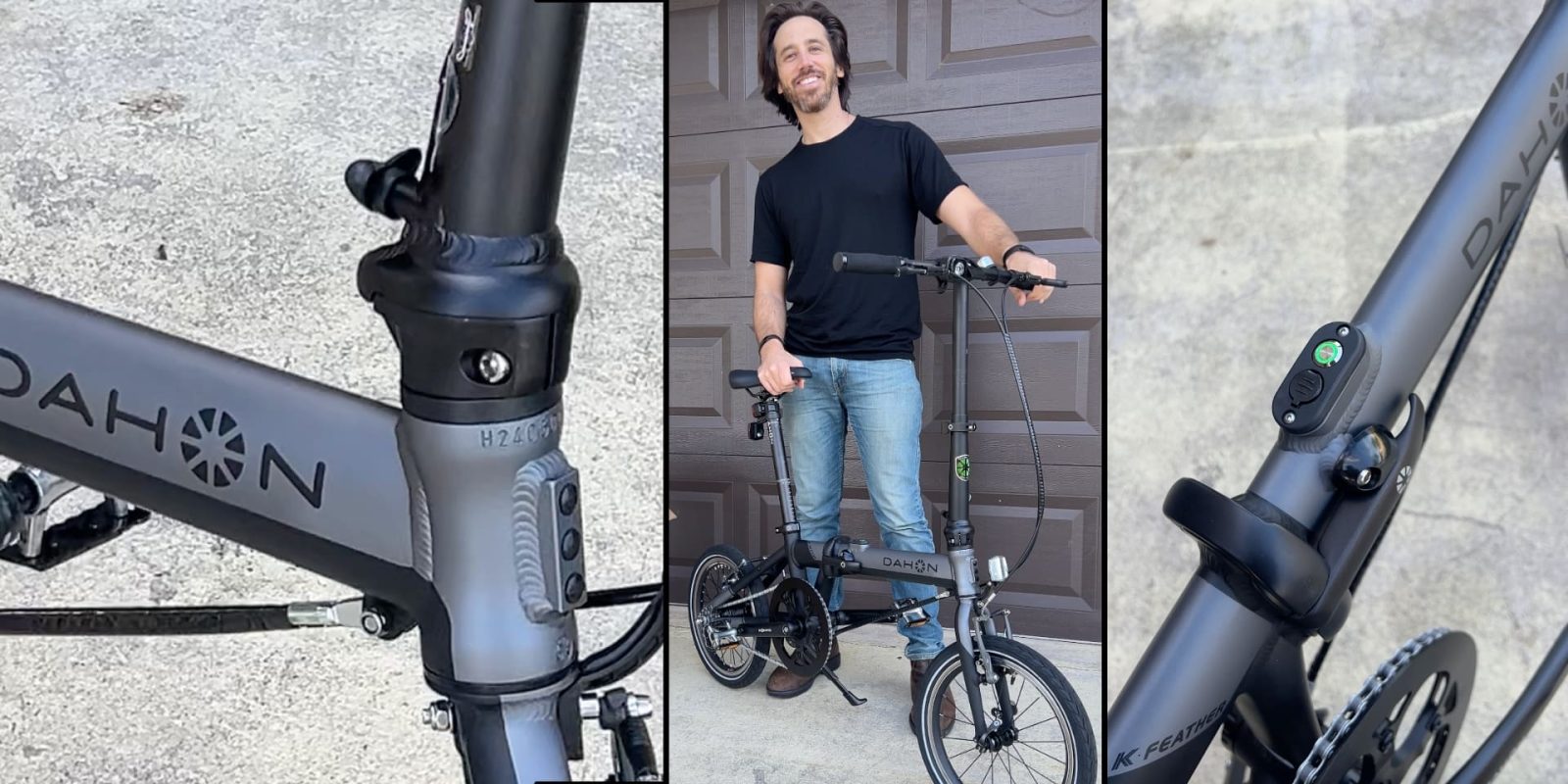
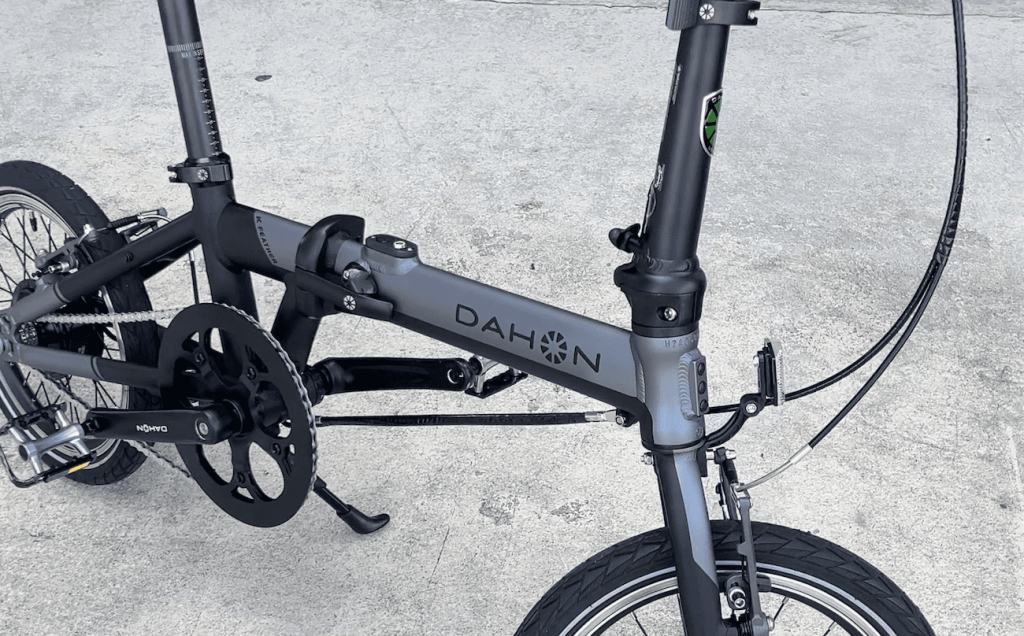
The Dahon K-Feather is one of those electric bikes that makes a lot more sense the longer you ride it. On paper, it looks rather low-power and low-capacity compared to the spec sheets for most e-bikes. In practice, especially when used exactly as intended, it turns out to be a remarkably well-executed urban commuter that still feels refreshingly different years after its release.
Launched earlier this year by Dahon, a brand best known for decades of folding bike experience, the K-Feather was never meant to compete with high-power folding e-bikes loaded with throttles, suspension, and giant batteries.
Instead, it aims for something far simpler: a super lightweight folding bike that just happens to have electric assist.
A lightweight e-bike, even by light e-bike standards
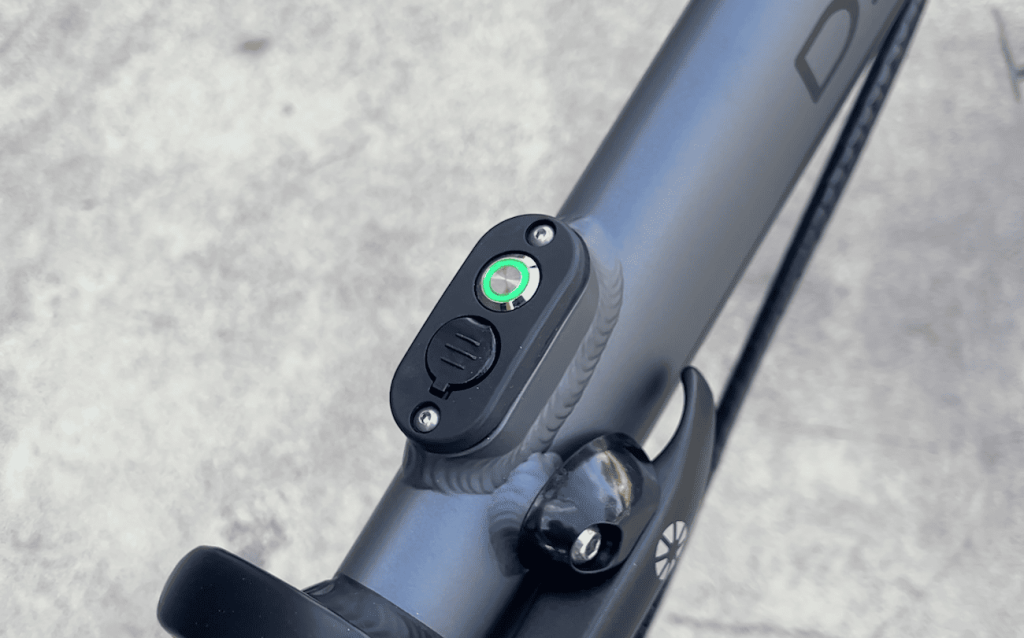
At around 26 lb (11.8 kg), the K-Feather is shockingly light for an electric bike, even by today’s standards. Pick it up and it barely registers as an e-bike at all. That’s largely thanks to its extremely minimalist design, highlighted by the cleverly hidden battery integrated into the seatpost.
The 24V 5Ah battery offers roughly 120 Wh of capacity, which is undeniably small, but it also avoids the bulky look and awkward weight distribution that many early e-bikes suffered from.
The result is a bike that feels balanced, easy to carry, and genuinely pleasant to live with in an urban environment. Folding it up is quick and intuitive, and carrying it up stairs or onto public transport doesn’t feel like a chore. For apartment dwellers, train commuters, or anyone combining cycling with other forms of transportation, this matters a lot.
I’m not sure how else to say this without beating a dead horse, but it is just incredibly lightweight. When you pick it up, your brain just sort of short-circuits as it fails to compute that this is still an electric bike.

Simple, subtle electric assist
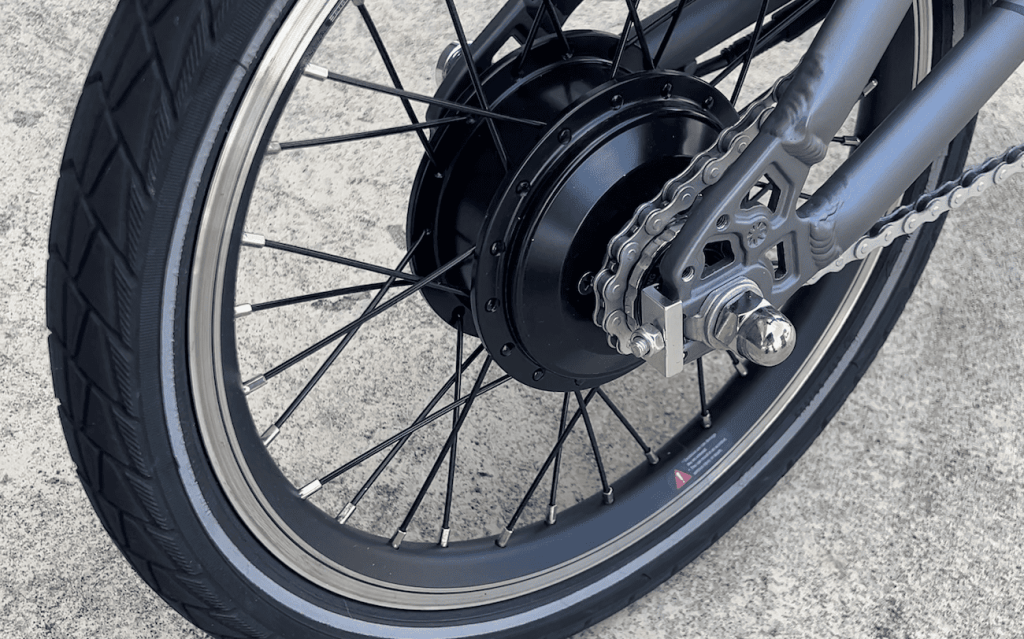
Power comes from a 250W rear hub motor that provides pedal assist only. There’s no throttle, no complex display, and no attempt to turn the K-Feather into something it isn’t. The assist tops out around 15.5 mph (25 km/h), aligning more with European-style pedelec limits than US Class 2 or Class 3 expectations.
For those accustomed to American-style electric bikes, that may sound quite slow. And if you’re trying to keep up with traffic on the shoulder of a busy road, it is slow. But this e-bike is more designed for bike lane cruising, where 15 mph means you’re easily keeping up with, or passing, most pedal bike riders.
The assist itself is quiet and unobtrusive. It doesn’t leap forward when you start pedaling, and it doesn’t overpower the ride. Instead, it feels like a gentle push that smooths out stop-and-go city riding and takes the edge off short climbs and headwinds. You still feel like you’re riding a bike, just a slightly stronger version of yourself.
The torque sensor definitely does its job, coming on quickly and effectively without being lurchy, though it’s hard for a 250W motor to feel lurchy anyway. But with an effective torque sensor instead of a laggy pedal assist sensor, the minimal assist still feels nice and natural, as if you’re simply always pedaling with a tailwind.
That riding feel is a big part of the K-Feather’s charm. It doesn’t try to impress you with acceleration or brute force. It simply makes urban cycling easier, calmer, and more approachable. It’s not a powerhouse, but rather a sensible commuter.
Where the limitations show up
There’s no getting around the fact that the K-Feather’s small battery and modest motor define its limits. Range is typically quoted at around 15 to 20 miles (25 to 40 km), and that’s realistic if you’re riding on relatively flat terrain and contributing a reasonable amount of pedal effort. Start pushing hills hard or riding aggressively, and that number will drop.
There aren’t multiple pedal assist levels, so it’s not like you can drop it into lower pedal assist power to save battery. Instead, range largely comes down to your weight, your riding, speed, and how hilly your terrain proves to be.
Similarly, steep climbs will quickly reveal the bike’s low power output. This is not a hill crusher, and it’s not pretending to be one. The single-speed drivetrain reinforces that reality, keeping things simple and low maintenance but limiting flexibility when terrain gets demanding.
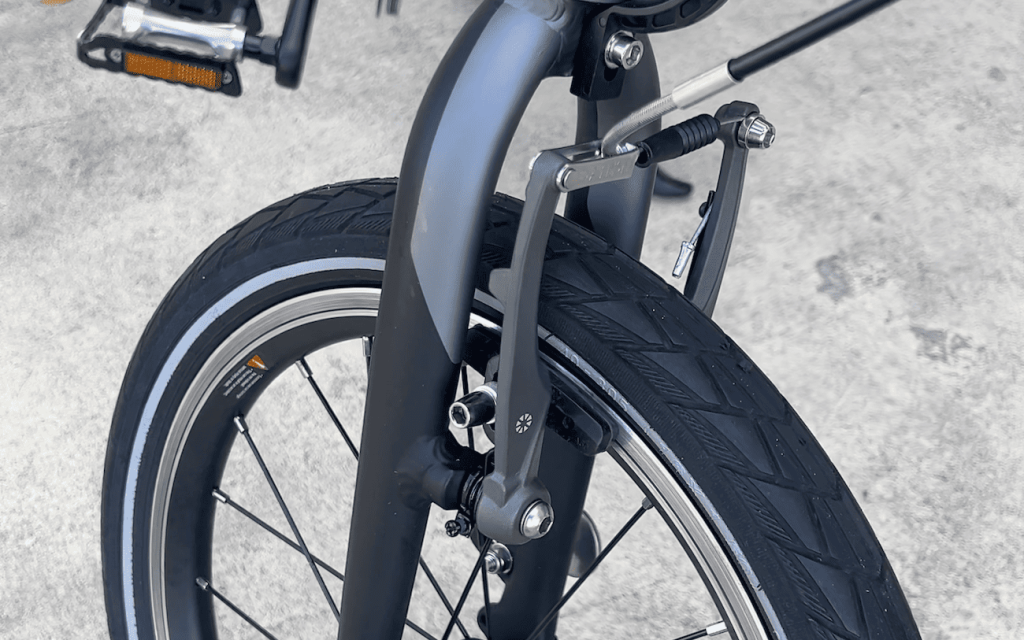
The V-brakes look old-school, sure. But I wouldn’t actually ding them here because they seem to work great. I had rim brakes for a long, long time. And while I enjoy the stopping power and low maintenance of hydraulic disc brakes, I can’t ignore the fact that when I yank on these stoppers, I quickly find myself stationary. So yeah, pooh-pooh them all you want for being older tech, but they work.
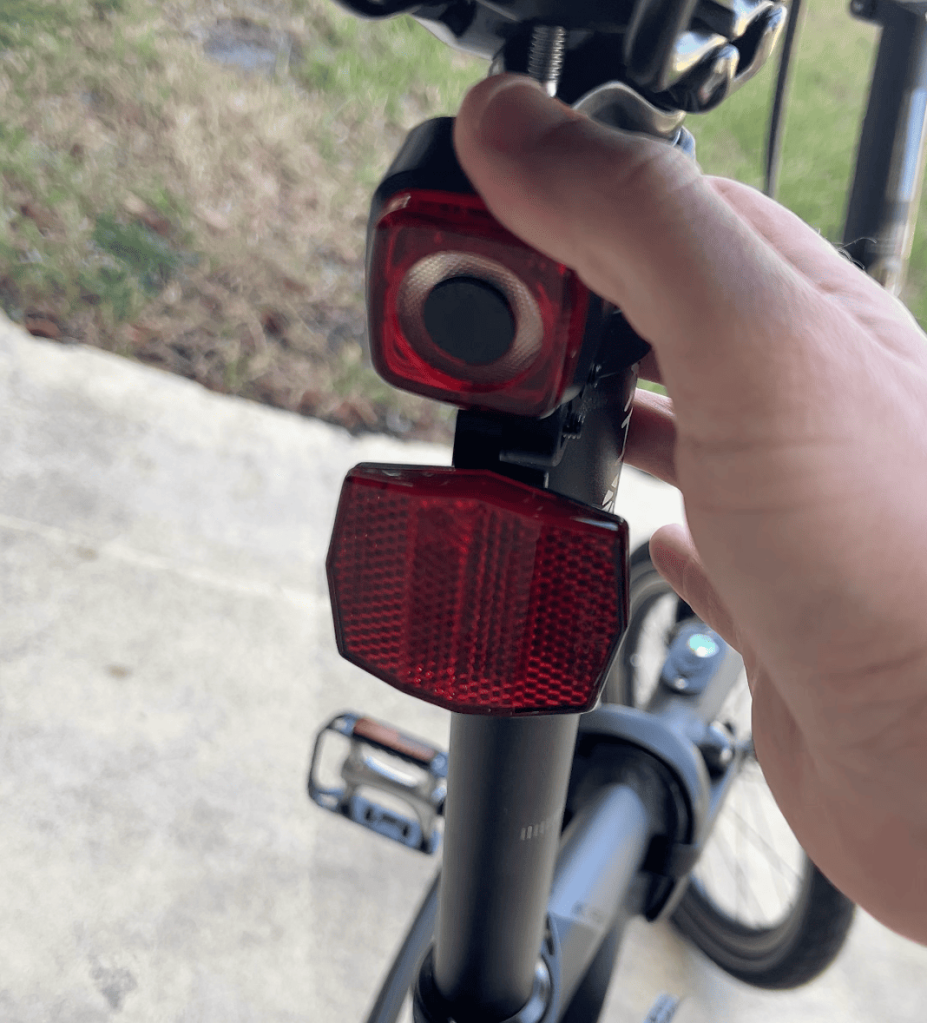
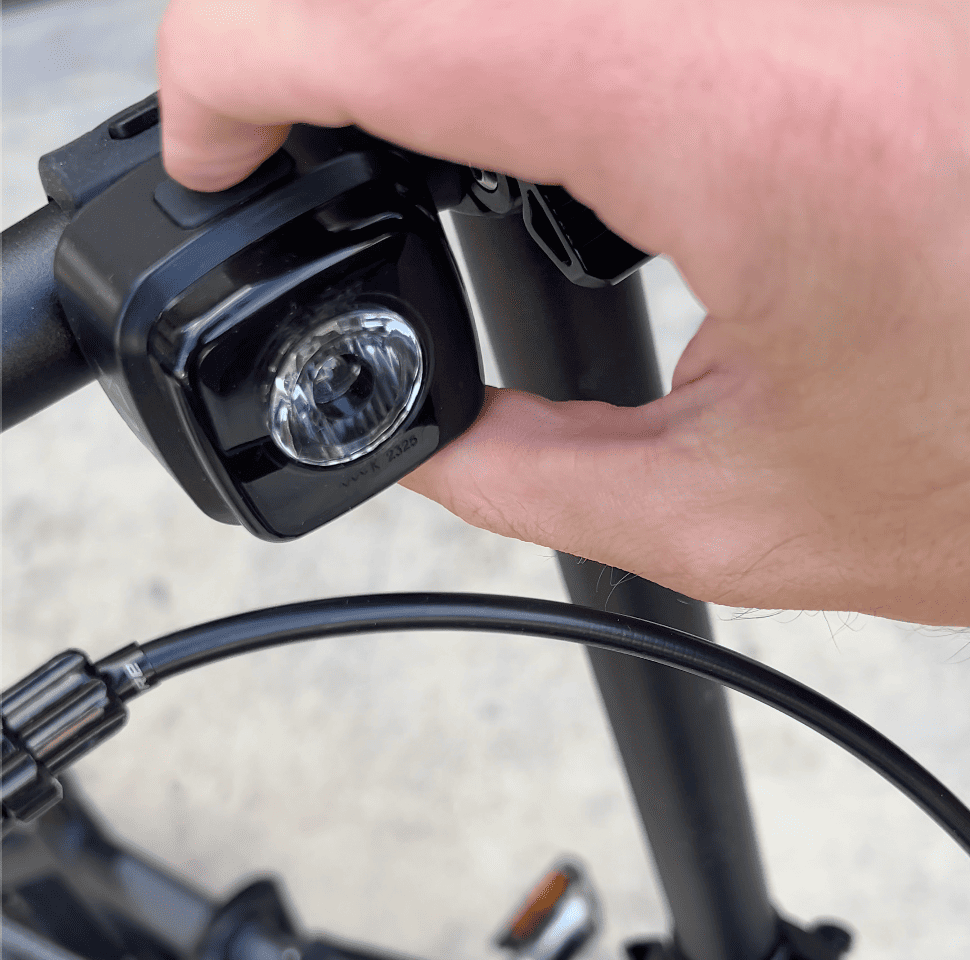
And lastly, I do wish the tail light and headlight were powered by the main e-bike battery. Instead, they have their own dedicated rechargeable batteries. It works, but it’s one more thing to remember to charge every now and again.
For riders coming from American-style, high-powered e-bikes, these constraints might feel significant. But context matters here, and that’s the thing to keep in mind for anyone considering an ultra-lightweight e-bike like this. The K-Feather isn’t trying to replace a car or handle long suburban commutes. It’s designed for short urban trips, last-mile riding, and compact living situations, and in that role, its limitations feel more like trade-offs than flaws.

In its element: city commuting
The key takeaway for me is that the K-Feather works best as a runabout in a dense city environment, which is where it makes perfect sense. Short trips between neighborhoods, errands, commuting a few miles to work, or riding to a train station are exactly what it excels at. Its light weight makes it easy to carry inside rather than locking up outside, and its discreet appearance doesn’t scream “expensive e-bike.”
In fact, at around US $1,299 depending on current pricing and sales, that’s a pretty darn good price for an ultra-lightweight e-bike. We’re used to seeing e-bikes in this price range fetch higher figures in the $3,000 to $4,000 range (and sometimes even much more) from exotic frame materials and obscure drivetrains. But the K-Feather just uses clever engineering that tracks with Dahon’s decades of design legacy to create something light yet stiff, and without breaking the bank.
The small wheels and compact geometry make it nimble in traffic, and the assist smooths out frequent starts and stops at intersections. You arrive less sweaty and less fatigued, but still feel like you actually rode a bike rather than being carried by a motor.
This is also a bike that appeals to riders who want electric help without fully committing to the idea of an e-bike. It’s unintimidating, visually understated, and mechanically simple. For many people, that’s a feature, not a drawback.
Final thoughts
The Dahon K-Feather isn’t for everyone, and it certainly isn’t trying to be. If you want high speed, long range, or hill-dominating power, this is not the bike for you. I’d recommend that you look elsewhere (and be prepared to lift several more kilos).
But if you want a genuinely lightweight folding e-bike that integrates electric assist in a subtle, elegant way, it still holds up remarkably well. And folds up remarkably well, too.
Used in its intended environment as a city-focused commuter and last-mile bike, the K-Feather works exactly as promised. It’s simple, refined, and quietly effective, and that’s a combination that remains surprisingly rare in the e-bike world.


FTC: We use income earning auto affiliate links. More.

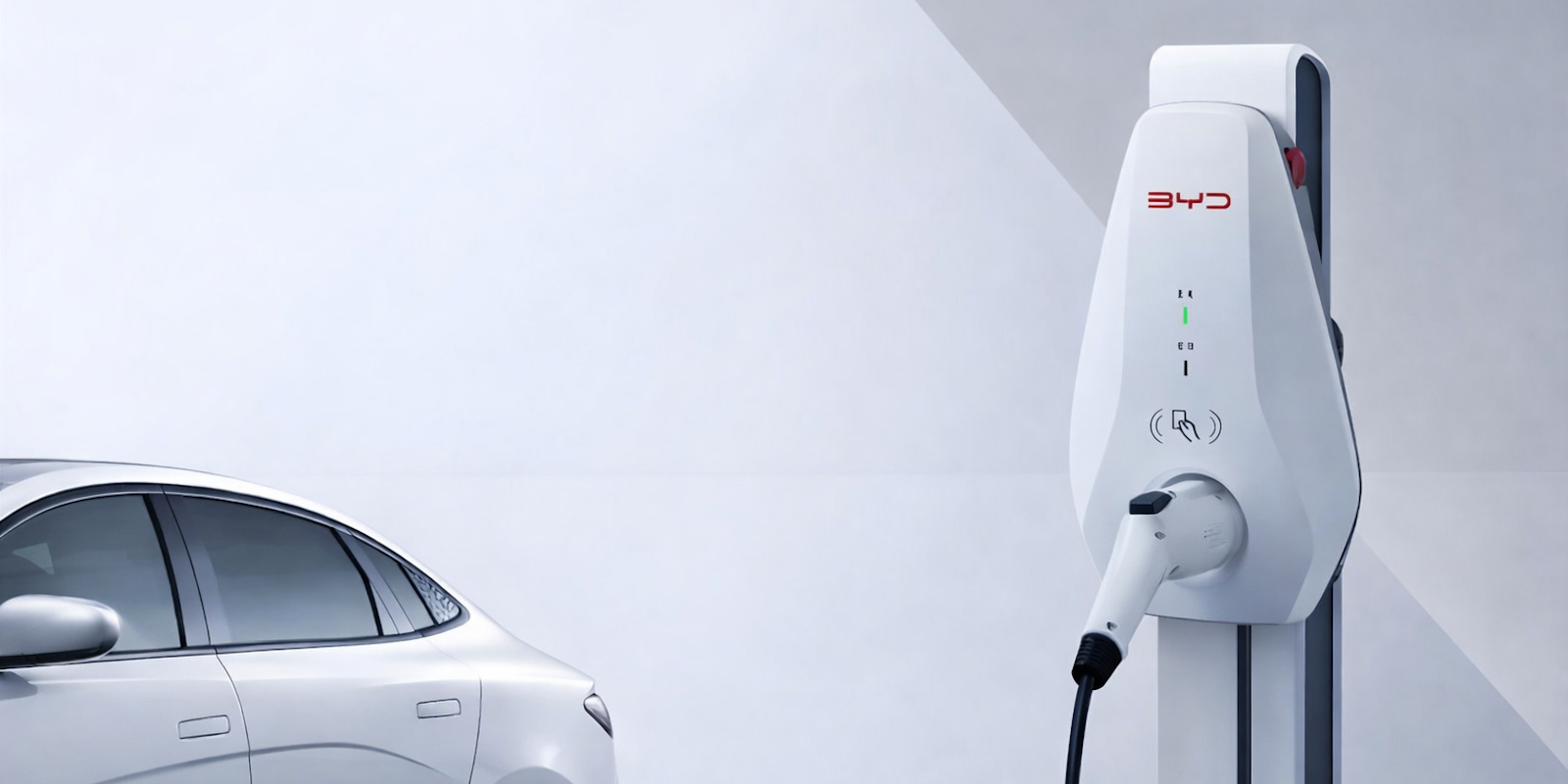
BYD is taking a page from the Airbnb playbook by launching a home charger sharing system that lets EV owners open up their personal charging equipment to other BYD drivers — and get paid for the convenience.
Instead of waiting for utilities or charging networks to build out more public infrastructure, BYD is effectively crowdsourcing existing capacity from home chargers its customers have already installed, turning underused residential charging equipment into a shared resource while its owner is at work or away.
Also like Airbnb, the app allows the charger’s owner and user to settle the pricing and availability and other transaction details between themselves, with contact information and messaging also going through the app.
Great, if not totally unique idea
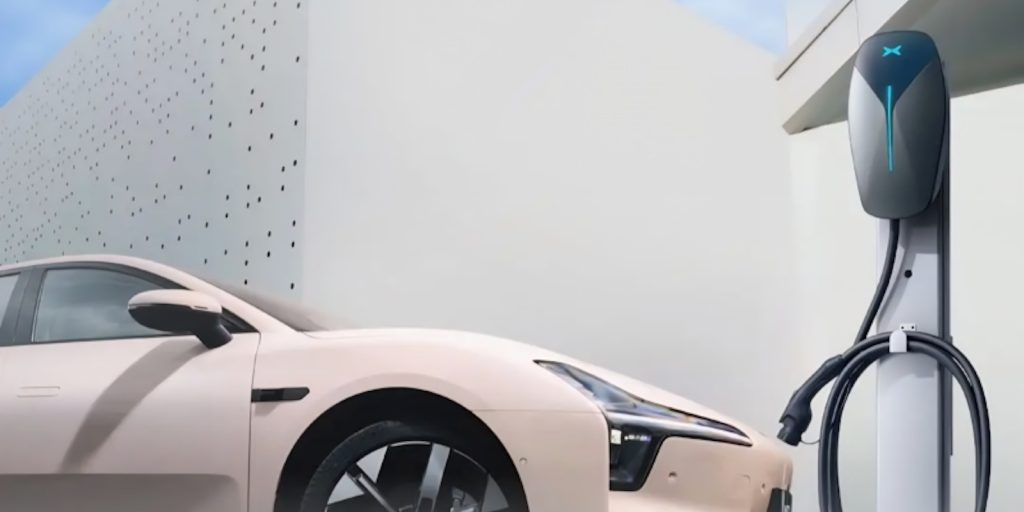
BYD’s system seems to be more polished and, thanks to the integrated card reader, a bit more accessible than similar concepts from Nio and XPeng. XPeng’s system allows charger owners to set different electricity prices at different times (ex.: off-peak electricity at 0.35 yuan/kWh, significantly lower than peak), to cover their electricity costs.
The XPeng system also only seems to support automatic payment through the app, as opposed to the BYD system that bakes a card reader right in.
Electrek’s Take
I don’t know enough about the public charging scene throughout China – a massive country half a world away – to know how much of a need this is serving, but here in the US, I seem to recall that this was more or less PlugShare’s original concept, and could easily imagine a half-dozen scenarios outside of an Airbnb where a simple, app-based system like this could play out positively for both the EV driver and the equipment owner.
Multifamily apartments or condos with deeded spaces, churches, schools, municipal buildings, or other spaces that sit empty most days could be great uses for this, and I bet you guys could think of two or three more. I look forward to hearing about them, and whether or not a brand-specific network could help move the needle for a brand like Harley or Jeep that’s struggling with its EVs, in the comments.
SOURCE | IMAGES: BYD, via CarNewsChina.

If you’re considering going solar, it’s always a good idea to get quotes from a few installers. To make sure you find a trusted, reliable solar installer near you that offers competitive pricing, check out EnergySage, a free service that makes it easy for you to go solar. It has hundreds of pre-vetted solar installers competing for your business, ensuring you get high-quality solutions and save 20-30% compared to going it alone. Plus, it’s free to use, and you won’t get sales calls until you select an installer and share your phone number with them.
Your personalized solar quotes are easy to compare online and you’ll get access to unbiased Energy Advisors to help you every step of the way. Get started here.
FTC: We use income earning auto affiliate links. More.
![Maximizing fleet efficiency and ROI with telematics integration [update]](https://i0.wp.com/electrek.co/wp-content/uploads/sites/3/2023/11/Daimler-North-America-semi-electric-trucks.jpg?resize=1200,628&quality=82&strip=all&ssl=1)

Even without clean fleet tax credits and cash-on-the-hood incentives, fleet managers are working hard to maximize their ROI on vehicle assets and reduce their total cost of ownership – and they’re increasingly turning to data‑driven telematics solutions to help.
Telematics use data gathered from sensors embedded in a vehicle to monitor its operations. When collected and interpreted correctly, that data can be used to improve fleet safety, boost operational efficiency, and enable predictive maintenance that reduces (if not eliminates) unexpected downtime. Those are real benefits, with some analysts showing up to 30% savings in repair costs even before you factor in the fuel savings from EVs that, according to MAN CEO Alexander Vlaskamp, will cover the added cost of a BEV in less than three years.
As you can imagine, that’s a big business – and the global market for vehicle telematic platforms is projected to reach an impressive $127 billion in the next decade, and the rush is on to get OEMs like Ford (through Ford Pro) and Volvo (who has a deal with Geotab) to integrate digital solutions into their vehicles.
We originally covered these topics back in February, ahead of the ACT Expo. You can read that original article, below, and let us know what you think of the OEMs’ telematics’

Last month, Geotab signed a deal with Volvo Group to integrate the manufacturer’s vehicle data API into Geotab’s telematics platform. It’s the latest in a recent onslaught of such deals between telematics providers and OEMs that begs the question: what’s in it for the OEMs?
Almost all modern cars and trucks are “connected” in some way. Ford, for example, began fitting the FordPass Connect modem on all its vehicles in the 2020 model year, and the vehicle (and driver) data gathered powers the Ford Pro fleet management platform and enables offerings like the company’s E-Switch Assist, which enables Ford fleet managers to identify which of its ICE-powered F-150 and Transit assets are ready to make the switch to EV.
“Smart tools informed by data like E-Switch Assist are opening up many new conversations with our commercial customers large and small about EV readiness; we’re already using E-Switch Assist regularly in consultations to help organizations determine if electric trucks and vans are right for them,” says Nate McDonald, EV strategy and cross vehicle brand manager at Ford Pro. “The importance of these tools and technologies goes beyond selling a customer a new vehicle—it changes mindsets about whether electric vehicles will work for their business while potentially saving them time and money.”
So, it makes sense for manufacturers to build that connectivity into their vehicles and makes even more sense to use that data connection to populate a fleet management dashboard that makes it painless for fleet managers to monitor their assets within a trusted ecosystem. Think Android vs. iPhone, and the pain that would go into switching from one to the other after a decade or so of constant interaction – because that’s how the OEMs are looking at it.
Why, then, would an OEM open up that data stream to a third party like Geotab?
The answer, presumably, is that that data sharing is a two-way street: the manufacturer’s are opening up their APIs to Geotab, and Geotab is sharing at least some of the data from other manufacturers with their industry partners.
And Geotab has a lot of partners:
- In 2019, Geotab began working with Ford to integrate Ford’s telematics data into its fleet management platform
- In 2020, Geotab began integrating with GM and its OnStar telematics in North American markets
- In 2022, Geotab began partnering with Stellantis’ Free2move car sharing brand, providing full telematics integration into the MyGeotab platform in North America
- In April of 2024, Geotab partnered with Mobilisights to integrate data from Stellantis’ European brands, including Opel, Fiat, Alfa Romeo, Citroën, and Peugeot
- In September of 2024, Geotab announced a new partnership with VW Group Info Services aimed at improving the company’s data integration across its brands
- A deal with Rivian, VW’s partner in a $5 billion joint software venture, followed soon after
All of those players are convinced that the data coming from their vehicles can produce enough value to seriously impact fleet ROI.
Fleet managers seem convinced, too. In a recent McKinsey survey, nearly 57% of EV buyers said they were willing to switch brands in order to get better connectivity features. And, if you’ve ever worked in “a Ford shop” or “a Chevy shop” you already know what a huge that deal that number might be to an OEM.
McKinsey connectivity survey

In that point of view, working with a trusted, universal platform like Geotab who doesn’t have a dog in the vehicle sales fight makes sense. If the Ford Transit the fleet buyer is looking at plays well with their fleet auditing software and systems and the Nissan NV doesn’t – well, it doesn’t really matter if Nissan’s fleetail guy is giving you a better deal at that point. It’s just too painful to operate a second dashboard for one subset of assets.
The man-hours saved with a universal and brand agnostic fleet management platform may not be the easiest to trace all the way to the bottom line, but they’re there.
Additionally, the Geotab dashboard can be configured to collect and even analyze data that’s specifically relevant to EVs. Information like charging history, and regenerative braking efficiency, and overall battery health – data that, over thousands of vehicles, can give fleet managers real insight into how long the new electric vehicles they’re considering will last compared to the gas and diesel vehicles they have experience with.
Geotab research shows that EV batteries could last 20 years or more if they degrade at an average rate of 1.8% per year, as we have observed.
According to our data, the simple answer is that the vast majority of batteries will outlast the usable life of the vehicle and will never need to be replaced. If an average EV battery degrades at 1.8% per year, it will still have over 80% state of health after 12 years, generally beyond the usual life of a fleet vehicle.
Telematics integrations can also help optimize a fleet’s charging schedules, both by scheduling EV charging for lower priced, off-peak hours and by identifying the most dependable high-speed charging stations along regular routes to minimize down time for both vehicles and drivers.
Finally, these data-driven platforms can provide fleet managers tools for tracking and reporting things like carbon emissions and overall energy consumption, which can streamline ESG reporting processes and make it easier for the worker bees to get regulators, administrators, and managers the sort of charts, tables, and graphs they love.
Something like that, anyway.
You can check out my Quick Charge with Nate McDonald, EV strategy and cross vehicle brand manager at Ford Pro, who explores how Ford’s in-house telematics can help fleet managers decarbonize, and head over to Geotab to find out more about their brand agnostic fleet management dashboard, below. Enjoy!
EV or gas – which is right for you?
SOURCES: Fleet Europe, Ford Pro, Geotab, McKinsey; add’l links in article.
If you’re considering going solar, it’s always a good idea to get quotes from a few installers. To make sure you find a trusted, reliable solar installer near you that offers competitive pricing, check out EnergySage, a free service that makes it easy for you to go solar. It has hundreds of pre-vetted solar installers competing for your business, ensuring you get high-quality solutions and save 20-30% compared to going it alone. Plus, it’s free to use, and you won’t get sales calls until you select an installer and share your phone number with them.
Your personalized solar quotes are easy to compare online and you’ll get access to unbiased Energy Advisors to help you every step of the way. Get started here.
FTC: We use income earning auto affiliate links. More.
-
 Sports2 years ago
Story injured on diving stop, exits Red Sox game
-
 Sports3 years ago
‘Storybook stuff’: Inside the night Bryce Harper sent the Phillies to the World Series
-
 Sports2 years ago
Game 1 of WS least-watched in recorded history
-
 Sports3 years ago
Button battles heat exhaustion in NASCAR debut
-
 Sports3 years ago
MLB Rank 2023: Ranking baseball’s top 100 players
-
Sports4 years ago
Team Europe easily wins 4th straight Laver Cup
-
 Environment3 years ago
Japan and South Korea have a lot at stake in a free and open South China Sea
-
 Environment1 year ago
Here are the best electric bikes you can buy at every price level in October 2024