


Sophie Kinsella, author of the Shopaholic series of novels, has been hailed as a “graceful” inspiration who left her readers feeling better about themselves, following her death at the age of 55.
The writer, whose real name was Madeleine Sophie Wickham, revealed last year she had been diagnosed with an aggressive form of brain cancer in 2022.
A statement posted to her Instagram account read: “We are heartbroken to announce the passing this morning of our beloved Sophie (aka Maddy, aka Mummy). She died peacefully, with her final days filled with her true loves: family and music and warmth and Christmas and joy.
“We can’t imagine what life will be like without her radiance and love of life.
“Despite her illness, which she bore with unimaginable courage, Sophie counted herself truly blessed – to have such wonderful family and friends, and to have had the extraordinary success of her writing career. She took nothing for granted and was forever grateful for the love she received.
“She will be missed so much our hearts are breaking.”
‘Made you feel better about yourself’
Kinsella’s novels have sold more than 45 million copies in more than 60 countries, and have been translated into more than 40 languages.
Speaking to The UK Tonight With Sarah-Jane Mee, fellow author Jojo Moyes, who was friends with Kinsella for decades, described her as a “graceful”, “kind” and “encouraging” mentor.
Those who knew her “will always be grateful to have had her in our lives”, she said.
Her characters “were flawed and messy, but they were also relatable, and you always finished a Sophie Kinsella book feeling better about yourself”.
“If the thing that you are remembered for is joy and grace and kindness, as well as your talent, what more can any of us ask?”
Jojo Moyes on the Sophie Kinsella she knew
In a post on social media last year, Kinsella revealed she had been receiving chemotherapy and radiotherapy at London‘s University College Hospital, and had undergone “successful” surgery.
She said she “wanted for a long time to share with you a health update, and I’ve been waiting for the strength to do so”.
“At the end of 2022 I was diagnosed with glioblastoma, a form of aggressive brain cancer,” she said.
“I did not share this before because I wanted to make sure that my children were able to hear and process the news in privacy and adapt to our ‘new normal’.
“At the moment all is stable and I am feeling generally very well, though I get very tired and my memory is even worse than it was before!
“I am so grateful to my family and close friends who have been an incredible support to me, and to the wonderful doctors and nurses who have treated me.”
Kinsella’s most recent book is What Does it Feel Like?, published in October 2024 and which “is fiction, but it is my most autobiographical work to date”, the author wrote on her website.
Other books by the London-born author include The Burnout, released in October 2023, Can You Keep A Secret? and The Undomestic Goddess.
The first two novels in her hit eight-book Shopaholic series, The Secret Dreamworld Of A Shopaholic and Shopaholic Abroad, were adapted into the 2009 film Confessions Of A Shopaholic, starring Isla Fisher.
She is survived by her children, four sons and a daughter, and her husband Henry Wickham.
Read more:
‘Unacceptable’ prostate ads banned
David Cameron treated for prostate cancer

Kinsella at the premiere of the Confessions of a Shopaholic film adaption in 2009. Pic: Reuters
Bill Scott-Kerr, publisher at Transworld, the publishing home of Kinsella for the past 30 years, said: “She has been such an unshakeable pillar of our publishing at Transworld for so many years that the thought of a year without a Sophie Kinsella to publish is inconceivable.”
He added: “Maddy leaves behind a glorious and indelible legacy: a unique voice, an unquenchable spirit, a goodness of intent and a body of work that will continue to inspire us to reach higher and be better, just like so many of her characters.
“On a personal level Maddy was the embodiment of joy, an extraordinarily clever, funny, sassy, impish, kind and generous collaborator who brought light into our lives. She was as part of this company as anyone, and we will all truly miss her.”
Entertainment
Live music venues warn of ‘devastating consequences’ of budget tax changes in letter to Sir Keir Starmer


Tax changes announced in the budget could have “devastating, unintended consequences” on live music venues, including widespread closures and job losses, trade bodies have warned.
The bodies, representing nearly 1,000 live music venues, including grassroots sites as well as arenas such as the OVO Wembley Arena, The O2, and Co-op Live, are calling for an urgent rethink on the chancellor’s changes to the business rates system.
If not, they warn that hundreds of venues could close, ticket prices could increase, and thousands could lose their jobs across the country.
Politics latest: Ex-Olympic swimmer nominated for peerages
Business rates, which are a tax on commercial properties in England and Wales, are calculated through a complex formula of the value of the property, assessed by a government agency every three years. That is then combined with a national “multiplier” set by the Treasury, giving a final cash amount.
The chancellor declared in her budget speech that although she is removing the business rates discount for small hospitality businesses, they would benefit from “permanently lower tax rates”. The burden, she said, would instead be shifted onto large companies with big spaces, such as Amazon.
But both small and large companies have seen the assessed values of their properties shoot up, which more than wipes out any discount on the tax rate for small businesses, and will see the bills of arena spaces increase dramatically.
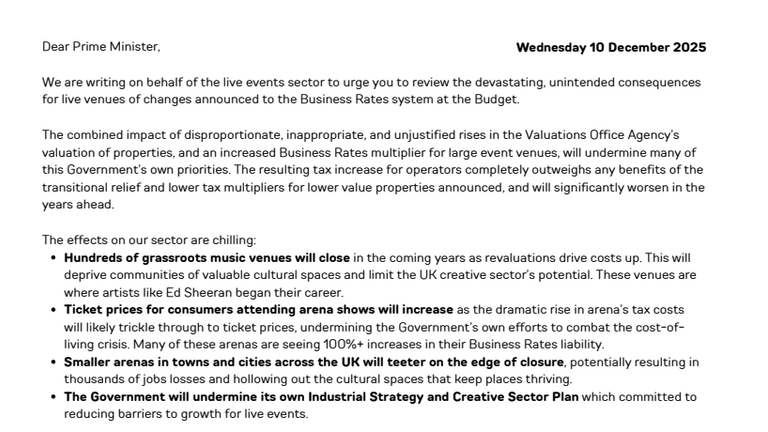
In the letter, coordinated by Live, the trade bodies write that the effect of Rachel Reeves’s changes are “chilling”, saying: “Hundreds of grassroots music venues will close in the coming years as revaluations drive costs up. This will deprive communities of valuable cultural spaces and limit the UK creative sector’s potential. These venues are where artists like Ed Sheeran began their career.
“Ticket prices for consumers attending arena shows will increase as the dramatic rise in arena’s tax costs will likely trickle through to ticket prices, undermining the government’s own efforts to combat the cost of living crisis. Many of these arenas are seeing 100%+ increases in their business rates liability.
“Smaller arenas in towns and cities across the UK will teeter on the edge of closure, potentially resulting in thousands of jobs losses and hollowing out the cultural spaces that keep places thriving.”
The full letter from trade bodies to the prime minister.
They go on to warn that the government will “undermine its own Industrial Strategy and Creative Sector Plan which committed to reducing barriers to growth for live events”, and will also reduce spending in hotels, bars, restaurants and other high street businesses across the country.
To mitigate the impact of the tax changes, they are calling for an immediate 40% discount on business rates for live venues, in line with film studios, as well as “fundamental reform” to the system used to value commercial properties in the UK, and a “rapid inquiry” into how events spaces are valued.
Sky’s Jess Sharp explains how the budget could impact your money
In response, a Treasury spokesperson told Sky News: “With Covid support ending and valuations rising, some music venues may face higher costs – so we have stepped in to cap bills with a £4.3bn support package and by keeping corporation tax at 25% – the lowest rate in the G7.
“For the music sector, we are also relaxing temporary admission rules to cut the cost of bringing in equipment for gigs, providing 40% orchestra tax relief for live concerts, and investing up to £10m to support venues and live music.”
But Conservative shadow business secretary Andrew Griffith told Sky News: “The government has failed to deliver the reform to business rates they promised, and need to change course before more jobs and venues are lost forever.”
The warning from the live music industry comes after small retail, hospitality and leisure businesses warned of the potential for widespread closures due to the changes to the business rates system.
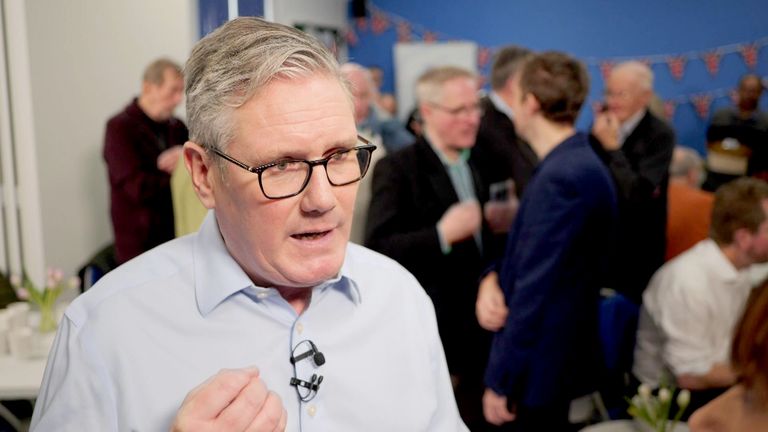
Sky’s political editor Beth Rigby challenged Prime Minister Sir Keir Starmer on the tax rises in the budget.
Sky News reported after the budget that the increase in business rates over the next three years following vast increases in the assessed values of commercial properties has left small retail, hospitality and leisure businesses questioning whether their businesses will be viable beyond April next year.
Analysis by UK Hospitality, the trade body that represents hospitality businesses, has found that over the next three years, the average pub will pay an extra £12,900 in business rates, even with the transitional arrangements, while an average hotel will see its bill soar by £205,200.
Read more: Hospitality pleads for ‘lifeline’
A Treasury spokesperson said their cap for small businesses will see “a typical independent pub pay around £4,800 less next year than they otherwise would have”.
“This comes on top of cutting licensing costs to help more venues offer pavement drinks and al fresco dining, maintaining our cut to alcohol duty on draught pints, and capping corporation tax,” they added.


The U.K. and Germany are emerging as key hubs for a new wave of AI defense startups, as Europe scrambles to rearm amid rising geopolitical tensions.
Private funding for defense startups across the region has ramped up in recent years, with investors looking to tap into increasing government military budgets, driven by the ongoing Russia-Ukraine war and pressure from the Trump administration.
But it’s ecosystems in the U.K. and Germany that are seeing the most activity. The majority of the biggest rounds across the sector have been for startups based in those two countries, with both emerging as key launchpads into new markets and battlefield training.
David Ordonez, senior associate at NATO Innovation Fund, told CNBC that this was “thanks to the scientific expertise of their talent base, national commitments to treat this sector as an economic engine for growth and a manufacturing base that enables the rapid scaling of breakthrough innovation.”
‘Visible pathways to procurement’
Venture capital for European defense startups has spiked as members of the NATO military alliance have agreed to increase security spending to 5% of gross domestic product, and defense departments in London and Berlin have increasingly signaled a willingness to adopt new technology built by younger players in the market.
Investors, buoyed by the promise of commercial deals, have funneled a record $4.3 billion into the sector since the start of 2022, according to Dealroom — nearly four times the funds deployed in the previous four years.
Germany’s AI drone makers Helsing and Quantum Systems hit valuations of 12 and 3 billion euros this year, respectively, after rounds worth hundreds of millions of euros. In the U.K., manufacturing platform PhysicsX, which works with defense companies, raised $155 million this year, and missile interception startup Cambridge Aerospace reportedly picked up a $100 million round in August.
The U.K. government’s Strategic Defence Review in June proposed boosting spending on novel tech and streamlining procurement processes, as well as unveiling a £5 billion tech investment package.
“We see a system increasingly open to non-traditional primes, supported by wider investment in skills and technology,” Karl Brew, head of defense at Portuguese-U.K. drone startup Tekever, told CNBC.
Tekever, which became a unicorn this year, announced a major contract to supply uncrewed aerial systems to the Royal Air Force in May. Helsing has several contracts with the U.K. government, and U.S.-based Anduril signed a £30 million contract for its attack drones in March.
Tekever’s AR3 EVO drone undergoing pre-flight checks prior to being launched. Credit: Tekever
Germany announced its defense spending would rise to upwards of 100 billion euros — a record figure since the German reunification — from 2026, and also changed procurement processes to make it easier for startups to participate.
While most European governments have ramped up defense spending, Germany stands out as having “visible pathways from prototype to major procurement [for startups] that many other European markets still do not provide,” Meghan Welch, managing director at financial advisory firm BGL, told CNBC.
Helsing and attack drone startup Stark are both in line to win a contract for kamikaze drones, the Financial Times reported in October. Helsing and Stark declined to comment to CNBC about this.
Legacy infrastructure
Germany’s industrial heritage has also created talent pipelines and infrastructure that startups are tapping into.
“Germany has the industrial base, the infrastructure and the technical talent to produce the next-generation technologies NATO urgently needs,” Philip Lockwood, international managing director of Stark, told CNBC.
Founded in 2024, Stark is building attack and reconnaissance drones and has raised $100 million from investors, including Sequoia Capital, Peter Thiel’s Thiel Capital, and the NATO Innovation Fund.
Stark’s Virtus drone
“Many of Europe’s best engineers developed their expertise in Germany’s industrial and technological sectors, which have long led in hardware, software, manufacturing and supply-chain resilience,” Lockwood said.
The U.K.’s broader ecosystem is also a decisive factor in its appeal as a defense base, said Tekever’s Brew. “It brings together world-class universities and R&D centres with a dense network of aerospace, software and advanced-manufacturing suppliers,” he said.
Launchpads
Another key driver of defense tech in the U.K. and Germany is that both countries serve as launchpads into new markets or frontline training.
The U.K. has had a security and defense partnership with Australia and the U.S. since 2021, known as AUKUS, which has lifted certain export controls and restrictions on technology sharing between the nations.
“As part of AUKUS, the move into the UK was a natural entry point into Europe,” Rich Drake, managing director at Anduril UK, told CNBC.
Alongside signing contracts totalling nearly £30 million for its attack drones earlier this year, Anduril also has plans to open a new manufacturing and R&D facility in the UK.
Anduril UK’s Seabed Sentry. Credit: Anduril UK
“[AUKUS] allows us to work with the MOD [Ministry of Defence], align on operational needs and accelerate the deployment of leading autonomous systems in a context where trust, shared priorities and strategic alignment matter as much as technology,” Drake said.
U.S. defense startups looking to sell into European markets have also often chosen London as a base from which to expand across the region. Second Front Systems and Applied Intuition expanded into the country in 2023 and 2025, respectively.
“Given the history of the special relationship between the US and the UK, the UK serves as an excellent launching pad into the rest of the European market,” said Enrique Oti, chief strategy officer at Second Front Systems.
The U.K. can also serve as a base for European defense startups with global ambitions, added Dmitrii Ponomarev, product manager at VanEck.
“In practice the UK is becoming the interoperability testbed and politically acceptable landing zone for tech flowing in both directions,” Ponomarev told CNBC.
“If you can win a pilot with UK forces, comply with UK/US-aligned security and export regimes and operate in English with UK industrial and legal standards, you look much more ready to US primes, Department of War programs and AUKUS-related efforts.”
In 2025, some of Europe’s best-funded defense startups, including Helsing, Quantum Systems and Stark, announced factories, offices, or investments in the country.
Further east, Germany’s role as one of the largest donors of military aid to Ukraine has given the country’s startups a “front row seat for battlefield feedback,” said Ponomarev.
Quantum Systems has deployed its reconnaissance tech in Ukraine and Helsing announced in February it would produce thousands of strike drones for the country.

Despite the advances, analysts, investors and startup execs all caution there’s more work to be done to create the conditions for building global defense startups in the UK and Germany.
“Scaling remains difficult without continued political and procurement reform,” Ponomarev told CNBC.
“The UK still struggles with slow procurement cycles, clearance bottlenecks and a shortage of security-approved technical talent,” he added. Germany’s biggest obstacles are bureaucracy, strict export controls and heavy dependence on a single customer — the country’s armed forces, Ponomarev added.
BLG’s Welch said the winners of Europe’s AI defense boom “are likely to be companies that can master both the political economy, including export rules, alliances and public narratives, and the technology race, positioning themselves as enablers of national sovereignty rather than disruptors of it.”
-
 Sports2 years ago
Story injured on diving stop, exits Red Sox game
-
 Sports3 years ago
‘Storybook stuff’: Inside the night Bryce Harper sent the Phillies to the World Series
-
 Sports2 years ago
Game 1 of WS least-watched in recorded history
-
 Sports3 years ago
Button battles heat exhaustion in NASCAR debut
-
 Sports3 years ago
MLB Rank 2023: Ranking baseball’s top 100 players
-
Sports4 years ago
Team Europe easily wins 4th straight Laver Cup
-
 Environment3 years ago
Japan and South Korea have a lot at stake in a free and open South China Sea
-
 Environment1 year ago
Here are the best electric bikes you can buy at every price level in October 2024