Connect with us

Published

on

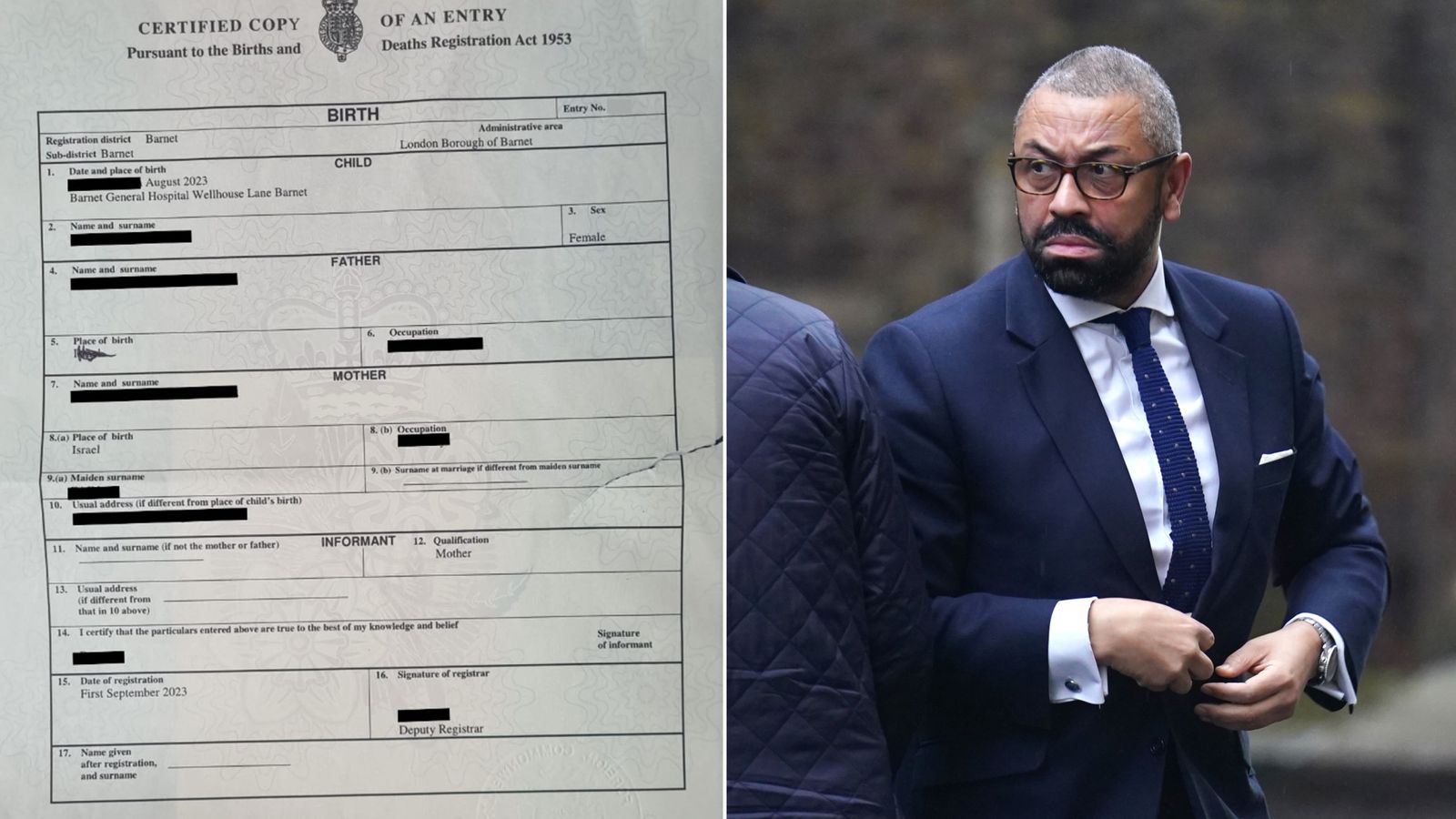
The Home Office is launching an investigation after a baby’s birth certificate was returned to her parents “with the word Israel scribbled out”.

The Campaign Against Antisemitism said the certificate was sent off as part of a passport application two weeks ago and returned on Monday with the father’s place of birth defaced.

The organisation, which exposes cases of antisemitism, said the incident was “completely unacceptable”.

It posted the image on X, saying: “Two weeks ago, a member of the public sent off a passport application to @ukhomeoffice for his six-month-old baby girl.

“Today, the birth certificate was returned ripped with the word ‘Israel’ scribbled out. The parents are understandably very concerned about this incident.

“We are asking the Home Office to investigate how this happened. The Home Office has responsibility for law enforcement and the security of the Jewish community.

Politics live: Possible move against Russia would send ‘very powerful signal’

More from Politics

“Confidence in the authorities is at painfully low levels and must be restored.”

Home Secretary James Cleverly replied and said he had asked officials to “investigate this urgently and will see that appropriate action is taken”.

The incident comes after figures published by the Community Security Trust (CST), a charity providing security to Jewish schools and institutions, revealed more than 4,000 antisemitic incidents were recorded in the UK in 2023.

Speaking in the Commons on Monday, policing minister Chris Philp said the report made for “deeply disturbing reading” and that the figure provided was “the highest annual total” ever reported to the charity.

“There is no excuse for the behaviour outlined in the CST report, or seen in some of the shocking incidents that have occurred recently,” he said.

“Whenever and wherever criminality involving antisemitism occurs, this government expects police to fully investigate the incident, and work with the Crown Prosecution Service to bring the perpetrators to justice.”

Read more:
Winehouse statue Star of David covered by Palestine sticker

Increase in antisemitism since Israel-Hamas war, say police
Antisemitic and Islamophobic hate crimes up

A spokesperson for Campaign Against Antisemitism said: “This is completely unacceptable. When sending off a passport application to the Home Office, the last thing one should ever expect is to have their child’s birthday certificate returned, torn, with the parent’s place of birth scribbled out, just because it is the Jewish state.

“We are assisting the parents, who are understandably very concerned about this incident. We are also asking the Home Office to investigate how this happened.

“The Home Office has responsibility for law enforcement and the security of the Jewish community and the wider public. Confidence in the authorities among British Jews is at painfully low levels and must be restored.”

The Home Office has been approached for comment.

Continue Reading

Politics

EU may consolidate crypto regulations, IMF warns of stablecoin risk: Global Express

Published

on

By

EU may consolidate crypto regulations, IMF warns of stablecoin risk: Global Express

European tech regulators have fined social media platform X 120 million euros ($140 million) for breaking EU rules pertaining to online content.

The fine follows a two-year investigation under the Digital Services Act (DSA), which reportedly found that X was not doing enough to tackle illegal and harmful material.

Regulators also said that the blue check marks on Elon Musk’s platform were deceiving. They did not follow industry decisions and negatively impacted users’ ability to make informed decisions about the authenticity of an account.

The fine is part of a wider crackdown on Big Tech companies, particularly social media. TikTok reported it had avoided a fine by making concessions.

The actions against X are bound to create tension with the US. Vice President JD Vance said that EU regulators shouldn’t be “attacking” American companies.

Source: JD Vance

The DSA will also apply to crypto platforms, DeFi frontends and NFT marketplaces if they grow to a sufficiently large size. It can influence how these platforms handle ads, user-directed content and market financial instruments.

EU banks launch euro-stablecoin firm as EU considers ESMA crypto oversight

A group of 10 European banks, including institutional heavyweights such as BNP Paribas, is planning to launch a stablecoin backed by the euro by the second half of 2026.

BNP Paribas partnered with Danish Danske Bank, the Netherlands’ ING, Austria’s Raiffeisen Bank International and others to create and incorporate the project as Qivalis. The company will be based in Amsterdam.

Qivalis CEO Jan-Oliver Sell said that stablecoins provide both convenience and monetary autonomy “in the digital age.” He said it will give “new opportunities for European companies and consumers to interact with on-chain payments and digital asset markets in their own currency.”

The new project was announced days before the European Commission proposed expanding the powers of the EU’s key financial regulator, the European Securities and Markets Authority (ESMA).

The proposal, released Thursday, would transfer supervision “over significant market infrastructures such as certain trading venues, Central Counterparties (CCPs), CSDs, and all Crypto-Asset Service Providers (CASPs)” to the ESMA.

The move is part of a broader effort to streamline European market regulation. Three countries — France, Italy and Austria — have requested that the ESMA take over crypto regulations. This followed concerns that there was uneven enforcement of Markets in Crypto-Assets (MiCA) standards across member states.

Related: What is Markets in Crypto-Assets (MiCA)?

Spot crypto assets to begin trading on futures market, CFTC says

In the United States, the Commodity Futures Trading Commission (CFTC) has approved spot cryptocurrency products to trade on futures markets.

Acting Chair Caroline Pham said that the move brings these products onshore to “safe U.S. markets.” She said the approval followed recommendations from the White House’s Working Group on Digital Asset Markets and engagement with the Securities and Exchange Commission (SEC).

Earlier this year, the SEC and CFTC established the “Crypto Sprint” initiative to share recommendations and consult on best practices.

Source: Acting CFTC Chair Caroline Pham

Pham became acting chair at the beginning of the year. She is expected to step down when the Trump administration’s nominee, Michael Selig, is approved by Congress.

South Africa flags crypto risks; new rules in the works

The South African Reserve Bank, the country’s central bank, issued a warning on Nov. 25 about the perceived risks associated with stablecoins and cryptocurrencies. These include a lack of comprehensive regulations.

The bank was concerned that the global and borderless nature of cryptocurrencies would make them ideal for skirting financial regulations.

South Africa is second on the continent for value received in crypto. Source: Chainalysis

Herco Steyn, the bank’s lead macroprudential specialist, reportedly said the risk stemmed from “the lack of a complementary and full regulatory framework, which is not possible at the moment.”

In 2023, he wrote, “Regulatory influence over stablecoin issuers – whether domiciled domestically or abroad – may result in spillovers from the crypto asset ecosystem to the traditional financial system, particularly if South African regulatory authorities are unable to impose prudential requirements on stablecoin issuers.”

To address this, the reserve bank is reportedly working on new rules with the National Treasury to monitor cross-border crypto transactions and change exchange control laws so they fall under regulatory scrutiny.

IMF warns stablecoins could upend fragile financial systems

On Thursday, the International Monetary Fund (IMF) published a report on stablecoins outlining a number of risks, including:

  • Volatility in value and runs

  • Disintermediation of banks

  • Interconnection with the financial system

  • Currency substitution.

It said that the “use of foreign currency-denominated stablecoins, especially in cross-border contexts, could lead to currency substitution and potentially undermine monetary sovereignty, particularly in the presence of unhosted wallets.”

The IMF also noted that many major stablecoin issuers don’t provide or offer any redemption rights for holders. “Uncertainty of treatment in case of insolvency of stablecoin issuer may also accelerate runs,” it said.

Runs would also create first-mover advantages when there is a crisis of confidence, which could result in investors selling their holdings at a significant discount.

The IMF did acknowledge possible benefits of stablecoins, including faster transactions compared to bank transfers, particularly in the context of cross-border transactions and remittances. They can also facilitate digital payment in remote areas and reduce counterparty risk when integrated with smart contracts.

Magazine: Indian investors look beyond Bitcoin, Japan to soften crypto tax: Asia Express