
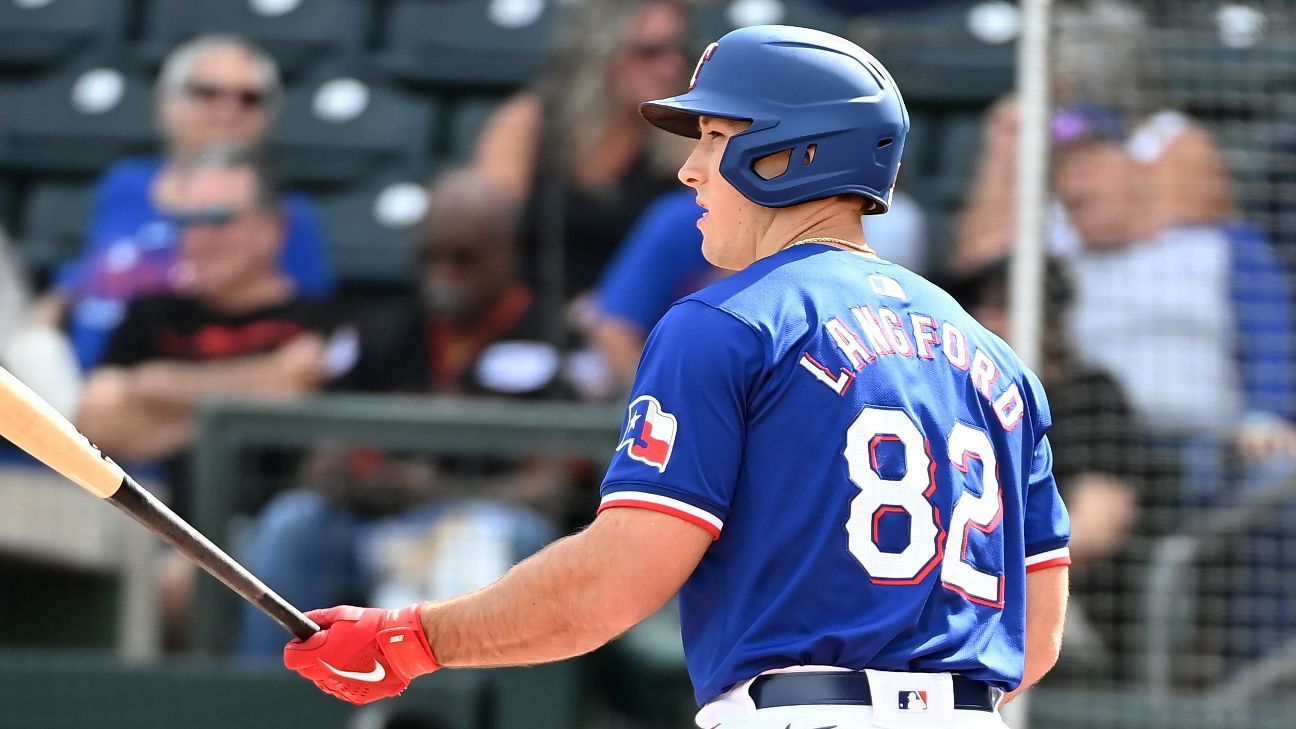
‘I just saw the best player on the field’: Wyatt Langford is turning heads with every thunderous swing of his bat


-
Jeff Passan, ESPN
SURPRISE, Arizona — During the first week of spring training, Texas Rangers pitching coach Mike Maddux returned to the team’s clubhouse after watching a live batting practice session and declared: “I just saw the best player on the field.” The room of coaches and assorted personnel perked up. The Rangers came into camp off a World Series title but with questionable starting pitching depth, and they were hopeful Maddux, a coach for 20 seasons, had unearthed his latest gem on the mound.
“Wyatt Langford,” Maddux said.
Langford is not a pitcher. He is a 6-foot-1, 225-pound power-hitting outfielder, and for a pitching coach — particularly one of Maddux’s stature — to gravitate so quickly to Langford provided the latest evidence that the defending champions’ offense could be even better this year.
Maddux’s answer surprised no one internally. After sliding to Texas at the No. 4 pick in a loaded 2023 draft, Langford, now 22, spent two months destroying four minor league levels, hitting .360/.480/.677 with 10 home runs in 200 plate appearances. He arrived this spring “in real competition to make the club,” according to Texas general manager Chris Young, and only the Rangers’ outfield excellence stands between Langford and an every-day big league role.
“I know if I do what I can do,” Langford said, “they’ll give me the opportunity to showcase that.”
Langford’s right-handed swing has impressed the Rangers so thoroughly that he was under substantial consideration to make his major league debut during the playoffs last year. Toward the end of the regular season, with right fielder Adolis Garcia injured, the Rangers discussed promoting Langford to fill out an already-dangerous lineup. They weren’t afraid of his age or inexperience. As ably as rookie Evan Carter was already garnering headlines with his impressive play, adding Langford to Carter and center fielder Leody Taveras would’ve provided a needed offensive boost.
Garcia returned, of course, going on a legendary hot streak that netted him American League Championship Series MVP honors. But Langford remained around the team during the postseason, joining the Rangers’ so-called “stay-ready squad” in case of injuries. Quickly, he distinguished himself.
The group would gather at Globe Life Field in the morning and take live at-bats. Among those on the mound were Jack Leiter, Owen White and Cole Winn, the best pitching prospects in the Rangers’ organization. Danny Duffy, a World Series champion for the 2015 Kansas City Royals with Young as his teammate, was there and already had a deep respect for Langford after playing with him in Double-A during Duffy’s attempt at a return to the big leagues.
“I got him out once, and it was the first pitch I ever threw him,” Duffy said. “It was a changeup. I didn’t want to challenge him right there. Ball was flying. I hadn’t given up a homer all year, and he wasn’t about to be my first, but he just missed one. Hit it like 400 feet in the air to the middle of center field. If he would’ve clipped it, it would’ve gone to the Embassy Suites.”
Future Hall of Famer Max Scherzer, then trying to return from an injury, didn’t know who Langford was before he faced him during a live batting practice in October. Scherzer learned quickly when Langford hammered a double off the wall. As the month went on and the Rangers cruised to the AL pennant, Langford continued to flabbergast onlookers, consistently barreling balls at 110 mph-plus, territory typically reserved for elite major league hitters. While the stay-ready crew was sent home after Game 1 of the World Series, Garcia’s oblique injury suffered in Game 3 reignited the chatter among Rangers personnel to summon Langford.
“He was right there in the conversation,” Texas bench coach Donnie Ecker said. “And if he did play, he was going right in the 3-hole.”
“I don’t know if he would’ve hit third, to be honest,” Rangers manager Bruce Bochy said, “but watching him in the live BPs was impressive. The numbers, what he was doing, was incredible. You can’t ignore that. And then you get to know the man and he’s got no fear. And you saw what Carter did. And so, we had that to go on too that, hey, these guys are different, these young kids. And so, we didn’t think he’d be afraid. That’s why it was legit, why he was with us.
“Looking back, I mean, it actually would’ve been pretty cool to see.”
Ultimately, Texas chose to give veteran Travis Jankowski the left-field slot and elevate utility man Ezequiel Duran to the active roster. Both had been there all year. They were capable, game-tested. With a 2-1 lead in the Series and home-field advantage, the Rangers didn’t feel the need to push the envelope. The prospect of Langford in the lineup, though, remained in their thoughts. During the celebration after the Rangers’ championship-clinching Game 5, one coach, already looking forward to 2024, said: “And we’re going to have Langford next year, too.”
“It wasn’t just the performance or the results in the minor leagues,” Young said. “It was the process metrics, which we value, that suggested he could come up and have success. His exit velos were extremely high. His chase rate was extremely low. He was walking. He was showing elite discipline. It’s everything we saw when we drafted him — and he’d also performed on the biggest stage in college baseball.
“When you take that into account, the moment wasn’t going to be too big for him.”
Langford had laid waste to college baseball over the previous two years, going from a backup catcher who got four at-bats as a freshman at Florida to arguably the most productive hitter in the country. As a sophomore, Langford hit an SEC-leading 26 home runs with a 1.166 OPS. His follow-up was even better: While his home run total dropped to 21, Langford hit 19 more doubles as a junior and walked 20 more times while maintaining his strikeout rate. His season ended just one win short of a College World Series title.
As much as he would’ve enjoyed being the first position player to participate in the College World Series and the World Series in the same season, Langford saw 2023 as a grand success — one he spent the offseason trying to replicate as he trained with hopes of convincing the Rangers he would be ready this spring. Because Langford understands that dominating in college and the minors guarantees nothing at the major league level, he has used the early goings of spring training to pick the brains of veterans Marcus Semien, Nathaniel Lowe and Josh Jung — Langford’s spring roommate — to better understand the fundamentals of playing his first 162-game season.
“The biggest goal is just to learn as much as I can, make sure to just be myself and go out there and play and have fun,” Langford said. “If it happens, then awesome. If not, then I’ll go to wherever they send me to and do the best I can.
“I know if I do what I can do, they’ll give me the opportunity to showcase that.”
When he gets that chance might depend on the Rangers’ needs. With Jung and shortstop Corey Seager sidelined, they could use their 26th roster spot for a utility man to open the season. What’s clear is that the Rangers won’t keep Langford down just to keep him down — not with MLB’s rules that award a full year of service time to top rookies and incentivize teams to promote them by giving draft picks.
Especially if Rangers coaches continue to see him as the best player on the field.
“He will tell us when he’s ready,” Young said, “and if that’s now, it’s now.”

-
Bradford Doolittle
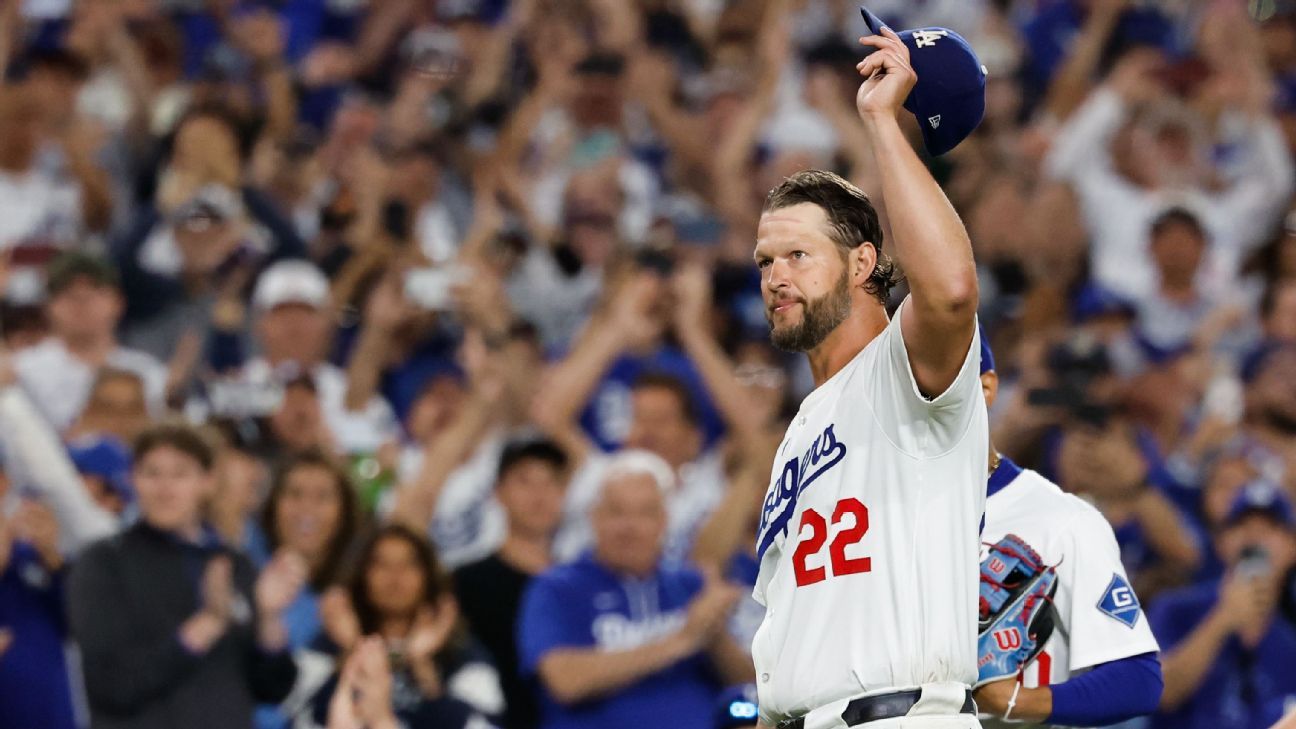
The 3,000-strikeout club has grown by one, with Clayton Kershaw of the Los Angeles Dodgers whiffing the Chicago White Sox‘s Vinny Capra in the sixth inning Wednesday at Dodger Stadium, becoming the 20th pitcher in baseball history to reach that milestone.
The 3K pitching club doesn’t generate as much hullabaloo as its hitting counterpart, but it is more exclusive: Thirty-three players have reached 3,000 hits.
When you look at the list of pitchers with 3,000 strikeouts, and Kershaw’s place on it, a few things jump out.
• None of them pitched at Ebbets Field, at least not in a regular-season game. I frame it like that to illustrate that this level of whiffery is a fairly recent phenomenon. The Dodgers bolted Brooklyn after the 1957 season, and at that point, Walter Johnson was the only member of the 3,000-strikeout club. A career Washington Senator, he never pitched against the Dodgers. Every other 3K member made his big league debut in 1959 or later. Half of them debuted in 1984 or later. Three of them (Kershaw, Max Scherzer and Justin Verlander) are active.
• For now, Kershaw has thrown the fewest career innings of any 3K member, though he’s likely to eventually end up with more frames than Pedro Martinez.
• Kershaw has the highest winning percentage of the 20 (.697) and the best ERA+ (155), though his edges over Martinez (.685 and 154) are razor thin.
• Kershaw tops the list in average game score (61.9) and is tied for second (with Bob Gibson) for quality start percentage (68%), behind only Tom Seaver (70%).
• Kershaw lags behind in bWAR, at least among this group of current, future and should-be Hall of Famers with 77.1, ranking 16th.
So where does Kershaw really rank in the 3K club? I’m glad you asked.
First, what should be obvious from the above bullet points is that the response to the question will vary according to how you choose to answer it. The ranking below reflects not only how I chose to answer the question but how I’d like to see starting pitchers rated in general — even today, in the wildly different context from the days of Walter Johnson.

1. Roger Clemens
FWP: 568.8 | Strikeouts: 4,672 (3rd in MLB history)
Game score W-L: 477-230 (.675)
The top three pitchers on the list, including Rocket, match the modern-era top three for all pitchers, not just the 3K guys. (The string is broken by fourth-place Christy Mathewson.) Before running the numbers, I figured Walter Johnson, with his modern-era record of 417 career wins (the old-fashioned variety), would top the list. But Clemens actually started more games (relief appearances don’t factor in) and had a better game score win percentage.
2. Randy Johnson
FWP: 532.9 | Strikeouts: 4,875 (2nd)
Game score W-L: 421-182 (.698)
Since we’re lopping off pre-1901 performances, the method does Cy Young dirty. Only two pitchers — Young (511 wins) and Walter Johnson got to 400 career wins by the traditional method. By the game score method, the club grows to nine, including a bunch of players many of us actually got to see play. The Big Unit is one of the new 400-game winners, and of the nine, his game score winning percentage is the highest. The only thing keeping Johnson from No. 1 on this list is that he logged 104 fewer career starts than Clemens.
3. Walter Johnson
FWP: 494.7 | Strikeouts: 3,509 (9th)
Game score W-L: 437-229 (.656)
Don’t weep for the Big Train — even this revamping of his century-old performance record and the fixation on strikeouts can’t dim his greatness. That fact we mentioned in the introduction — that every 3K member except Walter Johnson debuted in 1959 or later — tells you a lot about just how much he was a man out of his time. Johnson retired after the 1927 season and surpassed 3,000 strikeouts by whiffing Cleveland’s Stan Coveleski on July 22, 1923. It was nearly 51 years before Gibson became 3K member No. 2 on July 17, 1974.
4. Greg Maddux
FWP: 443.3 | Strikeouts: 3,371 (12th)
Game score W-L: 453-287 (.612)
There is a stark contrast between pitcher No. 4 and pitcher No. 5 on this ranking. The wild thing about Maddux ranking above Nolan Ryan in a group selected for strikeouts is that no one thinks of Maddux as a strikeout pitcher. He never led a league in whiffs and topped 200 just once (204 in 1998). He was just an amazingly good pitcher for a really long time.
5. Nolan Ryan
FWP: 443.1 | Strikeouts: 5,714 (1st)
Game score W-L: 467-306 (.604)
Ryan is without a doubt the greatest strikeout pitcher who ever lived, and it’s really hard to imagine someone surpassing him. This is a guy who struck out his first six batters in 1966, when Lyndon Johnson was in the White House, and his last 46 in 1993, when Bill Clinton was there. Ryan was often criticized during his heyday for his win-loss record, but the game score method clears that right up. Ryan’s revised winning percentage (.604) is markedly higher than his actual percentage (.526).
6. Max Scherzer
FWP: 385.7 | Strikeouts: 3,419 (11th)
Game score W-L: 315-145 (.685)
Here’s another club Mad Max is in: .680 or better game score winning percentage, minimum 100 career starts. He’s one of just eight members, along with Kershaw. The list is topped by Smoky Joe Wood, who dominated the AL during the 1910s before hurting his arm and converting into a full-time outfielder. The full list: Wood, Martinez, Randy Johnson, Lefty Grove, Mathewson, Kershaw, Stephen Strasburg and Scherzer.
7. Justin Verlander
FWP: 385.0 | Strikeouts: 3,471 (10th)
Game score W-L: 349-190 (.647)
Like Scherzer, Verlander is fresh off the injured list. Thus, the two active leaders in our version of FWP have resumed their tight battle for permanent supremacy. Both also resume their quests to become the 10th and 11th pitchers to reach 3,500 strikeouts. Verlander, who hasn’t earned a traditional win in 13 starts, is 4-9 this season by the game score method.
8. Pedro Martinez
FWP: 383.5 | Strikeouts: 3,154 (15th)
Game score W-L: 292-117 (.714)
By so many measures, Martinez is one of the greatest of all time, even if his career volume didn’t reach the same levels as those of the others on the list. His 409 career starts are easily the fewest of the 3K club. But he has the highest game score winning percentage and, likewise, the highest score for FWP per start (.938).
9. Steve Carlton
FWP: 379.8 | Strikeouts: 4,136 (4th)
Game score W-L: 420-289 (.592)
When you think of Lefty, you think of his 1972 season, when he went 27-10 (traditional method) for a Phillies team that went 59-97. What does the game score method think of that season? It hates it. Kidding! No, Carlton, as you’d expect, dominated, going 32-9. So think of it like this: There were 32 times in 1972 that Carlton outpitched his starting counterpart despite the lethargic offense behind him.
10. Tom Seaver
FWP: 371.3 | Strikeouts: 3,640 (6th)
Game score W-L: 391-256 (.604)
Perhaps no other pitcher of his time demonstrated a more lethal combination of dominance and consistency than Seaver. The consistency is his historical differentiator. As mentioned, his career quality start percentage (70%) is tops among this group. Among all pitchers with at least 100 career starts, he ranks fifth. Dead ball era pitchers get a leg up in this stat, so the leader is the fairly anonymous Jeff Tesreau (72%), a standout for John McGraw’s New York Giants during the 1910s. The others ahead of Seaver are a fascinating bunch. One is Babe Ruth, and another is Ernie Shore, who in 1917 relieved Ruth when The Babe was ejected after walking a batter to start a game. Shore replaced him, picked off the batter who walked, then went on to retire all 26 batters he faced. The other ahead of Seaver: Jacob deGrom.
11. Clayton Kershaw
FWP: 370.9 | Strikeouts: 3,000 (20th)
Game score W-L: 301-137 (.687)
And here’s the guest of honor, our reason for doing this ranking exercise. As you can see, Kershaw joined the 300-game-score win club in his last start before Wednesday’s milestone game, becoming the 38th member. In so many measures of dominance, consistency and efficiency, Kershaw ranks as one of the very best pitchers of all time. When you think that he, Verlander and Scherzer are all in the waning years of Hall of Fame careers, you can’t help but wonder who, if anyone, is going to join some of the elite starting pitching statistical clubs in the future.
12. Don Sutton
FWP: 370.6 | Strikeouts: 3,574 (7th)
Game score W-L: 437-319 (.578)
For a post-dead ball pitcher, Sutton was a model of durability. He ranks third in career starts (756) and seventh in innings (5,283⅓). During the first 15 seasons of his career, Sutton started 31 or more games 14 times and threw at least 207 innings for the Dodgers in every season.
13. Ferguson Jenkins
FWP: 353.8 | Strikeouts: 3,192 (14th)
Game score W-L: 363-231 (.611)
Jenkins is in the Hall of Fame, so we can’t exactly say he was overlooked. Still, it does feel like he’s a bit underrated on the historical scale. His FWP score ranks 17th among all pitchers, and the game score method gives him a significant win-loss boost. That .611 percentage you see here is a good bit higher than his actual .557 career winning percentage. He just didn’t play for very many good teams and, in fact, never appeared in the postseason. He’s not the only Hall of Famer associated with the Chicago Cubs who suffered that fate.
14. Gaylord Perry
FWP: 335.6 | Strikeouts: 3,534 (8th)
Game score W-L: 398-292 (.577)
Perry, famous for doing, uh, whatever it takes to win a game, famously hung around past his expiration date to get to 300 wins, and he ended up with 314. Poor Perry: If my game score method had been in effect, he’d have quit two wins shy of 400. Would someone have given him a shot at getting there in 1984, when he was 45? One of history’s great what-if questions.
15. Phil Niekro
FWP: 332.5 | Strikeouts: 3,342 (13th)
Game score W-L: 408-308 (.570)
Knucksie won 318 games, and lost 274, the type of career exemplified by his 1979 season, when he went 21-20. We aren’t likely to see anyone again pair a 20-win season with a 20-loss season. His .537 traditional winning percentage improves with the game score method, but he’s still the low man in the 3K club in that column. Niekro joins Ryan and Sutton on the list of those with 300 game score losses. Sutton, at 319, is the leader. The others: Tommy John, Tom Glavine and Jamie Moyer. Of course, they were all safely over the 300-game-score win threshold as well.
16. CC Sabathia
FWP: 323.2 | Strikeouts: 3,093 (18th)
Game score W-L: 339-221 (.605)
Sabathia will be inducted into the Hall of Fame next month, and his place in this group only underscores how deserving he is of that honor. Sabathia debuted in 2001, and to reach the 250 traditional-win level (he won 251) in this era is an amazing feat. The only pitcher in that club who debuted later is Verlander, stuck at 262 wins after debuting in 2005. Right now, it’s hard to imagine who, if anyone, will be next. Of course, if we just went with game score wins, that would be different.
17. Bob Gibson
FWP: 321.0 | Strikeouts: 3,117 (16th)
Game score W-L: 305-177 (.633)
Gibson, incidentally, also won 251 games — and also gets enough boost from the game score method to climb over 300. His revised percentage is better than his traditional mark of .591. His average game score ranks third in this group, a reflection of his steady dominance but also of the era in which he pitched. Gibson is tied for eighth in quality start percentage among all pitchers. In 1968, when Gibson owned the baseball world with a 1.12 ERA, he went 22-9 by the traditional method. The game score method: 26-8. You’d think it would be even better, but it was, after all, the Year of the Pitcher.
18. Bert Blyleven
FWP: 320.2 | Strikeouts: 3,701 (5th)
Game score W-L: 391-294 (.571)
It took a prolonged campaign by statheads to raise awareness about Blyleven’s greatness and aid his eventual Cooperstown induction. He finished with 287 traditional wins, short of the historical benchmark. Here he would fall short of the 400-win benchmark, but, nevertheless, he is tied with John and Seaver for 11th on the game score wins list. His actual winning percentage was .534.
19. Curt Schilling
FWP: 307.1 | Strikeouts: 3,116 (17th)
Game score W-L: 281-155 (.644)
There are 31 pitchers who have broken the 300 FWP level, and it’s hard for me to imagine how anyone in that group could be left out of Cooperstown. You can sort this out for yourself in terms of baseball and not baseball reasons for this, but the group not there is Clemens, Schilling, John and Andy Pettitte, plus the greats (Kershaw, Verlander, Scherzer) who are still active.
20. John Smoltz
FWP: 273.8 | Strikeouts: 3,084 (19th)
Game score W-L: 290-191 (.603)
Smoltz won 213 games the traditional way, and he falls just short of 300 by the revised method. But all of this is about starting pitching, and with Smoltz, that overlooks a lot. After missing the 2000 season because of injury, he returned as a reliever, and for four seasons he was one of the best, logging 154 saves during that time. He’s the only member of the 200-win, 100-save club.

-
Alden Gonzalez
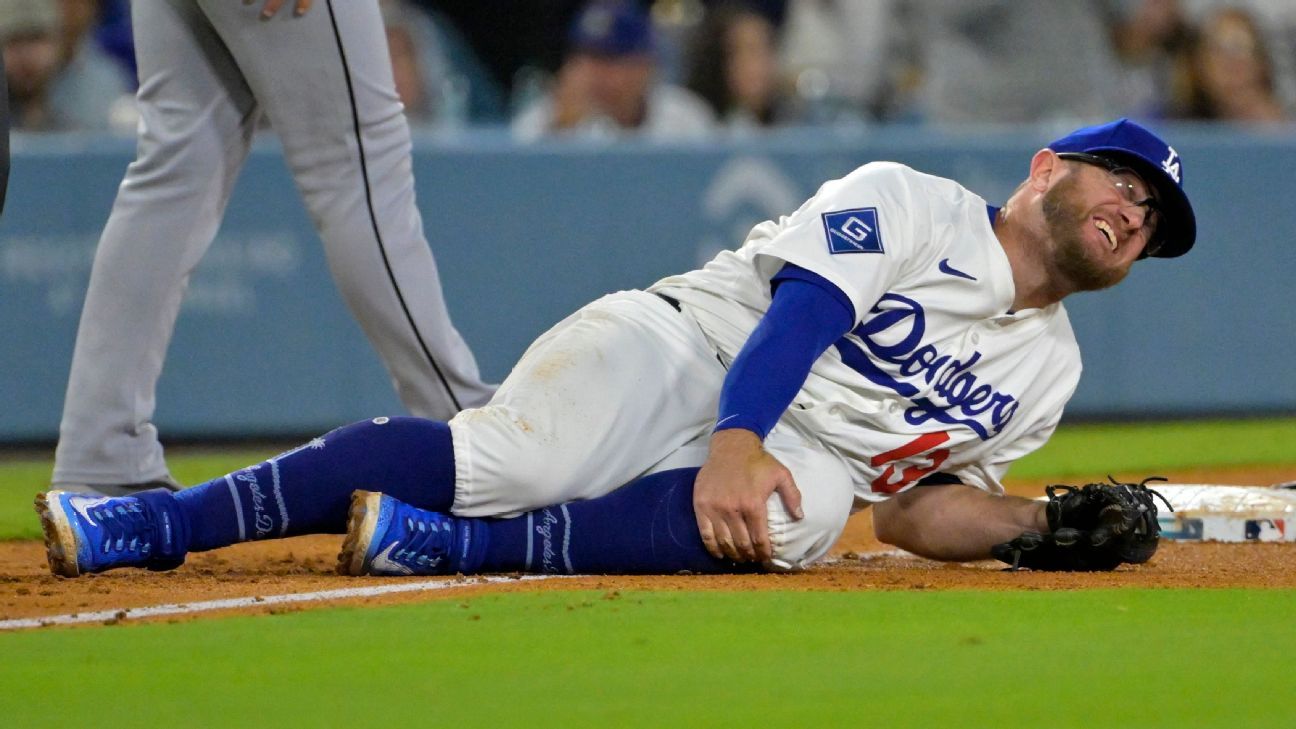
LOS ANGELES — Clayton Kershaw‘s 3,000th career strikeout was preceded by a scary, dispiriting moment, when Los Angeles Dodgers third baseman Max Muncy injured his left knee and had to be helped off the field Wednesday night.
Muncy is set to undergo an MRI on Thursday, but Dodgers manager Dave Roberts said initial tests have them feeling “optimistic” and that the “hope” is Muncy only sustained a sprain.
With one out in the sixth inning, Muncy jumped to catch a throw from Dodgers catcher Will Smith, then tagged out Chicago White Sox center fielder Michael A. Taylor on an attempted steal and immediately clutched his left knee, prompting a visit from Roberts and head trainer Thomas Albert.
Muncy wrapped his left arm around Albert and walked toward the third-base dugout, replaced by Enrique Hernandez. His injury, caused by Taylor’s helmet slamming into the side of his left knee on a headfirst slide, was so gruesome that the team’s broadcast opted not to show a replay.
Taylor also exited the game with what initially was diagnosed as a left trap contusion.
The Dodgers went on to win 5-4 on Freddie Freeman‘s walk-off single that scored Shohei Ohtani.
-
Alden Gonzalez
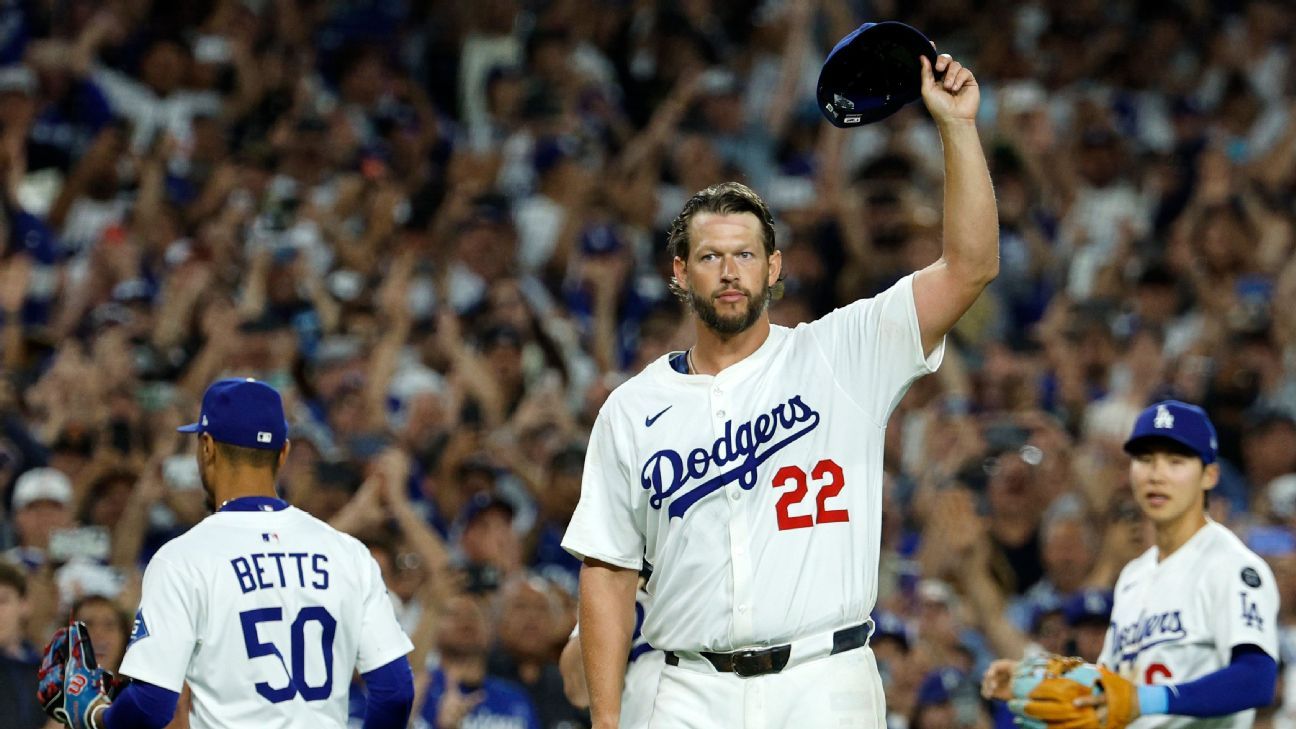
LOS ANGELES — His start prolonged, the whiffs remained elusive, and the Dodger Stadium crowd became increasingly concerned that Clayton Kershaw might not reach a hallowed milestone in front of them Wednesday. Finally, with two outs in the sixth inning, on his 100th pitch of the night, it happened — an outside-corner slider to freeze Chicago White Sox third baseman Vinny Capra and make Kershaw the 20th member of the 3,000-strikeout club.
Kershaw came off the mound and waved his cap to a sold-out crowd that had risen in appreciation. His teammates then greeted him on the field, dispersing hugs before a tribute video played on the scoreboard, after which Kershaw spilled out of the dugout to greet the fans once more.
Kershaw, the Los Angeles Dodgers‘ longtime ace, is just the fourth lefty to reach 3,000 strikeouts, joining Randy Johnson, Steve Carlton and CC Sabathia. He is one of just five pitchers to accumulate that many with one team, along with Walter Johnson, Bob Gibson, Steve Carlton and John Smoltz. The only other active pitchers who reached 3,000 strikeouts are the two who have often been lumped with Kershaw among the greatest pitchers of this era: Justin Verlander and Max Scherzer, the latter of whom reached the milestone as a member of the Dodgers in September 2021.
Kershaw’s first strikeout accounted for the first out of the third inning — immediately after Austin Slater’s two-run homer gave the White Sox a 3-2 lead. Former Dodger Miguel Vargas fell behind in the count 0-2, becoming the ninth batter to get to two strikes against Kershaw, then swung through a curveball low and away. The next strikeout, No. 2,999 of his career, came on his season-high-tying 92nd pitch of the night, a curveball that landed well in front of home plate and induced a swing-and-miss from Lenyn Sosa to end the fifth inning.
Dodgers manager Dave Roberts did not even look at Kershaw as he made his way back into the dugout, a clear sign that Kershaw would not be taken out. The crowd erupted as Kershaw took the mound for the start of the sixth inning. Mike Tauchman grounded out and Michael A. Taylor hit a double, then was caught stealing on a play that prompted Dodgers third baseman Max Muncy to come down hard on his left knee, forcing him to be helped off the field.
The mood suddenly turned somber at Dodger Stadium. Then, four pitches later, came elation.
Kershaw reached 3,000 strikeouts in 2,787⅓ innings, making him the fourth-fastest player to reach the mark, according to research from the Elias Sports Bureau. The only ones who got there with fewer innings were Johnson (2,470⅔), Scherzer (2,516) and Pedro Martinez (2,647⅔).
The Dodgers came back to win 5-4, capping their rally with three runs in the bottom of the ninth.
Before the game, Roberts called the 3,000-strikeout milestone “the last box” of a Hall of Fame career — one whose spot in Cooperstown had already been cemented by three Cy Young Awards, 10 All-Star Games, an MVP, five ERA titles and more than 200 wins.
Kershaw’s 2.51 ERA is the lowest in the Live Ball era (since 1920) among those with at least 1,500 innings, even though Kershaw has nearly doubled that. He was a force early, averaging 200 innings and 218 strikeouts per season from 2010 to 2019. And he was a wonder late, finding ways to continually keep opposing lineups in check with his body aching and his fastball down into the high 80s.
Kershaw went on the injured list at least once every year from 2016 to 2024. A foot injury made him a spectator last October, when the Dodgers claimed their second championship in five years. The following month, Kershaw underwent surgery to repair a torn meniscus in his left knee and a ruptured plantar plate in his left big toe, then re-signed with the Dodgers and joined the rotation in mid-May. He allowed five runs in four innings in his debut but went 4-0 with a 2.08 ERA in his next seven starts, stabilizing a shorthanded rotation that remains without Blake Snell, Tyler Glasnow, Roki Sasaki and Tony Gonsolin.
Since the start of 2021, Kershaw has somehow managed to put up the sixth-lowest ERA among those with at least 400 innings.
-
 Sports3 years ago
‘Storybook stuff’: Inside the night Bryce Harper sent the Phillies to the World Series
-
 Sports1 year ago
Story injured on diving stop, exits Red Sox game
-
 Sports2 years ago
Game 1 of WS least-watched in recorded history
-
 Sports2 years ago
MLB Rank 2023: Ranking baseball’s top 100 players
-
Sports4 years ago
Team Europe easily wins 4th straight Laver Cup
-
 Environment2 years ago
Japan and South Korea have a lot at stake in a free and open South China Sea
-
 Sports2 years ago
Button battles heat exhaustion in NASCAR debut
-
 Environment2 years ago
Game-changing Lectric XPedition launched as affordable electric cargo bike