
Why do NHL teams make so many in-season coaching changes?


-
Ryan S. Clark, NHL reporter
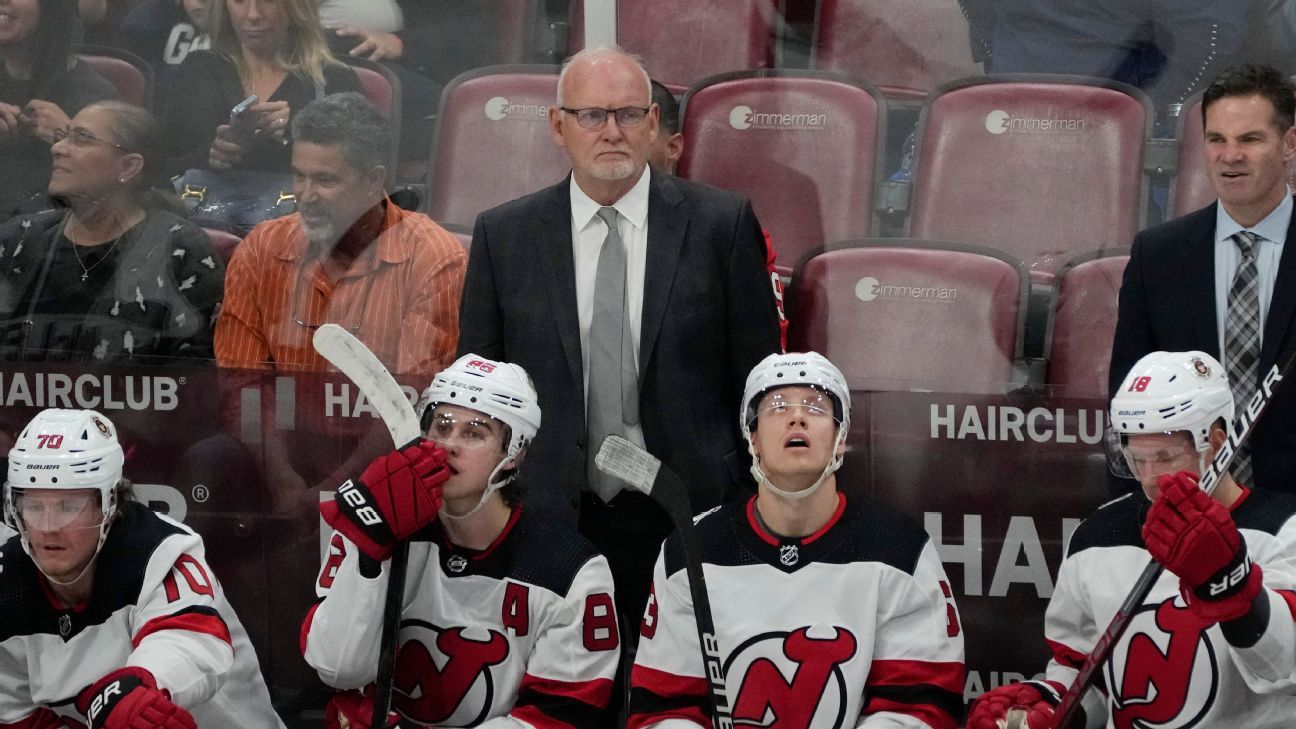
Lindy Ruff is no longer the coach of the New Jersey Devils, becoming the seventh NHL head coach to be fired during the 2023-24 season.
He is also the latest example that being behind an NHL bench might be the most disposable position in all of sports. In the last five years, there have been 25 head coaches who have been fired during the NHL season.
How does that compare to other sports? Major League Baseball, the NBA and the NFL have had a total of 32 in-season coaching/managerial changes combined in that same amount of time, according to ESPN Stats & Information research. The NFL has had the most with 13. The NBA is second with 10 while Major League Baseball has had nine.
“Actually, I thought the number would have been a little bit higher to be honest with you,” former Buffalo Sabres and Pittsburgh Penguins coach Dan Bylsma said. “I know it’s been a lot in the last 16-to-18 months. It’s a lot. But, it happens.”
Several items have been attributed as to why NHL organizations burn through head coaches at a rate that’s rapidly higher compared to its MLB, NBA and NFL counterparts.
Each situation has its nuances. The common denominator that nearly every in-season coaching change shares is management has reached a breaking point. The seven teams that have fired coaches this season all entered the season with playoff aspirations ranging from a preseason Stanley Cup front runner in the Edmonton Oilers to a team such as the Ottawa Senators that had one of the more active offseasons in the league.
That eventual point of separation came either because of a slow start or a team was going through a free fall. Getting off to a poor start is what prompted the Oilers to make a change by mid-November after losing 10 of their first 12 games. The Senators did the same after losing five of six games in mid-December for an 11-15 start that saw them gradually fall out of the playoff discussion.
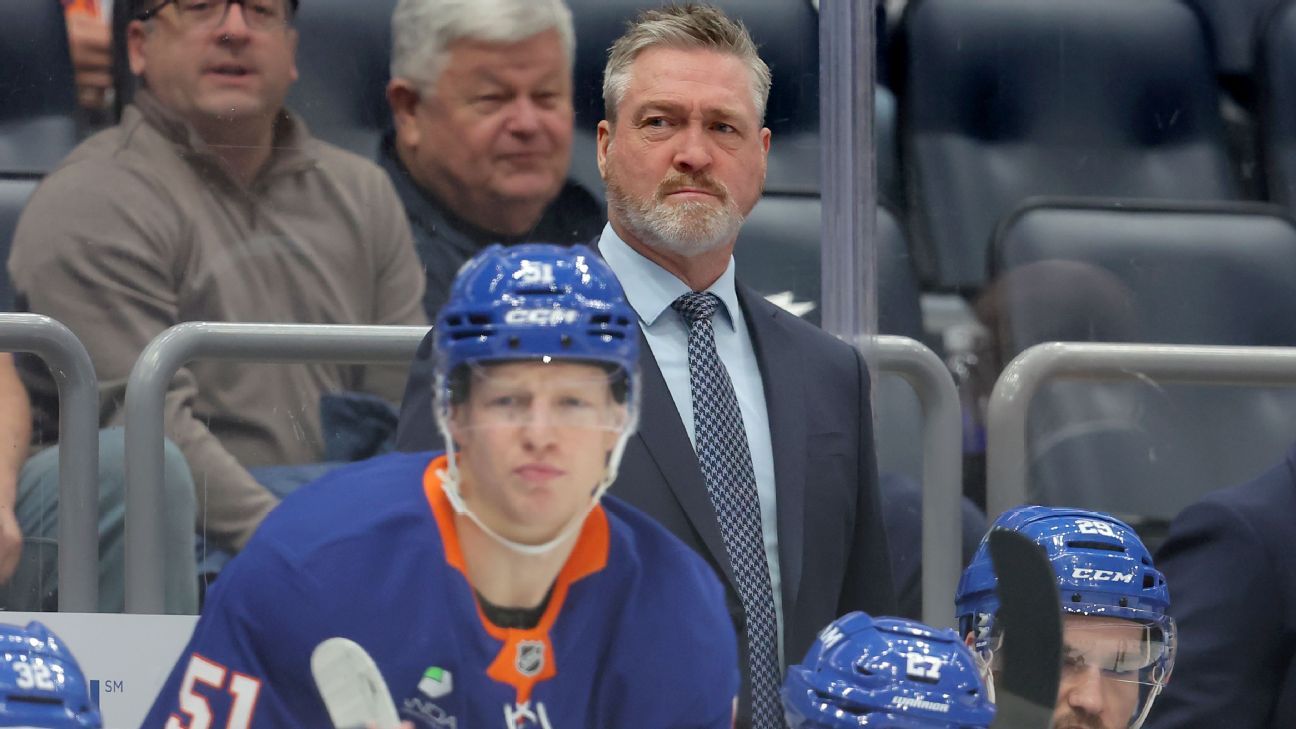
Free fall is what happened with the Los Angeles Kings and New York Islanders. The Kings were another potential Stanley Cup challenger and started 20-7-4 only to lose 14 of their next 17 games before making a change at the All-Star Break. The Islanders were 17-9-9 when they lost nine of their next 11 contests before replacing Lane Lambert with Patrick Roy.
Of the six teams that made coaching changes before Ruff was fired, the Kings and Oilers are the only ones who entered Tuesday in a playoff spot. The Blues, Islanders and Minnesota Wild were more than five points shy of the wild-card while the Senators were adrift by 19 points. The Devils were eight points behind the leading teams in the wild-card race.
There’s also the notion that a coach might be the easiest change to make considering the challenges teams constantly face to move players because of a salary cap that’s become even more constricting in recent years.
“If a team has certain expectations from ownership and management, it’s either going to be a GM who is let go or a coach who is let go,” said Lindsay Pennal, the executive director for the NHL Coaches Association. “We can see who falls on the chopping block. … In the NHL, if you have lost a few games over a few weeks, teams are ready to make a decision.”
Pennal said it’s encouraging that the NHL’s three longest tenured coaches — the Tampa Bay Lightning’s Jon Cooper, the Pittsburgh Penguins’ Mike Sullivan and the Colorado Avalanche’s Jared Bednar — prove that longevity can lead to success.
After all, those three coaches have won five of the eight most recent Stanley Cups.
But there have been coaches who were fired this season who were proof that longevity and success can only go so far. Craig Berube won a Stanley Cup and led the St. Louis Blues to four straight playoff appearances in his five-plus seasons. Dean Evason led the Wild to the postseason in four straight seasons.
Even they got fired. Their firings also came with a sense of symmetry that further emphasizes a team’s expectations. Berube, Evason and Jay Woodcroft, who was fired after parts of three seasons in Edmonton, were also in-season hires who were added when their respective teams decided a change was needed.
This is why the phrase “hired to be fired” is one that is commonly heard about NHL coaches.
“I can only surmise what coaches tell me, which is that this comes with the territory,” Pennal said. “They have a short life span with a team but there’s a lot of circular movement. Even though they are being fired, they can be hired by another team. They can have a long tenure with coaching in the NHL.”
To Pennal’s point, four of the seven teams that fired their coach replaced them with someone who had previously been an NHL head coach elsewhere. The NHL currently has 15 coaches with previous head coaching experience for another team.
Bylsma, now the coach of the AHL’s Coachella Valley Firebirds, said the NHL’s current playoff format could also play a role in why teams quickly move on from coaches. He said 16 teams or half the NHL makes the playoffs which creates the belief for enough franchises that they could get into the postseason.
“So, there’s an added pressure on the coach and the manager when you don’t meet those expectations but 16 other teams do,” Bylsma said. “You can go around the league and see what the Sabres were saying, the Red Wings were saying, the Blue Jackets, the Senators and a lot of those teams were talking about playoff expectations. The facts are when you look at the East … you are fighting for a slim, narrow margin of maybe making the playoffs.”
As an agent who represents NFL and NHL coaches, Ian Greengross, offered insight into why the shelf lives for coaches in those leagues are different.
Greengross said the perception around how coaches are valued in either league goes back to the nature of each sport. He said the NFL and football as a whole is more methodical in nature when it comes to details such as clock control, lengthy drives and scripted plays. The NHL and hockey, while it allows for coaches to also run systems and script some plays, remains more free-flowing in nature with items such as line combinations or defensive pairings that can be shuffled multiple times throughout a game.
The mentality in those leagues and sports is something Greengross said plays a role in how coaching contracts are handled. He said NFL coaches often sign contracts that are between four and five years in length while an NHL coach is getting three years, and he pointed out that NFL coaches are making around $7 or $8 million annually while the average NHL coach makes $2.5 million.
Greengross also mentioned an NFL player can keep the same agent when they transition to coaching. In the NHL, an agent cannot represent coaches and players, which means they must choose one over the other.
“Coaches have gone agentless which has led to a system where they feel fungible and take the first offer,” Greengross said. “It’s not because they are not smart people or not deserving but it’s because nobody has been there to guide them. They’re coaches, they’re not agents. They’re not negotiators per se. They’ve been made to feel that if they don’t accept a team’s offer, the team will go get their second choice or someone else instead.”
While the number of coaching agents is growing, Greengross added that there are coaches who are starting to understand that they don’t have to take the first offer and that they can ask for more money.
“They’re not going to hang up and never call again,” Greengross said. “They may say ‘No.’ But at least you asked for it.”
Bylsma remarked how his expiration date was something that did come up during his time with the Penguins. He had heard about how coaches in Pittsburgh were usually gone after three seasons with Bylsma making it to a sixth season where he reached the playoffs in every one but was eventually dismissed.
So what would make someone want to go back for more after getting fired the first time?
“I’m slapping myself with the word ‘arrogance’ here,’ Bylsma laughed. “I think you have to have a belief that as a coach, the way your team plays, the way you can get your team to play and with the players you have, that you can be a winner.”

-
Greg Wyshynski
ELMONT, N.Y. — The Colorado Avalanche entered Thursday night’s game at the New York Islanders as a juggernaut, having lost just once in regulation in 26 games. Islanders coach Patrick Roy’s message to his team before that game: “If there’s a team that could surprise them, it’s us and the way we’ve been playing.”
St. Patrick was prophetic: Roy’s team defeated the mighty Avalanche 6-3 to snap Colorado’s 17-game point streak in a statement win for the Islanders (15-10-3).
The Islanders built a 4-0 lead against Colorado and responded every time the Avalanche crept back into the game. That included a late third-period penalty kill, as the Avalanche pulled goalie Mackenzie Blackwood for a 6-on-4 advantage. Forward Casey Cizikas iced the win with an empty-netter.
“That’s a really good hockey team over there,” Cizikas said. “They’ve proved it all season. They’re never out of a game, so you’ve got to complete it.”
Even after the loss, Colorado remained the NHL’s top team in points percentage (.815), goal differential (plus-47), offense (4.04 goals per game) and defense (2.19 goals against per game). The Avalanche have the NHL’s leading scorer in center Nathan MacKinnon (46 points) and the leading scorer among defenseman in Cale Makar (33 points).
But Islanders forward Mathew Barzal said New York’s 4-1 loss in Denver on Nov. 16 gave his teammates confidence they could hang with the NHL’s best.
“We feel like when we played them in Colorado, we probably should have won,” said Barzal, who had a goal and two assists in the win. “As a group, too, we know who we’re playing and that always makes a difference. Against Colorado, if we don’t show up, it could be ugly.”
The Islanders showed up on the scoresheet at 5:56 in the first period, on a controversial goal by forward Kyle MacLean. His shot sailed into the top corner of the net with Blackwood (36 saves) flat on the ice. Replays showed that after a scramble in the crease, the stick of Islanders center Marc Gatcomb had become wedged in Blackwood’s pads as Blackwood attempted to defend the net.
Colorado coach Jared Bednar challenged the goal. The NHL Situation Room cited Rule 69.7 in upholding the goal, which states that “in a rebound situation, or where a goalkeeper and attacking player(s) are simultaneously attempting to play a loose puck, whether inside or outside the crease, incidental contact with the goalkeeper will be permitted, and any goal that is scored as a result thereof will be allowed.”
Bednar disagreed with that assessment.
“Listen, I think goalie interference is a joke. If that’s not goalie interference, I don’t know what is. You can’t just shove the goalie’s pads out of the way to create a loose puck,” said Bednar. “I’m not going to challenge unless it’s obvious. And I thought that was obvious.”
On the other end of the ice, Islanders goalie Ilya Sorokin was great when he needed to be in making 35 saves against the high-octane Avalanche. Roy cited one save in the second period where Sorokin stopped Artturi Lehkonen on a 2-on-1 before Barzal increased their lead to 5-2 with a power-play goal.
“I think that gave us the confidence. Ilya made the key save at the right time,” said the coach.
The Islanders’ win over the Avalanche came on a poignant night at UBS Arena for the players. Their fathers and mentors were in attendance, ahead of their road trip to Florida. The game also marked the return of former Islanders star Brock Nelson, who was sent to Colorado at last season’s trade deadline. He received a standing ovation from Islanders fans after a video tribute.
It was just the second loss for the Avalanche (19-2-6) in the past 14 games.
“It’s closer than you think, but it still wasn’t good enough,” Bednar said. “We’ll refocus on the things that we need to do to make us successful.”
-
 Sports2 years ago
Story injured on diving stop, exits Red Sox game
-
 Sports3 years ago
‘Storybook stuff’: Inside the night Bryce Harper sent the Phillies to the World Series
-
 Sports2 years ago
Game 1 of WS least-watched in recorded history
-
 Sports3 years ago
Button battles heat exhaustion in NASCAR debut
-
 Sports3 years ago
MLB Rank 2023: Ranking baseball’s top 100 players
-
Sports4 years ago
Team Europe easily wins 4th straight Laver Cup
-
 Environment3 years ago
Japan and South Korea have a lot at stake in a free and open South China Sea
-
 Environment1 year ago
Here are the best electric bikes you can buy at every price level in October 2024