
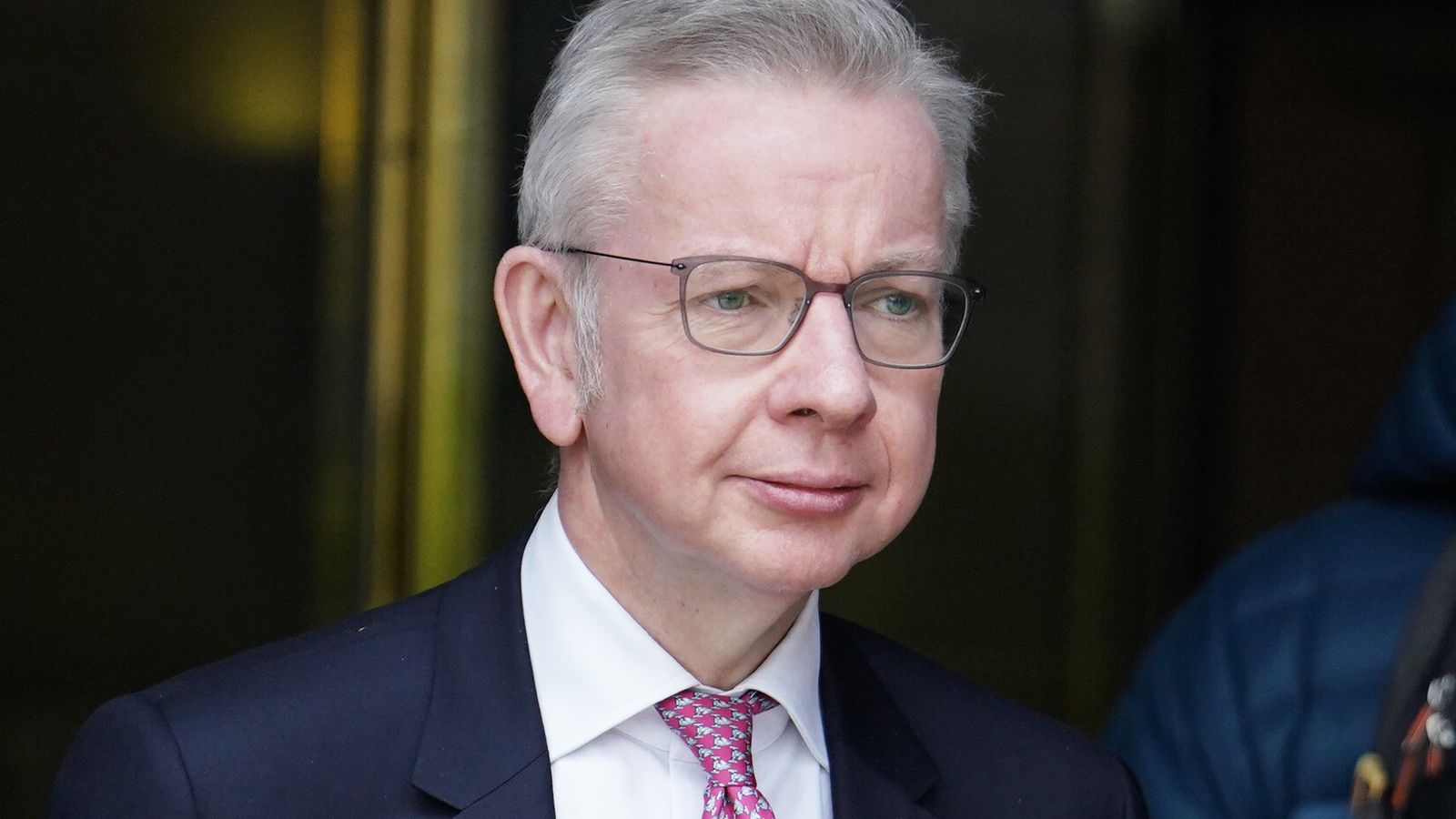
Michael Gove names far-right and Islamist groups which could fall under fresh extremism definition


Michael Gove has named five groups that will be re-assessed as a result of the government’s new definition of extremism.
Speaking in the Commons, the communities secretary said two far-right organisations – the British National Socialist Movement and the Patriotic Alternative – and three Islamist organisations – the Muslim Association of Britain, Cage and Mend – were groups “we should be concerned” about.
Follow live: Reaction as Gove gives extremism statement to MPs
Speaking after the government announced the new definition of extremism this morning, the minister said it was “critically important we do not unwittingly or through ignorance fund or support organisations who are themselves extremist” as it had been the case in the past that “extremist groups and actors have sought to present themselves as moderate voices representative of majority or mainstream opinion”.
Mr Gove also sought to reassure critics the plan was “in no way intending to restrict freedom of expression, religion or belief”, saying gender critical campaigners, trans activists, those with conservative religious views and environmental protest groups would not be included.
But, he added: “The government cannot be in a position where, unwittingly or not, we sponsor, subsidise or support in any way organisations or individuals opposed to the freedoms we hold dear.”
Labour’s deputy leader, Angela Rayner, agreed that “hateful extremism threatens the safety of our communities and the unity of our country,” and was “a serious problem which demands a serious response”.
But she criticised how long it had taken the government to act since their last definition was introduced in 2011, and said it was “deeply concerning” that extremists had already “benefited from government engagement, endorsement and support”.
Ms Rayner also raised concerns about how the announcement had been trailed, with leaks detailing organisations that could face reassessment after the definition came into force.
Mr Gove revealed an investigation into the leaks had been launched, saying it was “fundamentally a challenge to the effective operation of government”.
Extremism redefinition will ‘risk more division’, say Muslim activists
The new definition described extremism as “the promotion or advancement of an ideology based on violence, hatred or intolerance” that aims to “negate or destroy the fundamental rights and freedoms of others” or “undermine, overturn or replace the UK’s system of liberal parliamentary democracy and democratic rights”.
It also includes those who “intentionally create a permissive environment for others to achieve” either of those aims.
The update came as part of a ministerial drive to clamp down on the Islamist and far-right extremism that has intensified in the wake of the Israel-Hamas war.
But some critics have raised concerns that it could have a “chilling effect” on free speech, while others say it doesn’t go far enough and there needs to be a change in the law to tackle extremism.
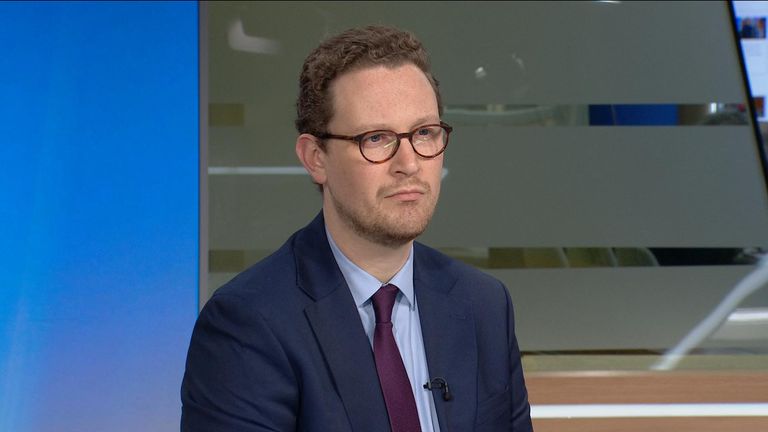
Labour’s Darren Jones: ‘We need more than a definition’
Mr Gove pointed to five specific groups that would come in for further scrutiny now the new definition is in place.
After warning the “activities of the extreme right-wing are a growing worry”, the minister said: “Across this House, I am sure that we would agree that organisations such as the British National Socialist Movement and Patriotic Alternative, who promote neo-Nazi ideology, argue for forced repatriation, a white ethno state and the targeting of minority groups by intimidation, are precisely the type of groups about which we should be concerned and whose activities we will assess against the new definition.”
And after saying the religion of Islam should not be confused with the “totalitarian ideology” of Islamists, he added: “Organisations such as the Muslim Association of Britain, which is the British affiliate of the Muslim Brotherhood, and other groups such as Cage and Mend, give rise to concern for the Islamist orientation and views.
“We will be holding these and other organisations to account, to assess if they meet our definition of extremism and will take action as appropriate.”
Mr Gove confirmed there would be a new “centre of excellence” on counterterrorism created within the Home Office, promising it would become a “world-leading authority” on the issue.
The minister added: “The liberties that we hold dear and indeed the democratic principles we are all sent here to uphold, requires us to counter and challenge the extremists who seek to intimidate, coerce and to divide.
“We have to be clear-eyed about the threat we face, precise about where that threat comes from and rigorous in defending our democracy.
“That means upholding freedom of expression, religion and belief when we are threatened, facing down harassment and hate, supporting the communities facing the greatest challenge from extremist activity and ensuring this House and this country are safe, free and united.”
The prime minister’s official spokesperson confirmed a full list of organisations covered by the government’s new extremism would be published “in the coming weeks”.
But Labour wants ministers to also update its full counter-extremism strategy and its action plan on hate crime.
Ms Rayner told MPs: “We need much stronger action to tackle the corrosive forms of hatred that devastate lives and corrode communities.
“But today’s statement does not go far enough. And regardless of how workable and effective this new definition and centre of excellence is, this announcement will not be enough.”
Tory MPs also voiced their concerns, with former immigration minister Robert Jenrick saying: “I fear that the definition, though well-intentioned, lands in no man’s land – not going far enough to tackle the real extremists, not doing enough to protect the non-extremists, those people who are simply expressing contrarian views who might find this definition used against them, not perhaps now, but possibly in the future.”
Fellow Conservative Sir Edward Leigh also said he was worried the definition was “going to add to the increasing culture, in what should be a free country, of the intolerance of the right to offend”.
Politics
Live music venues warn of ‘devastating consequences’ of budget tax changes in letter to Sir Keir Starmer

Tax changes announced in the budget could have “devastating, unintended consequences” on live music venues, including widespread closures and job losses, trade bodies have warned.
The bodies, representing nearly 1,000 live music venues, including grassroots sites as well as arenas such as the OVO Wembley Arena, The O2, and Co-op Live, are calling for an urgent rethink on the chancellor’s changes to the business rates system.
If not, they warn that hundreds of venues could close, ticket prices could increase, and thousands could lose their jobs across the country.
Politics latest: Ex-Olympic swimmer nominated for peerages
Business rates, which are a tax on commercial properties in England and Wales, are calculated through a complex formula of the value of the property, assessed by a government agency every three years. That is then combined with a national “multiplier” set by the Treasury, giving a final cash amount.
The chancellor declared in her budget speech that although she is removing the business rates discount for small hospitality businesses, they would benefit from “permanently lower tax rates”. The burden, she said, would instead be shifted onto large companies with big spaces, such as Amazon.
But both small and large companies have seen the assessed values of their properties shoot up, which more than wipes out any discount on the tax rate for small businesses, and will see the bills of arena spaces increase dramatically.
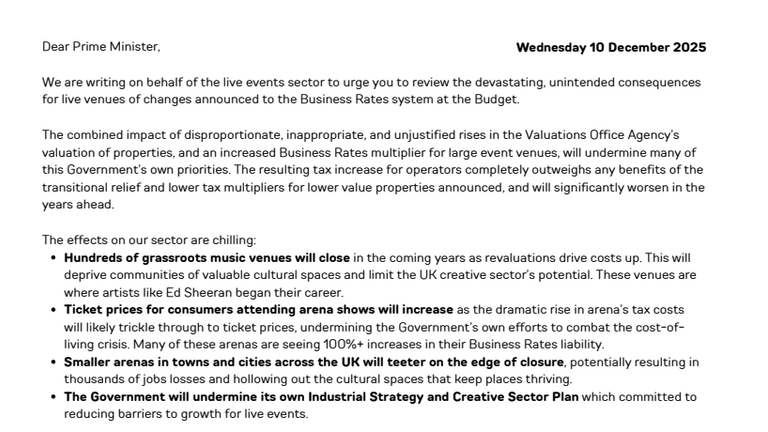
In the letter, coordinated by Live, the trade bodies write that the effect of Rachel Reeves’s changes are “chilling”, saying: “Hundreds of grassroots music venues will close in the coming years as revaluations drive costs up. This will deprive communities of valuable cultural spaces and limit the UK creative sector’s potential. These venues are where artists like Ed Sheeran began their career.
“Ticket prices for consumers attending arena shows will increase as the dramatic rise in arena’s tax costs will likely trickle through to ticket prices, undermining the government’s own efforts to combat the cost of living crisis. Many of these arenas are seeing 100%+ increases in their business rates liability.
“Smaller arenas in towns and cities across the UK will teeter on the edge of closure, potentially resulting in thousands of jobs losses and hollowing out the cultural spaces that keep places thriving.”
The full letter from trade bodies to the prime minister.
They go on to warn that the government will “undermine its own Industrial Strategy and Creative Sector Plan which committed to reducing barriers to growth for live events”, and will also reduce spending in hotels, bars, restaurants and other high street businesses across the country.
To mitigate the impact of the tax changes, they are calling for an immediate 40% discount on business rates for live venues, in line with film studios, as well as “fundamental reform” to the system used to value commercial properties in the UK, and a “rapid inquiry” into how events spaces are valued.
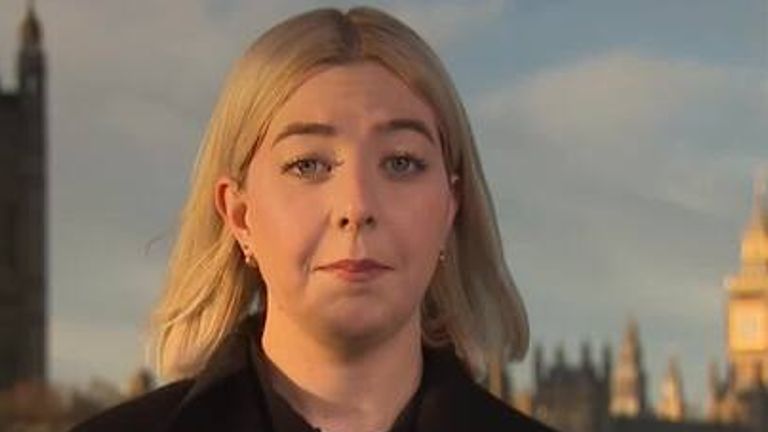
Sky’s Jess Sharp explains how the budget could impact your money
In response, a Treasury spokesperson told Sky News: “With Covid support ending and valuations rising, some music venues may face higher costs – so we have stepped in to cap bills with a £4.3bn support package and by keeping corporation tax at 25% – the lowest rate in the G7.
“For the music sector, we are also relaxing temporary admission rules to cut the cost of bringing in equipment for gigs, providing 40% orchestra tax relief for live concerts, and investing up to £10m to support venues and live music.”
The warning from the live music industry comes after small retail, hospitality and leisure businesses warned of the potential for widespread closures due to the changes to the business rates system.
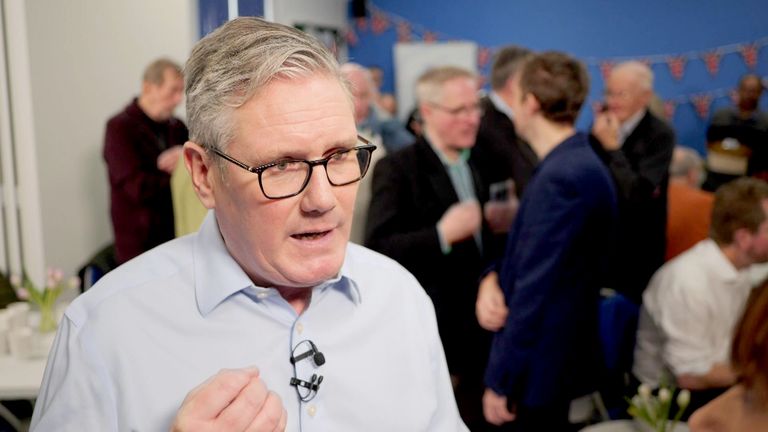
Sky’s political editor Beth Rigby challenged Prime Minister Sir Keir Starmer on the tax rises in the budget.
Sky News reported after the budget that the increase in business rates over the next three years following vast increases in the assessed values of commercial properties has left small retail, hospitality and leisure businesses questioning whether their businesses will be viable beyond April next year.
Analysis by UK Hospitality, the trade body that represents hospitality businesses, has found that over the next three years, the average pub will pay an extra £12,900 in business rates, even with the transitional arrangements, while an average hotel will see its bill soar by £205,200.
Read more: Hospitality pleads for ‘lifeline’
A Treasury spokesperson said their cap for small businesses will see “a typical independent pub pay around £4,800 less next year than they otherwise would have”.
“This comes on top of cutting licensing costs to help more venues offer pavement drinks and al fresco dining, maintaining our cut to alcohol duty on draught pints, and capping corporation tax,” they added.
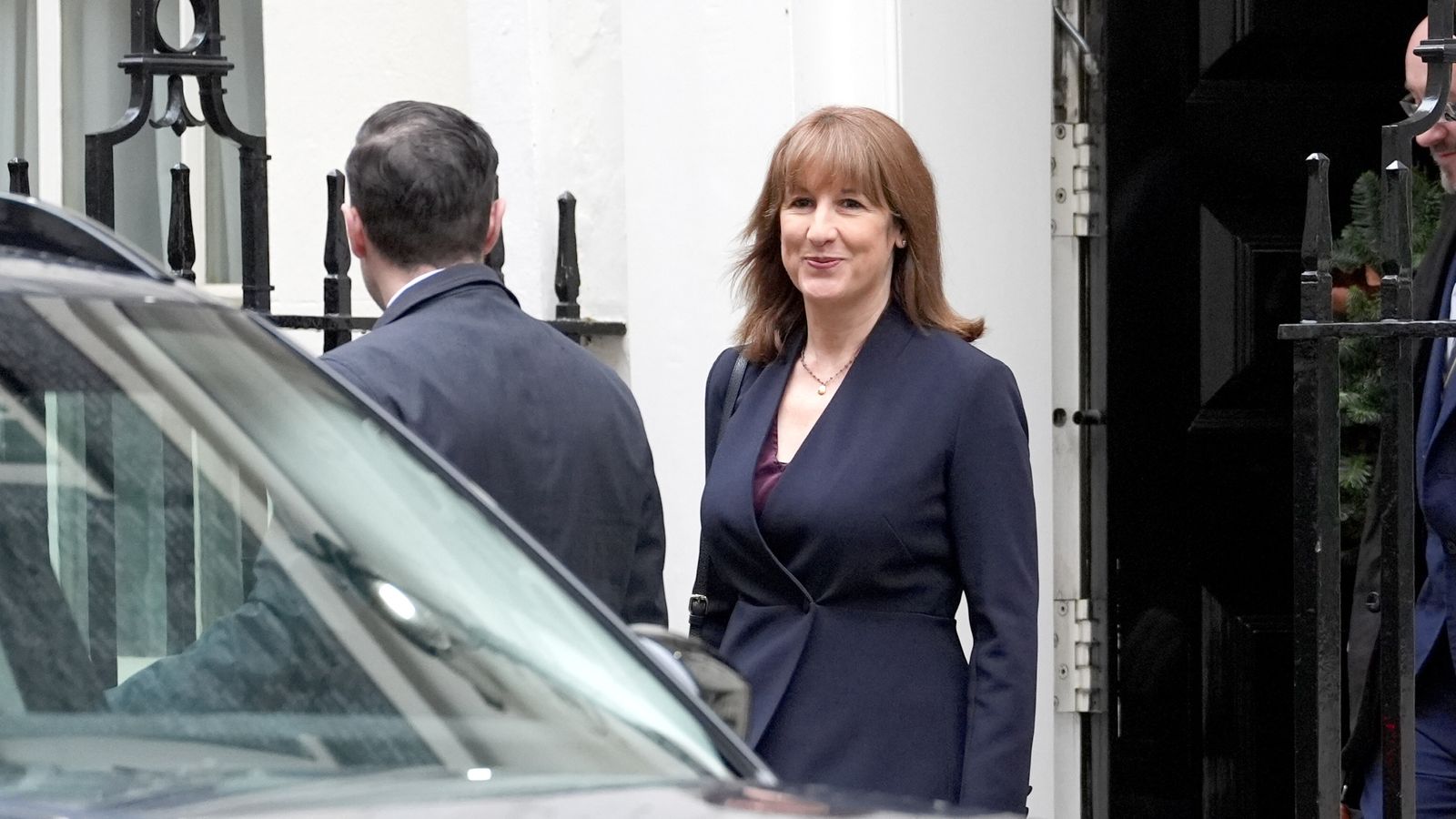
The Chancellor Rachel Reeves has acknowledged there were “too many leaks” in the run-up to last month’s budget.
The flow of budget content to news organisations was “very damaging”, Ms Reeves told MPs on the Treasury select committee on Wednesday.
“Leaks are unacceptable. The budget had too much speculation. There were too many leaks, and much of those leaks and speculation were inaccurate, very damaging”, she said.
Money blog: Nine-year-old set up Christmas tree business to pay for university
The cost of UK government borrowing briefly spiked after news reports that income taxes would not rise as first expected and Labour would not break its manifesto pledge.
An inquiry into the leaks from the Treasury to members of the media is to take place. But James Bowler, the Treasury’s top official, who was also giving evidence to MPs, would not say the results of it would be published.
Committee chair Dame Meg Hillier asked if the group of MPs could see the full inquiry.
“I’d have to engage with the people in the inquiry about the views on that”, replied Mr Bowler, permanent secretary to the Treasury.
OBR leak ‘a mistake of such gravity’
The entire contents of the budget ended up being released 40 minutes early via independent forecasters, the Office for Budget Responsibility (OBR).
A report into this error found the OBR had uploaded documents containing their calculations of budget numbers to a link on the watchdog’s website it had mistakenly believed was inaccessible to the public.
Tax rises ruled out
The chancellor ruled out future revenue-raising measures, including applying capital gains tax to primary residences and changing the state pension triple.
Committee member and former chair Dame Harriet Baldwin had noted that the chancellor’s previous statement to the MPs when she said she would not overhaul council tax and look at road pricing, turned out to be inaccurate.
During the budget, an electric vehicle charge per mile was introduced, as was an additional council tax for those with properties worth £2m or more.

Strategy, the largest Bitcoin treasury company, submitted feedback to index company MSCI on Wednesday about the proposed policy change that would exclude digital asset treasury companies holding 50% or more in crypto on their balance sheets from stock market index inclusion.
Digital asset treasury companies are operating companies that can actively adjust their businesses, according to the letter, which cited Strategy’s Bitcoin-backed credit instruments as an example.
The proposed policy change would bias the MSCI against crypto as an asset class, instead of the index company acting as a neutral arbiter, the letter said.

The MSCI does not exclude other types of businesses that invest in a single asset class, including real estate investment trusts (REITs), oil companies and media portfolios, according to Strategy. The letter said:
“Many financial institutions primarily hold certain types of assets and then package and sell derivatives backed by those assets, like residential mortgage-backed securities.”
The letter also said implementing the change “undermines” US President Donald Trump’s goal of making the United States the global leader in crypto. However, critics argue that including crypto treasury companies in global indexes poses several risks.
Related: Strive calls on MSCI to rethink its ‘unworkable’ Bitcoin blacklist
Crypto treasury companies can create systemic risks and spillover effects
Crypto treasury companies exhibit characteristics of investment funds, rather than operating companies that produce goods and services, according to MSCI.
MSCI noted that companies capitalized on cryptocurrencies lack clear and uniform valuation methods, making proper accounting a challenging task and potentially skewing index values.
Strategy held 660,624 BTC on its balance sheet at the time of this writing. The stock has lost over 50% of its value over the last year, according to Yahoo Finance.
Bitcoin (BTC) is also 15% below its value at the beginning of 2025, when it was trading over $109,000, meaning that the underlying asset has outperformed the equity wrapper.
The high volatility of cryptocurrencies may heighten the volatility of the indexes tracking these companies or create correlation risks, where the index performance would mirror crypto market performance, according to a paper from the Federal Reserve.

The “common use” of leverage by crypto traders amplifies volatility and lends to crypto’s fragility as an asset class, the Federal Reserve wrote.
MSCI’s proposed policy change, set to take effect in January, could also prompt treasury companies to divest their crypto holdings to meet the new eligibility criteria for index inclusion, creating additional selling pressure for digital asset markets.
Magazine: The one thing these 6 global crypto hubs all have in common…
-
 Sports2 years ago
Story injured on diving stop, exits Red Sox game
-
 Sports3 years ago
‘Storybook stuff’: Inside the night Bryce Harper sent the Phillies to the World Series
-
 Sports2 years ago
Game 1 of WS least-watched in recorded history
-
 Sports3 years ago
Button battles heat exhaustion in NASCAR debut
-
 Sports3 years ago
MLB Rank 2023: Ranking baseball’s top 100 players
-
Sports4 years ago
Team Europe easily wins 4th straight Laver Cup
-
 Environment3 years ago
Japan and South Korea have a lot at stake in a free and open South China Sea
-
 Environment1 year ago
Here are the best electric bikes you can buy at every price level in October 2024