
Welcome to the NHL rookie experience: How this season’s class has navigated life on and off the ice


-
Kristen Shilton, ESPN NHL reporter
HOCKEY PLAYERS KNOW the power of a good video session.
It’s how they study an opponent. Critique their own game. And — thanks to years of recorded highlights available online — admire the exploits of superstars past and present.
Yes, video study is an integral part of an athlete’s day. So it’s no wonder that Columbus Blue Jackets rookie Adam Fantilli has leaned into that again in confronting a whole new life frontier.
“So I’m learning to cook. I’m working on it,” he told ESPN recently. “I have to watch the YouTube videos. I can do, like, a steak and veggies, potatoes; pasta and fish are easy. But when I get a little bit exotic with it? That definitely means watching. I can pretty much do it all, just takes more time to get creative.”
Welcome to the NHL rookie experience.
It’s more than just figuring out how to play in the toughest league on earth. Rookies are navigating extreme on-ice expectations while mastering how to live alone for the first time, finding work-life balance, keeping up with frenzied travel schedules and facing all the real-world pressures of growing up — and growing into their best selves as players and people.
“It’s pretty eye-opening, playing in this league,” Maple Leafs forward Matthew Knies said. “It’s challenging to have juice and have energy every day to show up and just be prepared and be willing to sacrifice your body every day and get better. It’s challenging and it’s a lot of fun at the same time.”
Players have spent their rookie seasons searching for a secret sauce to keep them dialed in at home and the rink. Many have been guided by older teammates. Others count on family support. There’s a formula to it for everyone — with some common threads. Those ties that bind are revealed here by nearly a dozen of the NHL’s best freshmen.
“To be honest with you, the best part now is I just get to do what I love for a longer period of time throughout the day,” said Fantilli, the third pick in the 2023 draft. “It’s my job. I’m coming from college [at the University of Michigan] where I had to focus on school half the time and that was taking time away from hockey. But now I can just take all of that time and focus on opponents, focus on myself and just put all my efforts into hockey.”
ROOKIES CAN BECOME ENTHRALLED by the more grandiose parts of professional life.
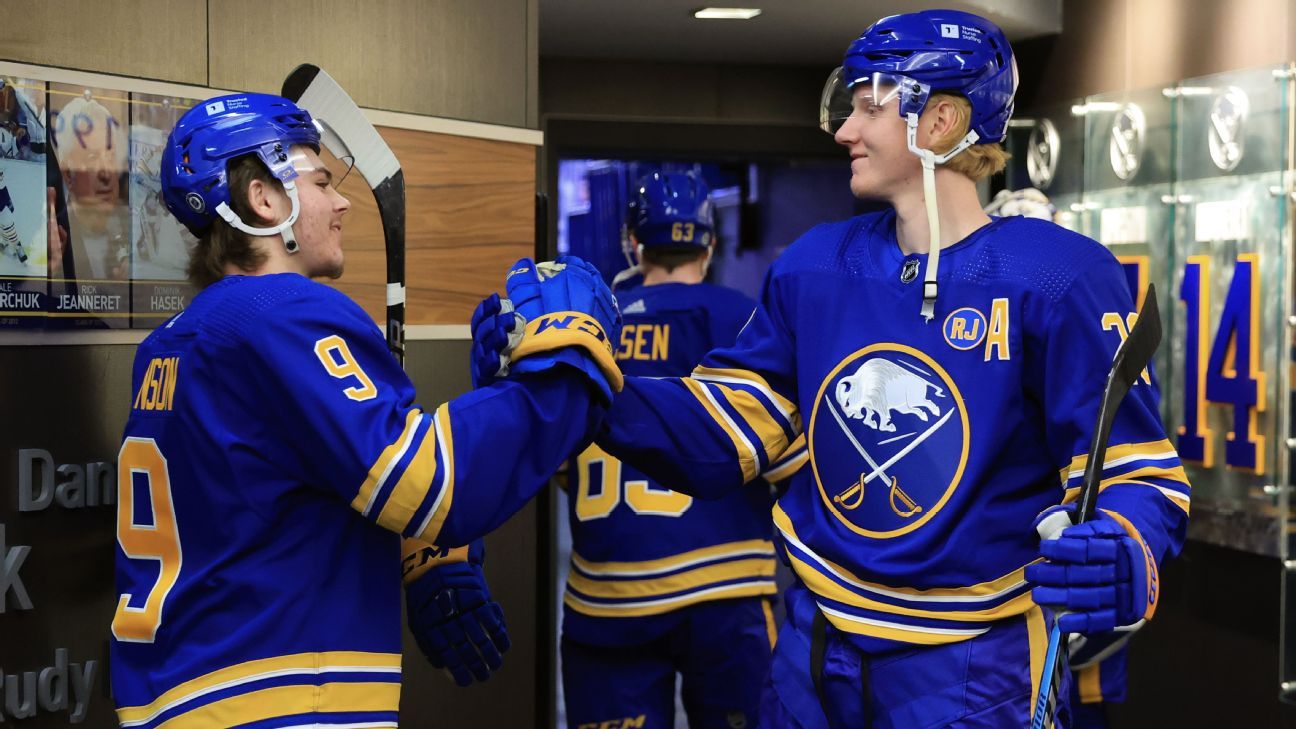
Buffalo Sabres forward Zach Benson — going straight from the Western Hockey League to a top-six NHL slot — was mesmerized by one in particular.
“I mean, we’re riding on a plane instead of a bus up here? That is life-changing, for sure,” he said. “There’s definitely been some big, huge changes in my life and they’re definitely good changes.”
Case in point: Benson’s living situation. Just like that awe-inspiring upgrade in transportation, Benson’s head was spinning over his luxury five-star dwelling — until something even better than that came along.
“It was pretty crazy living in a hotel to start the season. It was so, so nice,” he said. “They make your room every day. It’s hard to complain. But I’m just moving out of there now and moving into [Sabres’ defenseman] Rasmus Dahlin‘s house. He just offered it, him and his girlfriend. It’s pretty hard to turn that down.”
Benson — who has scored six goals and 18 points through 54 games — isn’t the only one who got an assist from a teammate in that department. Fantilli became acclimated to Columbus while living with Patrik Laine for a few weeks (“he’s an awesome personality”) , and Knies spent all of two nights in a hotel after he landed in Toronto before Leafs captain John Tavares invited him to bunk at his place.
“John opened his doors and was like, ‘Hey, I want you to live with our family,'” Knies recalled. “I checked out with his wife, so that was good. I’d been staying there the whole time, and I actually just got a place of my own. That’s a first. At school [playing for the University of Minnesota], I had a roommate, so this will be the first space of my own. I haven’t really moved everything yet. It’s pretty hectic trying to get settled when we’re playing.”
Brock Faber can relate. The Minnesota Wild standout — who’s second behind Connor Bedard in rookie scoring, with 37 points through 65 games — spent the summer rooming with teammate Sam Walker before seeking out solo accommodations. Faber found a spot easily enough. Making it feel like home is a work in progress.
“I’m just in an apartment here all by myself, first time ever having no roommates,” he said. “I’m enjoying it. But, yeah, still trying to set up the place a little bit. The season started and I did a good job moving in before that, got a good chunk of things, but I’m still missing a few. It’s a busy season, so it’s tough to get it all done.”
Being by their lonesome may be uncharted waters for some rookies. It’s old hand for Anaheim Ducks first-year center Leo Carlsson. What’s not so familiar is being separated from his family by an ocean.
“I’ve been living on my own [in California], but I lived by myself for three years in Sweden before this [while playing in the Swedish Elite League],” he said. “But my parents were maybe one hour away from that place I was living then. I saw them all the time. And now it’s like a 12-hour flight for them. So that’s different. But at least I’m more used to the alone time.”
The same can’t be said for Ridly Greig. The Ottawa Senators rookie — a consistent contributor with nine goals and 21 points — is sharing space alongside teammates Jake Sanderson and Jacob Bernard-Docker, preferring their collective chaos to recharging by himself.
“It’s a lot of fun; it’s always nice having both of them around to hang out and chitchat or watch movies together or whatever you want to do,” he said. “I moved away from home when I was 16 [to play in the WHL] so I had those four years of experience away from my family and that helped to definitely make this a smooth transition. It’s still a bit different going from living with billets [local families who players live with] to on your own with teammates, though. It’s good to have those guys.”
Grieg may be used to not having his parents around physically, but they’re never far from his mind. There’s nothing simple about stepping into a full-time NHL role and Greig fell under a massive leaguewide spotlight in February when his slapshot into an empty net against Toronto drew a crosscheck to the face from Morgan Rielly. The play earned Rielly a five-game suspension and offered Greig new attention he didn’t anticipate.
Whatever the struggle is though, Grieg knows how best to handle it.
“I definitely lean on my dad. I call him a lot,” said Greig. “Whenever I want to pick his brain or whatever it is, he definitely helps me a lot. Not only with ideas for on the ice, but just the mental side of things too.”
FABER CAN SKATE CIRCLES around almost anyone.
But he’s entirely direct about the tough parts of professional life.
“There are positives [throughout the season], but there’s some bad, too,” he said. “It’s a hard league. You’re making mistakes. There’s a lot of travel and back-to-backs. Stuff like that can make things harder. There’s really both sides to the NHL for sure.”
Carlsson felt that, too. Anaheim picked their forward second overall in 2023, an investment immediately producing high expectations. The 19-year-old has responded with a respectable nine goals and 23 points through 40 games, in between missed time nursing a sprained right knee. Carlsson wasn’t fazed by the setbacks though; he’d never tried to predict how Year 1 would go.
“It’s hard to have expectations as a rookie,” he said. “It’s your first year going against the best players in the world. You don’t really know how good they’re going to be or how hard they’re going to hit. The first time I played against Nathan MacKinnon, you realize how good [the best players are] and how fast they are. You just learn so fast how good you’re going to have to be to play in this league.”
It’s a nightly battle for players adjusting to an 82-game schedule with excellence as a baseline. Failing to show up? Not an option.
“I’ve seen it’s a grind, and you’ve got to be ready to play every night and ready to go even when you’re not feeling it,” Calgary Flames forward Connor Zary said. “You’ve got to come in and try and play your best every night. It’s a mental test. So even if you normally do [certain things] to get ready, maybe you do them even longer and even more on those days you don’t feel good, to help the body move a little quicker and a little better on those back-to-backs and those tough games. When you can get your body feeling good, it helps mentally too.”
Another hurdle the rookies must clear is becoming monthly cross-country travelers. Yes, they’re ferried now via private planes instead of coach buses (much to Benson’s delight), but the constant time zone changes coupled with late night check-ins and early-morning wakeups can take their toll.
“Coming from college, I didn’t play that many games last year,” Fantilli said. “I had like Sunday to Thursday to kind of get my body right for the weekend, and we would only have one opponent for two games. So getting used to playing a bunch of different opponents in one week or two weeks and having a quick turnaround on flights and with playing time have been the biggest adjustments.”
“It’s been the biggest surprise,” Wild forward Marco Rossi noted. “Just the amount of games and all the travel is a lot. When you’re playing almost every day, the consistency is the most important thing and that’s what you learn in this league. When you play night in, night out, it’s got to always be at your best and sometimes it gets tiring.”
Teammates become invaluable resources there. Rookies have unencumbered access to veterans who’ve discovered their own hacks to maintain an edge regardless of the circumstance. All the rookies have to do is pay attention.
That is Knies’ strategy anyway. The forward — who’s spent time on Auston Matthews‘ wing while producing 11 goals and 26 points through 62 games — scoured the Leafs’ dressing room for intel on a stable routine that would also remove some of that draining day-to-day monotony.
“It gets repetitive,” he admits of the long NHL season. “I had to switch up [what I was doing]. You’re playing triple the number of games now. I had to find what works with me and I’ve been seeing what other guys do. I’m just picking up on them and seeing things I like and putting it in my game. It’s a lot of stealing things away from other players and just adding it to myself.”
Spoken like a true student of the game. But it’s not all work and no play, either. Balance is the key.
FANTILLI WON’T DENY he’s a rink rat.
When the time finally comes to head home though, there’s no shortage of activities to occupy his non-hockey focused hours.
“I’ll hang out with whatever teammates can hang out. I like to get dinner or lunch or do whatever,” he said. “I don’t get on the sticks too much. I don’t even own a console, to be honest with you. But I like to watch TV shows. A lot.”
Fantilli wholly embraced the habit while sidelined for eight weeks with a calf laceration. The 19-year-old was having a stellar rookie campaign before the injury as a top-line skater for the Blue Jackets, now with 12 goals and 27 points through 49 games.
When Fantilli couldn’t play he channeled his energy elsewhere.
“I’ve actually had a few [TV show binges], believe it or not,” he said. “I have been watching ‘Masters of the Air’ on Apple TV. I watched that ‘Griselda’ show that was on Netflix. It was really good. I watched the ‘Ted’ series. All these are like five episodes long and I’ve been injured, so don’t judge me. But, I’ve been making my way through ‘The Sopranos’ as well.”
Zary’s downtime is similarly filled with couch-sitting, something for which he’s likely had more time lately. The 22-year-old suffered an upper-body injury earlier this month that has held him out of game action; before that, Zary had been on a solid scoring pace with 12 goals and 29 points through 50 games.
“I’m a pretty big binge watcher. That’s my thing,” he said. “Whenever I have a night just to hang out and relax, especially when the schedule can get pretty busy, just spending a couple hours vegging out is something that’s always nice, especially when you’re really tired after a long week or after a lot of games.”
In Knies’ case there’s a best of both worlds, where one solo passion holds space with another more virtually immersive hobby enjoyed with others.
“I wasn’t big into video games but like so many teammates play that I don’t want to miss out on it,” he said. “It’s like peer pressure; it’s like I want to play just to honestly chat with the guys. But I actually got a guitar so I’m learning guitar. I picked it up this summer so I’ve got a good six, seven months in me now. Self-taught to now. I’ve been looking into a teacher but I think it feels more like an accomplishment to be self-taught.”
Given all the time players spend inside it’s a treat for some to recharge outdoors.
Carlsson, who has embraced the shift from frigid Swedish winters to semi-permanent sunshine in California, is an avid golfer (and has a 5 handicap).
Nature is healing for others too. Rossi — who’s third behind teammate Faber in rookie scoring, with 17 goals and 33 points through 65 games — doesn’t look to escape the real world outside the office; he wants to get lost in it. Preferably with company.
“I love to go for a walk,” he said. “Me and my girlfriend, we just bought a dog [a Pomeranian] earlier in the year and it brings you away a little bit from hockey when you think about different things [on the walks] and just turn your brain off a little bit about hockey.”
Benson’s a fan of walking, too. His walks just happen in a different venue. And inadvertently attract attention.
“I’ll search up the local malls,” he said. “You just drive around to find spots that you like. That’s what I’ve done. I actually went to the mall yesterday and a few people recognized me. I don’t mind that, it’s cool to see fans that enjoy watching you play hockey.”
He’s not the only rookie who’s been stopped in his tracks by well-wishers. Rossi said it happens to him in restaurants. Ditto for Fantilli. And they get it. The players are fans, too. And on most nights, guys they admire are directly across from them on the ice.
DMITRI VORONKOV USES words sparingly. But they’re highly effective.
Like when the Blue Jackets forward — who has 31 points through 58 games — dropped his initial takeaways after facing Edmonton captain Connor McDavid.
“It looked like he has arrived from a different planet,” Voronkov said, via a translator. “I don’t think I’ve seen somebody like that, ever.”
Faber recalls the “wild” (no pun intended) feeling of witnessing those iconic players of his youth still crushing the competition — right in front of him.
“You can’t believe you’ve playing against [Sidney] Crosby and [Alex] Ovechkin,” he said. “I watched them a ton growing up. When I was a young kid, they were the superstars of the league and they still are. That’s crazy.”
The trick is not to get distracted in the moment. Carlsson figured that out in a hurry against Pittsburgh.
“I had Sidney Crosby as an idol growing up, so the first time I played against him was really cool,” he said. “When I saw him on the opposite side of the faceoff dot, that was like, wow. It was so cool. But I think when I was out there against him after that first faceoff, I was just focused on playing hockey.”
There’s precious little time for chitchat once the puck gets dropped anyway. So some league veterans make sure to get their hellos in early.
“My first NHL game, Artemi Panarin off the draw kind of tapped me on the shin pads and was like, ‘Welcome to the NHL, kid,'” Benson said. “So that was pretty cool for me.”
Not every rookie gets an ideal NHL greeting, though. Knies points to another, more humbling experience that truly summarized where he was at. And of course, it’s something he’ll never forget.
“Last year at playoffs, I missed the first two power-play meetings,” he laughed. “I had no idea what time [they were] or what was going on. Guys kind of give it to me for that. That was probably my ‘welcome to the NHL moment;’ like, you need to show up, and you need to be ready.”
THERE ARE SOME THINGS for which a rookie can prepare himself. Some can’t be controlled.
Take Faber, for instance. He’s heard the outside chatter for months. It’s saying there’s a chance he’ll be more than just a Calder Trophy finalist. He’ll be a favorite to win.
Chicago’s Bedard looked like the runaway Rookie of the Year leader early in the season. Then Bedard missed six weeks with a fractured jaw and Faber’s increasingly excellent play separated him from the remaining freshman pack.
It’s a nice compliment to Faber that he’s been seen as award-worthy. It’s just not what drives him, especially now when Minnesota is on track to miss the playoffs.
“It’d be really cool and a tremendous honor [to be a finalist] considering how many great rookies there are this year,” he said. “It’s crazy to think that it’s maybe a possibility. But I think every guy in the league would say they’re more focused on the team’s success, and doing what they can for their teammates. Individually, it’s just a pretty cool thing on the side to be mentioned in.”
And there’s another bit of balance that rookies have to find. They might be teenagers and 20-somethings living a dream, but the NHL is a business, too. Winning matters in ways it sometimes hasn’t in the past, with real-world implications — and painful fallout — when players and teams fall short.
Confidence becomes more than just a buzzword: It’s a mantra. The rookies, after all, have to believe they belong — even among the future Hall of Famers.
“It’s not like the guys you’re playing against are not human, you know what I mean?” Carlsson said. “You realize you can be a good player here too, and you don’t have to be worried that you’re not going to make it. If you have confidence out there, you’re going to be fine.”
The trick for Zary has been remembering every skater — regardless of their status — is going through a season-long adventure that inevitably produces highs and lows. The rookies won’t be exempt from, or destroyed by, their struggles.
This is, after all, just the beginning.
“Bad games or a bad day, whatever it is, just let it go, and know the next day is a new day and you can go enjoy that,” he said. “Put a smile on your face and take a step back and realize, you know what, you might have had a bad day, maybe made a couple bad plays, but at the end of the day, you know where you are and you know how good you can be.
“Step back and tell yourself, ‘I’m in the NHL and that’s one of my lifelong goals,’ so you’ve got to kind of pinch yourself sometimes.”

-
Adam Rittenberg
The wildest college football coaching cycle — perhaps ever — has reached the hiring phase.
Schools around the Power 4 that fired their coaches in the first two months of the season — or, in Stanford’s case, way back in late March — are targeting candidates and finalizing deals. Interestingly enough, one of the first major coaches to lose his job, Penn State’s James Franklin, was the first noninterim coach to be hired, as he is headed to Virginia Tech.
New hires always come with hope and optimism, grand proclamations and the chance to get programs on the right track. But not all hiring processes are the same. The financial component with jobs is essential — what schools are willing to spend not just on their head coach, but the assistants and support staff and, perhaps most important, the team roster.
We will be reviewing all of the major coaching hires in the 2025-26 cycle, evaluating how each coach fits in the job, their major challenges and what it will take to be successful. We will also assign an initial letter grade for each hire.
Jump to: Kentucky | Michigan State | UCLA | LSU | Ole Miss | Florida | Arkansas
Auburn | Stanford | Oklahoma State | Virginia Tech


Why is this a good fit?
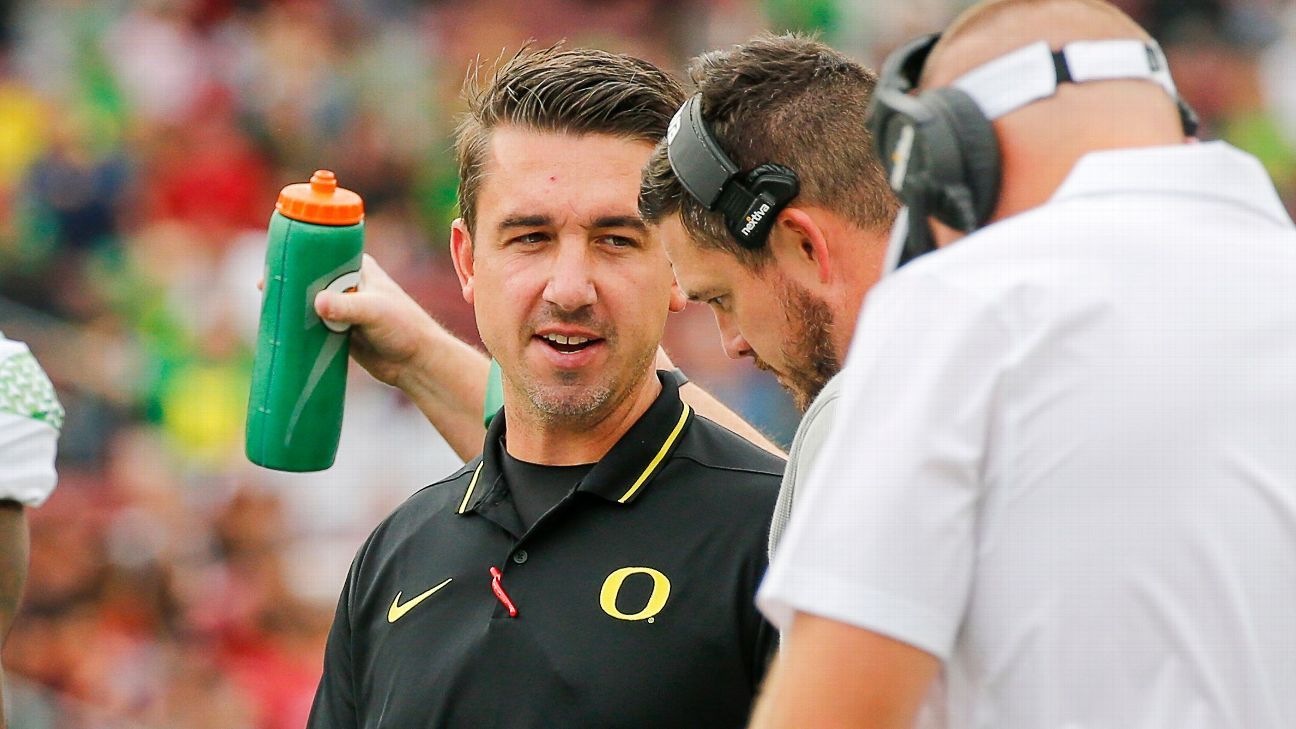
Stein loves Kentucky. He told me that when I visited Oregon recently. We were talking about the coaching carousel, jobs that had opened and potential openings, and he mentioned his connection to Kentucky. How both of his parents went there and that his dad, Matt, played defensive end for the Wildcats under coach Jerry Claiborne. Stein is from Louisville and played quarterback for the University of Louisville, Kentucky’s in-state rival, but grew up attending UK games. Despite other suitors in this cycle and likely in future ones, Stein had a desire to coach Kentucky, which really matters.
He also gives Kentucky a vision for the offense that it needs after the past few seasons. Since the start of the 2022 season, Kentucky ranks 115th nationally in scoring and 101st in total offense. Stein has quickly emerged as one of the sport’s top playcallers, and has won with different quarterbacks, from the record-setting Frank Harris at UTSA to Bo Nix, Dillon Gabriel and now Dante Moore at Oregon. He operates a system that should attract talented offensive players to Lexington. Stein also has been around strong mentors, from Jeff Traylor to Dan Lanning.
What are the biggest challenges for Stein?
Stein has shown he can handle quarterbacks and design offensive game plans, but how ready is he to oversee an SEC program? He has made a quick rise after landing his first on-field job in the FBS in 2020. The SEC is seemingly getting deeper by the year and can be merciless to coaches and programs that aren’t buttoned-down in every aspect. Stein will need to compile a strong staff, especially on defense but also with a veteran mentor or two. He must take the best elements of coaches like Lanning and Traylor, and apply them as he shapes his own program.
The other big challenge is personnel and upgrading Kentucky’s talent level, ideally with greater resources than Stoops had at the end of his tenure. Stein’s childhood connection to Kentucky and personality should get donors and fans engaged, but the program has fallen behind operationally as teams like Vanderbilt and Missouri have accelerated. Athletics director Mitch Barnhart and university president Eli Capilouto have been in their roles a long time, but they’re also nearing the ends of their careers. Stein must push both leaders to help him get what he needs, especially during the first 12-18 months of his tenure.
Grade: A-
Stein’s lack of head-coaching experience is the only thing keeping the grade from being a full-on A. Kentucky needed a coach who wanted to be there, knew enough about the program and had a plan to elevate its offensive production after Mark Stoops went through a revolving door of coordinators late in his tenure. Kentucky will score and be exciting under Stein, who already has a baked-in connection to the program. Stein will need a strong staff around him but should give UK a chance to rise, even in the difficult SEC. — Adam Rittenberg

Why is this a good fit?
The Big Ten always made the most sense as the setting for Fitzgerald’s return to the sideline. His connections to Northwestern and the Chicago area are obviously extensive, and he has a son playing for Kirk Ferentz at Iowa, where he attended several games this season. Fitzgerald knows the league and the recruiting footprint, and also how to do more with less. Jonathan Smith is a good coach but had never worked outside of the Pacific Northwest; Fitzgerald is a true Midwesterner who has seen firsthand how good Michigan State can be. He coached at Northwestern when MSU won three Big Ten titles under Mark Dantonio and recorded three consecutive AP top-6 finishes from 2013 to 2015. Fitzgerald should create an immediate connection with MSU fans that Smith unfortunately lacked.
The 50-year-old will receive improved resources at Michigan State, both financially and with admissions, that he never really had at Northwestern. He put together Northwestern’s most consistently successful stretch of the modern era from 2008 to 2018, when the program had five AP Top 25 finishes, won two Big Ten West titles and appeared in 10 bowl games. He will need a much better plan for the staff than he showed toward the end of his Northwestern tenure, when the team’s results fell off a cliff. But sometimes several years away from the game can give a talented coach like Fitzgerald the perspective needed to shift certain philosophies that held him back. — Rittenberg
Biggest challenges Fitzgerald will face?
Michigan State’s quarterbacks have struggled the past decade, following the years of stability with Drew Stanton, Kirk Cousins, Brian Hoyer and Connor Cook, who all gave the Spartans offense a high floor. Aidan Chiles, who came over with Smith from Oregon State two years ago, was benched in favor of Alessio Milivojevic on Nov. 1. Milivojevic lost his first three starts before throwing four touchdowns in the season-ending win over Maryland. To have any chance at instant success, Fitzgerald will have to look at the quarterback situation, potentially bringing in a transfer. Fitzgerald will also have to be smart with who he brings in at coordinator.
Northwestern never recovered after Fitzgerald fired longtime offensive coordinator Mick McCall in 2019 and veteran defensive coordinator Mike Hankwitz retired in 2020. The Wildcats won four games combined in 2021-22. The Big Ten is also different from when Fitzgerald last coached. Oregon, Washington and USC — combined with the emergence of Indiana — have made the Big Ten that much tougher for programs like Northwestern and Michigan State. — Jake Trotter
Grade: B
Fitzgerald deserved another opportunity after settling his lawsuit with Northwestern this past summer and being publicly cleared of culpability in the hazing scandal. There has been some selective amnesia in evaluating his candidacy, though. He wasn’t the first coach to win at Northwestern (predecessors Randy Walker and Gary Barnett both won Big Ten titles there). While he had a really nice run before NIL, the transfer portal and when the Big Ten had divisions, he also went 4-20 in his last two seasons and won three games or fewer in three of the last four. Fitzgerald must harness the qualities that made him a consistent winner at Northwestern but also show growth in how he hires staff and approaches roster-building to win at MSU. — Rittenberg

Why is this a good fit?
For UCLA to come out of a competitive hiring cycle with a coach like Chesney is certainly a big win for the program. Chesney not only has continued the success predecessor Curt Cignetti had at James Madison, but he has won everywhere else he has coached. The 48-year-old guided Holy Cross to five consecutive FCS playoff appearances, including a No. 6 finish in 2022. Chesney went 44-16 at Assumption University in Massachusetts and 23-9 at Salve Regina, a Division III program in Rhode Island. There might not be an exact replica of Cignetti out there, but Chesney’s background as a program-builder, with a clear vision, provides a nice pathway for UCLA after a tumultuous period.
Penn State seemingly would have made more sense for Chesney, a Pennsylvania native who has spent his entire career in the region. But UCLA pried him away and gives itself a chance to reset after a 2025 season that began with great optimism but sidetracked quickly with the firing of coach DeShaun Foster. Chesney is charismatic and should be able to connect with key UCLA stakeholders and garner the support needed to move the program forward. UCLA has tried several coaches with ties to its program who haven’t really panned out. Chesney is a bit of a departure but could be the one to get the Bruins more competitive in the Big Ten. — Rittenberg
What are the biggest challenges for Chesney?
When Foster was hired to be UCLA’s next head coach after Chip Kelly’s departure, the challenge was making UCLA attractive again. The Bruins opted for familiarity with a former player and first-time head coach and it backfired. Now, they’ve gone outside the box to a coach who hasn’t spent any time on the West Coast. There lies Chesney’s biggest challenge.
UCLA may not be able to immediately recruit or use the transfer portal with the likes of USC and Oregon on this side of the college football world, but Chesney has the pedigree of being able to develop players at lower levels and win wherever he has been. How he can harness that into not only excitement around the program, but also substance and results will be crucial.
There’s plenty of talent on the West Coast for UCLA to be better than it has been in recent years, but Chesney may need to completely revamp the school’s reputation on the recruiting trail (and in his roster-building approach utilizing the portal) as he sets out to create a vision for what kind of team he wants the Bruins to be.
It never quite felt like Foster was able to do just that, and though interim Tim Skipper did infuse life into the team after Foster’s firing, this is a program that needs a clear, viable and effective long-term directive. The question is whether Chesney can concoct the right recipe to turn a fledgling brand into more than just a Big Ten also-ran. — Paolo Uggetti
Grade: B+
Chesney is a really strong hire for UCLA. My only hesitation is the location — and, to a degree, the league — as Chesney has never worked anywhere near the West Coast. UCLA is a hard job even for those familiar with campus politics, the University of California system, the stadium situation and the Southern California recruiting scene. Although parallels will be drawn between Cignetti and Chesney, Cignetti worked in the Power 4 for Nick Saban at Alabama, as well as NC State and Pitt. There will be an adjustment period for Chesney, but his track record suggests UCLA will be winning soon and consistently. — Rittenberg

Why is this a good fit?
LSU got the coach it wanted ahead of other suitors, further confirming that its coaching job, despite the drama and dysfunction, remains one of the best in college football. Kiffin left a great situation at the height of his powers because he knows that LSU can consistently compete for national titles in ways that other programs simply cannot. In Kiffin, LSU gains a coach accustomed to the bright lights and the big stadiums, who can attract and develop talent and potentially restore the program to national powerhouse status. LSU can offer the big stage Kiffin lacked at Ole Miss, and wanted again.
Kiffin hasn’t worked at LSU but knows the SEC well after stops at Ole Miss, Alabama and Tennessee. Like Kiffin did at Ole Miss, he should put together an excellent staff that can scour Louisiana, Texas and the surrounding areas for top talent. He certainly will try to bring some of Ole Miss’ top players with him. Kiffin brings the offensive chops that LSU lacked at the end of Kelly’s tenure. He’s one of the nation’s best at identifying and developing quarterbacks, and the emergence of running back Kewan Lacy and others underscores that the Kiffin plan works on offense. — Rittenberg
Biggest challenges Kiffin will face
LSU has a reputation as a place where it is possible to win championships, and that expectation will be placed on Kiffin immediately – especially with the money he is being paid. The Tigers pride themselves on this fact as Nick Saban, Les Miles, then Ed Orgeron all won national titles. Brian Kelly was an awkward fit from the start and never truly got the vibe down on the Bayou. Kiffin has his own unique way of running a program, but he has to find a way to work with all the different “cooks in the kitchen” so to speak. The entire state is heavily invested in LSU football, and though Kiffin has an extremely high profile, he is moving to an even bigger spotlight in Baton Rouge — the only Power 4 school in the state. Kiffin must embrace that, and everything that comes with it. As coveted as he was in this cycle, Kiffin has never won a conference title and finding a way to get over the hump at a school like LSU has to happen. This will be his best shot to get it done, and the clock will start ticking as soon as his first press conference ends. — Andrea Adelson
Grade: A-
The fixation around Kiffin the past few weeks would normally be attached to a multi-time national championship winner, or at least a coach who has won a Power 4 conference title. Kiffin did tremendous work at Ole Miss but still needs to show he can win the biggest games consistently. LSU is a national championship-or-bust type of program, and Kiffin will be judged at the very highest level, which he craves. He brings the right ingredients to get it done in Baton Rouge, especially his work with quarterbacks. — Rittenberg

Ole Miss makes DC Pete Golding new head coach
Why is this a good fit?
Under normal circumstances, Ole Miss could run a complete coaching search, thoroughly assess candidates currently in head-coaching roles, and others who might help build on the historic success under Lane Kiffin. But these are the strangest of times in Oxford, as Kiffin exits for LSU, a College Football Playoff first-round game looms for the Rebels, and emotions are running extremely high. Kiffin certainly will try to poach the roster for top pieces, and Ole Miss must do what it can to protect as many players as possible. Golding was the lead recruiter for many of them. He’s well-liked by players and won’t need to familiarize himself with Oxford, the administration and how Ole Miss is set up to compete.
Golding, 41, might not have been on the wish list for other SEC jobs just yet, but Ole Miss found itself in a unique situation. He’s a Louisiana native who has spent his entire career in the region, first at his alma mater Delta State and other smaller programs, and then Southern Miss and UTSA before getting his big break with Nick Saban at Alabama in 2018. Golding spent five seasons as a coordinator under Saban, and helped the Crimson Tide to a national title in 2020, before joining Kiffin at Ole Miss. He gives Ole Miss a chance not only for success in this year’s CFP, but can minimize disruptions during a very bumpy coaching transition.
What will be Golding’s biggest challenge?
Golding should be able to handle the next few weeks, but his true readiness for the enormity of the job is unclear. Again, he didn’t emerge as a candidate for the other SEC openings in this cycle, which suggests some external concern about his ability to handle such a role. Any first-time coaching job brings its challenges and even though Golding knows Ole Miss, he hasn’t been the face of the program. He’s also replacing a coach who put together the team’s most successful run since John Vaught in the late 1950s and early 1960s.
Although Golding has shown his talents in recruiting and with schematics, how will he handle the media? How does he do in front of donors and other key stakeholders with the university? Perhaps he just needed the chance, which he now has, but assistant coaches that are shielded from the media often take some time to get fully comfortable.
Grade: B
Coaching hires can’t be evaluated in a vacuum, and Golding’s ultimate success or failure at Ole Miss will be judged by what he accomplishes beyond the 2025 season. But what happens in Ole Miss’ first CFP appearance, after losing Kiffin to a rival SEC school, absolutely does matter, too, and Golding gives Ole Miss a chance to prolong a really special season. There’s little doubt he will continue to compile strong rosters. He will need a strong supporting staff, especially a talented offensive coordinator hire, to ultimately sustain and even elevate the program. The key question here is whether other SEC programs missed out on a great candidate in Golding, or will Ole Miss suffer for making an in-the-moment decision that could backfire long-term? — Rittenberg

Why is this a good fit?
Florida fans: Sumrall isn’t Billy Napier. Yes, Sumrall is another promising Group of 5 coach from a program in Louisiana, just as Napier was when he came to Gainesville. But Sumrall is a different personality who comes from the opposite side of the ball and has more ties to the SEC, where he both played (Kentucky) and coached (Ole Miss, Kentucky). He is more comfortable than Napier was in being the face of a major program and will delegate to his coordinators while compiling a strong staff. Although Auburn seemed like a more natural spot for Sumrall because of his connections to the state of Alabama, Florida gives him an even bigger platform at the lone SEC program in one of the nation’s top talent-producing states.
The other thing Sumrall brings is wins. He won Sun Belt titles in both of his seasons at Troy and went to the American Conference title game in his first year at Tulane. Sumrall has succeeded in different ways and with different types of quarterbacks. He hasn’t won in the Power 4 or at a program such as Florida, which is an understandable concern. But Sumrall is ready for the opportunity and should be able to foster the consistency Florida has lacked for far too long. Florida didn’t have a talent problem under Napier, and Sumrall should continue to excel in personnel while translating it better on the field. — Rittenberg
Biggest challenges Sumrall will face
Where do we start? First and foremost, Sumrall has to find a way to win over a fan base that thought it had a shot at landing Lane Kiffin. Whether that was a reality or not, Gators fans had their hopes up that Kiffin would choose them. With that, Sumrall has to convince fans he is not another version of Napier. Once Sumrall has done that, he has to find a way to win at what has proved to be one of the hardest jobs to crack in the SEC. Florida has not won an SEC title since 2008, and while there remains a belief it is one of the best jobs in the country, Florida goes through coaches at a fairly frequent clip. If past is precedent, Sumrall will be given a year or two to find success before the fan base starts to turn on him; four years max to compete for a championship. Expectations are sky-high, and Sumrall will be given no leeway to learn on the job. — Adelson
Grade: B+
Sumrall has the ingredients to become the next great SEC coach. He’s an excellent communicator who connects with a range of people and should get Florida fans excited about the future, even if they might be skeptical at first because of his background. Florida isn’t where I initially saw Sumrall ending up in a wild coaching cycle, but if the school gives him some time, he should stabilize and elevate the Gators’ on-field performance and start getting more out of very talented rosters there. — Rittenberg

Why is this a good fit?
Silverfield has quietly become a really successful coach in the region, and he certainly seems ready for a Power 4 opportunity such as Arkansas. Although he hasn’t generated as much buzz as Tulane’s Jon Sumrall and other American Conference coaches, Silverfield has beaten many of them in head-to-head matchups and boasts a 29-9 record since the start of the 2023 season, including an AP Top 25 finish last fall. Silverfield led Memphis to a win against Arkansas earlier this season, and he has beaten four consecutive Power 4 opponents, including West Virginia and Iowa State in bowl games over the past two seasons.
He has led Memphis since late 2019 but has been at the program since 2016, so he understands the recruiting landscape and where Arkansas must look for players. Arkansas’ location can be a challenge for acquiring talent, but Silverfield shouldn’t be intimidated by it. He also brings a strong background on offense to Fayetteville and should compile a staff that has similar knowledge to the area and possibly the SEC.
What are the biggest challenges for Silverfield?
The SEC is only getting tougher with the additions of Texas and Oklahoma, the emergence of Texas A&M, Ole Miss and Vanderbilt, and the pressure on a traditional heavyweight such as Florida to start making the CFP. Where does Arkansas really fit in the SEC pecking order? Silverfield likely will have to do more with less initially and win games against programs that have been on steadier footing. His real challenge will be trying to energize and unite the financial hubs around the Arkansas program, which give it a chance to accelerate but haven’t always been harnessed.
Athletic director Hunter Yurachek was blunt earlier this year about the increased resources needed to better compete in the SEC. Arkansas seemingly could access those individuals and corporations with the right coach and vision. That’s where Silverfield comes in, as Arkansas can use those relationships to overcome some of its baked-in obstacles. Silverfield will need a strong introductory period, as Arkansas fans might not know him that well and need to embrace his personality and leadership style. The first offseason will be critical to make sure the program doesn’t fall further behind.
Grade: B
Silverfield’s consistency and success tended to go under the radar at a program such as Memphis, where people have grown accustomed to really strong seasons. But his steady leadership style, shown in 2023, 2024 and most of this year, should help an Arkansas program that needs clear direction. He hasn’t coached in the SEC, and there could be a learning curve, but he shouldn’t be surprised walking in the door at Arkansas after spending so much time with Memphis. — Rittenberg

Why is this a good fit?
Every SEC school asks its head coaches to be engaged in recruiting, and Auburn is no exception. Although Auburn never got the results it wanted with Hugh Freeze, the school’s approach toward NIL and acquiring talent — a major draw when it tried to lure Lane Kiffin from Ole Miss — showed up on the roster. Golesh is the type of head coach who could harness Auburn’s established personnel apparatus and really maximize things going forward. He’s about as hands-on in the recruiting space as head coaches get. When Golesh was offensive coordinator at Tennessee, I remember sitting in his office and seeing him monitor all the recruiting transactions from social media on a giant screen. Golesh will get after it to upgrade Auburn’s roster and use all the resources available to him. He won’t be intimidated by the SEC recruiting scene and has ties to multiple states, including Florida and Ohio.
Golesh also brings an offensive background that should energize Auburn fans, especially after how poorly things went on that side of the ball under Freeze. Golesh spent time with Matt Campbell early in his career then with Josh Heupel at both UCF and Tennessee. South Florida ranks in the top five nationally in both scoring and total offense this season, and its defense shined in wins against Boise State and Florida.
What will be Golesh’s biggest challenge?
The challenge at Auburn is almost always the same: Can the head coach truly capitalize on the best parts of the place — an advantageous recruiting location, strong financial resources and a large and extremely devoted fan base — while navigating the big donors and other significant forces that have clashed too often over time and ultimately held back the program’s progress? Golesh is a strong communicator and brings a good mix of experience to the Plains, most notably his two seasons as an SEC coordinator at Tennessee.
He hasn’t been an SEC head coach, though, and he will need to show he won’t be pushed around or swayed by the forces that have doomed Auburn in the past. Golesh’s staff hires at Auburn will be especially important on defense, as South Florida made strides on that side this season but also struggled in key losses to Memphis and Navy. The other element worth watching is how Golesh balances the personnel element, undoubtedly his passion, with some of the other key responsibilities that come with managing an exciting but complicated program such as Auburn.
Grade: B+
Despite no Power 4 head coaching experience, Golesh checks a lot of boxes with his background, having worked in the Big Ten, Big 12 and SEC, and in the Midwest, South and Southeast. His time at Tennessee should really help him at a program such as Auburn, which has a chance to move up in the SEC pecking order but will need a smart, aggressive approach. Golesh’s record of 23-15 doesn’t really jump off the page, and he hasn’t been part of a conference championship just yet. But his assertive vision as a recruiter gives Auburn a chance to quickly improve its roster and win more in an increasingly difficult SEC. — Rittenberg

Why is this a good fit?
Pritchard understands Stanford — its advantages, limitations and possibilities — better than most. He played quarterback for the Cardinal from 2006 to 2009, ahead of Andrew Luck’s run, and then spent the first 13 years of his coaching career with his alma mater, until joining the Washington Commanders‘ staff in 2023. He won’t be blindsided by what he’s walking into at Stanford. He also has a very close relationship with Luck, who is truly directing the program. There will be no feeling-out period between head coach and general manager.
Pritchard, 38, was part of Stanford’s seismic shift under Jim Harbaugh, quarterbacking the team to a signature win against USC in 2007. He then witnessed Stanford’s rise to a consistent contender and, more importantly, saw how things went downhill so quickly after COVID and in the portal/NIL era. His ability to learn from those difficult times and ensure Stanford avoids them will be important. But again, he’s not doing this alone, as he comes in immediately aligned with Luck. — Rittenberg
What will be Pritchard’s biggest challenge?
Generating momentum. Few people share as close an association with some of the biggest moments in Stanford history as Pritchard, but during those heights, the Cardinal never truly resonated broadly within a competitive San Francisco Bay Area sports market. With the collapse of the Pac-12 and six losing seasons in the past seven years, Stanford football has essentially become irrelevant locally. Building a program under those circumstances is difficult.
The academic side of things will always be a draw and should, in theory, help the program limit excessive outgoing transfers, but there also needs to be a robust NIL program. At Stanford that doesn’t have to be a problem. The university’s alumni base is notably wealthy, but it also has not proved to be a group eager to part with large sums of money to help field a better football team. That’s perhaps more of an issue that Luck will be responsible for dealing with, but it is very much part of the hand Pritchard has been dealt.
Beyond the structural challenges, this is just a team that needs a talent upgrade. They don’t have the players right now to compete at a high level. — Kyle Bonagura
Grade: C+
Luck didn’t make the most imaginative hire here. He went with a close friend who needs no introduction to Stanford and the vision for success there. But Pritchard hasn’t been a head coach before and wasn’t mentioned as being on the radar for many other college or NFL jobs. Stanford is really betting on potential here. He only really knows Stanford, which might work out in this case, but he also must learn from what happened toward the end of David Shaw’s tenure and chart out a new path. — Rittenberg

Why is this a good fit?
Oklahoma State needed a coach who knew the Big 12 and the region, and someone who could bring a clear vision, especially on offense. Quarterback play was central to Oklahoma State’s identity under Mike Gundy, and Morris has become one of the best talent identifiers in recent years. Oklahoma State needs to accelerate its recruiting, but likely won’t have the first choice for players, and Morris has repeatedly shown the ability to find and develop under-the-radar players. Ideally, he can bring quarterback Drew Mestemaker and others to Stillwater, and perhaps more importantly, make Oklahoma State an attractive destination for top offensive performers again.
Morris played and coached in the Big 12 at Texas Tech and spent time at Houston early in his career, so he won’t be unfamiliar with the key characteristics of a program like Oklahoma State. He’s not a Gundy disciple, but he can respect what Gundy did to elevate the program, while implementing his own vision, which worked both at Incarnate Word and at North Texas. — Rittenberg
What will be Morris’ biggest challenge?
The answer here is twofold: 1) Morris must live up to the unprecedented levels of consistent success his predecessor brought Oklahoma State; 2) Morris will also have to figure out exactly how to take the Cowboys’ football program to the future.
On the first point, whomever Oklahoma State chose to hire this cycle was going to be replacing a coach who won more — and more consistently — than any other figure in program history. Before 2023, the Cowboys made 18 consecutive bowl appearances under Gundy, winning eight or more games in 13 of those seasons. Past leading Oklahoma State to the very top of the sport and turning the program into a national brand, Gundy’s greatest achievement was transforming a school that had registered back-to-back 10-win seasons only once before he took over in 2005 into a perennial winner. Morris, who made two playoff appearances at Incarnate Word and has North Texas contending for the American this fall, has a history of producing quick turnarounds. Getting Oklahoma State upright — which will likely require a massive roster and staff overhaul — should be his first objective. From there, Morris will be judged on the expectations set by Gundy before him.
How does Morris take Oklahoma State into the future? Gundy’s initial, outspoken reluctance, then too-little, too-late embrace of college football’s NIL/transfer portal era hurt the Cowboys on the field and laid the groundwork for his unceremonious departure earlier this fall. Oklahoma State has fallen behind in terms of roster budgeting compared to its Big 12 counterparts, and industry sources suggested that the Cowboys’ ability to present improved resources would be a key piece of the hiring process. Morris has built a career on making more out of less, and that will serve him well in Stillwater. He has also proven capable of navigating the transfer portal and the current complexities of the sport. With help from Oklahoma State (and its boosters), Morris must take steps to modernize the program. If he can, a Big 12 conference landscape that remains wide open outside of Texas Tech could once again be Oklahoma State’s for the taking. — Eli Lederman
Grade: A-
Morris is only 40 (cue the Gundy memes), hasn’t been a Power 4 head coach, and before this season had only middling results with North Texas. His quarterback track record is his superpower, though, and Oklahoma State needs a renaissance at the position after things fell off too sharply. Morris can recruit Texas and build up the roster. Time will tell if he has the expertise to win one-score games in a league where programs are extremely similar. — Rittenberg

0:32
Paul Finebaum: Is Virginia Tech an upgrade for James Franklin?
Paul Finebaum weighs in on James Franklin reportedly being hired as Virginia Tech’s next coach.
Why is this a good fit?
When Franklin was fired and almost immediately announced his intentions to coach in 2026, Virginia Tech emerged as a natural landing spot for the 53-year-old. He has spent most of his career near the mid-Atlantic region, twice serving as a Maryland assistant, leading programs in Vanderbilt and Penn State and even working within the state at James Madison in 1997.
He understands the key recruiting areas extremely well. Franklin ultimately was fired for not winning the biggest games at Penn State, but he still won a lot of them (104) and understands how to build a consistently successful program. Virginia Tech ultimately had to do more of the selling here and convince a veteran coach that it was financially serious enough to contend in the ACC. Franklin isn’t shy about asking for what he needs, and he wouldn’t take the job if he didn’t feel that Virginia Tech’s investments are sufficient to compete for ACC championships. — Rittenberg
What will be Franklin’s biggest challenge?
This hire would not have happened without the financial investment Virginia Tech is about to make in football. The Hokies have languished behind their ACC counterparts in nearly every area — from staffing to salaries to NIL — and some of that has to do with an outdated way of thinking. The one through line has been the thought that the Hokies could win the way Frank Beamer won. That is a big reason why they hired Brent Pry, who served as Franklin’s defensive coordinator, as head coach in November 2021. That clearly did not work, as Pry never won more than seven games in a season. Virginia Tech pledged to add $229 million to its overall athletics budget over the next four years — a huge concession that the old model no longer works in this new era of college football.
But Franklin has to get the entire athletic department to believe the old Beamer days truly are over and things must be done his way. That is challenge No. 1. The second challenge is to restore Virginia Tech’s prowess in recruiting its home state. Franklin had success taking players out of Virginia Tech’s backyard and turning them into stars at Penn State. Will he be able to do the same now at Virginia Tech, which has lost an enormous amount of ground to powers outside the state? The high school players being recruited now were toddlers the last time Virginia Tech was a nationally respected program playing in BCS games. They don’t remember the Hokies being elite. Convincing players to stay in state will be a challenge, but one that Franklin can achieve given his track record. — Adelson
Grade: A
Virginia Tech’s two post-Frank Beamer hires were a coach who had not led a Power 4 program (Justin Fuente) and a first-time head coach (Brent Pry). In Franklin, Virginia Tech gets a proven winner from the Big Ten and SEC, who knows the region extremely well and will be extremely motivated to compete for league titles and CFP appearances.
Franklin’s big-stage shortcomings are a concern but perhaps not as much for a program like Virginia Tech, which is seeking to become a consistent conference title contender again. — Rittenberg

-
Eli Lederman
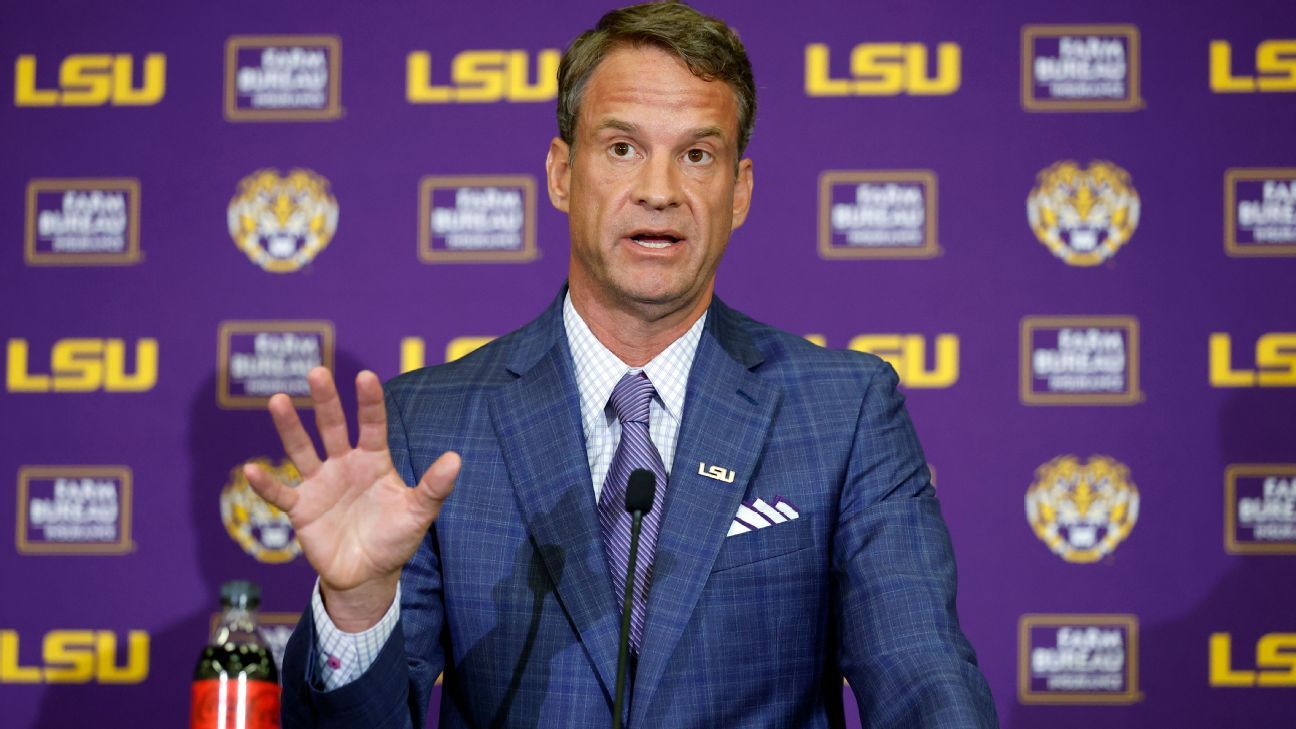
Four-star tight end JC Anderson, No. 165 in the 2026 ESPN 300, flipped his commitment from Ole Miss to LSU on Tuesday, landing as the first pledge of Lane Kiffin’s tenure with the Tigers.
Anderson, a 6-foot-6, 235-pound tight end from Mount Zion, Illinois, is ESPN’s No. 8 overall tight end. He initially committed to Kiffin and the Rebels in June and remained as the second-ranked member of Ole Miss’ incoming class prior to Tuesday.
Anderson joined LSU’s 2026 class less than 24 hours after Kiffin’s introductory news conference with the Tigers Monday afternoon, during which the former Ole Miss coach said closing the program’s latest recruiting class would be his first task in the new job. ESPN sources expect LSU to remain active during this week’s early signing period with wide receivers Corey Barber (Ole Miss decommit) and Brayden Allen (Oklahoma decommit) among the program’s leading targets. Anderson is now the second top 300 skill position prospect set to sign with LSU this week, joining wide receiver Jabari Mack (No. 64).
Four-star wide receiver Kenny Darby (No. 272) announced his decommitment from the Tigers shortly after Anderson’s pledge on Tuesday.
Anderson arrives as the 11th ESPN pledge in the Tigers’ incoming class, which entered Tuesday at No. 15 in ESPN’s latest class rankings for the cycle. That group is anchored by No. 1 overall recruit Lamar Brown and fellow defensive tackle Deuce Geralds (No. 37 overall).
Ole Miss has lost three 2026 pledges since Kiffin officially left the program Sunday. The Rebels enter the three-day signing period Wednesday with the nation’s No. 21 class.

-
Jake Trotter
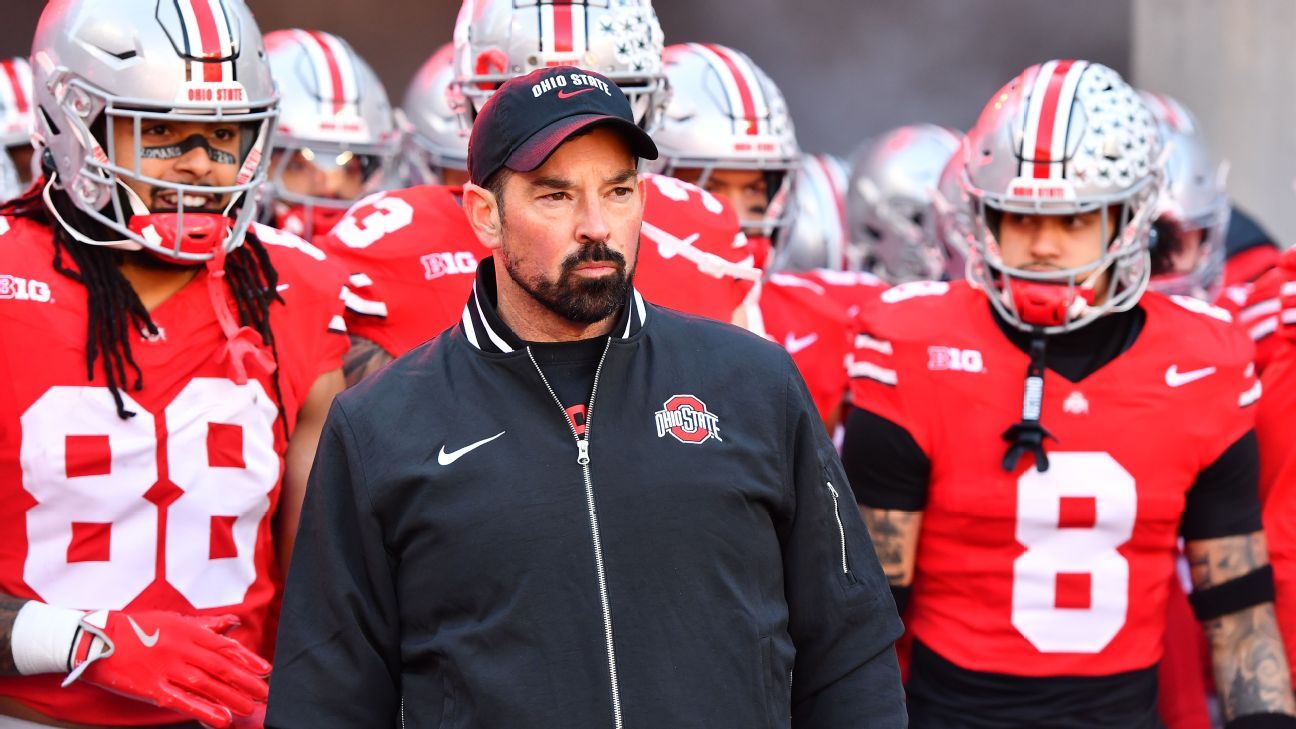
Ryan Day said he “had an inkling” Ohio State‘s headsets might go down during Saturday’s game at Michigan — so the Buckeyes coach had a backup communication plan already in place.
Ohio State lost the ability to communicate over the headsets during the second half of its 27-9 win over the Wolverines.
The Buckeyes had quarterback Julian Sayin come to the sideline between plays and get the calls directly from Day before going back to the huddle, until the problem was fixed later in the half.
“I was just getting us through it until we got the headsets up and running, which took a little while to get done,” Day said Tuesday. “But yeah, just by chance we had planned for it, and so we were ready to go.”
Day was then asked why he had the inkling.
“You just got to be ready for anything,” Day said. “When you go into any big game, you’re always trying to put contingency plans in place for anything that could possibly happen.”
Sayin said, after the game, that running to the sideline before each play reminded him of playing in high school. Day said he met with his assistant coaches Friday to go through the contingency plan.
“I think some of the guys on the staff were looking at me sideways,” Day said, “like, ‘Why would you think that would happen?’ I said, ‘I just don’t know. We just got to be ready for anything.’ It’s funny how your mind works.”
Day then winked, drawing several laughs.
Michigan, however, did not find Day’s implication humorous, denying any involvement in the Buckeyes’ communication issue in a statement Tuesday afternoon.
“We do not manage their communication system. Each athletic department provides electrical power and fiber lines that are equal on both sidelines. Ohio State has staff within its athletic department that handles coach-to-player communication and the coach-to-coach headset system. The coach-to-player communication system is run by a third party chosen by the Big Ten. A neutral technician is on the sidelines to assist both teams at every game across the conference,” the statement read.
“With any cellular-based communication system, there are technical issues that happen from time to time in stadiums across the country. We don’t want the opponent to have issues because our team would have to take our communication system down as well. No one benefits from a system failure.
“In this instance, our game event manager, stadium supervisor, an electrician and staff immediately jumped in to assist with the issue on Saturday. The issue was resolved before anything needed to be taken offline.”
In August, the NCAA Division I Committee on Infractions penalized Michigan after investigating the school for stealing signs through advance scouting. The NCAA fined the Wolverines at least $30 million, imposed recruiting restrictions and suspended coach Sherrone Moore three games, including next season’s opener, noting it had “overwhelming” and concerning evidence of a cover-up by Michigan staff. The NCAA committee also levied an eight-year show-cause penalty for former Michigan staffer Connor Stalions and a 10-year show-cause for former coach Jim Harbaugh, now coach of the Los Angeles Chargers.
The top-ranked Buckeyes will face No. 2 Indiana in Indianapolis on Saturday, with the College Football Playoff’s top overall seed on the line.
Day said his team had already put the Michigan win in the past and is “locked in” on winning the Big Ten title.
“This is going to be an electric atmosphere,” he said. “It’s a great opponent. This is a very important game for us. We got to go play our best.”
-
 Sports2 years ago
Story injured on diving stop, exits Red Sox game
-
 Sports3 years ago
‘Storybook stuff’: Inside the night Bryce Harper sent the Phillies to the World Series
-
 Sports2 years ago
Game 1 of WS least-watched in recorded history
-
 Sports3 years ago
Button battles heat exhaustion in NASCAR debut
-
 Sports3 years ago
MLB Rank 2023: Ranking baseball’s top 100 players
-
Sports4 years ago
Team Europe easily wins 4th straight Laver Cup
-
 Environment3 years ago
Japan and South Korea have a lot at stake in a free and open South China Sea
-
 Environment1 year ago
Here are the best electric bikes you can buy at every price level in October 2024