

Doctors are turning medical generative AI into a booming business

Attendees at HIMSS in Orlando, Florida 2024.
Courtesy of HIMSS
The hottest new technology for doctors promises to bring back an age-old health-care practice: face-to-face conversations with patients.
As more than 30,000 health and tech professionals gathered among the palm trees at the HIMSS conference in Orlando, Florida, this week, ambient clinical documentation was the talk of the exhibition floor.
This technology allows doctors to consensually record their visits with patients. The conversations are automatically transformed into clinical notes and summaries using artificial intelligence. Companies like Microsoft’s Nuance Communications, Abridge and Suki have developed solutions with these capabilities, which they argue will help reduce doctors’ administrative workloads and prioritize meaningful connections with patients.
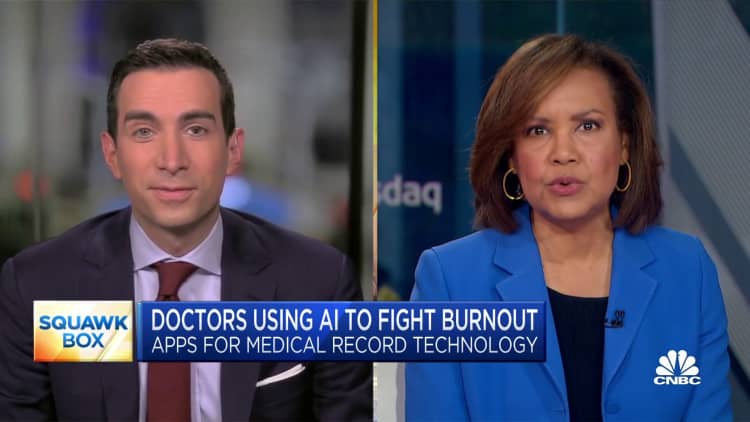
“After I see a patient, I have to write notes, I have to place orders, I have to think about the patient summary,” Dr. Shiv Rao, founder and CEO of Abridge, told CNBC at HIMSS. “So what our technology does is it allows me to focus on the person in front of me — the most important person, the patient — because when I hit start, have a conversation, then hit stop, I can swivel my chair and within seconds, the note’s there.”
Administrative workloads are a major problem for clinicians across the U.S. health-care system. A survey published by Athenahealth in February found that more than 90% of physicians report feeling burned out on a “regular basis,” largely because of the paperwork they are expected to complete.
More than 60% of doctors said they feel overwhelmed by clerical requirements and work an average of 15 hours per week outside their normal hours to keep up, the survey said. Many in the industry call this at-home work “pajama time.”
Since administrative work is mostly bureaucratic and doesn’t directly influence doctors’ decisions around diagnoses or patient care, it has served as one of the first areas where health systems have seriously begun to explore applications of generative AI. As a result, ambient clinical documentation solutions are having a real moment in the sun.
“There isn’t a better place to be,” Kenneth Harper, general manager of DAX Copilot at Microsoft, told CNBC in an interview.
Microsoft’s Nuance announced its ambient clinical documentation tool Dragon Ambient eXperience (DAX) Express in a preview capacity last March. By September, the solution, now called DAX Copilot, was generally available. Harper said there are now more than 200 organizations using the technology.
Microsoft acquired Nuance for around $16 billion in 2021. The company had a two-story exhibition booth in the exhibit hall that was often packed with attendees
Harper said the technology saves doctors several minutes per encounter, though the exact numbers vary depending on the specialty. He said his team gets feedback about the service almost daily from doctors who claim it has helped them take better care of themselves — and even saved their marriages.
Harper recounted a conversation with one physician who was considering retirement after practicing for more than three decades. He said the doctor was feeling worn out from years of stress, but he was inspired to keep working after he was introduced to DAX Copilot.
“He said, ‘I literally think I’m going to practice for another 10 years because I actually enjoy what I do,'” Harper said. “That’s just a personal anecdote of the type of impact this is having on our care teams.”
At HIMSS, Stanford Health Care announced it is deploying DAX Copilot across its entire enterprise.
Gary Fritz, chief of applications at Stanford Health Care, said the organization had initially started by testing the tool within its exam rooms. He said Stanford recently surveyed physicians about their use of DAX Copilot and 96% found it easy to use.
“I don’t know that I’ve ever seen that big a number,” Fritz told CNBC in an interview. “It is a big deal.”
Dr. Christopher Sharp, chief medical information officer at Stanford Health Care and one of the physicians who tested DAX Copilot, said it is “remarkably seamless” to use. He said the tool’s immediacy and reliability are accurate and strong but could improve at capturing a patient’s tone.
Sharp said he thinks the tool saves him documentation time and has changed how he spends that time. He said he is often reading and editing notes instead of composing them, for instance, so it is not as though the work has disappeared entirely.
In the near term, Sharp said he’d like to see more capabilities for personalization within DAX Copilot, both at an individual and specialty level. Even so, he said it was easy to see the value of it from the start.
“The moment that that first document returns to you, and you see your own words and the patient’s own words being reflected directly back to you in a usable fashion, I would say that from that moment, you’re hooked,” Sharp told CNBC in an interview.
Fritz said it is still early in the product life cycle, and Stanford Health Care is still working out exactly what deployment will look like. He said DAX Copilot will likely roll out in specialty-specific tranches.
Attendees at HIMSS in Orlando, Florida 2024.
Courtesy of HIMSS
In January, Nuance announced the general availability of DAX Copilot within Epic Systems’ electronic health record (EHR). Most doctors create and manage patient medical records using EHRs, and Epic is the largest vendor by hospital market share in the U.S., according to a May report from KLAS Research.
Integrating a tool like DAX Copilot directly into doctors’ EHR workflow means they won’t need to switch apps to access it, which helps save time and reduce their clerical burden even further, Harper said.
Seth Hain, senior vice president of R&D at Epic, told CNBC that more than 150,000 notes have been drafted into the company’s software by ambient technologies since the HIMSS conference last year. And the technology is scaling fast. Hain said more notes have already been drafted in 2024 than in 2023.
“You’re seeing health systems who have worked through an intentional process of acclimating their end users to this type of technology, now beginning to rapidly roll that out,” he said.
A company named Abridge also integrates its ambient clinical documentation technology directly within Epic. Abridge declined to share the exact number of health organizations using its technology. It announced at HIMSS that California-based UCI Health is rolling out the company’s solution system-wide.
Rao, the CEO of Abridge, said the rate at which the health-care industry has adopted ambient clinical documentation feels “historic.”
Abridge announced a $30 million Series B funding round in October, led by Spark Capital, and four months later, the company closed a $150 million Series C round, according to a February release. Rao said tail winds like physician burnout have turned into a “tornado” for Abridge, and it will use these funds to continue to invest in the science behind the technology and explore where it can go next.
The company is saving some doctors as much as three hours a day, Rao said, and is automating more than 92% of the clerical work it focuses on. Abridge’s technology is live across 55 specialties and 14 languages, he added.
Abridge has a Slack channel called “love stories,” which was viewed by CNBC, where the team will share the positive feedback they get about their technology. One message from this week was from a doctor who said Abridge helped them take their least favorite part of their job away and saves them around an hour and a half each day.
“That’s the type of feedback that absolutely inspires everybody in the company,” Rao said.
Suki CEO Punit Soni said the ambient clinical documentation market is “sizzling.” He expects rapid growth to continue through the next couple of years, though, like all hype cycles, he said he thinks the dust will settle.
Soni founded Suki more than six years ago after hypothesizing that there would be a need for a digital assistant to help doctors manage clinical documentation. Soni said Suki is now used by more than 30 specialties in around 250 health organizations nationwide. Six “large health systems” have gone live with Suki in the past two weeks, he added.
“For four to five years I’ve sat around, basically with the shop open, hoping somebody will show up. Now the entire mall is here, and there’s a line outside the door of people wanting to deploy, ” Soni told CNBC at HIMSS. “It’s very, very exciting to be here.”
Suki’s website says its technology can reduce the time a physician spends on documentation by an average of 72%. The company raised a $55 million funding round in 2021 led by March Capital. It will likely raise another round in the latter half of the year, Soni said.
Soni said Suki is focused on deploying its technology at scale and exploring additional applications, like how ambient documentation could be used to assist nurses. He said the Spanish language is coming to Suki soon, and customers should expect most major languages to follow.
“There is so much that has to happen,” he said. “In the next decade, all of health-care tech is going to look completely different.”
Technology
Altman and Musk launched OpenAI as a nonprofit 10 years ago. Now they’re rivals in a trillion-dollar market


Open AI CEO Sam Altman speaks during a talk session with SoftBank Group CEO Masayoshi Son at an event titled “Transforming Business through AI” in Tokyo, Japan, on February 03, 2025.
Tomohiro Ohsumi | Getty Images
On Dec. 11, 2015, OpenAI launched as a nonprofit research lab after Elon Musk and a group of prominent techies, including Peter Thiel and Reid Hoffman, pledged $1 billion to develop artificial intelligence for the benefit of humanity. The idea was for the project to be be free of commercial pressures and the pursuit of money.
A decade later, that founding mission is all but forgotten.
Musk, now the world’s richest person, is long gone, having created rival startup xAI. And he’s been engaged in a heated legal and public relations fight with OpenAI CEO and co-founder Sam Altman.
Far from the nonprofit realm, OpenAI has emerged as one of the fastest-growing commercial entities on the planet, zooming to a $500 billion private market valuation, with almost all of that value accruing since the company’s launch of ChatGPT three years ago. More than 800 million people now use the chatbot every week.
Musk’s xAI, meanwhile, is expected to close a $15 billion round at a $230 billion pre-money valuation this month, sources familiar with the matter told CNBC’s David Faber in late November.
OpenAI and xAI are two of the main companies, along with Google, Anthropic and Meta, pouring money into AI models, as the market rapidly evolves from text-based chatbots to AI-generated videos and more advanced compute-intensive forms of content, as well as into agentic AI, with large enterprises customizing tools to enhance productivity.
For OpenAI, the price tag is almost incomprehensible: $1.4 trillion and growing. That’s primarily for the mammoth data centers and high-powered chips required to meet what the company sees as insatiable demand for its technology. For now, OpenAI is a cash-burning machine going up against tech’s megacaps and their chip suppliers, drawing comparisons to earlier waves of high-growth tech firms that spent heavily for years to challenge behemoth incumbents, but to mixed results.
“OpenAI has a very big role in the in the history of the development of artificial intelligence, and will forever have that role,” said Gil Luria, an equity analyst at D.A. Davidson, in an interview. “Now, will that role be Netscape, or will it be Google? We’ve yet to find out.”
Nvidia CEO Jensen Huang speaks at an event ahead of the COMPUTEX forum, in Taipei, Taiwan, June 2, 2024.
Ann Wang | Reuters
It’s a position that would’ve been hard to imagine in 2016, when Nvidia CEO Jensen Huang hauled a black DGX-1 supercomputer up to OpenAI’s offices in San Francisco’s Mission District. The $300,000 machine had cost Nvidia “a few billion dollars” to develop, and there were no other buyers, Huang recalled recently on Joe Rogan’s podcast.
Musk, at OpenAI, was the only one who wanted it.
When Musk told him it was for “a nonprofit company,” Huang said all the blood drained from his face at the thought of parking such a costly box inside an organization that wasn’t meant to make money.
Behind the scenes, though, the nonprofit ideal was already under intense strain, and Musk didn’t like what he saw.
“Guys, I’ve had enough. This is the final straw,” Musk wrote in an email to his co-founders in 2017. He warned that he would “no longer fund OpenAI” if it turned into a tech startup instead of a nonprofit. Altman wrote back the next morning: “i remain enthusiastic about the non-profit structure!”
Altman vs. Musk
In February of the following year, Musk left the OpenAI board, and said at the time the move was to avoid a potential conflict of interest as his car company, Tesla, dove deeper into AI.
The story was more complicated.
Musk sued OpenAI and Altman in early 2024, alleging they abandoned the company’s founding mission to develop AI “for the benefit of humanity broadly,” and he’s regularly criticized OpenAI’s close ties to Microsoft, its principal backer. He also went to court to try and keep OpenAI from converting into a for-profit entity and, earlier this year, went so far as to try and acquire the AI lab for $97.4 billion.
In October, OpenAI announced it had completed a recapitalization, cementing its structure as a nonprofit with a controlling stake in its for-profit business, which is now a public benefit corporation called OpenAI Group PBC.
Musk isn’t the only early OpenAI team member who’s turned into a bitter rival. Siblings Dario and Daniela Amodei left OpenAI in late 2020 to form Anthropic, which said last month that Microsoft and Nvidia would invest in the company. The valuation from the funding round could reach as high as $350 billion.
Anthropic’s Claude family of large language models is one of the biggest competitors to OpenAI’s GPT models.
Altman is wagering that he can win the race by outspending the competition. While his company has sketched out plans for a trillion-dollar-plus AI infrastructure outlay, Anthropic has made roughly $100 billion in recent compute commitments, spaced out at various intervals over the next few years.
It all amounts to a giant bet that demand for AI services will continue apace.
“We’ve got all the various AI vendors making these huge capital investments,” said David Menninger, executive director of software research at ISG. “There’s a question as to how long those capital investments continue and whether or not they all pan out.”
Luria says Anthropic and others are making reasonable commitments based on their current growth trajectory and the funding they’ve already secured. But he said OpenAI’s approach has been based on a “fantastical set of commitments” with a “faint belief that those numbers are even possible.”
‘Pretty extreme’
Altman told CNBC in an interview on Thursday that OpenAI is already seeing enough demand to justify its spending plans, which “makes us confident that we will be able to significantly ramp revenue.”
“It’s obviously unusual to be growing this fast at this kind of scale, but it is what we see in our current data,” Altman said, adding that “the demand in the market is pretty extreme.”
Altman said last month that he expects annualized revenue to hit $20 billion by the end of this year and to reach hundreds of billions by 2030. Its historic pace of growth has been a big boon for major tech companies.
Oracle signed a roughly $500 billion deal to sell infrastructure services to OpenAI over five years. Chipmakers Advanced Micro Devices and Broadcom have woven OpenAI-linked demand into multi-year forecasts.
But Oracle’s shares plunged 11% on Thursday after the software vendor reported weaker-than-expected revenue, a miss that dragged down Nvidia, CoreWeave and other AI-related stocks. Despite a surge in long-term contract commitments from companies like OpenAI, Meta, and Nvidia, investors are growing concerned about Oracle’s debt load that’s fueling its buildout.

Still, venture capitalist Matt Murphy of Menlo Ventures, said that in his 25 years in the venture business, “this is the mother of all waves.”
Murphy, an early investor in Anthropic, said the combination of AI models, custom chips and hyperscale data centers adds up to the potential for trillion-dollar outcomes. That explains the eye-popping level of capital expenditures and the astronomical valuations, he said.
Altman recently declared a “code red” inside his company, and shuffled resources to focus on making ChatGPT faster, more reliable and more personal, while delaying work on ads, health and shopping agents and a personal assistant called Pulse. His declaration came after Google released its Gemini 3 model last month, further accelerating the search giant’s ascent in the market.
On Thursday, OpenAI unveiled ChatGPT-5.2, a faster, more capable reasoning model that the company says is its best system yet for everyday professional use. It also struck a three-year, $1 billion content and equity deal with Disney around the Sora AI video generator.
Altman downplayed the threat from Google, telling CNBC that Gemini had less of an impact on the company’s metrics than OpenAI initially feared.
“I believe that when a competitive threat happens, you want to focus on it, deal with it quickly,” Altman said.
He said he expects the company to exit code red by January.
— CNBC’s Kif Leswing contributed to this report.

Technology
Broadcom stock reverses lower on a misinterpretation of what the CEO said on the earnings call


-
 Sports2 years ago
Story injured on diving stop, exits Red Sox game
-
 Sports3 years ago
‘Storybook stuff’: Inside the night Bryce Harper sent the Phillies to the World Series
-
 Sports2 years ago
Game 1 of WS least-watched in recorded history
-
 Sports3 years ago
Button battles heat exhaustion in NASCAR debut
-
 Sports3 years ago
MLB Rank 2023: Ranking baseball’s top 100 players
-
Sports4 years ago
Team Europe easily wins 4th straight Laver Cup
-
 Environment3 years ago
Japan and South Korea have a lot at stake in a free and open South China Sea
-
 Environment1 year ago
Here are the best electric bikes you can buy at every price level in October 2024