
Connect with us

Published

on

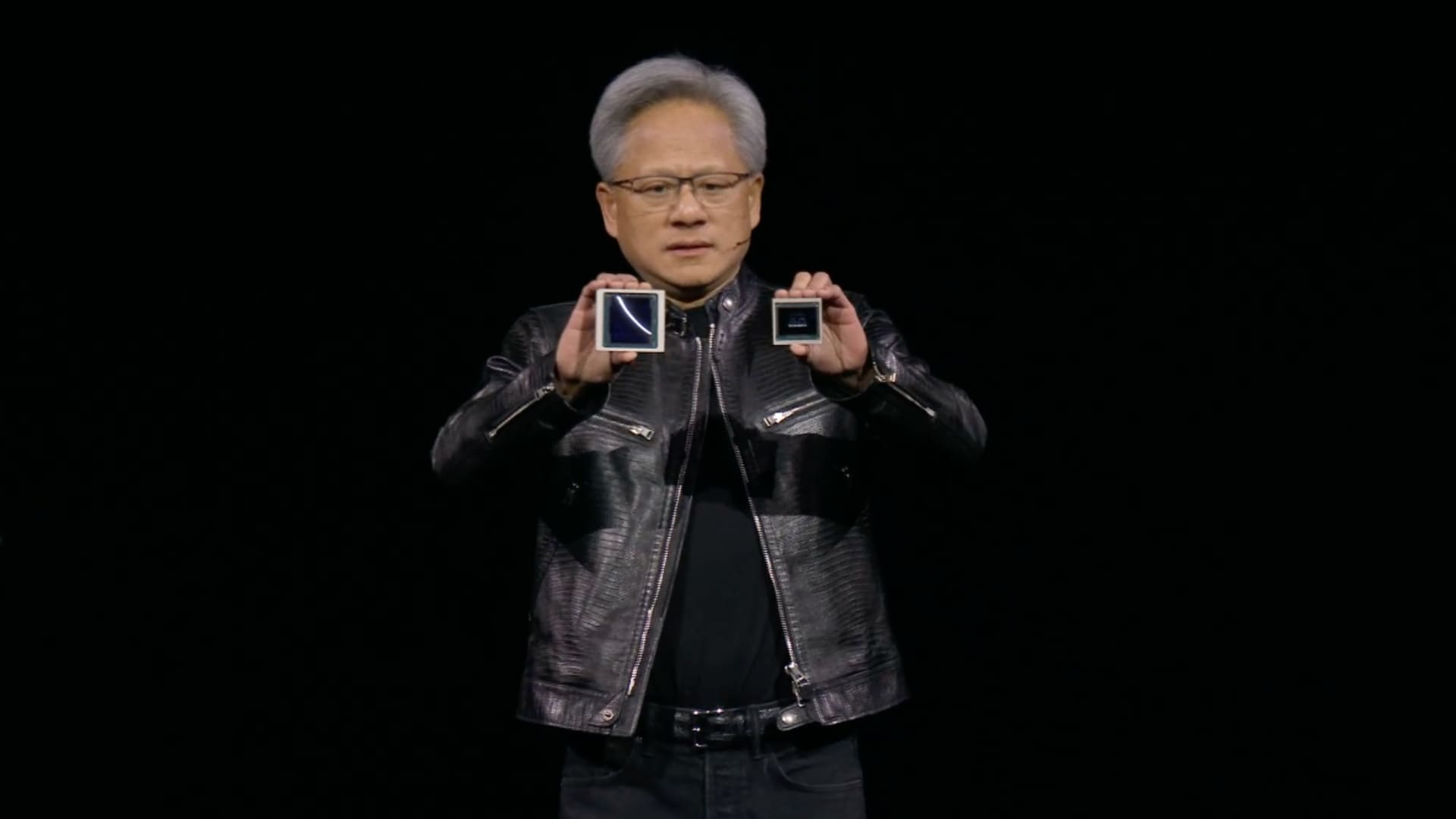
Nvidia CEO Jensen Huang delivers a keynote address during the Nvidia GTC Artificial Intelligence Conference at SAP Center on March 18, 2024 in San Jose, California.

Justin Sullivan | Getty Images

Nvidia on Monday announced a new generation of artificial intelligence chips and software for running artificial intelligence models. The announcement, made during Nvidia’s developer’s conference in San Jose, comes as the chipmaker seeks to solidify its position as the go-to supplier for AI companies.

Nvidia’s share price is up five-fold and total sales have more than tripled since OpenAI’s ChatGPT kicked off the AI boom in late 2022. Nvidia’s high-end server GPUs are essential for training and deploying large AI models. Companies like Microsoft and Meta have spent billions of dollars buying the chips.

The new generation of AI graphics processors is named Blackwell. The first Blackwell chip is called the GB200 and will ship later this year. Nvidia is enticing its customers with more powerful chips to spur new orders. Companies and software makers, for example, are still scrambling to get their hands on the current generation of “Hopper” H100s and similar chips.

“Hopper is fantastic, but we need bigger GPUs,” Nvidia CEO Jensen Huang said on Monday at the company’s developer conference in California.

The company also introduced revenue-generating software called NIM that will make it easier to deploy AI, giving customers another reason to stick with Nvidia chips over a rising field of competitors.

Nvidia executives say that the company is becoming less of a mercenary chip provider and more of a platform provider, like Microsoft or Apple, on which other companies can build software.

“Blackwell’s not a chip, it’s the name of a platform,” Huang said.

“The sellable commercial product was the GPU and the software was all to help people use the GPU in different ways,” said Nvidia enterprise VP Manuvir Das in an interview. “Of course, we still do that. But what’s really changed is, we really have a commercial software business now.”

Das said Nvidia’s new software will make it easier to run programs on any of Nvidia’s GPUs, even older ones that might be better suited for deploying but not building AI.

“If you’re a developer, you’ve got an interesting model you want people to adopt, if you put it in a NIM, we’ll make sure that it’s runnable on all our GPUs, so you reach a lot of people,” Das said.

Meet Blackwell, the successor to Hopper

Nvidia’s GB200 Grace Blackwell Superchip, with two B200 graphics processors and one Arm-based central processor.

Nvidia CEO Jensen Huang compares the size of the new “Blackwell” chip versus the current “Hopper” H100 chip at the company’s developer conference, in San Jose, California.

Nvidia

Amazon, Google, Microsoft, and Oracle will sell access to the GB200 through cloud services. The GB200 pairs two B200 Blackwell GPUs with one Arm-based Grace CPU. Nvidia said Amazon Web Services would build a server cluster with 20,000 GB200 chips.

Nvidia said that the system can deploy a 27-trillion-parameter model. That’s much larger than even the biggest models, such as GPT-4, which reportedly has 1.7 trillion parameters. Many artificial intelligence researchers believe bigger models with more parameters and data could unlock new capabilities.

Nvidia didn’t provide a cost for the new GB200 or the systems it’s used in. Nvidia’s Hopper-based H100 costs between $25,000 and $40,000 per chip, with whole systems that cost as much as $200,000, according to analyst estimates.

Nvidia will also sell B200 graphics processors as part of a complete system that takes up an entire server rack.

NIM

Nvidia also announced it’s adding a new product named NIM to its Nvidia enterprise software subscription.

NIM makes it easier to use older Nvidia GPUs for inference, or the process of running AI software, and will allow companies to continue to use the hundreds of millions of Nvidia GPUs they already own. Inference requires less computational power than the initial training of a new AI model. NIM enables companies that want to run their own AI models, instead of buying access to AI results as a service from companies like OpenAI.

The strategy is to get customers who buy Nvidia-based servers to sign up for Nvidia enterprise, which costs $4,500 per GPU per year for a license.

Nvidia will work with AI companies like Microsoft or Hugging Face to ensure their AI models are tuned to run on all compatible Nvidia chips. Then, using a NIM, developers can efficiently run the model on their own servers or cloud-based Nvidia servers without a lengthy configuration process.

“In my code, where I was calling into OpenAI, I will replace one line of code to point it to this NIM that I got from Nvidia instead,” Das said.

Nvidia says the software will also help AI run on GPU-equipped laptops, instead of on servers in the cloud.

Continue Reading

Technology

Biggest mistakes crypto investors make with estate planning

Published

on

By

Biggest mistakes crypto investors make with estate planning

Roughly 1 in 7 people are leaving unclaimed property on the table, according to the National Association of Unclaimed Property Administrators. While the recent heavy selling in bitcoin and ether is rightly getting all the short-term attention, this estate planning issue is a longer-term one that’s likely to be exacerbated as crypto adoption and ownership increase.

Many people neglect to account for cryptocurrency in their estate plans, or they don’t let their heirs know how to access their crypto holdings. With surveys in recent years from Gallup and Pew Research estimating that 14% to 17% of U.S. adults have owned cryptocurrency, losing access to those funds is a growing concern.

“Leaving property or mutual funds behind in a will is pretty cut and dried, but with more and more assets placed in cryptocurrency, a large share of inherited assets are in danger of forfeiture,” said Azriel Baer, partner in the estate planning and administration group at law firm Farrell Fritz.

This issue could be mitigated, in part, by crypto ETFs, which are gaining popularity with investors since the first batch of spot bitcoin ETFs were approved by the SEC in 2024, such as the iShares Bitcoin Trust (IBIT), followed a few months later by ethereum spot price ETFs, such as the Fidelity Ethereum Fund ETF (FETH). These ETFs allow investors access to the crypto asset class without actually owning crypto outright, helping reduce the chances of actual crypto getting lost.

Nevertheless, estate planning mistakes among crypto owners are common and can be avoided. Here are some of the biggest issues cryptocurrency owners need to tackle sooner rather than later.

Wills, if they exist, often don’t include digital assets language

Only 24% of Americans have a will that describes how they want their money and estate managed after their death, according to a survey from Caring.com. Even people who have wills in place have not updated them for many years, with nearly one in four Americans saying they haven’t touched their wills since their original was drafted, according to the survey.

This can be problematic for many reasons. An old will may no longer reflect people’s current wishes. In a crypto-specific context, anyone who hasn’t updated their estate plan in the past several years may not have language to provide legal authority for the trustee or executor to gain access to digital assets.

“It’s very common for people not to update their estate planning documents for 10, 20 years or sometimes longer. If that’s the case, you’re behind,” said Patrick D. Owens, shareholder at Buchalter and a member of the law firm’s tax, benefits and estate planning practice group.

Absent language about digital assets, your heirs might have to go to court to get the authority for the executor or administrator of the estate to gain access to the crypto assets. Most likely they’ll get access, “but it’s a hassle,” Owens said. “Obviously, it means time and money going into court.”

Even with a will, crypto assets can get stuck in court

A standard will is appropriate for many people, but many attorneys recommend clients also utilize a revocable living trust as part of their estate plan. Drafting a will is less expensive, but a revocable living trust offers more privacy and can help limit the time and expense of the probate process after death.

Baer advises clients to transfer their crypto to a revocable living trust so the trustee has immediate access upon the owner’s death. It could be six to eight months, or more, before a will is settled in probate and in the meantime, heirs wouldn’t have access to the assets. If the price of the crypto was going down rapidly, for example, they would have to wait to sell it if the estate was caught up in probate. Putting crypto assets into a revocable trust to avoid probate can prevent a lot of headaches, he said. 

Generally, a revocable trust is paired with a pour-over will so that assets not included in the trust at the time of a person’s death are transferred to the trust and distributed accordingly. 

Not sharing basic crypto information can cost millions

You don’t have to tell heirs you’re worth a fortune in bitcoin before you pass away, but you should make sure they know how to access your crypto after you’re gone. 

Baer worked on an estate where tens of millions of dollars in crypto were lost to the heirs because they didn’t know the decedent’s private keys, which function as digital passwords to grant access to cryptocurrency funds and prove ownership of blockchain assets.

Someone should know how to access the assets, whether through written instructions in a safe box, a safe at home, or directions kept with a lawyer or with one of the various crypto inheritance services that help ensure crypto assets are passed on to your family members, Baer said. Don’t put these private keys or other sensitive information in a will, because wills become public through the probate process, he added.

Many designated fiduciaries can’t handle crypto 

The person you chose to handle your other assets may not be the right person to deal with the crypto portion of your estate.

Not everyone understands crypto, the associated volatility or how to transact with digital currency, meaning lots of money can inadvertently be lost. The recent volatility in the price of bitcoin is a reminder that if you name someone who needs weeks to get up to speed on how to transact with bitcoin, the financial losses could be meaningful, Baer said. “Uncle Bob may be a great person, but he may have more challenges transacting with an asset class he’s totally not familiar with,” he added.

Sometimes, even institutional trustees might not be able to take on the responsibility for crypto. Owens had a client pass away with half a million dollars in bitcoin and ether. The institutional trustee who oversaw the client’s account refused to take on the responsibility for the crypto and a special trustee was named. Luckily, the client had a nephew who took on the role, but finding a suitable replacement can often be costly from a time and money perspective, Owens said. 

Failure to plan for crypto estate taxes

With the massive explosion in the values around cryptocurrency, many people have large crypto holdings, which could be subject to significant taxes, whether that’s income taxes or estate taxes, and failure to plan could be detrimental to their families, said Jonathan Forster, shareholder at law firm Weinstock Manion.

There could, for example, be estate taxes due, depending on the size of the estate. The federal estate tax exemption for 2025 is $13.99 million per individual. Some states also have a state-level estate tax.

Knowing the impact crypto ownership might have on your estate is an important consideration while you are alive. Forster has clients whose crypto holdings are worth more than $50 million. They wanted an efficient way to make gifts for the benefit of their children to get some money out of their estate. They created a limited liability corporation, transferred the crypto into the LLC and gifted an interest in the LLC to an irrevocable trust for the benefit of minor children with an independent trustee, Forster said. 

Many crypto investors fail to keep track of cost basis, which can be problematic for many reasons, including if you’re considering gifting digital assets during your lifetime. If you want to gift the assets while you’re alive, you need to have the basis so the recipient can properly account for the crypto if it’s eventually sold, Baer said. “It can be onerous to keep track of basis, but it’s important,” he said.

Continue Reading

Technology

SpaceX aims for $800 billion valuation in secondary share sale, WSJ reports

Published

on

By

SpaceX aims for 0 billion valuation in secondary share sale, WSJ reports

Dado Ruvic | Reuters

Elon Musk’s SpaceX, is initiating a secondary share sale that would give the company a valuation of up to $800 billion, The Wall Street Journal reported Friday.

SpaceX is also telling some investors it will consider going public possibly around the end of next year, the report said.

At the elevated price, Musk’s aerospace and defense contractor would be valued above ChatGPT maker OpenAI, which wrapped up a share sale at a $500 billion valuation in October.

SpaceX has been investing heavily in reusable rockets, launch facilities and satellites, while competing for government contracts with newer space players, including Jeff Bezos‘ Blue Origin. SpaceX is far ahead, and operates the world’s largest network of satellites in low earth orbit through Starlink, which powers satellite internet services under the same brand name.

A SpaceX IPO would include its Starlink business, which the company previously considered spinning out.

Musk recently discussed whether SpaceX would go public during Tesla‘s annual shareholders meeting last month. Musk, who is the CEO of both companies, said he doesn’t love running publicly traded businesses, in part because they draw “spurious lawsuits,” and can “make it very difficult to operate effectively.”

However, Musk said during the meeting that he wanted to “try to figure out some way for Tesla shareholders to participate in SpaceX,” adding, “maybe at some point, SpaceX should become a public company despite all the downsides.”

WATCH: What retail investors should know about OpenAI and SpaceX

Want to ‘invest' in OpenAI and SpaceX? How tokenization will change investing

Continue Reading

Technology

Judge finalizes remedies in Google antitrust case

Published

on

By

Judge finalizes remedies in Google antitrust case

The logo for Google LLC is seen at the Google Store Chelsea in Manhattan, New York City, U.S., November 17, 2021.

Andrew Kelly | Reuters

A U.S. judge on Friday finalized his decision for the consequences Google will face for its search monopoly ruling, adding new details to the decided remedies.

Last year, Google was found to hold an illegal monopoly in its core market of internet search, and in September, U.S. District Judge Amit Mehta ruled against the most severe consequences that were proposed by the Department of Justice.

That included the proposal of a forced sale of Google’s Chrome browser, which provides data that helps the company’s advertising business deliver targeted ads. Alphabet shares popped 8% in extended trading as investors celebrated what they viewed as minimal consequences from a historic defeat last year in the landmark antitrust case.

Investors largely shrugged off the ruling as non-impactful to Google. However some told CNBC it’s still a bite that could “sting.”

Mehta on Friday issued additional details for his ruling in new filings.

“The age-old saying ‘the devil is in the details’ may not have been devised with the drafting of an antitrust remedies judgment in mind, but it sure does fit,” Mehta wrote in one of the Friday filings.

Google did not immediately respond to a request for comment. The company has previously said it will appeal the remedies.

In August 2024, Mehta ruled that Google violated Section 2 of the Sherman Act and held a monopoly in search and related advertising. The antitrust trial started in September 2023.

In his September decision, Mehta said the company would be able to make payments to preload products, but it could not have exclusive contracts that condition payments or licensing. Google was also ordered to loosen its hold on search data. Mehta in September also ruled that Google would have to make available certain search index data and user interaction data, though “not ads data.”

The DOJ had asked Google to stop the practice of “compelled syndication,” which refers to the practice of making certain deals with companies to ensure its search engine remains the default choice in browsers and smartphones.

The judge’s September ruling didn’t end the practice entirely — Mehta ruled out that Google couldn’t enter into exclusive deals, which was a win for the company. Google pays Apple billions of dollars per year to be the default search engine on iPhones. It’s lucrative for Apple and a valuable way for Google to get more search volume and users.

Mehta’s new details

In the Friday filings, Mehta wrote that Google cannot enter into any deal like the one it’s had with Apple “unless the agreement terminates no more than one year after the date it is entered.”

This includes deals involving generative artificial intelligence products, including any “application, software, service, feature, tool, functionality, or product” that involve or use genAI or large-language models, Mehta wrote.

GenAI “plays a significant role in these remedies,” Mehta wrote.

The judge also reiterated the web index data it will require Google to share with certain competitors. 

Google has to share some of the raw search interaction data it uses to train its ranking and AI systems, but it does not have to share the actual algorithms — just the data that feeds them.” In September, Mehta said those data sets represent a “small fraction” of Google’s overall traffic, but argued the company’s models are trained on data that contributed to Google’s edge over competitors.

The company must make this data available to qualified competitors at least twice, one of the Friday filing states. Google must share that data in a “syndication license” model whose term will be five years from the date the license is signed, the filing states.

Mehta on Friday also included requirements on the makeup of a technical committee that will determine the firms Google must share its data with.

Committee “members shall be experts in some combination of software engineering, information retrieval, artificial intelligence, economics, behavioral science, and data privacy and data security,” the filing states.

The judge went on to say that no committee member can have a conflict of interest, such as having worked for Google or any of its competitors in the six months prior to or one year after serving in the role.

Google is also required to appoint an internal compliance officer that will be responsible “for administering Google’s antitrust compliance program and helping to ensure compliance with this Final Judgment,” per one of the filings. The company must also appoint a senior business executive “whom Google shall make available to update the Court on Google’s compliance at regular status conferences or as otherwise ordered.”

This is breaking news. Check back for updates.

WATCH: Judge Issues final remedies in Google antitrust case

Judge Issues final remedies in Google antitrust case

Continue Reading

Trending





