

BYD expands reach in Europe with best-selling Atto 3, Seal EV launching in Greece

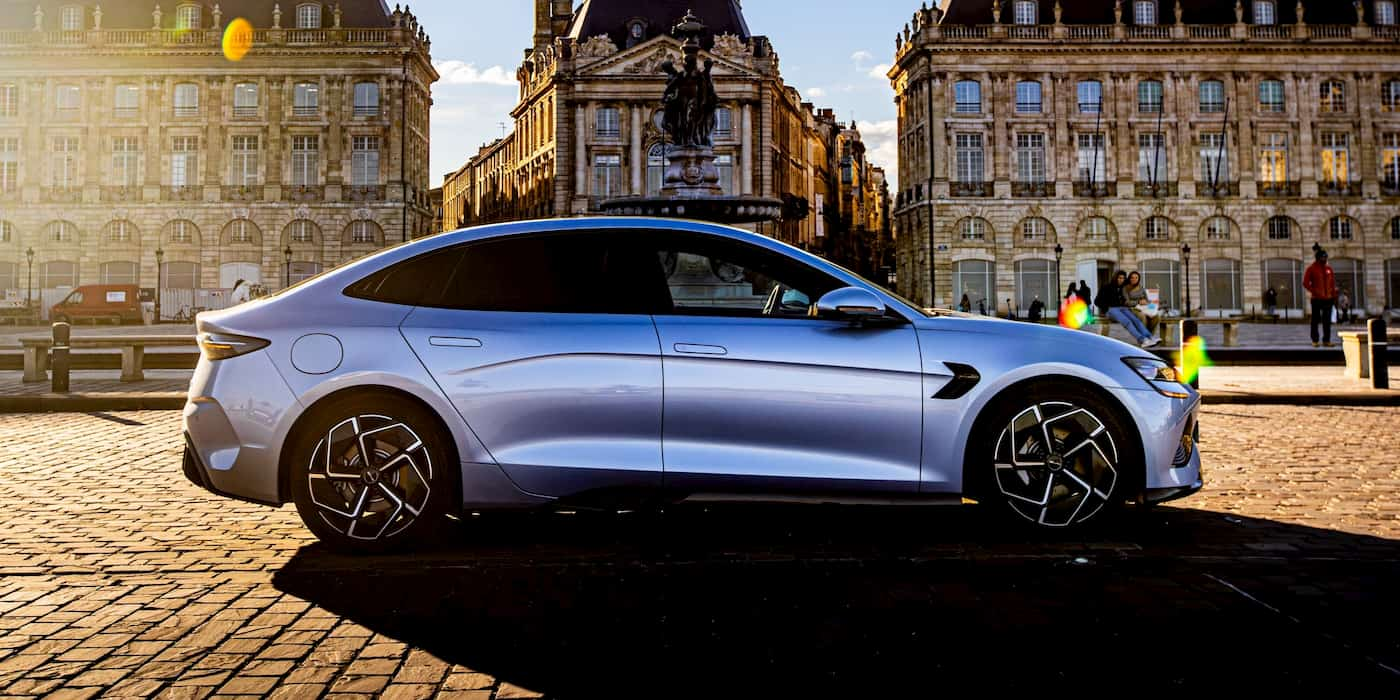
China’s leading EV maker, BYD, is expanding its presence in Europe by launching its best-selling Atto 3 and Seal in Greece. BYD said more models are launching soon.
BYD expands in Europe, launches two new EVs in Greece
BYD is “just getting started” in Europe, according to the region’s CEO, Michael Shu. After dominating its home market, BYD is taking its best-selling EVs overseas to challenge legacy automakers.
Although BYD began selling EVs in Europe in 2021 (in Norway), the company only sold 15,644 electric cars in the region last year. According to global data collection firm DataForce, that would give BYD a 1.1% share of the European EV market.
In an interview with Automotive News Europe last week, Shu said BYD is just learning “how Europeans respond” to the new tech, products, and services it offers.
Shu highlighted how Europe is a much different market than China or the US, with multiple legislations and languages to work with.
After admitting that ramping sales in the region will take time, Shu said BYD aims to more than triple its market share. Even before it begins producing vehicles at its Hungary plant.
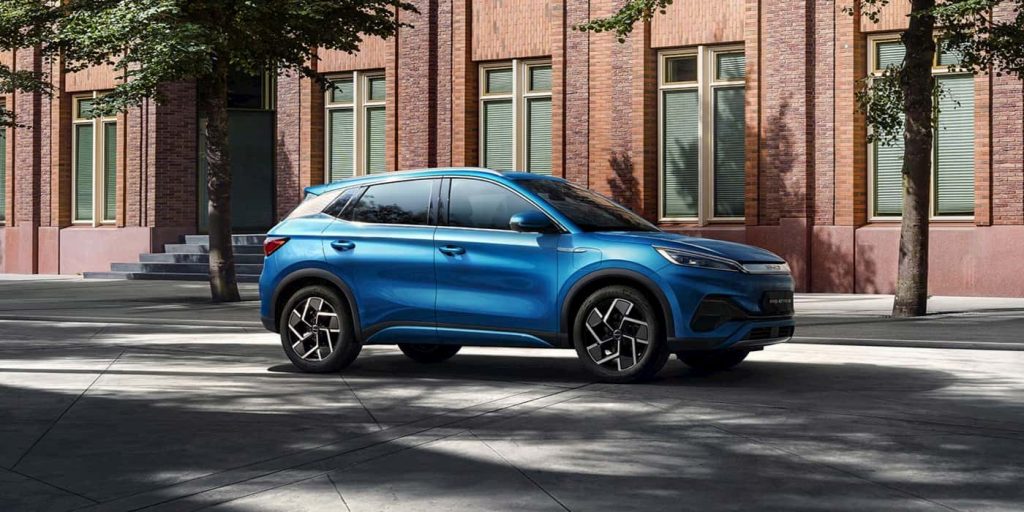
BYD aims for a 5% share by then, up from just 1.1% currently. The company’s European boss confirmed the plant will begin production in 2026. To speed up output, it will also build battery packs in Hungary.
Once up and running, the plant will be able to build 150,000 vehicles a year, which can be doubled if needed.
“It will be Europe for Europe,” Shu said, adding, “We will be closer to customers, offering faster deliveries, and people will trust us more.”

According to its Weibo page, BYD launched two new EVs in Greece as it expands the brand overseas. BYD launched the Atto 3 and Seal EV, marking its official entry into the Greek passenger auto market.
Last year, BYD’s Atto 3 was its best-selling EV in Europe, with 12,363 models sold. BYD’s Seal was fifth, with 284 vehicles sold, behind the Dolphin (1,079), Tang (1,055), and Han (849).
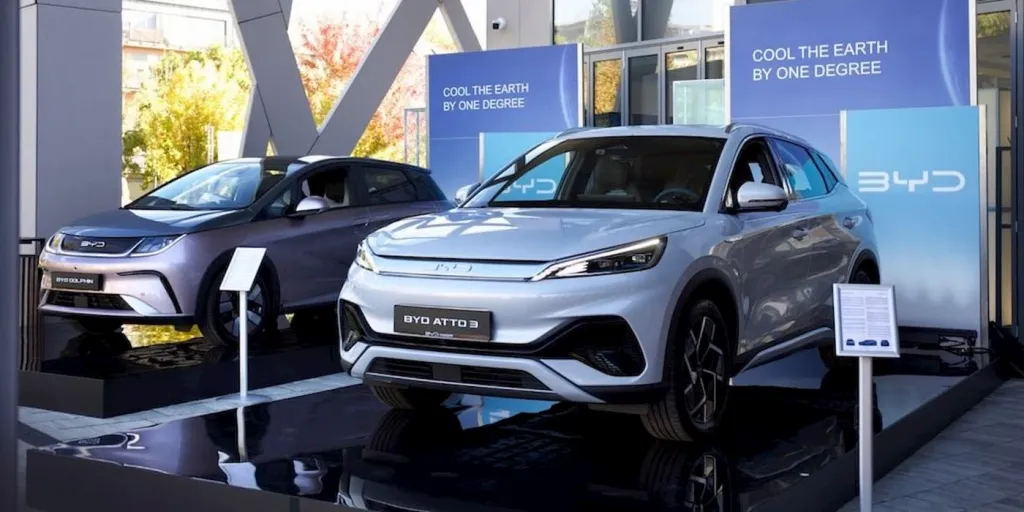
BYD said it will introduce additional vehicles, including the Dolphin, Song Plus EV Champion Edition, and Song Plus DM-i in the future.
Electrek’s Take
Despite BYD’s minor presence in the European EV market, the automaker plans to expand aggressively.
BYD launched a “liberation battle” against gas-powered vehicles earlier this year to drive EV adoption by slashing prices and introducing drastically lower-priced models.
The Atto 3 starts at just $16,644 (119,800 yuan) in China. In Europe, it starts at around $40,000 (37,990 euros). Once its Hungary plant begins production, BYD will be able to cut prices closer to what’s offered in China.
The EV maker has an advantage by building nearly all components in-house, enabling low prices.
According to a new report, BYD is working on its next-gen EV platform, which will further lower costs and promote even cheaper electric models.
In the meantime, BYD’s first auto transport ship docked in Germany last month, carrying around 3,000 vehicles set to hit the European market.
FTC: We use income earning auto affiliate links. More.


A Tesla drove in the wrong direction, resulting in a head-on collision with another vehicle, during a livestream, demonstrating Tesla’s ‘Full Self-Driving’ features.
Earlier this year, Tesla launched its Level 2 driver-assist system, ‘Full Self-Driving’ (FSD), in China.
Like in the US, despite its name, the system requires constant driver supervision. Unlike in the US, China quickly made Tesla change the name of the system as it was judged not representative of its capabilities.
Many Tesla owners in China have been enthusiastically livestreaming their drives using FSD on platforms such as Douyin (TikTok).
They try to demonstrate that Tesla FSD is able to operate the vehicle by itself and compare it to other similar systems from other automakers in China.
Last week, a Douyin user going by 切安好 was livestreaming a Tesla FSD drive in his Model 3 when the vehicle went into the left lane, which was for the opposing traffic, and collided head-on with another car.
The livestream itself wasn’t widely popular, but the Tesla owner posted video captures of the aftermath, which quickly went viral:

Fortunately, no one was critically hurt during the crash.
Many questioned whether FSD was active during the incident, and the driver initially didn’t release the crash footage as he claimed to be seeking direct compensation from Tesla, which isn’t likely.
The automaker always states that it is not responsible for its FSD or Autopilot systems.
The Tesla driver has now released the footage, which clearly shows that FSD was active during the crash and initiated the lane change into the wrong direction:
The crash highlights the dangers of being overconfident in Tesla’s autonomous driving features.
Electrek’s Take
Be safe out there. Some people are abusing driver assistance features and are a danger to all road users.
Tesla isn’t helping with its own marketing, encouraging abuse with claims that FSD “gives you time back” as if you don’t have to be supervising the system all the time.
Recently, Tesla even started monitoring usage of your phone less while using FSD.
Also of note, Grok, Elon Musk’s LLM, falsely claimed that this crash was “staged” and that the driver was “manual driving”:

There’s misinformation everywhere. Weird times.


FTC: We use income earning auto affiliate links. More.

If you’ve covered e-bikes as long as I have, you’ll know two things about them: they’re an awesome way to get around, and the basic technology behind an e-bike motor hasn’t radically changed in a long, long time. However, based on the new e-bike motor design I just tested from a powertrain technology company called CHARGE, the e-bike world may be about to get turned on its head. These guys discovered that nearly any e-bike hub motor can perform regenerative braking, but everyone has just been building them wrong this whole time.
I know that sounds crazy, but stick with me. Because I’ve seen this in action, and it’s legit.
So here’s the background: The most common motor style for an electric bike is a hub motor (a motor in the center of the wheel), and we’ve all known for a long time that e-bikes generally can’t do regenerative braking. Well, they can, except that it requires a heavy and lower efficiency direct drive hub motor, something that we haven’t seen employed on any major retail e-bike in years. These days, everyone uses smaller geared motors that allow the wheel to freewheel like a typical bicycle wheel, making an e-bike coast like a pedal bike yet still have the power of an electric drivetrain.
The problem is that the freewheeling nature of a typical geared e-bike motor means regenerative braking is impossible; there’s just no way to backdrive the motor and turn it into a generator since it doesn’t turn when the bike isn’t being powered (i.e. coasting or braking). You’d need a controllable clutch to do that, and while there have been designs for such a thing, no one has ever succeeded in doing it in a simple enough or cost-effective way that it could reach production.
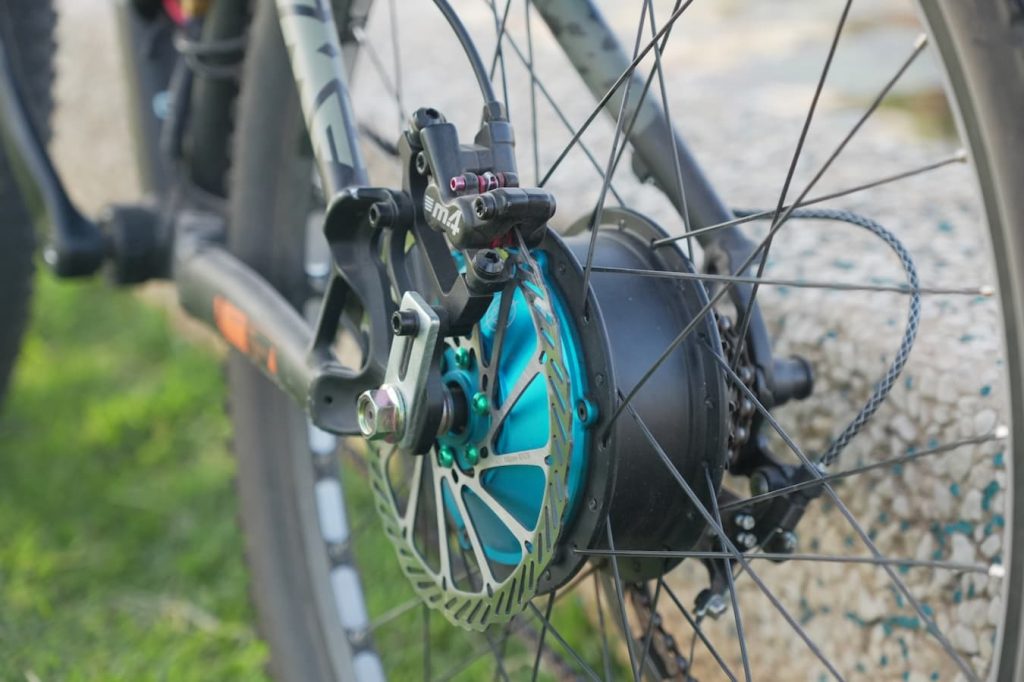
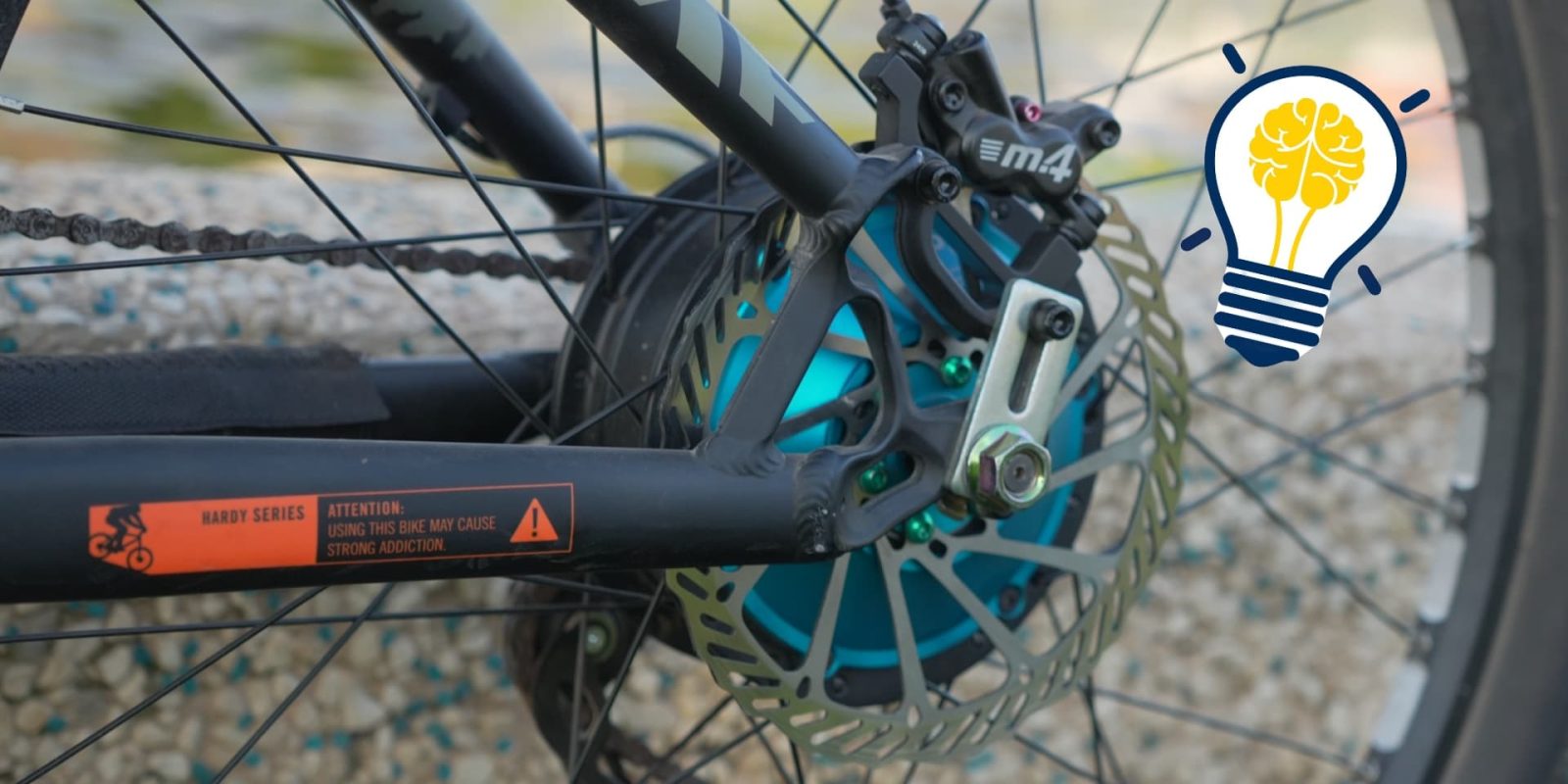
But the clever guys at CHARGE discovered that it doesn’t have to be that way, at least not if you simply tweak the motor design. Instead of mounting the disc rotor to the motor’s shell, which has been the go-to method for decades, they mounted the disc rotor to the carrier plate that holds the planet gears in the motor’s internal gearbox. It requires a slightly different shell for the motor – one that lets a mount connect the disc rotor to the gears’ carrier plate – but that’s the only difference, and it’s an easy one to produce. It just requires tweaking the motor assembly line. After that, the entire braking system is the same.
So the user still pulls the brake lever on the handlebar as usual, and the brake pads still grip that disc rotor. But the difference is that as the pads bite down on the disc rotor, the motor is forced to turn, which is what creates the braking force. In essence, the disc rotor now doubles as the user-operable clutch that has always been missing. That means the motor can switch into generator mode, essentially becoming a brake as it loads the motor and converts rotational energy back into electrical energy to charge the battery. The controller and motor continuously communicate with each other, increasing or decreasing braking power according to how hard the user pulls the brake lever.
The amount of slip of the disc rotor in the brake is basically the clutch that controls how much regenerative braking power is applied. That’s the second clever trick here. Since the rotor is connected to the planetary gears instead of the motor shell, the motor knows how fast the disc brake rotor is spinning, because it’s the same speed that the planetary gears are spinning. When the disc brake rotor begins to slow down or stop – essentially brake lock up – the motor knows that the user wants to brake harder, and so in turn it draws more power by applying more regenerative braking, which prevents the disc brake rotor from locking up and keeps it spinning slowly. It’s constantly monitoring rotation speed to ensure the braking power matches what the user is doing with their own hand pull on the lever (i.e. the brake pads on the rotor). And it’s doing so with the existing motor speed sensors already built into every hub motor – no extra sensors required.
But since the brake pads are just applying a small force to the rotor and not actually using friction to create much heat and cause significant braking, they experience very minimal wear and likely won’t need replacing. They’re simply lightly squeezing the rotor as a way for the motor and thus the controller to experience braking input from the hand lever. Nearly all the braking power is actually coming from the motor itself, which is acting as a generator to generate electricity. Or at least, that’s true most of the time. There’s another neat trick where when the battery is full and thus can’t use regen to charge it anymore, the controller can automatically lock or nearly lock the disc rotor speed by stalling the motor, which means more friction is generated by the brake pads. That’s a rare case though, that only happens upon braking when the battery is in a fully-charged state (e.g., at the beginning of a ride).
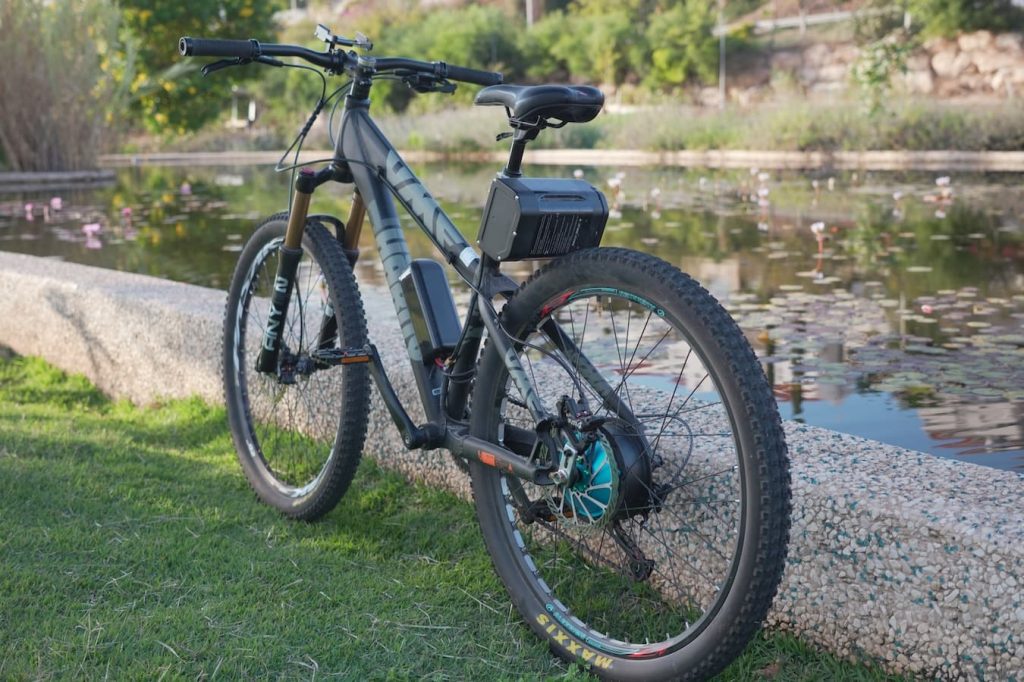
Conceptually, it can be a bit hard to wrap your head around. And honestly, seeing it in real life doesn’t exactly hammer the mechanics home, either.
But since I got to test it myself, why not take a look at the trippy way the disc rotor moves – and doesn’t move – during the test ride experience. See it in the short clip below! Or check out CHARGE’s own slow motion video that brakes it down even more (get it?).
Having ridden it myself, I can tell you that this setup feels exactly the same as normal braking with physical disc brakes. The harder I squeeze the right brake lever, which controls the rear brake caliper, the more braking power I get from the rear wheel.
If no one had told me that something was different back there in the braking system, I might not have even noticed it. Perhaps the only giveaway is that you don’t get the same amount of brake noise like you might get from a squeaky disc rotor under hard braking. And if you happen to turn around and look at your rear wheel riding (which is a tricky thing to do, in general), you’ll notice a strange sight which is that when you are riding along, your wheel is turning but the disc brake rotor is actually still. It’s trippy, and it’s the only giveaway that something isn’t quite normal back there.
The craziest part of this is that the CHARGE engineer who first came up with the solution, Alon Goldman, had never actually ridden an electric bike before coming up with this invention. He simply heard of the problem and started thinking about how he could solve it. And perhaps that was the secret that allowed him to approach motor design in a way that no one had thought of in over two decades. After learning about the problem – that e-bike motors couldn’t perform regenerative braking due to the freewheeling design of geared hub motors – he started thinking outside of the box, or rather inside of the wheel, and he realized the solution was simple. It just meant changing the way we have connected disc brake rotors to the wheel since the dawn of the first hub motor. Everything else could stay the same.
And that opens the door to finally bringing regenerative braking to basically any e-bike, or at least the majority of e-bikes on the road today, which are using geared hub motors. It requires the motor to be slightly adjusted mechanically so the disc is mounted differently, and to use CHARGE innovative controller to modulate the regenerative braking, but that’s it. It’s no longer an impossibility or even much of a hurdle. The solution is just sitting there on the table waiting to be implemented. And you better believe that the first e-bike company to jump on it is going to have a major advantage on their hands, both functionally and from a marketing perspective.
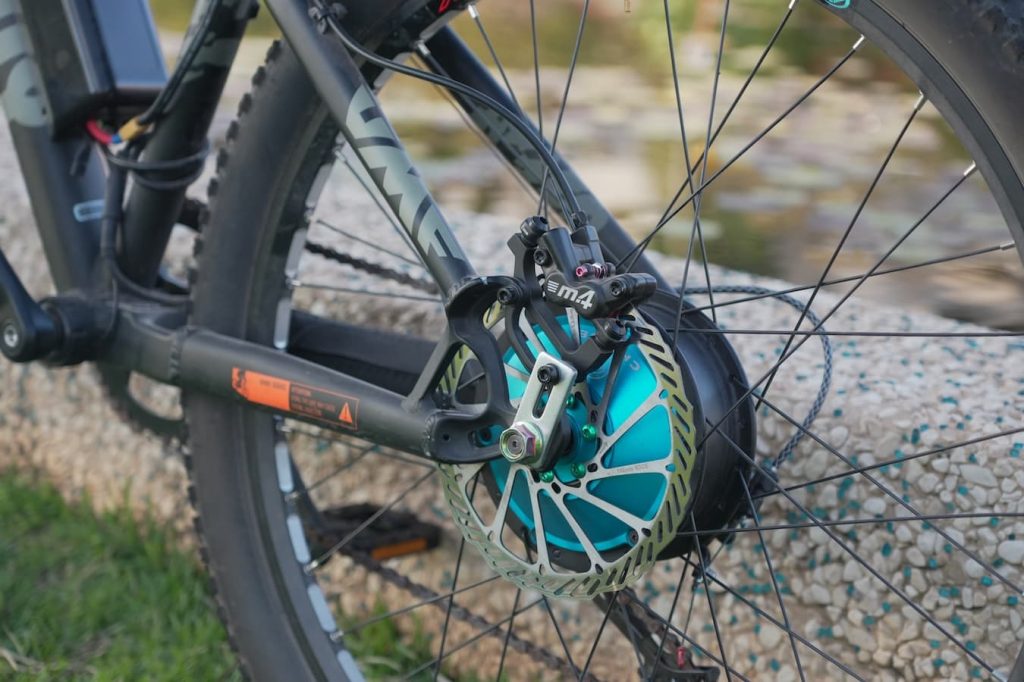
That brings us to one final question here, which is about the nature of regenerative braking itself. Regen is common in just about every electric vehicle out there except for e-bikes. We’ve long accepted that for e-bikes, the tradeoff of having a freewheeling motor to coast like a normal pedal bike is worth giving up regen, but that hasn’t numbed the desire for everyone. The benefits to other vehicles are the same to e-bikes. Brake pads last longer, batteries go farther, and we simply don’t waste the energy we worked hard to produce (or to charge up, if we haven’t been pedaling ourselves). The amount of energy we’re talking about isn’t huge on average, often between 5-10% of the total used for a trip, depending on the terrain and load (or up to 20-30% on long downhill sections, which could result in considerable increases in range). But even on average flat city riding, that still means riders can go 5-10% further, which isn’t nothing. And for many, the reduced wear and tear and lower maintenance are big benefits on their own.
So will we be watching this technology roll out on any new e-bikes soon? It sounds like the hardware and software are ready, but now it’s time to see if the market is ready to adopt it. We’ll be keeping a close eye on it, that’s for sure!
FTC: We use income earning auto affiliate links. More.
Environment
MOD Christmas Sale offers rare 10% sitewide e-bike savings from $1,799, Anker SOLIX final Xmas flash sale, Segway F3 e-scooter $750, more


Our Tuesday Green Deals are being led by the rare 10% savings from MOD Bikes’ Christmas Sale, which includes the second-ever discount on the new MOD Groove SideCar 3 e-bike at $3,149, among others. From there, we also have Anker’s final SOLIX 48-hour Christmas flash sale that is taking up to $5,299 off six varying offers that start from $699, as well as Segway’s F3 Electric Scooter down at $750, a rare Greenworks 40V power station deal, a DEWALT wet/dry shop vacuum discount, and much more waiting for you below. And don’t forget about the hangover deals that are collected together at the bottom of the page, like yesterday’s Bluetti Christmas Member Day Sale, or EcoFlow’s latest 48-hour flash sale that ends tonight, and more.
Head below for other New Green Deals we’ve found today and, of course, Electrek’s best EV buying and leasing deals. Also, check out the new Electrek Tesla Shop for the best deals on Tesla accessories.
Rare MOD Bikes Christmas deals offer hundreds in sitewide e-bike savings starting from $1,799
There are six days left to jump on MOD Bikes’ Christmas EV Sale with 10% sitewide savings, which is a rare occurrence these days. Aside from our love of the Easy 3 e-bike and its sidecar counterpart, there are notable second-chance savings hitting the newest MOD Groove SideCar 3 e-bike at $3,149 shipped, while its standalone e-bike model is down at $1,799 shipped. This is the latest sidecar-focused model from the brand that hit the market earlier in the year around the start of summer with a $3,499 full price. The brand stopped offering regular sales after March, with this model seeing its first discount during the Black Friday sale last month, when it dropped to $3,099. Now, you’re looking at the next-best rate with $350 cut from the tag – plus, the brand has promised that if prices drop further before the end of the year, you’ll get a refund for the difference. Head below to learn more about it and the full lineup of deals during MOD Bikes’ Christmas Sale.
Joining the two other sidecar-attached commuting solutions, the new MOD Groove SideCar 3 takes the brand’s Americana-inspired beach cruiser and upgrades it for passenger travel, primarily designed for pets, but it can hold up to 150 pounds total for human riders. It comes bearing a 750W geared hub motor and a 720Wh removable Samsung battery that give you up to 28 MPH top speeds and up to 50 miles of pedal-assisted travel (doubled to 100 miles with a dual battery setup).
This brand makes some high-quality e-bikes, and this model is no different, coming with a solid array of features to heighten your experience further. There’s the front suspension fork, hydraulic brakes, 3-inch multi-terrain tires with fenders over each, a Shimano ALTUS 7-speed derailleur, a snap-on rear cargo rack, LED headlight and taillight with brake lighting, a S3 Smart Color Display that has a USB port to charge your devices alongside password security to lock and unlock the bike, and more.
***Note: The sitewide 10% savings from MOD Bikes’ Christmas Sale is automatically applied in your cart, so don’t be surprised/confused by the pricing on any of these models’ landing pages.
MOD Bikes’ Christmas Sale offers:
- City 3 Step-Over Folding e-bike: $1,799 (Reg. $1,999)
- 28 MPH for up to 45 miles
- City Step-Thru 3 Folding e-bike: $1,799 (Reg. $1,999)
- 28 MPH for up to 45 miles
- Berlin 3 Commuter e-bike: $1,799 (Reg. $1,999)
- 28 MPH for up to 45 miles
- Berlin Step-Thru 3 Commuter e-bike: $1,799 (Reg. $1,999)
- 28 MPH for up to 45 miles
- CarGo 3 Step-Thru Cargo e-bike: $1,799 (Reg. $1,999)
- 28 MPH for up to 50 miles
- Groove Step-Thru 3 Beach Cruiser e-bike: $1,799 (Reg. $1,999)
- 28 MPH for up to 50 miles
- Easy 3 Cruiser e-bike: $2,159 (Reg. $2,399)
- 28 MPH for up to 50 miles
- Black 3 Off-Road e-bike: $2,159 (Reg. $2,399)
- 28 MPH for up to 50 miles
- Groove SideCar 3 e-bike: $3,149 (Reg. $3,499)
- 28 MPH for up to 50 miles
- Easy SideCar 3 e-bike: $3,509 (Reg. $3,899)
- 28 MPH for up to 50 miles
- Easy SideCar Sahara e-bike: $3,509 (Reg. $3,899)
- 28 MPH for up to 50 miles
- with upgraded features/sidecar with doggie door
You can browse MOD Bikes’ full Christmas EV Sale on the landing page here.

Final Anker SOLIX Xmas flash sale drops C2000 Gen 2 power station + alternator charger to new $969 low, more
As part of its full momentum Christmas Sale, Anker SOLIX has now launched a final 48-hour holiday flash sale through Christmas Eve with up to $5,299 savings across six offers. A notable standout amongst the crowd is the Anker SOLIX C2000 Gen 2 Portable Power Station bundled with an alternator charger at $969 shipped, which beats its Amazon pricing by $80. This station was just released back in October, with this particular bundle joining the lineup of various deals much later, and which we’ve seen brought down from its $2,098 full price to $1,049 at the lowest so far. For only two days, you can score a larger-than-ever 54% markdown that cuts $1,129 off the going rate for the lowest price we have tracked – or pick up the station on its own for nearly $300 less.
If you want to learn more about this power station bundle, or browse all the other flash offers, you can check out our original coverage of this flash sale here while it continues through December 24.

Cruise up to 44 miles on Segway’s F3 e-scooter with Apple Find My, proximity locking, more for $750
Shining another spotlight on Segway’s ongoing Christmas Holiday EV Sale, commuters needing longer-term support can jump on the F3 Electric Scooter at $749.99 shipped, which also happens to match in price at Amazon. This is one of the brand’s 2025 releases that hit the market back in April for $850, but has since been hiked up to $1,000 directly from Segway since May’s tariff increases – though, you can find it down at that original rate over at Amazon. Before May, we saw discounts go as low as $600, while our post-tariff market has now only seen costs taken as low as $700, which is where we saw it during Black Friday. If you missed out during that event, you can still save $100 off the going rate with this markdown.
If you want to learn more about this particular e-scooter, be sure to check out our original coverage of this deal here, while you can also browse the full Segway Christmas Holiday Sale lineup here.

Get more use out of your Greenworks 40V batteries with the 500W 4-slot power station at a $456 annual low
Amazon is now offering the Greenworks 40V 500W 4-Slot Portable Power Station at $455.99 shipped, which beats out its direct pricing by $144. It normally goes for $600 at full price, which is where it’s still priced direct from the brand’s website, with very few discounts over the year – the greatest of them being today’s deal to the best rate of 2025. While it did fall lower in 2024, you’re still getting the best price that we have tracked this year, with a 24% markdown here that cuts $144 off the tag.
If you want to learn more about this power station’s capabilities, be sure to check out our original coverage of these deals here.

Keep garages + shops clean during projects with this DEWALT 5-gallon wet/dry vacuum kit at new $120 Amazon low
Amazon is offering folks the DEWALT STEALTHSONIC 5-Gallon Wet/Dry Shop Vacuum Cleaner at $120.31 shipped. Coming down from $160 here, until the summer, we saw costs keep above $150, with discounts since summer taking things as low as $132 until today. Now, you can score $40 off the going rate, landing it at a new Amazon low price.
If you want to learn more about this shop vacuum, be sure to check out our original coverage of this deal here.







Best Winter EV deals!
- Velotric Nomad 2X e-bike (camo) with DELTA 3 Plus station: $3,048 (Reg. $3,298)
- Velotric Nomad 2X e-bike (sage or fig) with DELTA 3 Plus station: $2,948 (Reg. $3,298)
- Heybike Hero 750W Mid-Drive Carbon-Fiber All-Terrain e-bike: $2,099 (Reg. $3,099)
- Segway Xyber e-bike (at lowest price): $2,900 (Reg. $3,300)
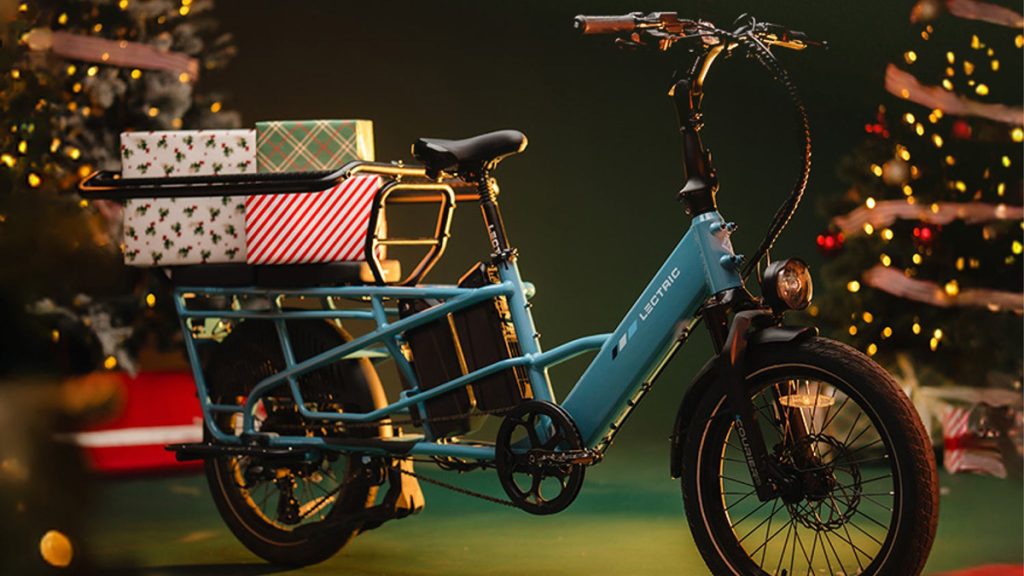
- Lectric XPedition 2.0 35Ah Cargo e-bike w/ $893 bundle: $1,999 (Reg. $2,761)
- Ride1Up TrailRush German Mid-Drive e-bike: $1,995 (Reg. $2,095)
- Heybike Hero 1,000W Carbon-Fiber All-Terrain e-bike: $1,899 (Reg. $2,599)
- Tenways Wayfarer e-bike with $366 bundle: $1,899 (Reg. $2,199)
- Velotric Fold 1 Plus e-bike with DELTA 2 station: $1,898 (Reg. $2,198)
- Segway Xafari e-bike (at lowest price): $1,800 (Reg. $2,400)
- Aventon Aventure 3 Smart All-Terrain e-bike: $1,799 (Reg. $1,999)
- Aventon Aventure 3 Smart Step-Through All-Terrain e-bike: $1,799 (Reg. $1,999)
- Velotric Summit 1 Versatile Multi-Terrain e-bike w/ 160 bundle: $1,799 (Reg. $2,059)
- Lectric XPedition 2.0 26Ah Cargo e-bike w/ $744 bundle: $1,799 (Reg. $2,543)
- Lectric XP Trike2 750 Long-Range eTrike: $1,699 (Reg. $1,799)
- Aventon Level 3 Step-Over Smart Commuter e-bike: $1,699 (Reg. $1,899)
- Aventon Level 3 Step-Through Smart Commuter e-bike: $1,699 (Reg. $1,899)
- Lectric XPeak 2.0 Long-Range Off-Road e-bike: $1,599 (Reg. $1,699)
- Aventon Abound Cargo e-bike: $1,599 (Reg. $1,999)
- Ride1Up VORSA Modular Multi-Use e-bike: $1,595 (Reg. $1,695)
- Navee’s new XT5 Pro Long-Range Off-Road Electric Scooter: $1,400 (Reg. $1,500)
- Lectric XP Trike2: $1,399 (Reg. $1,499)
- Lectric XPeak 2.0 Standard Off-Road e-bike: $1,399 (Reg. $1,499)
- Lectric XPedition 2.0 13Ah Cargo e-bike with $346 bundle: $1,399 (Reg. $1,745)
- Heybike ALPHA All-Terrain e-bike with $266 bundle: $1,299 (Reg. $1,699)
- Lectric XPress 750 Commuter e-bikes with $518 bundle: $1,299 (Reg. $1,817)
- Lectric XP4 750 LR Folding Utility e-bikes with $514 bundle: $1,299 (Reg. $1,813)
- Lectric XP Lite 2.0 JW Black LR e-bike with $350 bundle: $1,099 (Reg. $1,449)
- Heybike Hauler Dual-Battery Cargo e-bike with $89+ bundle (new low): $999 (Reg. $1,413)
- Lectric XP4 Standard Folding Utility e-bikes with $227 bundle: $999 (Reg. $1,226)
- Lectric XP Lite 2.0 Long-Range e-bikes with $350 bundles: $999 (Reg. $1,349)
- Segway ZT3 Pro All-Terrain Electric Scooter: $850 (Reg. $1,000)
- Segway E3 Pro Electric Scooter: $600 (Reg. $700)

Best new Green Deals landing this week
The savings this week are also continuing to a collection of other markdowns. To the same tune as the offers above, these all help you take a more energy-conscious approach to your routine. Winter means you can lock in even better off-season price cuts on electric tools for the lawn while saving on EVs and tons of other gear.
FTC: We use income earning auto affiliate links. More.
-
 Sports2 years ago
Story injured on diving stop, exits Red Sox game
-
 Sports3 years ago
‘Storybook stuff’: Inside the night Bryce Harper sent the Phillies to the World Series
-
 Sports2 years ago
Game 1 of WS least-watched in recorded history
-
 Sports3 years ago
Button battles heat exhaustion in NASCAR debut
-
 Sports3 years ago
MLB Rank 2023: Ranking baseball’s top 100 players
-
Sports4 years ago
Team Europe easily wins 4th straight Laver Cup
-
 Environment3 years ago
Japan and South Korea have a lot at stake in a free and open South China Sea
-
 Environment1 year ago
Here are the best electric bikes you can buy at every price level in October 2024