
SEC settles insider trading charges against Andy Bechtolsheim, co-founder of Arista, Sun Microsystems

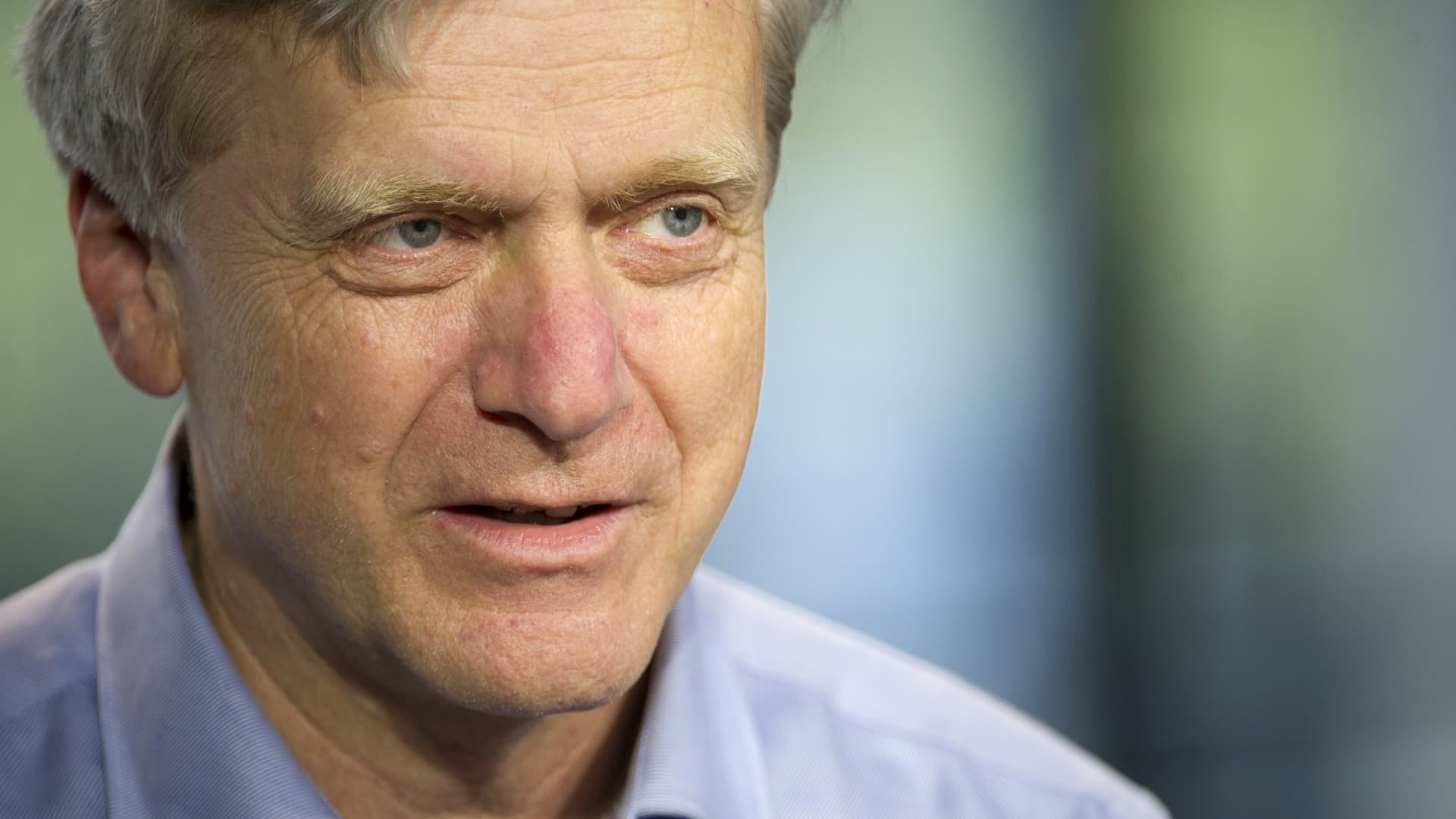
Andreas “Andy” Von Bechtolsheim, co-founder of Arista Networks Inc., speaks during a Bloomberg West television interview in San Francisco, California, U.S., on Thursday, May 2, 2013.
David Paul Morris | Bloomberg | Getty Images
Andy Bechtolsheim, the co-founder of Sun Microsystems and Arista Networks, has reached a settlement with the U.S. Securities and Exchange Commission on insider trading charges that will cost him close to $1 million and bars him from serving as a public company officer or director for five years.
The civil charges against Bechtolsheim, who has an estimated net worth of over $16 billion, is tied to Cisco’s acquisition of Acacia Communications in 2019. The SEC alleged on Tuesday that Bechtolsheim confidentially learned of an “impending acquisition” on July 8, 2019, and traded options of Acacia, netting him “combined illegal profits” of over $415,000 after the deal was made public the next day.
Cisco announced its agreement to buy networking company Acacia for $70 per share in a $2.6 billion deal, driving Acacia’s stock up 35%. The transaction ended up closing in 2021 at $115 per share for a total price of $4.5 billion.
The complaint, filed in federal district court in San Jose, California, alleged that Bechtolsheim, then chairman and chief development officer of Arista, learned that an acquisition of Acacia was fast approaching from an employee at a separate, unnamed multinational tech company. The employee had consulted with Bechtolsheim about a potential bid by that company to acquire Acacia, the suit said.
Immediately following the discussion, Bechtolsheim traded Acacia options in the brokerage accounts of a close relative as well as an associate, according to the lawsuit.
“Bechtolsheim knew or was reckless in not knowing that the information he learned about Acacia’s impending acquisition was material and nonpublic,” according to the complaint filed on Tuesday. “Bechtolsheim also knew or was reckless in not knowing that he had a duty of trust and confidence to keep such information confidential and not trade in Acacia securities based on this information.”
The SEC said Bechtolsheim settled its charges without admitting or denying the allegations against him. He agreed to pay a fine of $923,740.
Bechtolsheim, 68, resigned as Arista’s chairman and development chief in December but continues to serve as its chief architect. He’s the company’s biggest shareholder with a stake worth nearly $14 billion.
“While the SEC announcement did not involve any trading in Arista securities, Arista takes compliance to the company’s code of conduct and insider trading policy seriously,” an Arista spokesperson told CNBC in an email. “Arista will respond appropriately to the situation.”
Bechtolsheim’s attorneys didn’t immediately respond to a request for comment.
Bechtolsheim, who lives in Incline Village, Nevada, co-founded Arista in 2004 and took the company public a decade later. The networking vendor now has a market cap of close to $95 billion.
In 1982, Bechtolsheim co-founded Sun Microsystems with Scott McNealy, Vinod Khosla and Bill Joy, and served as chief hardware designer. Oracle announced its $7.4 billion acquisition of Sun in 2009.


Go back a decade and most Americans had never heard of Huawei. Today, the Chinese telecom giant is a symbol of how quickly China can dominate a strategic technology sector and in the process create new national security and market threats for U.S. government and industry.
Democratic Senator Mark Warner of Virginia, the top Democrat on the Senate Select Committee on Intelligence, is now worried about another Chinese company that he predicts will eclipse Huawei in both scale and consequence: BGI. It is not building cell towers or smartphones for the 5G era. It is collecting DNA.
“If Huawei was big, BGI will be even bigger,” Warner said at the CNBC CFO Council Summit in Washington, D.C. on Wednesday.
BGI is one of the largest genomics companies in the world. It operates DNA sequencing laboratories in China and abroad. It processes genetic data for hospitals, pharmaceutical firms and researchers across dozens of countries, according to a recent report by the National Security Commission on Emerging Biotechnology.
The company began as a Beijing-based research entity, the Beijing Genomics Institute, tied closely to China’s national genome projects. It later expanded into a global commercial powerhouse, selling DNA sequencing, prenatal testing, cancer screening, and large-scale population genetic analysis, according to an NBC News report.
Through subsidiaries, BGI says it operates in the U.S. Europe, and Japan. In several countries, it helped built national genetic databases and pandemic testing systems.
A man visits the booth of BGI at the Healthy Life Chain area of the third China International Supply Chain Expo CISCE in Beijing, capital of China, July 16, 2025.
Xinhua News Agency | Xinhua News Agency | Getty Images
U.S. intelligence officials believe that global footprint gives BGI access to one the largest collections of genetic data on Earth. Lawmakers have warned that genetic data is not just medical information. At scale, it becomes a strategic asset spurring a “DNA arms race,” according to a Washington Post report. DNA profiles can reveal ancestry, physical traits, disease risk, and family relationships, and when linked with artificial intelligence, the data can also be used for surveillance, tracking and long-term biological research tied to national security, according to the Washington Post’s reporting.
At the CNBC event this week, Warner continued to press for more focus on BGI. “They are hoovering up DNA data,” Warner said. “This level of experimentation on humans and intellectual property theft, we all should be concerned about it.”
Congressional investigators have previously warned that BGI maintains close ties to the Chinese Communist Party and Chinese military, according to a report from the House Select Committee on the CCP. They argue that China makes little distinction between commercial data and state security needs.
The ‘super soldier’ fear
One of the biggest fears tied to BGI and China’s broader biotech push is the possibility of a genetically enhanced soldier. U.S. officials have publicly claimed that China has explored human performance enhancement and military biotechnology. U.S. defense analysts say China’s research spans population DNA collection, military databases, and AI-driven human performance modeling, according to a Wall Street Journal op-ed written by U.S. Director of the Central Intelligence Agency John Ratcliffe in 2020, when he was Director of National Intelligence during President Trump’s first term.
Warner directly referenced those concerns this week.
“It’s terrifying,” Warner said.
Troops make preparations before a military parade in Beijing, capital of China, Sept. 3, 2025.
Xinhua News Agency | Xinhua News Agency | Getty Images
Warner described China as a great nation and great competitor, and as a former telecom executive (he was among the founders of Nextel), he said what Huawei was able to execute on — producing good products at inexpensive prices before the U.S. and Western competitors were prepared — is a cautionary tale.
The BGI story looks uncomfortably familiar to Warner.
“Go back in time eight or nine years, and most people had never heard of Huawei,” he said.
Huawei rose by combining massive state support, global market access and aggressive pricing, not only outcompeting Western firms on scale and cost, but positioning itself inside the world’s telecom infrastructure before governments understood the security implications. Huawei was first placed on a U.S. trade blacklist in 2019, which banned U.S. firms from selling some technology to the Chinese tech giant over national security concerns. Chip restrictions on Huawei have since become even stricter.
But Warner said by the time the U.S. moved to restrict Huawei, “[we started to] lose a little.”
Much of the 5G backbone had already been shaped by Chinese technology.
During a separate interview with Javers at the CNBC CFO Council Summit, the Republican Chairman of the House committee on the Chinese Communist Party, Michigan congressman John Moolenaar, said “We’ve seen how they run the play of excess capacity, price manipulation, driving people out of business in different areas; they’re going to continue to run that play,” he said. “We want to be friendly with China, but China is not our friend. They are our foremost adversary,” he added.
The Soviet Union was a military and ideological competitor, but China, in tech domain after domain, Warner says — from telecom and 5G to AI, quantum computing and biotech — is a different kind of competitor.
Warner now sees BGI following a similar model in biotechnology. Like Huawei, BGI scaled rapidly with state support. The Washington, D.C.-based think tank Foundation of Defense of Democracies called upon lawmakers of both parties earlier this year to restrict BGI’s access to U.S. institutions.
Congress has been trying to pass various versions of the BIOSECURE Act, which would limit the ability of Chinese biotechs to operate in the U.S. Some U.S. hospitals and research institutions with ties to Chinese genomics firms are under federal pressure, according to the Associated Press, though some medical professionals within the U.S. say they risk losing key research support for core medical goals. BGI told the AP that the bill is “a false flag targeting companies under the premise of national security. We strictly follow rules and laws, and we have no access to Americans’ personal data in any of our work,” it said.
U.S. intel has moved too slowly, and disrupted key spying alliances
Warner said the U.S. intelligence apparatus has moved too slowly to recognize the biotech threat. He says that intelligence agencies focus too much on foreign governments and militaries, with less attention placed on commercial technology sectors. But in a world where technology supremacy is national security, Warner says more of our intelligence efforts need to reflect this shift.
Only in the past two to three years, he says, has the U.S. seriously expanded spying into AI, semiconductors, and biotechnology. Warner says we need a more “advanced approach” in this area, and he gave as one recent example when China’s largest chipmaker SMIC stunned U.S. officials by producing a six-nanometer chip despite sweeping U.S. export controls. The breakthrough showed that Washington had underestimated both China’s technical qualities and ability to work around restrictions. “We got caught off guard with the SMIC six-nanometer chip,” Warner said.
Warner is also worried that tracking China’s tech rise requires a type of deep cooperation with U.S. allies that the Trump administration has squandered, such as the global intelligence-sharing network called the “Five Eyes” alliance.
Those relationships are now under strain, he said, and key partners including the United Kingdom, the Netherlands, and France have gone public in saying they are reluctant to share intel with the U.S. “They feel like we may be politicizing the intel product and that is not good news for America,” Warner said.
Underlying his concerns about the technology competition with China in areas including AI and biotech is the U.S. ceding the global lead in standards setting. For decades, the U.S. shaped the rules for wireless networks, satellites, and internet infrastructure. That dominance help Americans lead global markets, Warner said, but now China is aggressively positioning itself as the international standards setter.
Warner described the U.S. role in international bodies as one of the “secret sauces” in the era of America’s dominance of the global economy and technology, allowing the U.S. to leverage innovations occurring around the globe, “even if it didn’t arise in America.”
Across technology domains, influencing standards and protocols is critical to not only maintaining a competitive edge but also establishing ethical boundaries. “Will it be us or the Chinese?” Warner said. “The Chinese come in with clearly a less humanist approach. It’s been effective in lots of domains. We see it on standards-setting bodies. China floods the zone with lots of engineers, almost buying off the votes. We’ve got to reengage for American business and government,” he said.

-
 Sports2 years ago
Story injured on diving stop, exits Red Sox game
-
 Sports3 years ago
‘Storybook stuff’: Inside the night Bryce Harper sent the Phillies to the World Series
-
 Sports2 years ago
Game 1 of WS least-watched in recorded history
-
 Sports3 years ago
Button battles heat exhaustion in NASCAR debut
-
 Sports3 years ago
MLB Rank 2023: Ranking baseball’s top 100 players
-
Sports4 years ago
Team Europe easily wins 4th straight Laver Cup
-
 Environment3 years ago
Japan and South Korea have a lot at stake in a free and open South China Sea
-
 Environment1 year ago
Here are the best electric bikes you can buy at every price level in October 2024