
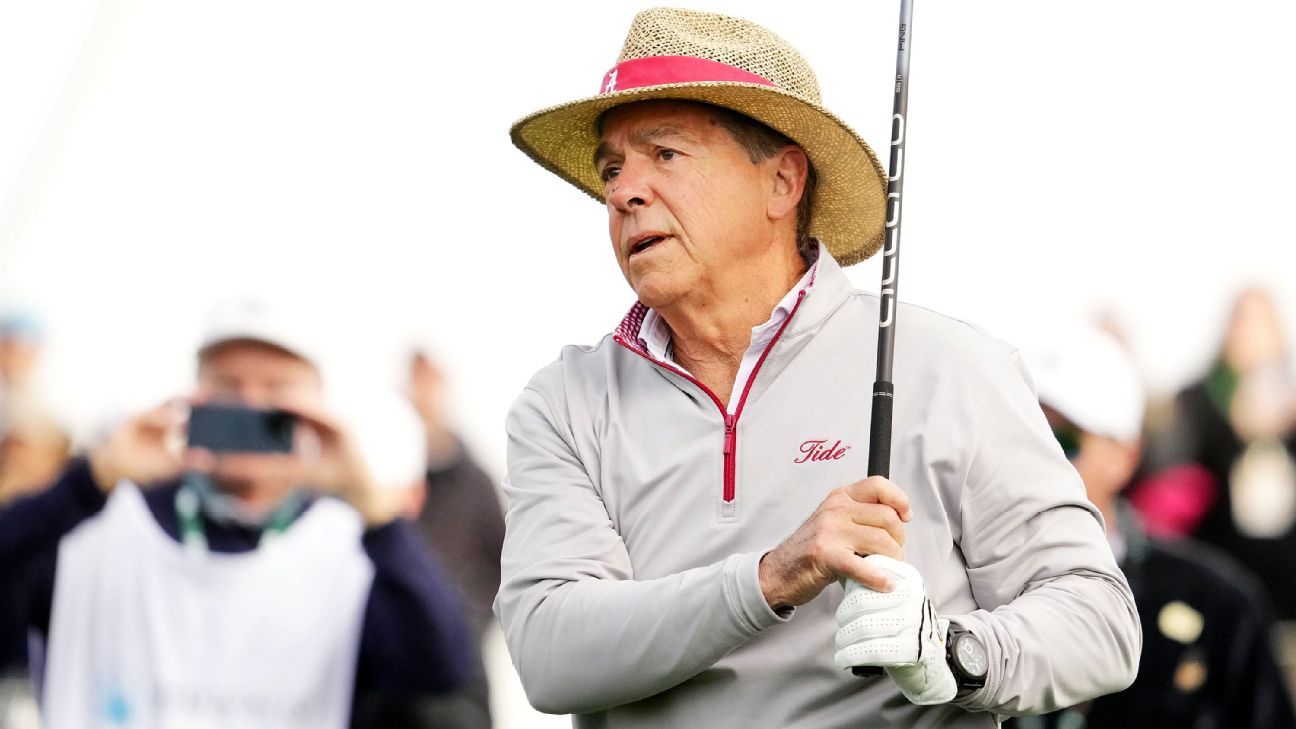
Sending emails and opening bills: Inside Nick Saban’s ‘new reality’


-
Chris Low, ESPN Senior Writer
TUSCALOOSA, Ala. — The stress level of former Alabama football coach Nick Saban is down exponentially these days, though there are some harrowing moments.
Like when his 3-year-old grandson, James, joins him on the golf course.
“The challenge is keeping him out of the sand traps,” Saban said. “He likes to play in the sand. That’s about the most stress I’ve had.”
The legendary coach’s meticulous attention to detail and unmatched work ethic during his 17 seasons in Tuscaloosa produced six national championships (after he won one at LSU), 123 NFL draft picks — including 44 first-rounders — and a new standard in college football.
But it left little time for anything else. Remember, Saban once reportedly complained about the national title game costing him a week of recruiting time.
So how has Saban adapted to his new life? It’s something his closest confidants, family members and Saban himself are still coming to grips with.
“When you’re in a rat race like he’s been, you could never really step away and appreciate what you’ve accomplished,” said Alabama head athletic trainer Jeff Allen, the only football staff member Saban brought to the Tide who was there for his entire tenure.
“You just never could because in this business as soon as you take a breath, you’re getting beat. He wasn’t going to take a breath.”
Not only is Saban now taking a breath, he’s seeing the world outside of football. He’s experiencing things he never had time for in the past. He’s actually relaxing, a word that previously wasn’t really part of his vocabulary.
“The biggest change for me as a person is that I lived my whole life for the last 50 years being in a hurry,” Saban told ESPN. “It was, ‘Hurry up to go here. Hurry up to go there. Don’t be late for this meeting. You’ve got another meeting in an hour. What are you going to say to the staff? What are you going to say to the team?’
“I mean, it was just deadline after deadline after deadline. Even when I was driving to the lake to go on vacation, I’d be in a hurry, and for what? But that’s just how you were built.”
‘The Ten Commandments of Retirement’
THERE WAS NEVER any debate about who was in charge of Alabama’s football program, but Saban has often joked that his wife of 52 years, Terry, was the family member most proficient at giving orders.
The day after he retired in January, Saban said he had a note from Ms. Terry, as he refers to her, sitting on his chair. It spelled out “The Ten Commandments of Retirement.”
Terry wouldn’t share all of them, but near the top was the decree that Saban wait for her to sit down at the dinner table and to slow down when eating. She also told him it was polite to leave a little something on his plate when eating at a restaurant.
“So at our first dinner at home, he brought his plate to me with half a pickle on it and said, ‘To be polite!'” Terry said.
Another commandment calls for Saban to alter his behavior when they are settling in on the couch. For years, when Terry would get a blanket for herself, she always picked one up for Saban.
“Now, I’d appreciate the same courtesy,” she wrote.
Terry has enrolled Saban into her own version of a “Tech 101” class.
“He’s actually texting and reading his own emails and sent his first-ever email,” Terry said. “He even took his first trip to the pharmacy to pick up his first prescription. He’s actually quite proud of himself.”
To be clear, Saban has hardly become a homebody. He doesn’t hang out watching television, though he admits to being a big fan of “Game of Thrones.”
“I can’t stand sitting around now any more than I could stand it when I was coaching,” Saban said. “I want to stay busy. I think everybody looks at me like, ‘This guy’s a ball coach and that’s all he does.’ I’ve got businesses, I do speaking stuff. I’ve got my TV job now with ESPN. I like to play golf. I’ve got tons of stuff to do. So I’m not retiring to quit working.”
Saban is part-owner of multiple car dealerships, including a Ferrari dealership in Nashville and a Mercedes-Benz dealership in Birmingham. He has a stake in a boutique hotel, The Alamite, in downtown Tuscaloosa.
“What’s so exciting for all of us, especially him, is that he kind of has a blank slate now that he can play around with,” said Saban’s daughter Kristen, who lives in Birmingham. “It’s really nice to see him not have this big stressful thing hanging over him. He’s accomplished so much that I don’t think he feels like he’s leaving anything behind. He’s leaving with no regrets and stepping away with a lot of gratitude and a lot of relief at the same time.
“He’s in a relaxed state of mind that I haven’t really seen him in, and it kind of puts everybody else at peace too.”
Now that Saban is home more, he has been doing the kind of mundane household tasks most don’t even think about but that weren’t part of his routine. Imagine being the delivery driver who finds himself face to face with college football’s greatest coach.
“It’s funny to see people’s reaction when he opens the door because for 17 years he has never been there to answer it,” said Terry, who has had as much fun as anybody reveling in the changes in her husband’s lifestyle.
She joked that Saban has now learned where all the light switches are in the house and has taken to getting the mail. He even opens up some of the bills now.
“Sometimes ignorance is bliss,” Terry said.
Kristen is confident her dad will continue to evolve and adapt in retirement, much as he did when he was coaching. But don’t expect him to show up on social media.
“No chance,” Kristen said, laughing. “People have said they want him on it, and I’ve said it’s just not going to happen. He just learned to text and email. How’s he going to tweet something?”
Kristen promises to post a few pictures of the retirement version of her dad from time to time on her social media accounts.
“But could you imagine him doing an Instagram selfie or something somewhere on the golf course?” she said. “We can hope, but it’s not going to happen.”
And don’t expect Saban to make many grocery store runs, as Kristen and Terry learned their lesson a few years ago when the family was at their old home in Boca Grande, Florida. They sent Saban to the store to restock the fridge with ketchup, mustard and other condiments, and to fill the car with gas. But the perfectionist in Saban quickly became a problem.
“He was like, ‘Yeah, yeah, I can do it,’ and he’s not even in the store for five minutes when he calls and says, ‘There’s a hundred bottles of ketchup and mustard on the shelf. Which kind am I supposed to get?'” Kristen recounted.
Saban was persistent: “Is there a specific brand or size?”
Kristen, who laughs as hard now as she did when the grocery store excursion occurred, said the general response from her and her mom was the same.
“God forbid he grabs the wrong bottle,” she said. “We were like, ‘OK, just grab whatever.'”
A windowless office and lunchtime golf
THE SABANS HAVE a new home in Jupiter Island, Florida, not far from where Tiger Woods lives. They’ve been there for most of March, and though they will spend plenty of time there in the offseason, they will remain based in Tuscaloosa. Saban wants to be close enough where he can be a resource for the university and will also have more time to join Terry in her philanthropic work.
“I want to bring the least amount of attention to me being around here as possible,” Saban said. “So I want to be supportive. I want to be helpful, but I don’t want to be looking over anybody’s shoulder.”
In other words, don’t expect him to be walking around the hallways at the football complex and poking his head in meetings. He’s talked multiple times with new coach Kalen DeBoer and even had a conversation with new defensive coordinator Kane Wommack, but Saban will steer clear of the day-to-day football operation.
He will keep an office on campus, but not in the Mal M. Moore Athletic Facility where it had been for the past 17 years. His new office is located above the south end zone of Bryant-Denny Stadium, the opposite side from the Walk of Champions and Saban’s statue, so he won’t have to walk past the 9-foot bronze likeness of himself every morning. His office is modest in size with no windows, and his desk is the same one he had at the football complex.
“It’s just a hell of a lot cleaner,” Saban said.
When he’s heading to the office, Saban leaves the house about the same time he always did, just before 7 a.m. Depending on what he has going on, he may head home around 4 p.m., or he may leave at lunchtime and go hit golf balls. He’s not naïve and knows there will be some football withdrawal as he settles into retirement life.
When Saban was nearing a decision about whether to retire, he spoke with Pro Football Hall of Fame coach Bill Parcells, who has a house in the same area of Jupiter Island. Parcells is in the thoroughbred racing business and cautioned Saban not to fall into the same trap as some of the jockeys he’s seen who keep riding into and beyond their 50s because it’s in their blood and they just can’t give it up.
“It’s a hazardous occupation, and I’m talking about screws just holding those guys’ chests together, and they’re still taking every mount they can get. There’s no way they’re ever going to quit,” Saban said, relaying his conversation with Parcells. “Coaches are like that, too, because as a coach, you think you’ve got to keep coaching, you’ve got to keep teaching, that you can’t do without it.
“But Parcells’ analogy was a good one for me, because you step back and realize that you can.”
Mark Dantonio, who was Saban’s defensive backs coach at Michigan State in the 1990s and was later the Spartans’ head coach for 13 seasons, remembers getting a call from his old boss about two or three days after Dantonio retired in 2019.
“He called just checking on how I was doing, and then two days after that call, he called me back again to check on me,” recalled Dantonio, who is part of the College Football Hall of Fame class of 2024. “When you retire in this business, you’re jumping off a fast car. There’s no landing place. You go from working 365 days, 24 hours a day, to being retired. There’s going to be other things that replace that, but nothing like you’re used to. So there’s quite an adjustment.”
Football will always be a part of Saban’s DNA, whether he’s lending his voice in an attempt to help ease the current chaos in the sport, as he did earlier this month when appearing before a congressional committee in Washington, D.C., or breaking down a matchup on ESPN’s “College GameDay,” which he will be a part of this season. Saban has been working overtime watching tape and researching players — many of whom he coached, coached against or recruited — in preparation for ESPN’s NFL draft coverage.
His desk is surrounded by a stack of boxes filled with notes going back more than 20 years. He’s in the process of consolidating his notes from some of the talks he had with coaches and players.
“It’s taken forever because they’re not in order,” Saban said. “I was looking at a talk today, for instance, when I was with the Dolphins before we played the Oakland Raiders. I want to be able to remember what I said to the players, the points I was trying to make, some of the things you want to get across when you’re talking to some of these groups about leadership.”
Joe Pendry was one of Saban’s most trusted confidants in football, and they go all the way back to their West Virginia roots. Pendry, who was Saban’s first offensive line coach at Alabama, offered his longtime pal a very simple piece of advice.
“‘Turn that phone off and leave it off,'” Pendry said he told Saban. “It’s never easy when you’ve done it as long and as well as Nick has and then walk away and not undergo a little bit of a debriefing process. He’ll get there. It just might take him some time, especially on those dates like preseason camp starting and the season starting. As much as anything, he’s going to miss practice because nobody loved being out there coaching and teaching those players more than Nick did.”
Enjoying a ‘new reality’
Saban promised Terry he would walk away from football while their quality of life would still allow them to do things they’ve wanted to but couldn’t because of his schedule. That may mean more trips to their home in Lake Burton, Georgia, where they have a group of friends who don’t bombard him with football talk. Saban has celebrated his birthday (he turns 73 this year) the past few years with those friends. And since his birthday falls on Halloween, usually during an open date on Alabama’s schedule, they don’t gather to watch football, but occasionally dress up in costumes.
Last October, Saban dressed up as explorer John Smith from “Pocahontas.” Other costumes included Thurston Howell III and Lovey from the old television show “Gilligan’s Island.”
“We all are enjoying this new reality of more time, more choices and less stress,” Terry said.
And more time to play golf.
Last month Saban played at a celebrity tournament in Florida with rappers 50 Cent and Travis Scott. When Kristen caught wind of that, she couldn’t resist needling her dad.
“I said, ‘Do you understand who you’re playing golf with right now?'” she asked. “He goes, ‘Yeah, they’re rappers.’ I told him they’re not just rappers, that 50 Cent was the biggest rapper of my generation and Travis Scott is one of the biggest of the current generation. I was like, ‘You have no idea the people you’re in the presence of,’ and he really didn’t.
“He could meet the Dalai Lama and not realize who it was.”
On a typical workday, Saban ate lunch at his desk, the same salad, with turkey slices and cherry tomatoes, day after day. His new office on campus is just steps away from Rama Jama’s, an iconic area restaurant that is a virtual football museum filled with helmets, jerseys and other memorabilia. On the day Saban moved into his new digs, Allen pointed to Rama Jama’s and said, “Coach, now you can walk across the street and get you a hamburger for lunch.”
Saban looked quizzically at the restaurant and said, “Yeah, what is that place? Has it been there for a long time?”
Allen, who had a front-row seat for Saban’s singular focus for 17 seasons, could only laugh.
“Yeah, Coach, for decades,” he responded.
Saban nodded and said that he might try it sometime.
“I just want to be there when he walks in and orders a hamburger,” Allen said with a laugh.
So does Kristen.
“We all do,” she said. “Seeing him sitting there and eating a hamburger in the middle of the day might be the surest sign yet that he’s really retired, and he deserves every bit of it.”
Saban smiled when asked how long it took for a sense of relief to set in after telling his players he was retiring.
“Really as soon as I did it,” he said. “Now, I had to adapt. People would call me and ask me questions. Players would call and ask what they should do, and I would commiserate on it and tell Terry that so-and-so is calling about this or that or whatever.”
Terry’s response was always the same: “It’s not your problem anymore.”
“I had to get used to that part of it,” Saban said.


-
Dave Wilson
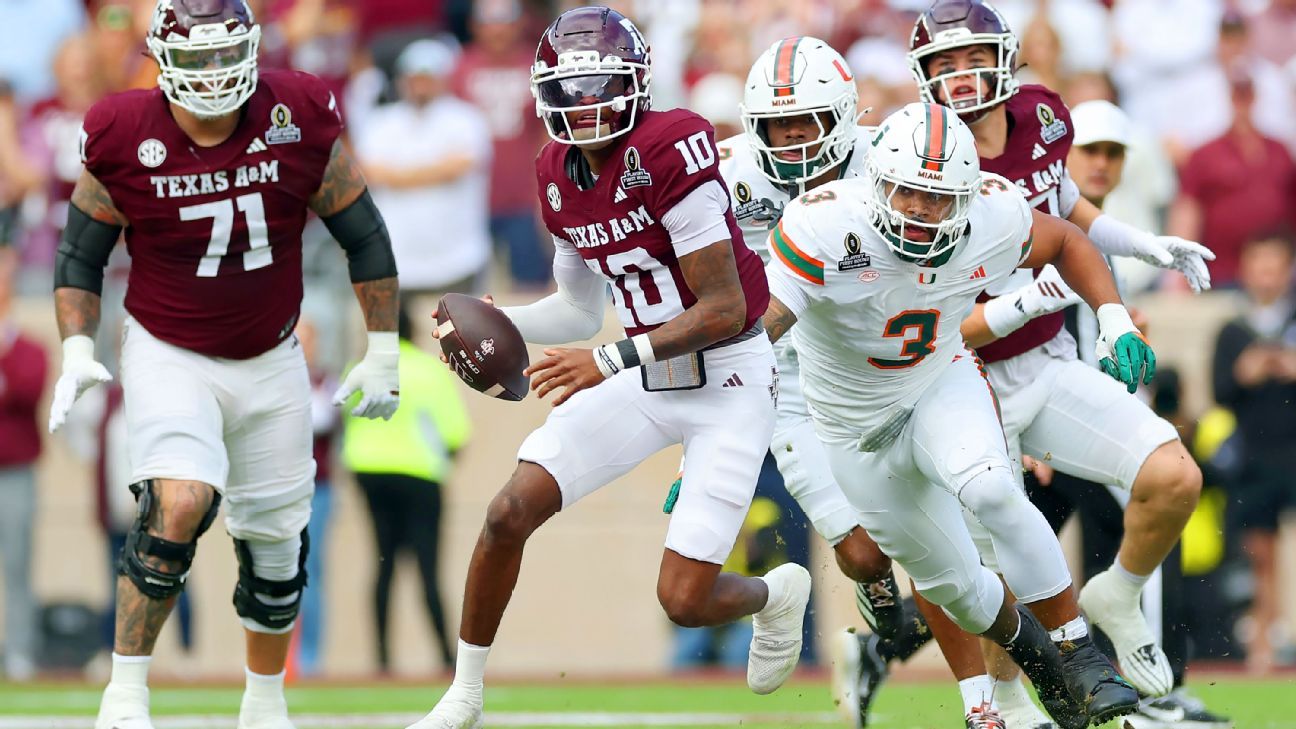
COLLEGE STATION, Texas — Texas A&M‘s historic season ended with a gut punch, as quarterback Marcel Reed, who had driven the Aggies to the Miami 5-yard line with 27 seconds left, threw an interception in the back of the end zone in a 10-3 loss at Kyle Field.
The loss Saturday in front of 104,122, the second-biggest crowd in CFP history, ended the Aggies’ season at 11-2, tying A&M’s 1939, 1998 and 2012 teams for the second-most wins in program history, behind the 1992 squad that finished 12-1.
Mike Elko, the Aggies’ second-year head coach, said that the loss will sting but that it shouldn’t discount what the team accomplished. When he took over before last season, he said that this was not an elite program ready to compete for a national championship. In his first season, the Aggies finished 8-5 after a 7-1 start and went into the offseason vowing to put an emphasis on finishing games. They did that all year and started 11-0 but lost their final two games: to Texas in Austin and then to the Hurricanes, their first defeat at home this season.
“We weren’t able to tilt the margins in our favor the last two games,” Elko said. “That’s going to be a killer. One to not go to Atlanta [to the SEC championship], one to not go to the quarterfinals. So that’s a killer, but you’ve got to swallow it and you’ve got to move forward just like we did last year.”
Elko said he and his staff believed this team had “fairly small margins” to be successful in each game, and that’s exactly how the season played out. He said that as a grown man he can handle the disappointment but that he is hurting for his players. Still, he emphasized that he didn’t want to discount what his players had done to help turn the tide for the Aggies.
“I said to the seniors who just played their last game, they left a mark on elevating this program that will never go away. From where this program was two years ago to where it is now, I don’t think that can be lost on people,” Elko said. “I said to the guys coming back, there’s still another major step we have to take as a program to finish. I think the last two games showed that.”
Elko said his offense had become one-dimensional, and he credited Miami’s defense for preventing the Aggies from being able to run the ball, enabling the Canes to tee off on Reed.
“Marcel Reed can’t be our leading rusher,” Elko said of his sophomore quarterback who had 15 carries for 27 yards, 6 more than running back Rueben Owens II. “He can’t have the most carries. It just can’t happen that way.”
Reed sat devastated on the bench as the game ended following the interception, a towel draped over his head. Reed’s offensive coordinator, Collin Klein, is headed to Kansas State, his alma mater, as the Wildcats’ new coach. The two spoke about how close their relationship is after the game, with Reed saying Klein is like a father figure for him.
“It didn’t really feel real,” Reed said. “I don’t want the season to end. A lot of changes are going to be made after the season, so I really didn’t want it to end. It sucked.”
Taurean York, the Aggies’ all-SEC linebacker, said he’s proud of the steps the team took and called the season a “foundation-setter,” saying A&M finally got to the big stage and has plans to keep building.
“We’re really just scratching the surface of who we’re going to become in the future,” he said.
The Aggies traded defensive blows with Miami all day, but Carson Beck‘s shovel pass to Malachi Toney with 1:44 left broke the game open. The Aggies’ offense responded, driving with a chance to tie the game before Bryce Fitzgerald‘s second interception of Reed on the day ended A&M’s season and crushed the Kyle Field faithful.
“We came up 5 yards short and that’s something we’ll have to live with throughout the off season,” Elko said. “But [I’m] still proud of this team, proud of what they accomplished, proud of what they did.”

-
David Hale
COLLEGE STATION, Texas — Rueben Bain rolled his eyes, smiled, then held up his cell phone, the lock screen glowing with a photo of Texas A&M offensive lineman Trey Zuhn III. Bain had anticipated the question. He was looking forward to it.
In the run-up to Saturday’s College Football Playoff game between Miami and Texas A&M, Zuhn had delivered the bulletin-board material, when he told reporters he didn’t think Bain “would be a threat that we need to worry about too much.”
Big mistake.
“We don’t take kindly to disrespect,” Bain said. “Some people said some things they shouldn’t have said.”
Bain and the Miami defense were dominant in a 10-3 win over the Aggies, ending a once-promising Texas A&M season and sending the Hurricanes on to the Goodyear Cotton Bowl, where they’ll face off against Ohio State.
Bain finished with five tackles — four for a loss — and three sacks, while also blocking a field goal in the first half.
The rest of the defense followed his lead, racking up nine tackles for loss and creating three takeaways, including a game-sealing interception in the back of the end zone with 24 seconds to play by freshman Bryce Fitzgerald.
In the aftermath, defensive end Akheem Mesidor was running through his rolodex of players who’d stepped up against the Aggies — defensive line, defensive backs, linebackers — then mentioned Fitzgerald.
“Bryce!” Bain and cornerback Keionte Scott both shouted in unison, laughing.
Fitzgerald arrived on campus in June, but quickly made his presence felt, and his role on Miami’s defense has grown as the season progressed. On Saturday, he was a star, intercepting Aggies quarterback Marcel Reed twice. The latter came on a third-and-goal at the 5 after the Aggies had marched down the field in an effort to tie it, but Fitzgerald stepped in front of a pass intended for Melin Ohrstrom and the celebration began.
“He’s a quick study,” Miami coach Mario Cristobal said. “He’s never flinched. He spends every waking minute studying, but when the lights come on, some guys just kind of have ‘it.’ He’s that guy. He just knows what to do and how to do it.”
A year ago, this Miami defense was the fly in the ointment that kept the Hurricanes from the playoff. With future No. 1 NFL draft pick Cam Ward working magic on offense, Miami’s battered secondary created a chain reaction that led to a complete defensive meltdown in the season’s stretch run. Miami lost two of its final three games to fall from No. 4 in the rankings to out of the playoff.
Cristobal responded by making a change at coordinator, bringing in Corey Hetherman — now a Broyles Award finalist — and putting a focus on rebuilding the back end of the defense. Fitzgerald and Scott, along with transfer Xavier Lucas, were keys to the turnaround. With the secondary secure, the defensive front was free to wreak havoc, and Mesidor and Bain did exactly that against the Aggies.
“We sat in the locker room for like 15 minutes [after the game],” Bain said, “just saying how crazy it was for us to win this game in this kind of way.”
Hetherman said the focus for Miami’s defense was actually more about patience and keeping Reed inside the pocket. The A&M quarterback did have a handful of scrambles that extended plays to find open receivers or picked up yards on the ground. But Hetherman said he prioritized showing Reed a host of different coverage schemes to keep him off balance, and eventually that allowed the Miami defensive front to get home.
Miami’s seven sacks against Texas A&M tied for the most by a ‘Canes defense in the last six seasons. And while there’d been concern about how Miami’s offensive line would handle the crowd noise at Kyle Field, where more than 104,000 fans provided a stifling soundtrack, it was actually the Aggies O-line that was flagged for multiple penalties.
“We lost the game of the line of scrimmage, and I think it got worse in the second half,” Aggies coach Mike Elko said. “We just couldn’t keep them off of us. We couldn’t get the run game established. We became one-dimensional. Once we became one-dimensional, they were able to tee off.”
Overall, Miami held the Aggies to just 326 yards of offense and just 89 on the ground — just 50 from A&M’s trio of tailbacks, Le’Veon Moss, Rueben Owens and EJ Smith.
And when Miami’s back was against the wall, the defense was at its best. A&M’s three red-zone trips amounted to just three total points, and when Miami receiver Malachi Toney fumbled near midfield late in the game, the Hurricanes defense followed with a quick three-and-out.
“A year ago, we had a tough time stopping people on defense,” Cristobal said. “This was one of those games where we felt like we were holding good and knocking them back. The confidence that [the defense] brings is off the charts, and they were the difference today.”
-
 Sports2 years ago
Story injured on diving stop, exits Red Sox game
-
 Sports3 years ago
‘Storybook stuff’: Inside the night Bryce Harper sent the Phillies to the World Series
-
 Sports2 years ago
Game 1 of WS least-watched in recorded history
-
 Sports3 years ago
Button battles heat exhaustion in NASCAR debut
-
 Sports3 years ago
MLB Rank 2023: Ranking baseball’s top 100 players
-
Sports4 years ago
Team Europe easily wins 4th straight Laver Cup
-
 Environment3 years ago
Japan and South Korea have a lot at stake in a free and open South China Sea
-
 Environment1 year ago
Here are the best electric bikes you can buy at every price level in October 2024