
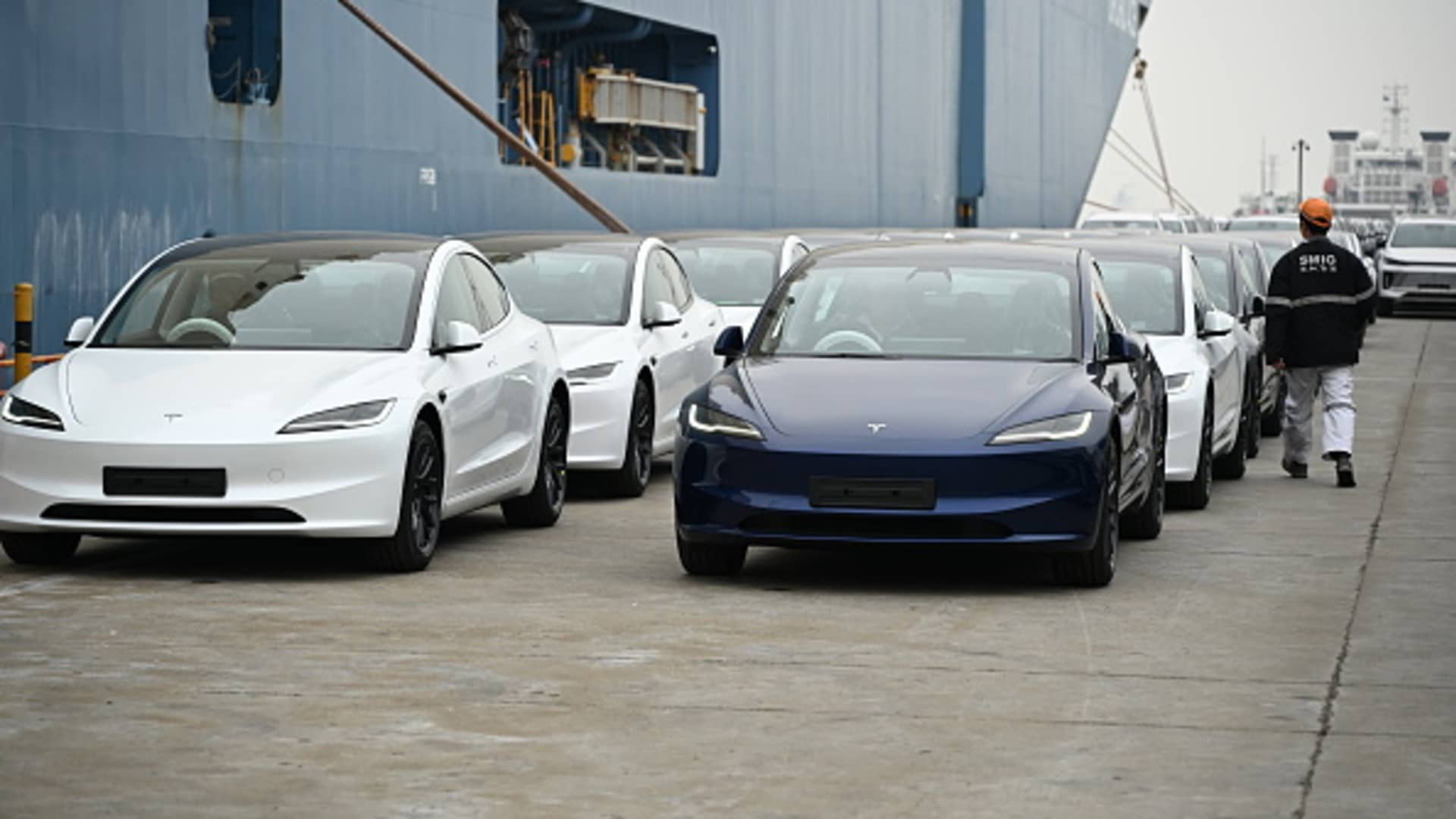
Tesla on Tuesday published its first-quarter vehicle production and deliveries report for 2024 that showed deliveries fell 8.5% from the year-ago quarter and about 20% from the fourth quarter. Here are the key numbers:
Total deliveries Q1 2024: 386,810 Total production Q1 2024: 433,371
Vehicle production declined 1.7% year over year and 12.5% sequentially for Tesla.
Shares dropped about 6.5%.
Tesla doesn’t break out sales by model but reported that it produced 412,376 Model 3/Y cars and delivered 369,783. It produced 20,995 of its other models and delivered 17,027.
In the same period last year, the electric automaker reported 422,875 deliveries and production of 440,808 vehicles. In the fourth quarter of 2023, Tesla reported 484,507 deliveries and production of 494,989 vehicles.
Deliveries are the closest approximation of sales reported by Tesla but are not precisely defined in the company’s shareholder communications.
Tesla’s deliveries fell below even the lowest analyst estimate.
According to a mean of 11 estimates compiled by FactSet, analysts were expecting deliveries of around 457,000 for the period ending March 31. Estimates ranged from a high of 511,000 deliveries to a low of 414,000 for the first quarter, with estimates updated in March ranging from 414,000 to 469,000 deliveries.
Independent auto industry researcher Troy Teslike, whose work is closely followed by Tesla fans, had expected deliveries to come in around 409,000.
Tesla’s head of investor relations Martin Viecha sent around a company-compiled consensus based on 30 analysts’ estimates over the weekend to select investors. The consensus, which was viewed by CNBC, said analysts were expecting a mean of 443,027 deliveries and a median of 431,125 deliveries for the quarter.
Tesla faced numerous challenges in the first quarter.
“Decline in volumes was partially due to the early phase of the production ramp of the updated Model 3 at our Fremont factory and factory shutdowns resulting from shipping diversions caused by the Red Sea conflict and an arson attack at Gigafactory Berlin,” Tesla said in a statement.
Houthi militia attacks on shippers in the Red Sea disrupted Tesla’s component supply and temporarily suspended production at its German factory outside of Berlin in January. In March, environmental activists set fire to infrastructure near that same factory, depriving Tesla of sufficient operation power and again causing a pause in production.
In China, Tesla faced an onslaught of competition from domestic EV makers, including BYD and newcomers such as the phone maker Xiaomi. After sluggish sales numbers for its China-made cars in January and February, Tesla reduced production of its Model 3 and Model Y at its Shanghai plant and slashed workers’ schedules to 5 days a week from 6 and a half days.
In the U.S., reviews were mixed for Tesla’s newest model — an angular pickup dubbed the Cybertruck — which the EV maker only began to sell in small numbers in December last year.
A series of discounts and incentives appeared to be less effective in driving sales volume than in the past for Tesla.
During the final days of the first quarter, Tesla CEO Elon Musk mandated that all sales and service staff install and demo the newest version of the company’s premium driver assistance system for customers in North America before handing over their cars. The system is marketed as Full Self-Driving but doesn’t make Tesla cars autonomous. They require a human at the wheel, ready to steer or brake at any time.
Shares of Tesla dropped 29% in the first quarter, the biggest decline since the end of 2022 and the third-steepest quarterly plunge since the company’s IPO in 2010.
The company scheduled an earnings call for April 23 to discuss quarterly results.
Oracle CEO Clay Magouyrk appears on a media tour of the Stargate AI data center in Abilene, Texas, on Sept. 23, 2025.
Kyle Grillot | Bloomberg | Getty Images
Oracle on Friday pushed back against a report that said the company will complete data centers for OpenAI, one of its major customers, in 2028, rather than 2027.
The delay is due to a shortage of labor and materials, according to the Friday report from Bloomberg, which cited unnamed people. Oracle shares fell to a session low of $185.98, down 6.5% from Thursday’s close.
“Site selection and delivery timelines were established in close coordination with OpenAI following execution of the agreement and were jointly agreed,” an Oracle spokesperson said in an email to CNBC. “There have been no delays to any sites required to meet our contractual commitments, and all milestones remain on track.”
The Oracle spokesperson did not specify a timeline for turning on cloud computing infrastructure for OpenAI. In September, OpenAI said it had a partnership with Oracle worth more than $300 billion over the next five years.
“We have a good relationship with OpenAI,” Clay Magouyrk, one of Oracle’s two newly appointed CEOs, said at an October analyst meeting.
Doing business with OpenAI is relatively new to 48-year-old Oracle. Historically, Oracle grew through sales of its database software and business applications. Its cloud infrastructure business now contributes over one-fourth of revenue, although Oracle remains a smaller hyperscaler than Amazon, Microsoft and Google.
OpenAI has also made commitments to other companies as it looks to meet expected capacity needs.
In September, Nvidia said it had signed a letter of intent with OpenAI to deploy at least 10 gigawatts of Nvidia equipment for the San Francisco artificial intelligence startup. The first phase of that project is expected in the second half of 2026.
Nvidia and OpenAI said in a September statement that they “look forward to finalizing the details of this new phase of strategic partnership in the coming weeks.”
But no announcement has come yet.
In a November filing, Nvidia said “there is no assurance that we will enter into definitive agreements with respect to the OpenAI opportunity.”
OpenAI has historically relied on Nvidia graphics processing units to operate ChatGPT and other products, and now it’s also looking at designing custom chips in a collaboration with Broadcom.
On Thursday, Broadcom CEO Hock Tan laid out a timeline for the OpenAI work, which was announced in October. Broadcom and OpenAI said they had signed a term sheet.
“It’s more like 2027, 2028, 2029, 10 gigawatts, that was the OpenAI discussion,” Tan said on Broadcom’s earnings call. “And that’s, I call it, an agreement, an alignment of where we’re headed with respect to a very respected and valued customer, OpenAI. But we do not expect much in 2026.”
“This is the wrong approach — and most likely illegal,” Sen. Amy Klobuchar, D-Minn., said in a post on X Thursday.
“We need a strong federal safety standard, but we should not remove the few protections Americans currently have from the downsides of AI,” Klobuchar said.
Trump’s executive order directs Attorney General Pam Bondi to create a task force to challenge state laws regulating AI.
The Commerce Department was also directed to identify “onerous” state regulations aimed at AI.
The order is a win for tech companies such as OpenAI and Google and the venture firm Andreessen Horowitz, which have all lobbied against state regulations they view as burdensome.
It follows a push by some Republicans in Congress to impose a moratorium on state AI laws. A recent plan to tack on that moratorium to the National Defense Authorization Act was scuttled.
Collin McCune, head of government affairs at Andreessen Horowitz, celebrated Trump’s order, calling it “an important first step” to boost American competition and innovation. But McCune urged Congress to codify a national AI framework.
“States have an important role in addressing harms and protecting people, but they can’t provide the long-term clarity or national direction that only Congress can deliver,” McCune said in a statement.
Sriram Krishnan, a White House AI advisor and former general partner at Andreessen Horowitz, during an interview Friday on CNBC’s “Squawk Box,” said that Trump is was looking to partner with Congress to pass such legislation.
“The White House is now taking a firm stance where we want to push back on ‘doomer’ laws that exist in a bunch of states around the country,” Krishnan said.
He also said that the goal of the executive order is to give the White House tools to go after state laws that it believes make America less competitive, such as recently passed legislation in Democratic-led states like California and Colorado.
The White House will not use the executive order to target state laws that protect the safety of children, Krishnan said.
Robert Weissman, co-president of the consumer advocacy group Public Citizen, called Trump’s order “mostly bluster” and said the president “cannot unilaterally preempt state law.”
“We expect the EO to be challenged in court and defeated,” Weissman said in a statement. “In the meantime, states should continue their efforts to protect their residents from the mounting dangers of unregulated AI.”
Weissman said about the order, “This reward to Big Tech is a disgraceful invitation to reckless behavior by the world’s largest corporations and a complete override of the federalist principles that Trump and MAGA claim to venerate.”
In the short term, the order could affect a handful of states that have already passed legislation targeting AI. The order says that states whose laws are considered onerous could lose federal funding.
One Colorado law, set to take effect in June, will require AI developers to protect consumers from reasonably foreseeable risks of algorithmic discrimination.
Some say Trump’s order will have no real impact on that law or other state regulations.
“I’m pretty much ignoring it, because an executive order cannot tell a state what to do,” said Colorado state Rep. Brianna Titone, a Democrat who co-sponsored the anti-discrimination law.
In California, Gov. Gavin Newsom recently signed a law that, starting in January, will require major AI companies to publicly disclose their safety protocols.
That law’s author, state Sen. Scott Wiener, said that Trump’s stated goal of having the United States dominate the AI sector is undercut by his recent moves.
“Of course, he just authorized chip sales to China & Saudi Arabia: the exact opposite of ensuring U.S. dominance,” Wiener wrote in an X post on Thursday night. The Bay Area Democrat is seeking to succeed Speaker-emerita Nancy Pelosi in the U.S. House of Representatives.
Trump on Monday said he will Nvidia to sell its advanced H200 chips to “approved customers” in China, provided that U.S. gets a 25% cut of revenues.
Coinbase is gearing up to launch an in-house prediction market, powered by Kalshi, a source close to the matter told CNBC — a strategic play to expand the number of asset classes available on the cryptocurrency exchange at a time some investors are shying away from digital assets.
The source said Coinbase and Kalshi will “soon” formally announce the prediction market, with news on the matter potentially coming as early as next week.
Rumblings of the prediction market launch have swirled for nearly a month. An alleged screenshot of Coinbase’s prediction markets dashboard shared by Silicon Valley researcher Jane Manchun Wong in an X post dated Nov. 18 offered some clues about the new product.
The Information first reported on Nov. 19 that Coinbase planned to launch prediction markets powered by Kalshi, adding that the exchange would unveil the new product at its “Coinbase System Update” event on Dec. 17. Bloomberg published a similar report on Thursday, citing a source familiar with the matter, adding that Coinbase would also announce a tokenized stock offering at the showcase.
Coinbase declined to confirm the reports to CNBC, but said to tune into its event next week. The firm did not comment on a timeline for when its prediction markets would go live for its users.
Coinbase’s upcoming product launches underscore its push to refashion itself into an “everything exchange,” or a one-stop shop for trading all kinds of assets, including crypto tokens, tokenized stocks and event contracts. In May, CEO Brian Armstrong articulated that “everything exchange” vision to investors, saying Coinbase would aim to become a top financial services app within the next decade.
The trading platform is setting its sights on that goal as it faces intensifying competition from rivals such as Robinhood,Gemini and Kraken. All three have launched tokenized equity offerings to users outside of the U.S. within the past year, in addition to exploring prediction markets to varying extents.
Coinbase’s moves to expand the financial instruments available to its users also come as investor sentiment on digital assets cools. A series of liquidations of highly leveraged digital asset positions in mid-October triggered several pullbacks in the crypto market, prompting investors to rotate out of tokens and into gold and other safe-have assets.
Bitcoin fell as low as around $85,000 in early December, hitting its lowest level since last March. The token was last trading at $89,951, down 23% in the past three months. Coinbase has also fallen more than 16% over the past three months.
The deal also underscores U.S.-based prediction markets operator Kalshi’s push to embed its event contracts into various brokerages, widening its reach as the prediction markets space becomes increasingly competitive.
This year, Kalshi embedded several of its prediction markets into trading platform Robinhood, as part of a non-exclusive partnership between the companies. Kalshi has also engaged in talks with several other major brokerages, including those in the crypto industry, with the aim of closing more deals like the ones it has struck with Robinhood and now Coinbase, a source familiar with the matter told CNBC.





