The logo of technology company Nvidia is seen at its headquarters in Santa Clara, California, on Feb. 11, 2015.
Robert Galbraith | Reuters
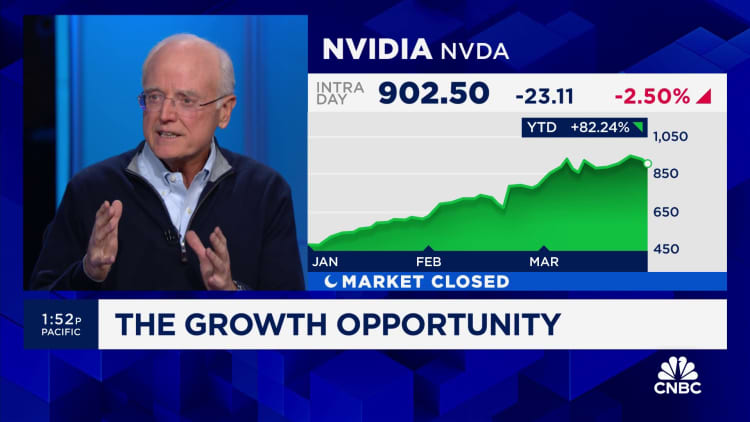
Nvidia is planning to build a $200 million artificial intelligence center in Indonesia in partnership with local telco giant Indosat Ooredoo Hutchison, as the U.S. tech darling continues its push into Southeast Asia.
According to Indonesia’s Communication and Information Technology Minister, Budi Arie Setiadi, the new facility will be based in the city of Surakarta in the Central Java province and will bolster local telecommunications infrastructure, human resources, and digital talent.
Indosat did not respond to a request for comment, while Nvidia declined to comment on the matter.
Last month, Indosat announced that it was ready to integrate Nvidia’s next-generation chip architecture, Blackwell, into its infrastructure, with “the goal of propelling Indonesia into a new era of sovereign AI and technological advancement.”
Indosat Ooredoo Hutchison is Indonesia’s second-largest mobile telco after a 2022 merger between Qatar’s Ooredoo and Hong Kong’s CK Hutchison.
Nvidia’s increased presence in Indonesia represents a broader push into Southeast Asia this year as data demand in the region booms on the back of the growing digital economy.
In January, Singapore telco provider Singtel announced its partnership with Nvidia to deploy artificial intelligence capabilities in its data centers across Southeast Asia.
Singtel said in March that the initiative would provide businesses in the region with access to Nvidia’s cutting-edge AI computing power by this year, without the need for clients to invest in and manage their own expensive data center infrastructure.
Singapore trailed the U.S., which generated 34.77% of Nvidia revenue, Taiwan with 23.91%, and China and Hong Kong, at 22.24% in sales rankings that quarter.
Revenue from the small nation-state that quarter represented a 404.1% increase from the $562 million recorded in the same period the previous year, outpacing Nvidia’s overall revenue growth and putting it as the company’s fourth largest market.
According to Nvidia’s latest blowout quarterly earnings report, data centers comprised the majority of its revenue, generating $18.40 billion on the back of global AI euphoria.
Google was on Tuesday hit with an EU antitrust investigation over its use of online content for AI purposes, marking the latest in a series of crackdowns from the bloc on regulating U.S. big tech companies.
The European Commission said it was investigating whether Google had breached EU competition rules by using the content of web publishers, as well as content uploaded on the online video-sharing platform YouTube, for AI purposes.
The probe will examine whether Google is distorting competition by imposing unfair terms and conditions on publishers and content creators, or by granting itself privileged access to that content and placing developers of rival AI models at a disadvantage, the Commission said.
“AI is bringing remarkable innovation and many benefits for people and businesses across Europe, but this progress cannot come at the expense of the principles at the heart of our societies,” said the bloc’s commissioner for competition Teresa Ribera.
“This is why we are investigating whether Google may have imposed unfair terms and conditions on publishers and content creators, while placing rival AI models developers at a disadvantage, in breach of EU competition rules.”
The Commission said it would investigate to what extent the generation of AI Overviews and AI Mode by Google is based on web publishers’ content without appropriate compensation and without the possibility for publishers to refuse without losing access to Google Search.
In September, the EU fined Google nearly 3 billion euros ($3.4 billion) for breaching antitrust rules by distorting competition in the advertising technology industry.
At the time, Google’s global head of regulatory affairs, Lee-Anne Mulholland said the EU decision was “wrong” and the firm would appeal. “There’s nothing anticompetitive in providing services for ad buyers and sellers, and there are more alternatives to our services than ever before,” she said.
EU vs. U.S. big tech
The move follows a slew of actions the bloc has taken against U.S big tech companies in recent days.
The Commission hit Elon Musk’s social media app X with a 120-million-euro ($140 million) fine on Friday for breaching transparency obligations around its advertising repository and “the deceptive design of its ‘blue checkmark.'”
Musk called for the European Union to be abolished in response, with key Republican officials also criticizing the decision.
Last week the EU also announced it had opened an antitrust investigation into Meta over its new policy on allowing AI providers’ access to WhatsApp, which it said may breach the bloc’s competition rules.
Signage for Tata Electronics Pvt Ltd. at the company’s factory in Hosur, Tamil Nadu, India, on Tuesday, Aug. 5, 2025.
Bloomberg | Bloomberg | Getty Images
Tata Electronics has lined up American chip designer Intel as a prospective customer as the division of Mumbai-based conglomerate Tata Group works to expand India’s domestic electronics and semiconductor supply chain.
Under a Memorandum of Understanding, the companies will explore the manufacturing and packaging of Intel products for local markets at Tata Electronics’ upcoming plants.
Intel and Tata also plan to assess ways to rapidly scale tailored artificial intelligence PC solutions for consumers and businesses in India.
In a press release on Monday, Tata said that the collaboration marks a pivotal step towards developing a resilient, India-based electronics and semiconductor supply chain.
“Together [with Intel], we will drive an expanded technology ecosystem and deliver leading semiconductors and systems solutions, positioning us well to capture the large and growing AI opportunity,” said N Chandrasekaran, Chairman of Tata Sons, the principal investment holding company of Tata companies.
Tata Electronics, established in 2020, has been investing billions to build India’s first pure-play foundry. The facility will manufacture semiconductor products for the AI, automotive, computing and data storage industries, according to Tata Electronics.
The firm is also building new facilities for assembly and testing.
India, despite being one of the world’s largest consumers of electronics, lacks chip design or fabrication capabilities.
However, the Indian government has been working to change that as part of efforts to reduce dependence on chip imports and capture a bigger share of the global electronics market, which is shifting away from China.
Intel CEO Lip-Bu Tan said the partnership with Intel was a “tremendous opportunity” to rapidly grow in one of the world’s fastest-growing computer markets, fueled by rising PC demand and rapid AI adoption across India.
The company is “here to finish what we started,” CEO David Ellison told CNBC, upping the ante with a $30-per-share, all-cash offer compared to Netflix’s $27.75-per-share, cash-and-stock offer for WBD’s streaming and studio assets.
Investors were certainly pleased, sending Paramount shares 9% higher and WBD’s stock up 4.4%.
Another development that traders cheered was U.S. President Donald Trump permitting Nvidia to export its more advanced H200 artificial intelligence chips to “approved customers” in China and other countries — so long as some of that money flows back to the U.S. Nvidia shares rose about 2% in extended trading.
Major U.S. indexes, however, fell overnight, as investors awaited the Federal Reserve’s final rate-setting meeting of the year on Wednesday stateside. Markets are expecting a nearly 90% chance of a quarter-point cut, according to the CME FedWatch tool.
Rate-cut hopes have buoyed stocks. “The market action you’ve seen the last one or two weeks is kind of essentially baking in the very high likelihood of a 25 basis point cut,” said Stephen Kolano, chief investment officer at Integrated Partners.
But that means a potential downside is deeper if things don’t go as expected.
“For some very unlikely reason, if they don’t cut, forget it. I think markets are down 2% to 3%,” Kolano added.
In that case, investors will be waiting, impatiently, for the Fed meeting next year — hoping for a more satisfying conclusion.
Trump allows Nvidia to sell H200 chip to China. But that’s only if the U.S. gets a 25% sales cut, the White House leader said in a Truth Social post on Monday. Trump added that Chinese President Xi Jinping had “responded positively” to the proposal.
China’s trade surplus roared above $1 trillion in November for the first time ever, despite the ongoing global trade war that has resulted in a steep drop in exports to the U.S. In the first 11 months this year, China’s overall exports grew 5.4% compared to the same period in 2024 while imports fell 0.6%.
The rebound in export growth would help mitigate the drag from weak domestic demand, putting the economy on track to deliver the “around 5%” growth target this year, said Zhiwei Zhang, president and chief economist at Pinpoint Asset Management.