

87% of US Tesla drivers say they’ll buy another Tesla

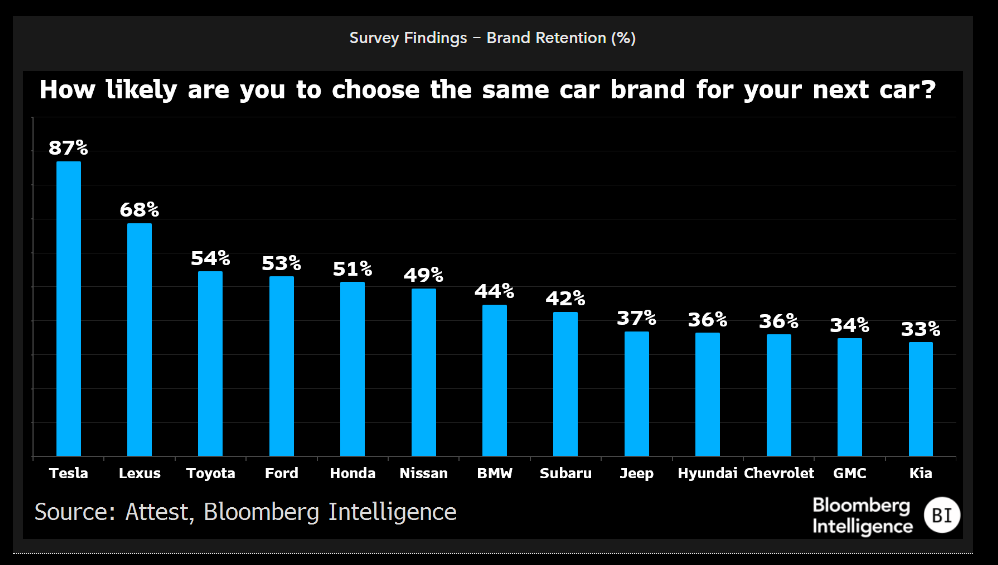
Tesla maintains an 87% brand retention rate, with Lexus (68%) and Toyota (54%) trailing, according to a new Bloomberg Intelligence survey.
Moreover, 81% of prospective US Tesla drivers are new customers switching from competing EV brands.
Bloomberg Intelligence, the research arm of Bloomberg, interviewed 1,000 adults planning to buy or lease a brand-new car in the next year. (It used criteria to reflect a nationally representative sample of geography and gender.)
Bloomberg Intelligence asserts that US BEV penetration is likely to reach 25% by 2030. That’s because EVs continue to pick up major traction in the US, with adoption continuing to accelerate even amid charging infrastructure challenges and overall affordability.
The survey found that 42% of respondents were considering purchasing a BEV as their next car, and 23% were considering hybrid EVs, in contrast to the current 7% penetration in hybrid EVs. Nine percent of those surveyed favored BEVs – an increase on the 7% BEV penetration last year.
Bloomberg Intelligence’s research shows that prospective auto purchasers who already own a BEV are extremely loyal to their cars. The report found that 93% would stick with their current powertrain for their next purchase, compared to 34% of gas car owners who are considering switching to an electric car.
Fuel-type stickiness suggests that EV penetration is unlikely to reverse course as the benefits of an EV could continue to outweigh the costs to current owners. This continuous preference for EVs is consistent across hybrid, plug-in hybrid, and BEV owner segments.
Steve Man, global lead director for auto & industrial market research at Bloomberg Intelligence and the lead author of the report, said: “Tesla, GM, and Stellantis’ slew of affordable EV models, set for debut by 2026, may tap more mass-market buyers. Despite this, the market still has a long way to go to mature, with charging network inadequacy, range anxiety, and extended charging wait times topping the list of concerns for all car buyers.”
To limit power outages and make your home more resilient, consider going solar with a battery storage system. In order to find a trusted, reliable solar installer near you that offers competitive pricing, check out EnergySage, a free service that makes it easy for you to go solar. They have hundreds of pre-vetted solar installers competing for your business, ensuring you get high quality solutions and save 20-30% compared to going it alone. Plus, it’s free to use and you won’t get sales calls until you select an installer and you share your phone number with them.
Your personalized solar quotes are easy to compare online and you’ll get access to unbiased Energy Advisers to help you every step of the way. Get started here. – ad*
FTC: We use income earning auto affiliate links. More.
![The ticket bot cometh: cities are ticketing drivers that AI says are bad [update]](https://i0.wp.com/electrek.co/wp-content/uploads/sites/3/2025/06/volvo-bus-nova-cta-copy.jpg?resize=1200,628&quality=82&strip=all&ssl=1)

In a high-tech move that we can all get behind and isn’t dystopian at all, the City of Barcelona is feeding camera data from its city buses into an advanced AI, but they swear they’re not using the footage to to issue tickets to bad drivers. Yet.
UPDATE 06DEC2025: the ticket bot cometh to Chicago.
Last month, the Chicago Transit Authority (CTA) contracted with Hayden AI to equip six of its transit buses with AI-powered license plate readers intended to target illegally parked vehicles in an area bound by North Avenue, Roosevelt Road, Lake Michigan and Ashland Avenue.
As with similar pilots in Barcelona and NYC, the Hayden AI technology captures information from vehicles illegally blocking bus and bike lanes, then submits its “findings” to a human reviewer for confirmation. If the reviewer agrees with the AI, they can issue a fine of $90 for parking in a bus lane, $250 for bike lane obstruction, $50 for parking in expired meters outside of the central business district, and $140 for personal vehicles parked in commercial loading zones.
Despite those hefty fines, Chicago Mayor Brandon Johnson is quick to point out that the goal of the program isn’t to generate revenue.
“Every Chicagoan deserves a transportation system that is safe, reliable, and efficient,” said Mayor Johnson, in a statement. “By keeping bus and bike lanes clear of illegally parked vehicles, the Smart Streets pilot helps us protect our most vulnerable road users while improving the daily commute for riders across the city.”
The official release makes no mention of the fact that Hayden AI’s system generated nearly $21 million in revenue for the city in just a few months, despite the fact that thousands of those ticketed weren’t doing anything wrong.
We wrote about some of these issues back in Jun. You can read that original article, below, and let us know what you think of Chicago’s “non-revenue” claims in the comments.

Barcelona and its Ring Roads Low Emission Zone have earned lots of fans by limiting ICE traffic in the city’s core. The city’s latest idea to promote mass transit is the deployment of an artificial intelligence system developed by Hayden AI for automatic enforcement of reserved lanes and stops to improve bus circulation – but while it seems to be working as intended, it’s raising entirely different questions.
“Bus lanes are designed to help deliver reliable, fast, and convenient public transport service. But private vehicles illegally using bus lanes make this impossible,” explains Laia Bonet, First Deputy Mayor, Area for Urban Planning, Ecological Transition, Urban Services and Housing at the Ajuntament de Barcelona. “We are excited to partner with Hayden AI to learn where these problems occur and how they are impacting our public transport service.”
Currently operating as a pilot program on the city’s H12 and D20 bus lines, the system uses cameras installed on the city’s electric buses to detect vehicles that commit static violations in the bus lanes and stops (read: stopping or parking where you shouldn’t). The Hayden AI system then analyses that data and provides statistical information on what it captures while the bus is driving along on its daily route.
Hayden AI says that, while it photographs and records video sequences and collects contextual information of the violation, its cameras do not record license plates or people and no penalties are being issued to drivers or owners of the vehicles.
So far so good, right? But it’s what happens once the six mont pilot is over that seems like it should be setting off alarm bells.
Big Brother Bus is watching

The footage is manually reviewed by a Transports Metropolitans de Barcelona (TMB) officer, who reportedly reviewed some 2,500 violations identified by AI in May alone. But, while the system isn’t being used to issue violations during the pilot program, it easily could.
And, in fact, it already has … and the AI f@#ked up royally.
AI writes thousands of bad tickets
When AI was given the ability to issue citations in New York City earlier this year, it wrote more than 290,000 tickets (that’s right: two-hundred and ninety thousand) in just three months, generating nearly $21 million in revenue for the city. The was just one problem: thousands of those drivers weren’t doing anything wrong.
What’s more, the fines generated by the AI powered cameras were supposed to be approved only after being verified by a human, but either that didn’t happen, or it did happen and the human operator in question wasn’t paying attention, or (maybe the worst possibility) the violations were mistakes or hallucinations, and the human checker couldn’t tell the difference.
In OpenAI’s tests of its newest o3 and o4-mini reasoning models, the company found the o3 model hallucinated 33% of the time during its PersonQA tests, in which the bot is asked questions about public figures. When asked short fact-based questions in the company’s SimpleQA tests, OpenAI said o3 hallucinated 51% of the time. The o4-mini model fared even worse: It hallucinated 41% of the time during the PersonQA test and 79% of the time in the SimpleQA test, though OpenAI said its worse performance was expected as it is a smaller model designed to be faster. OpenAI’s latest update to ChatGPT, GPT-4.5, hallucinates less than its o3 and o4-mini models. The company said when GPT-4.5 was released in February the model has a hallucination rate of 37.1% for its SimpleQA test.
I don’t know about you guys, but if we had a local traffic cop that got it wrong 33% of the time (at best), I’d be surprised if they kept their job for very long. But AI? AI has a multibillion dollar hype train and armies of undereducated believers talking about singularities and building themselves blonde robots with boobs. And once the AI starts issuing tickets to the AI that’s driving your robotaxi, it can just call its buddy AI the bank to send over your money. No human necessary, at any point, and the economy keeps on humming.
But, like – I’m sure that’s fine. Embrace the future and all that … right?
SOURCES: Hayden AI, via Chicago Sun Times, Forbes, Motorpasión.

If you’re considering going solar, it’s always a good idea to get quotes from a few installers. To make sure you find a trusted, reliable solar installer near you that offers competitive pricing, check out EnergySage, a free service that makes it easy for you to go solar. It has hundreds of pre-vetted solar installers competing for your business, ensuring you get high-quality solutions and save 20-30% compared to going it alone. Plus, it’s free to use, and you won’t get sales calls until you select an installer and share your phone number with them.
Your personalized solar quotes are easy to compare online and you’ll get access to unbiased Energy Advisors to help you every step of the way. Get started here.


FTC: We use income earning auto affiliate links. More.


The Japanese agriculture equipment experts Kubota are partnering with Norwegian tech startup Kilter to co-develop, pilot, and promote the new Kilter AX-1 ultra high-precision weeding robot across Europe.
The collaboration will initially target Kubota’s vegetable growing customers in Germany and the Netherlands, specifically farmers growing spinach, salad lettuces, herbs, celeriac, and strawberries who hope to benefit of higher yields and crop quality while cutting the use of chemical pesticides to an absolute minimum.
To accomplish those goals, the Kilter AX-1 uses a patented tech package it calls “Single Drop Technology.” Single Drop Technology combines AI weed recognition and ~6 mm placement accuracy to deliver micro-doses directly to weeds, protecting the crop and minimizing the impact to the surrounding soil.
Getting that 6 mm droplet application wasn’t easy. “You can’t buy a field-ready droplet applicator off the shelf,” Anders Brevik, CEO of Kilter, told AgTechNavigator. “We had to design one that survives years of dust, vibration, temperature swings, and long operating days, while keeping droplet size, timing, and placement consistent. That takes deep agronomy knowledge, a lot of engineering, and thousands of hours of field testing.”
Kilter says growers can reduce herbicide use by up to 95% by adopting the new AX-1, shifting selectivity from chemistry to smart application.
Kubota Europe’s Smart Farming Solutions Division, launched back in 2024, is working with the company’s European dealer network to train up sales staff and integrate the Kilter robot into Kubota’s broader farm solutions portfolio. There’s no word, yet, on pricing or if/when we’ll get the Kilter in North America.
Electrek’s Take

Kubota has been bringing literal tons of electrified and autonomous ag solutions to shows like CES for the past few years, and they’ve made significant waves there. With partnerships that take the sustainability push beyond decarbonization and into the realms of de-chemicalizing (that’s a word) and pro-pollenatoring (another word), they’re making real steps towards a more sustainable future for agriculture.
SOURCES | IMAGES: Kilter, AgTechNavigator.
If you’re considering going solar, it’s always a good idea to get quotes from a few installers. To make sure you find a trusted, reliable solar installer near you that offers competitive pricing, check out EnergySage, a free service that makes it easy for you to go solar. It has hundreds of pre-vetted solar installers competing for your business, ensuring you get high-quality solutions and save 20-30% compared to going it alone. Plus, it’s free to use, and you won’t get sales calls until you select an installer and share your phone number with them.
Your personalized solar quotes are easy to compare online and you’ll get access to unbiased Energy Advisors to help you every step of the way. Get started here.
FTC: We use income earning auto affiliate links. More.
![The future of electric farming is taking shape at John Deere [video]](https://i0.wp.com/electrek.co/wp-content/uploads/sites/3/2025/12/john-deere-electric.jpg?resize=1200,628&quality=82&strip=all&ssl=1)
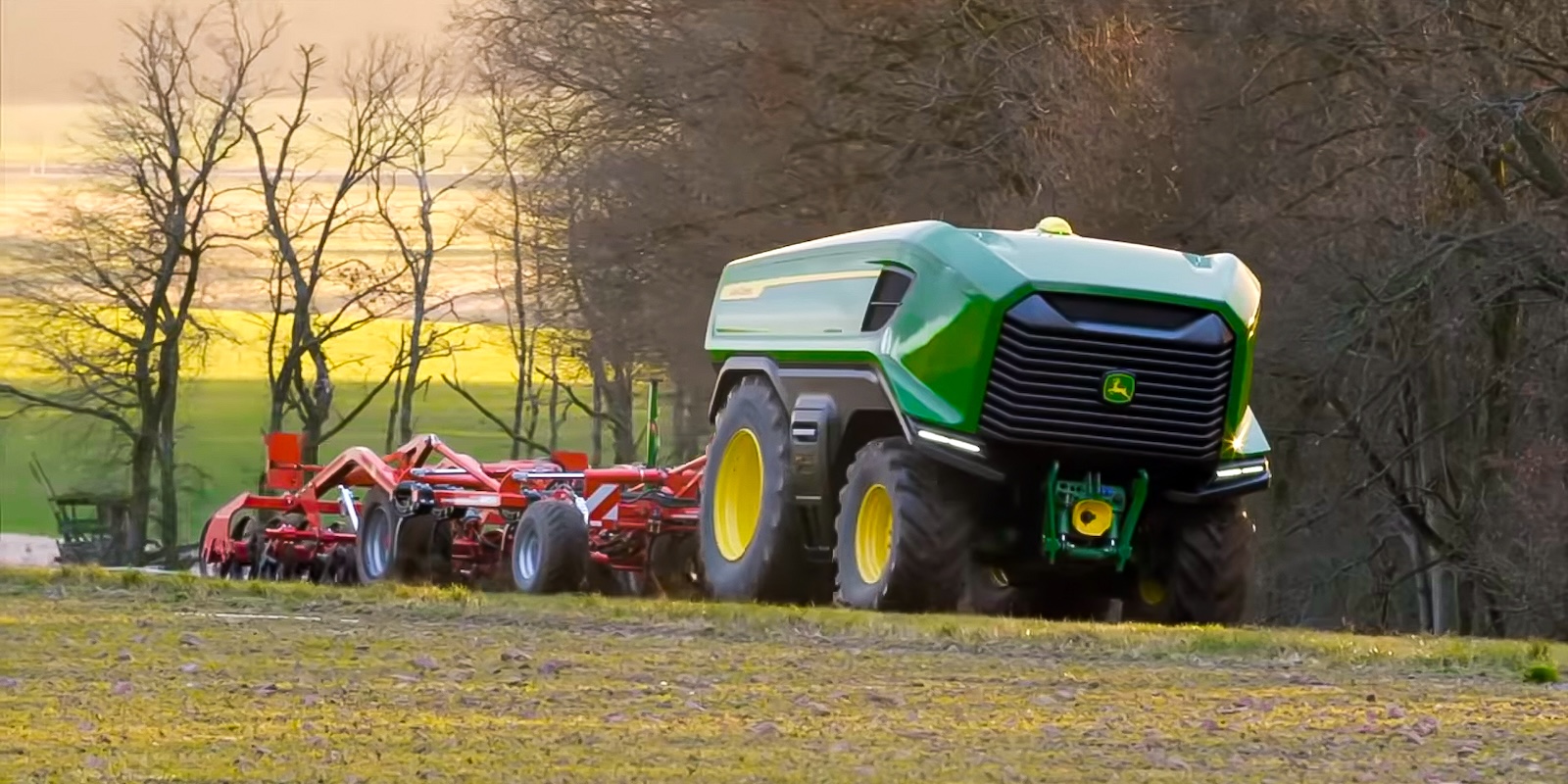
Energy independence and cost control are top of mind for farmers, and more companies are rolling out electric equipment that can be charged by solar, wind, or even on-farm biogas. With the debut of its latest next-generation electric tractor at Agritechnica last month, John Deere is signaling that it intends to lead that revolution.
John Deere says the E-Power electric tractor prototypes that it’s been quietly teasing since 2022 will be as quiet as a car, as easy to drive as a golf cart, and require minimal upkeep – and all while providing the same performance as the company’s beloved diesel tractors.
“Our goal with the E-Power tractor is to ensure it performs the same jobs as its diesel counterparts and works with the same implements, while unlocking incremental value,” explains Derek Muller, business manager for battery electric vehicle systems at John Deere. “Through our electric lineup, we’ll look to reduce operational and maintenance costs, deliver powerful and reliable performance, and intuitive operation.”
The latest electric John Deere tractor prototype, recently unveiled at Agritechnica, is equipped with a 100 hp drive motor and two, additional motors. One 130 continuous hp electric motor for the PTO, and a third for the hydraulic pump. They’ll draw power from up to five KREISEL li-ion battery packs, allowing customers significant pricing flexibility based on their ability to determine how much power and run time they need (and are willing to pay for) to get their jobs done.
Electric John Deere tractor

The customization will go well beyond just battery size. Deere plans to offer customers a number of different tractor and equipment options, and keep costs competitive by basing them on a vehicle common architecture.
“John Deere aims to develop a single electric concept that customers can configure to their own needs,” writes Bob Karsten, at Future Farming. “Buyers will be able to choose the number of batteries (up to five, totalling 195 kWh), the axle type (narrow or wide track), and the cab (either an orchard cab or the familiar 5M cab). In essence, buyers select their preferred battery capacity. With the largest battery (195 kWh), the tractor can operate for eight hours. The target is to enable fast charging up to 80% in 30 minutes.”
Deere revealed one version of that upcoming electric tractor (above) at Agritechnica last week, but despite being an early prototype, it’s a fully functional piece that’s already seen duty with some of John Deere’s most trusted customers.
- Daniel, an orchard customer from California, said his experience with the electric tractor led him to believe it could help ease training new operators, “I do think the tractor is much easier for drivers to understand it and to drive it. It would take less time to teach them [operators] how to use it.”
- Tyler, a vineyard customer in California, believes that a new electric tractor could help his operation meet its sustainability goals, “When we look at our carbon footprint, greenhouse gas emissions, we want to try and reduce those as we run our equipment to farm our vineyards, we want to be conscious of the community at large.”
There’s no official word yet on when the new John Deere electric tractor platform will start reaching customers, but Big Green’s recent purchase of battery manufacturer KREISEL and its continued push into more global markets means that it can’t afford to take things slow.
You can check out a quick, virtual walkaround of John Deere’s E-Power electric tractor concept in this (admittedly older) video released around the ACT Expo, and expect more details and possible configurations at the upcoming CON/AGExpo conference in March.
John Deere E-Power configurations
SOURCE | IMAGES: John Deere.
If you’re considering going solar, it’s always a good idea to get quotes from a few installers. To make sure you find a trusted, reliable solar installer near you that offers competitive pricing, check out EnergySage, a free service that makes it easy for you to go solar. It has hundreds of pre-vetted solar installers competing for your business, ensuring you get high-quality solutions and save 20-30% compared to going it alone. Plus, it’s free to use, and you won’t get sales calls until you select an installer and share your phone number with them.
Your personalized solar quotes are easy to compare online and you’ll get access to unbiased Energy Advisors to help you every step of the way. Get started here.
FTC: We use income earning auto affiliate links. More.
-
 Sports2 years ago
Story injured on diving stop, exits Red Sox game
-
 Sports3 years ago
‘Storybook stuff’: Inside the night Bryce Harper sent the Phillies to the World Series
-
 Sports2 years ago
Game 1 of WS least-watched in recorded history
-
 Sports3 years ago
Button battles heat exhaustion in NASCAR debut
-
 Sports3 years ago
MLB Rank 2023: Ranking baseball’s top 100 players
-
Sports4 years ago
Team Europe easily wins 4th straight Laver Cup
-
 Environment3 years ago
Japan and South Korea have a lot at stake in a free and open South China Sea
-
 Environment1 year ago
Here are the best electric bikes you can buy at every price level in October 2024