
Tesla slashes price of its premium driver assistance option by half in U.S.

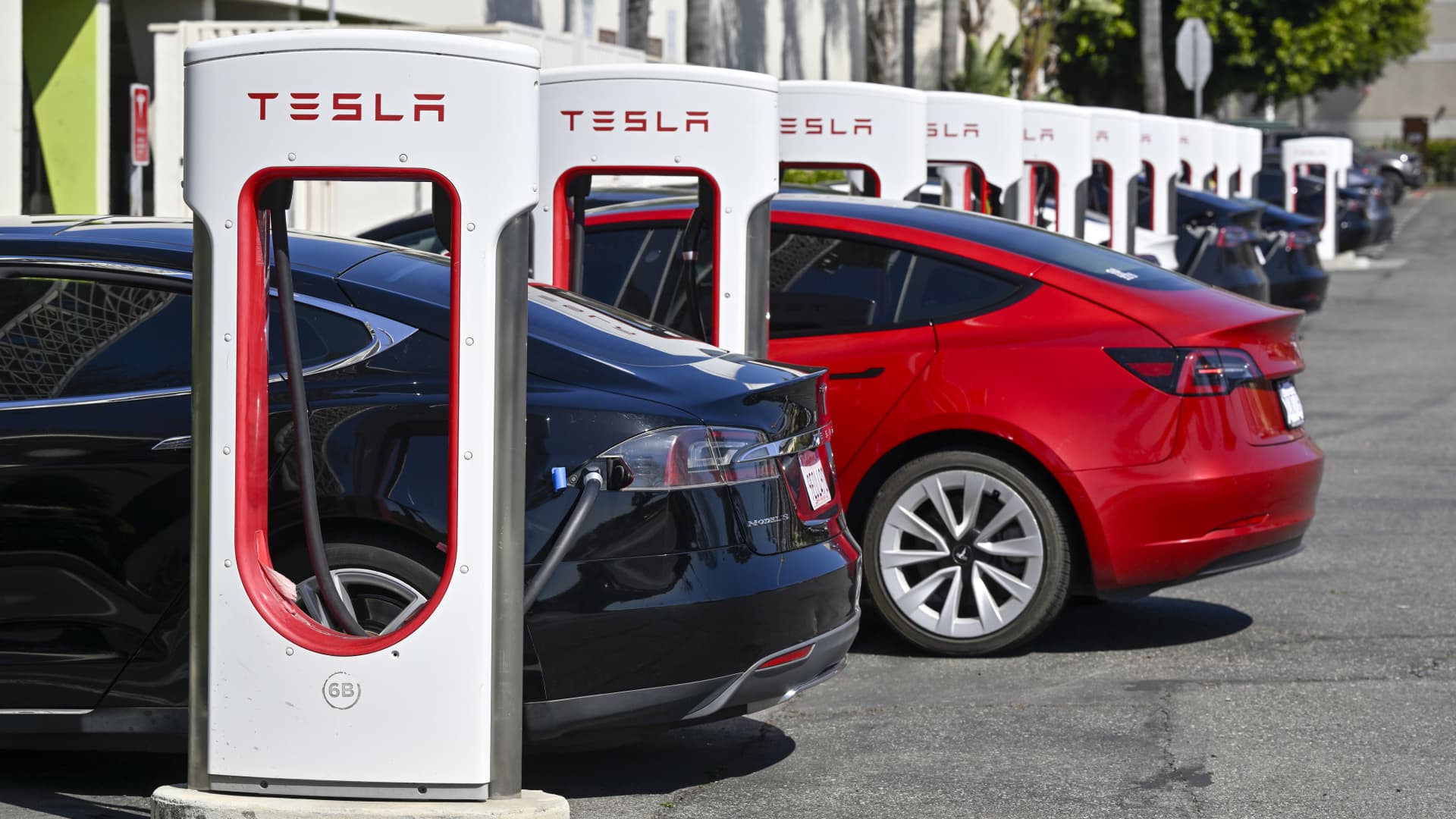
Drivers charge their Teslas in Fountain Valley, CA, on Wednesday, March 20, 2024.
Jeff Gritchen | Medianews Group | Getty Images
Tesla said on Friday that it’s cutting the subscription price of its premium driver assistance system for customers in the U.S.
Marketed as its Full Self-Driving, or FSD, package, Tesla customers will now pay $99 per month, down from $199 previously.
The price cut is at odds with previous promises from CEO Elon Musk, who has repeatedly said that the cost of FSD would only go up as Tesla adds features and functionality to the system.
“The FSD price will continue to rise as the software gets closer to full self-driving capability with regulatory approval,” Musk wrote on Twitter, now known as X, on May 18, 2020. He said at that point “the value of FSD is probably somewhere in excess of $100,000” per car.
Despite its brand name, the company’s FSD option today doesn’t make Tesla vehicles autonomous or functional as robotaxis.
Musk has promised shareholders and customers a robotaxi for years, and has said their existing vehicles would soon become self driving after an over-the-air software update.
He told investors on a call in 2019 that autonomous driving would transform Tesla into a company with a $500 billion market cap, up from around $42 billion at that time. (The company is worth over $500 billion today even without having developed an autonomous car.) Tesla raised over $2 billion through debt and equity after the call.
In a notice that’s now shown to some drivers through the touchscreen displays in their cars, Tesla says:
“Full Self-Driving (Supervised) can drive your Tesla almost anywhere. It will make lane changes, select forks to follow your navigation route, navigate around other vehicles and objects, and make left and right turns. It must be used with additional caution and an attentive driver. It does not make your vehicle autonomous. Do not become complacent.”
The company uses sensors in the steering wheel and cabin cameras, positioned above the rearview mirror, to determine if a driver is attentive or not, and will audibly alert drivers to keep their eyes on the road or hands on the wheel.
In 2022, the California Department of Motor Vehicles formally accused Tesla of engaging in deceptive practices around the marketing of its driver assistance systems, including its standard package Autopilot and FSD in the U.S., according to filings with a state administrative agency.
Meanwhile, Alphabet-owned Waymo is now operating commercial robotaxi services in several U.S. cities. The company also recently struck a partnership with Uber Eats for driverless food delivery. In China, Didi’s autonomous unit operates commercially in markets including Guangzhou. Companies including Bill Gates-backed Wayve in the U.K. and Amazon’s Zoox in the U.S. are testing robotaxis as well.
In a push for end-of-quarter sales last month, Musk mandated that all sales and service staff install and demo FSD for customers before handing over the keys. He wrote in an email to employees, “Almost no one actually realizes how well (supervised) FSD actually works. I know this will slow down the delivery process, but it is nonetheless a hard requirement.”
After that, Tesla also announced it would give away a one-month free trial of FSD to all customers in North America. Owners’ responses to the latest version of FSD have been mixed with some fans impressed, and many safety-conscious drivers switching off the free FSD trial, viewing it as inconsistent and unsafe.
Musk also recently promised to “unveil” a new dedicated robotaxi on Aug. 8. Tesla unveilings are marketing events, and don’t indicate a date for the start of production and deliveries. For example, Tesla unveiled a new version of the Roadster, and a fully electric heavy-duty truck called the Semi in 2017 and didn’t begin Semi deliveries until December 2022. It still hasn’t produced the new version of the Roadster.
Tesla didn’t respond to a request for more information, including whether the price cut announced Friday is permanent or temporary.
WATCH: Musk is trying to highlight the value that robotaxis could bring


U.S. artificial intelligence names were in negative territory in premarket trading on Friday, extending losses into their third day.
Oracle was 0.9% lower in premarket trading, paring earlier losses which saw it fall 1.3%. Nvidia shed 0.7%, Micron fell 0.9%, and CoreWeave was down 1.3% at 5:16 a.m. ET.
Broadcom, which reported a strong quarter on Thursday, was last seen down 5%.
The share price of cloud computing and database software maker Oracle plummeted on Thursday, ending the session around 11% lighter after revenue earnings missed analyst expectations on Wednesday.
It dragged other AI-related names down with it despite a record-breaking rally elsewhere on Wall Street, suggesting investors are rotating out of tech into other parts of the market.
The tech-heavy Nasdaq Composite fell 0.26% on Thursday, despite the Dow Jones Industrial Average and S&P 500 hitting fresh records at the end of the session.
Despite booming demand for Oracle’s artificial intelligence infrastructure, it posted mixed results this week. Revenue came in at $16.06 billion, compared with $16.21 billion expected by analysts, according to data compiled by LSEG.
It followed widespread speculation around the long-term health of the company, with investors cautious about its reliance on debt to execute its AI infrastructure build-out. The broader industry’s circular dealmaking has also raised eyebrows.
“We think recent investor scrutiny on artificial intelligence’s potential and circular GPU deals can be overly punitive to key AI suppliers like Oracle,” said Morningstar Equity Analyst Luke Yang. “Oracle remains a respectable cloud provider that enjoys strong switching costs across its database, application, and infrastructure lineup.”
That said, the firm reduced its fair value estimate for wide-moat Oracle to $286 per share, down from $340. Morningstar’s moat rating refers to its assessment of a company’s durable competitive advantage.
“We lowered our long-term earnings outlook as delivering Oracle’s planned capacity on time now proved to be a harder task. However, we continue to view shares as undervalued,” Yang added.

-
 Sports2 years ago
Story injured on diving stop, exits Red Sox game
-
 Sports3 years ago
‘Storybook stuff’: Inside the night Bryce Harper sent the Phillies to the World Series
-
 Sports2 years ago
Game 1 of WS least-watched in recorded history
-
 Sports3 years ago
Button battles heat exhaustion in NASCAR debut
-
 Sports3 years ago
MLB Rank 2023: Ranking baseball’s top 100 players
-
Sports4 years ago
Team Europe easily wins 4th straight Laver Cup
-
 Environment3 years ago
Japan and South Korea have a lot at stake in a free and open South China Sea
-
 Environment1 year ago
Here are the best electric bikes you can buy at every price level in October 2024