
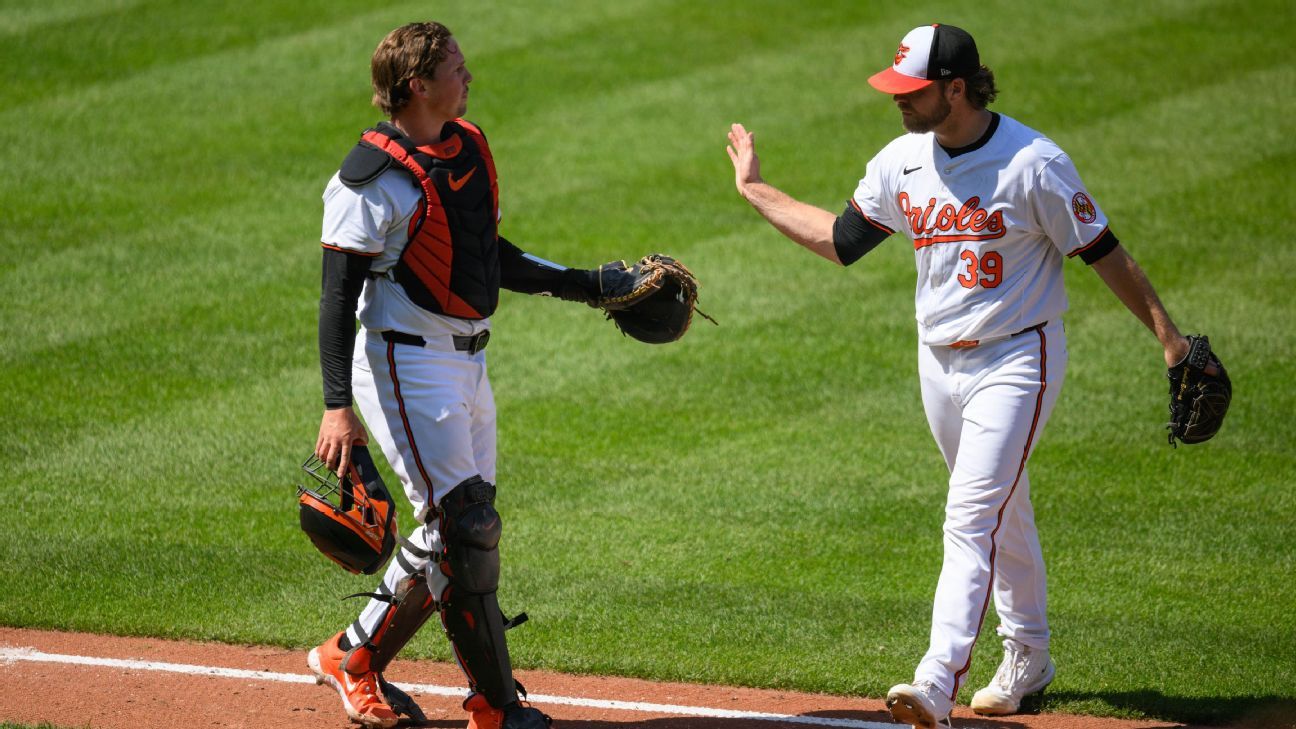
Burnes labors through 5 in start vs. Brewers


BALTIMORE — Milwaukee’s offensive tear finally ran into a roadblock in the form of the Brewers‘ former ace.
Not that Corbin Burnes had it easy.
Burnes allowed a home run to the first batter of the game, and Baltimore‘s new star pitcher left after five innings Sunday against the Brewers. He allowed three runs along with six hits and two walks, but he struck out five and pitched out of trouble on multiple occasions. The Orioles ultimately won 6-4.
“I’ve done a great job of giving up runs in the first inning,” Burnes said. “Didn’t execute anything real well, so it was definitely having to grind through it. Made some big pitches, got out of some jams. Also gifted them a couple runs.”
Some of those jams were self-inflicted — a throwing error by Burnes led to an unearned run in the fourth — but the Brewers couldn’t produce a big inning against the right-hander after scoring 11 runs in each of the first two games in Baltimore. Milwaukee tied a franchise record by scoring at least seven runs in six straight games before that streak ended Sunday.
The Brewers traded Burnes to the Orioles in the offseason for left-hander DL Hall and infielder Joey Ortiz. William Contreras greeted Burnes with a homer to center field leading off the game, and Rhys Hoskins followed with a double. Then the right-hander set down six in a row.
With the Orioles ahead 2-1, Blake Perkins led off the third with a single and then moved to second on a balk when Burnes committed a disengagement violation.
“Perkins is a guy that’s going to steal a lot of bags,” Burnes said. “Always gets a big lead. Had I made a couple better pickoff throws, we could have got him.”
With men on first and third and two out, Sal Frelick took off running toward second on a pitch to Willy Adames, and when catcher Adley Rutschman threw to second, Perkins dashed home. The Orioles caught Frelick in a rundown and tagged him out, but the run scored on the fielder’s choice.
With Baltimore up 3-2 in the fourth, Burnes allowed a single and a walk starting the inning, then fielded Brice Turang‘s bunt and threw wildly to first. The play was ruled an infield single and an error, with a run coming home and runners ending up at second and third. A popup and two strikeouts got Burnes out of that with no further scoring.
Milwaukee stole two bases in the fifth but didn’t score. With a man on third and one out, shortstop Gunnar Henderson fielded a grounder and threw home to retire Contreras. Burnes exited the game after that inning, having thrown 98 pitches.
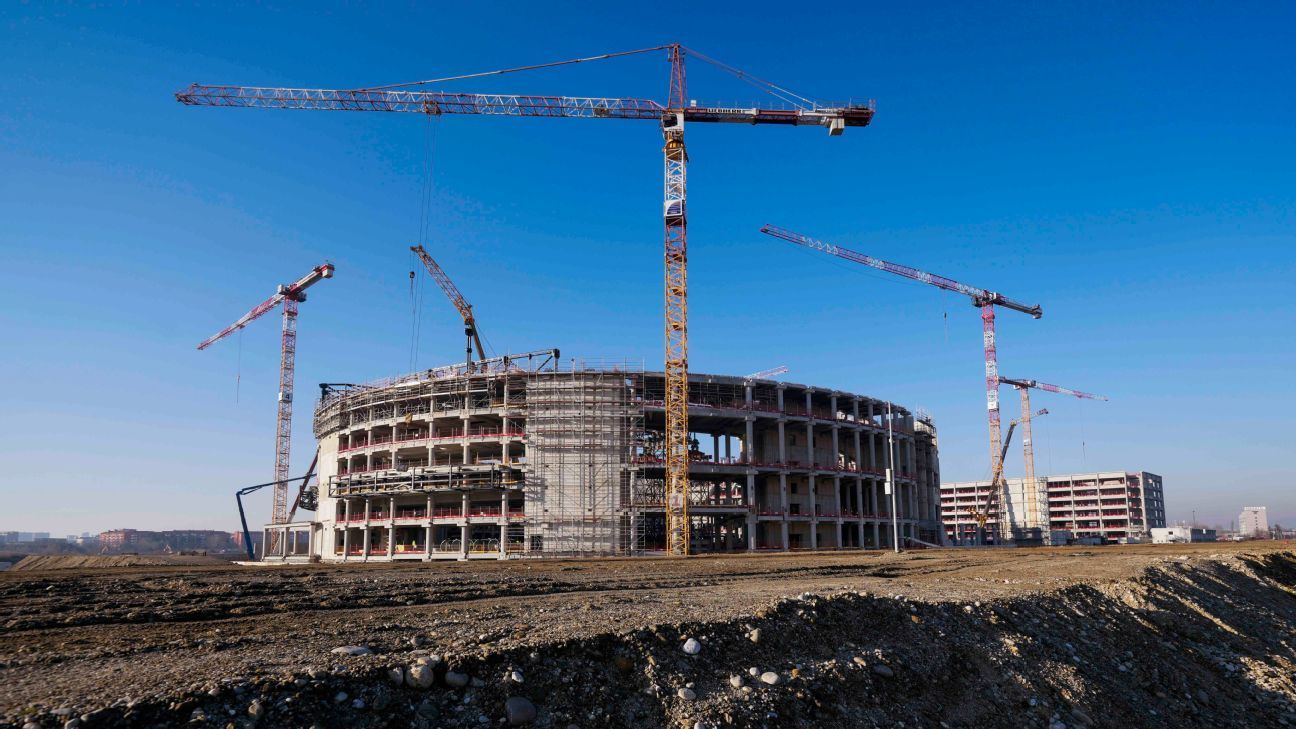

COLORADO SPRINGS, Colo. — NHL deputy commissioner Bill Daly said that if the league’s players feel the quality of the ice at the Olympics in Milan is unsafe, “then we’re not going to play.”
“It’s as simple as that,” Daly told reporters after the NHL board of governors meetings on Monday.
Daly told league owners Monday that he didn’t believe construction issues with the Olympic ice hockey rink were “insurmountable.”
The main hockey arena in Milan is scheduled to be finished Feb. 2. The women’s hockey tournament begins three days later, and the men’s tournament, with NHL players set to participate in the Olympics for the first time in over a decade, begins Feb. 11, leaving very little wiggle room.
The Olympic arenas will feature three games a day for nearly three weeks, which will challenge the resiliency of the ice. Daly categorized the updates the NHL and NHLPA received last week as positive, but said the league was upping its efforts to help see through the arena.
“We have offered and they’re utilizing our ice experts and technicians and outside providers,” Daly said. “We’re basically moving everybody there to try to help get this done in a way that’s acceptable for NHL athletes. And I’m cautiously optimistic it will be fruitful.”
The NHL will have ongoing access to the ice. That will include being on site for a test event scheduled for the main rink from Jan. 9-11.
On Monday, the IIHF acknowledged the two rinks in Milan would be about 3 feet shorter than a standard NHL rink (196.85 feet by 85.3 feet, instead of 200 feet by 85 feet) — which goes against the agreement the NHL and NHLPA signed with the IIHF in July.
Daly said the league found out about the skewed dimensions last week, and he was not sure how it happened. Some federations were made aware earlier, but Daly said nobody raised the issue to him and the league did not notice the difference in several site visits because it wasn’t anything “perceptible to anybody. It’s not like people bring tape measures there.”
But the NHL and NHLPA are willing to look past that for now — though they will insist the rink for the 2030 Olympics in France is built to NHL standards.
“The players association has canvassed the players and apparently they did not believe it to be a big issue, health and safety issue or a competitive issue,” Daly said.
The Pittsburgh Penguins and Nashville Predators played games on a similar-sized rink last month at the Global Series in Sweden; the solution was to move the lines so the missing ice was accounted for in the neutral zone rather than either offensive zone. Daly said they did not receive any feedback from players after those games.
Organizers have insisted there is no Plan B for the Olympic hockey tournament to be held elsewhere if the rink is not ready. Daly said the NHL also doesn’t have a contingency plan yet if it decides the ice is not suitable.
“I mean, it kind of is what it is,” Daly said. “Having said that, if you’re faced with that being the reality, then you have to think about what you do next. “
The NHL will go dark for a two-week period during the Games. Asked if it was possible to reconfigure the schedule if necessary, Daly said he wasn’t sure yet.
“Well, I can’t tell you exactly what we do,” he said. “What I’d say is, I think in emergency-type situations like that in the past, I think we’ve responded appropriately, came up with good solutions and I have no doubt that we’ll be able to come up with good solutions if we’re faced with that.”

-
Kristen Shilton
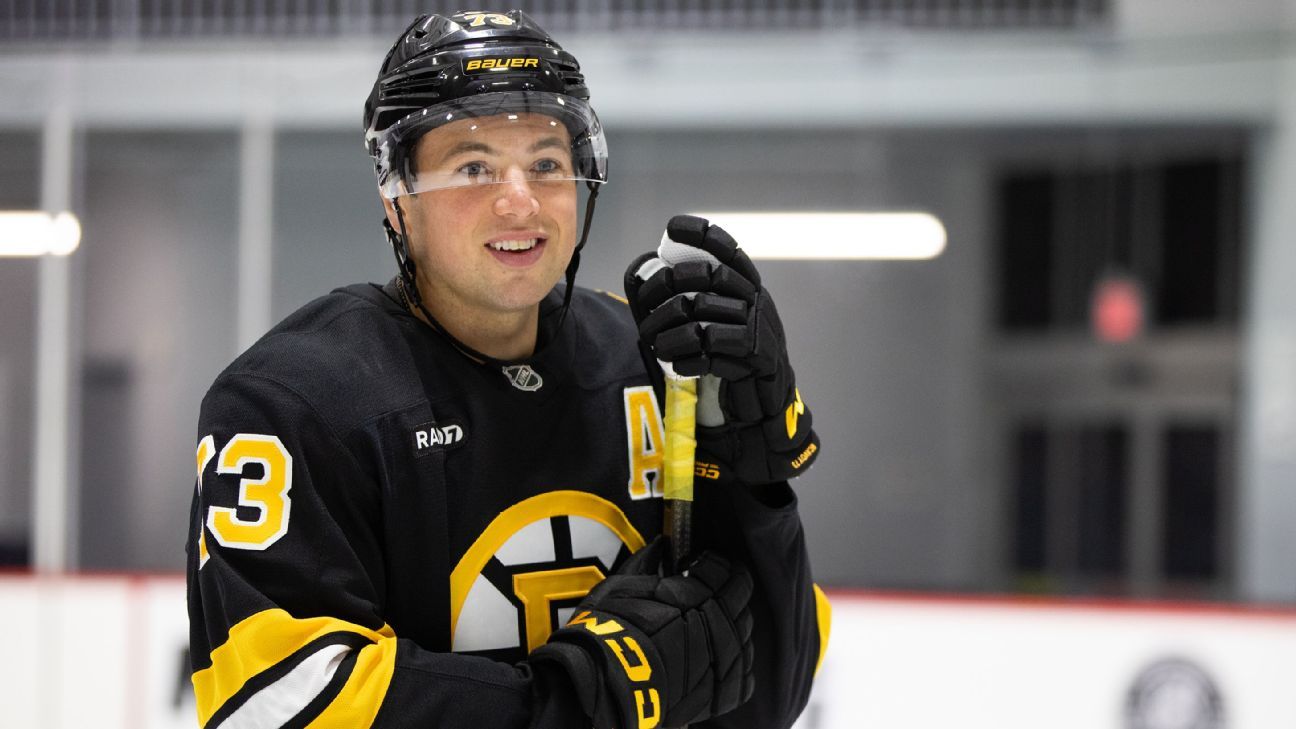
Charlie McAvoy is on the road to recovery and close to rejoining the Boston Bruins’ lineup.
Boston’s top defenseman has been sidelined since taking a slap shot to the face from Montreal Canadiens defenseman Noah Dobson on Nov. 15. McAvoy suffered what he recently described as a “linear fracture” to the left side of his face that included, he said, “some displacement, and I lost a lot of teeth on the bottom.”
The blueliner was instructed not to eat solid foods until at least six weeks after suffering the injury. He lost 20 pounds in the first week and a half afterward while relegated to a liquid diet. McAvoy said on Monday that he’s mending nicely now though and, after shedding his noncontact jersey at practice, was looking forward to getting back to work with the Bruins.
“Every day I feel better,” he said. “We’re getting it back. We’re getting the chance to do more, skate more, skate longer, and work out off the ice. All those things. We’re making strides, and I’m healing on the fly.”
McAvoy will be on Boston’s upcoming three-game road trip starting on Tuesday in St. Louis, although it’s still unclear when he’ll get the green light to suit up.
“We’ll see,” said McAvoy when asked if he would be ready to face the Blues. “Going on the trip with the expectation and hoping that some point along the way on the trip I’ll be able to get back in.”
It’s not the first time McAvoy has missed time with a significant injury — he just had shoulder surgery in February after getting hurt while representing Team USA at the 4 Nations Face-Off — but this particular ailment was something entirely new.
“It’s been one of the weirdest injuries I’ve ever had,” he said last week. “The feeling of having so much trauma in your mouth. It’s a wild feeling. But we’re doing everything we can to get back fast.”
McAvoy has been forced to consume only what could be made in a blender. He tried some creative options at first — including pulverized chicken and vegetables — but called that a “nonstarter” and carried on with classic soft foods.
“Soups have been my go-to,” said McAvoy, who has gained back about half of the weight he lost. “Early on a lot of milkshakes and ice cream.”
Considering the force of Dobson’s shot — which knocked McAvoy directly onto his back — the Bruins’ blueliner admitted he “knew right away I was in trouble” and is grateful to finally have enough energy to anchor Boston’s backend again.
McAvoy has 14 points in 19 games this season, while pacing the club in ice time with 23:46 per game. The Bruins are 4-5-0 since McAvoy went down and are currently second in the Atlantic Division.
McAvoy isn’t the only injured party Boston hopes to get back soon. David Pastrnak — the Bruins’ leading scorer — has been out since Nov. 26, but he will be on Boston’s road trip as well with sights set on a return.
-
 Sports2 years ago
Story injured on diving stop, exits Red Sox game
-
 Sports3 years ago
‘Storybook stuff’: Inside the night Bryce Harper sent the Phillies to the World Series
-
 Sports2 years ago
Game 1 of WS least-watched in recorded history
-
 Sports3 years ago
Button battles heat exhaustion in NASCAR debut
-
 Sports3 years ago
MLB Rank 2023: Ranking baseball’s top 100 players
-
Sports4 years ago
Team Europe easily wins 4th straight Laver Cup
-
 Environment3 years ago
Japan and South Korea have a lot at stake in a free and open South China Sea
-
 Environment1 year ago
Here are the best electric bikes you can buy at every price level in October 2024