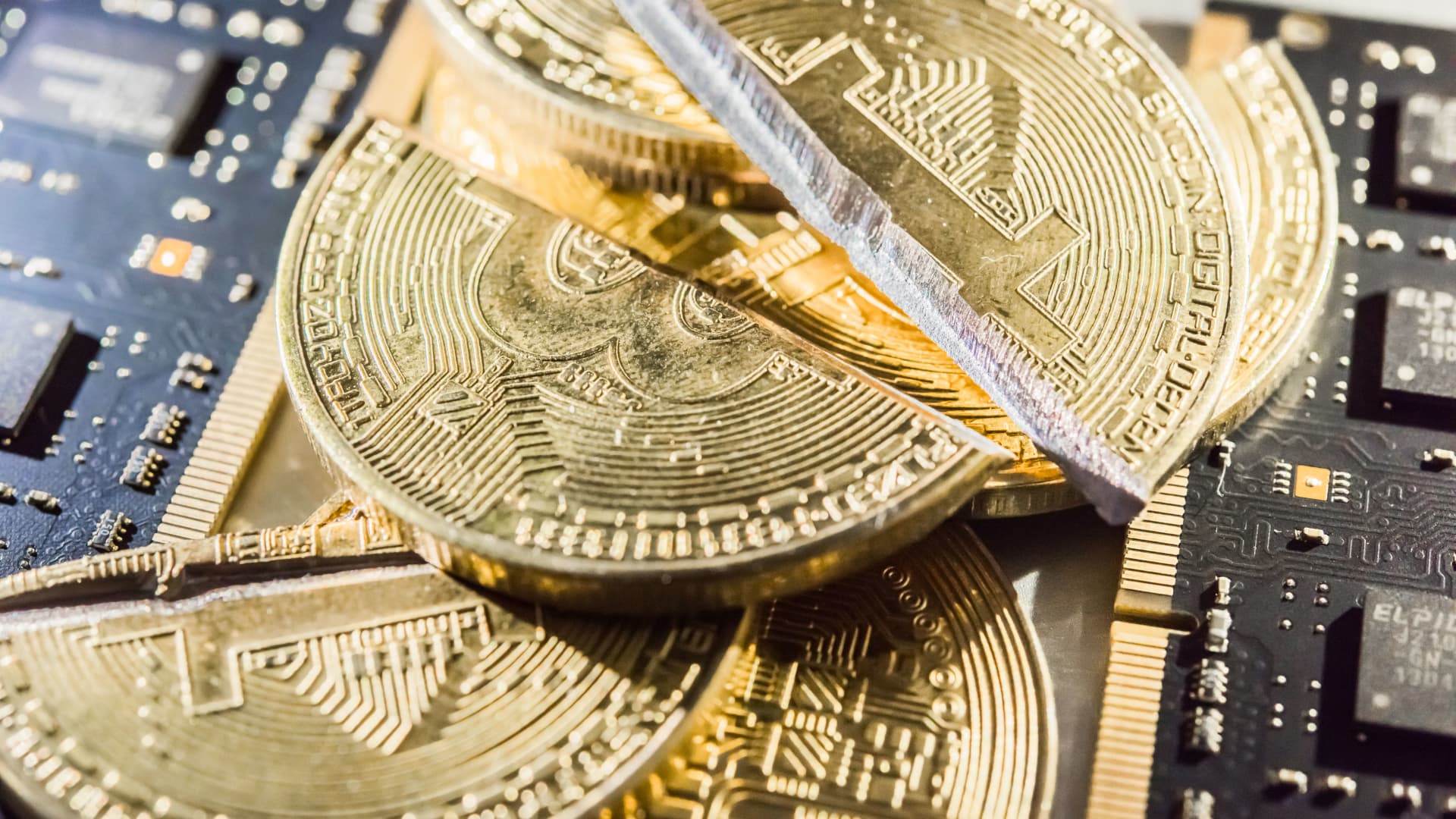
This technical event, written in bitcoin’s code, happens every four years. In simple terms, it is when the rewards for bitcoin miners are cut in half. This reduces the pace at which new bitcoins enter the market.
Since there will ever only be 21 million bitcoins, the halving serves to create more scarcity.
Bitcoin has already hit a new record high, before the halving has taken place. That’s because the approval of spot bitcoin exchange-trade funds has excited the market and brought in lots of demand for the cryptocurrency.
In the latest episode of CNBC Tech’s “Beyond the Valley” podcast — which you can listen to above — Tom Chitty and I discuss what exactly the halving is and how this latest bitcoin cycle is different from the past.
If you have any thoughts on this or previous episodes, please email us at beyondthevalley@cnbc.com.
You can subscribe to “Beyond the Valley” by clicking the links below to your chosen platform:
Here is a transcript of the episode of “Beyond the Valley” released on Apr. 11, 2024. It has been edited for clarity.
Tom Chitty
The halving will soon be upon us, not some medieval ritual. The halving which happens every four years is when the rewards for mining bitcoin are cut in half, which should reduce supply and increase demand for the cryptocurrency. Arjun has been at Paris Blockchain Week, Europe’s biggest blockchain and digital assets event to find out why the halving is so important, what it will mean for the price of bitcoin and how this halving cycle may be different to before. And we’ll also get the latest on the future of crypto exchange Binance. And finally, whether Ethereum is the next cryptocurrency after bitcoin to be granted an ETF. So how was Paris?
Arjun Kharpal
Paris was very nice. Had a delightful Parisian beer while I was there.
Tom Chitty
I knew you’re gonna start with either food or drink.
Arjun Kharpal
It was whirlwind, you know, we sort of got in Eurostar. I love the Eurostar. Nice little handy journey. No, no sort of, you know, airport situation.
Tom Chitty
If you want to email us then the email address is beyondthevalley@cnbc.com. And of course, we will read them out on the show. But before we discuss our main story, we’ve got to hear Arjun’s stat of the week, which is…
Arjun Kharpal
Which is 13,777.
Tom Chitty
13,777B. Okay, now, if you’d like to keep up to date on the world of tech, then the best place to start is the Beyond the Valley weekly newsletter packed with the best international tech stories from CNBC, you can subscribe by heading to CNBC.com/beyond-the-valley, click on the subscribe button, and it will drop in your inbox every Friday. So back to our main story, the bitcoin halving Arjun for someone that’s never heard of it. What is it?
Arjun Kharpal
The halving or the halvening, as others call it.
Tom Chitty
That’s so weird. Halvening sounds even more medieval?
Arjun Kharpal
I don’t know, I just go with halving. It’s easy to pronounce. But you have to go back to bitcoin and the way it functions, there will only ever be 21 million bitcoin in existence. And the way that Bitcoin is effectively created is this public ledger of activity. And transactions need to be validated in order to sort of go through. And this validation process is done by what’s known as miners, could be you and I, probably not you and I though, but it could be you and I are running very specialized high power machines, computers that are able to solve very complex cryptographic mathematical puzzles, in order to validate a bitcoin transaction. And when they do validate a transaction, they’re competing with other miners to do so when they when they do validate a transaction, they’re rewarded for their efforts in bitcoin. Every four years written in bitcoin’s code is the halving in which those rewards the miners get are slashed in half. The idea then is that the … amount of new bitcoin created is cut in half. And so it slows down the supply of bitcoin onto the market. It keeps a lid on on inflation in the bitcoin space. And that’s, that’s the whole idea of it.
Tom Chitty
So if I go and buy bitcoin, the bitcoin I buy is fresh bitcoin that’s been mined, not someone who’s selling bitcoin is that right?
Arjun Kharpal
The likelihood is if you buy bitcoin, if we go on an exchange and buy bitcoin, we’re selling bitcoin that’s in existence already. That bitcoin may have come into circulation, when the miners were rewarded with it, and then sold it at some point and is entered into the sort of buy and sell market. But that’s effectively what it is.
Tom Chitty
Why is it so important, then? Have we seen historically huge price rises off the back of it?
Arjun Kharpal
So it’s important because I think a lot of enthusiasts of bitcoin just from a pure technological level, love the idea. So, often, people who are proponents proponents of bitcoin will say, well, if you look at currencies like the U.S. dollar or something else, you know, those can U.S. dollar can be printed, ad infinitum, you know, central bank control the supply, and you know, they can print more money effectively. Yeah, quantitive easing is one is one way of doing that, and that devalues the dollar, or it devalues the currency. And so what they say is, well, with the halving, you know, bitcoin will not be devalued. There’s only a limited, finite supply and no central bank in the world can overturn that. There’s no central entity that controls bitcoin. And so from a from an ideological from a technological point of view. That’s what the bitcoin enthusiasts like. Now, from the price and market point of view that’s a different story. So when people talk about bitcoin price, you’ll often hear him talk about the bitcoin cycle. And it’s this sort of four year cycle that happens. And often, the new bull run, which has begun, starts or begins just before the halving takes place. And after halving a few months later, bitcoin in hits a new all time high. That is the typical cycle. And the idea is that, well, if the supply of bitcoin is becoming more finite, it is becoming rarer, just like gold, or like precious metal or something, you know, that’s becoming rarer then the price would go higher. And that’s the kind of thinking behind it.
Tom Chitty
Yeah I was talking to one crypto enthusiast about it. And he said, that’s what makes bitcoin special, everything else is sort of, you know, other cryptos follow a similar technology. But it’s the, it’s the fact that, you know, there is a limited supply, and our currencies are constantly being devalued through inflation through printing of money, people see that as well. If I get my hands on some bitcoin, there’s no chance that there’s going to be more created, you know, this, it will hold its value. Or at least that’s what they think.
Arjun Kharpal
That from a from a tech and ideological point of view. That’s that’s really what so many of the enthusiasts and proponents love about it.
Tom Chitty
Let’s talk a little bit about why this cycle is a little bit different then. It’s to do with the ETF that happened a few months ago, right?
Arjun Kharpal
Yeah, that’s right. So Bitcoin hit an all time high, a new all time high before the halving took place. A lot of that was because we, you know, we have spoken about the ETF in a past episode, the spot ETF approvals in the U.S., which has increased investor access to bitcoin. But it also means that the issuers of those ETFs need to buy bitcoin to underpin the ETF. So there’s been a ton of demand and inflows of money into these ETFs to support that, those issuers are going to have to go out and buy bitcoin that’s really helped the price and excitement about that, the fact that to so many bitcoin has gone mainstream. It is part of why we saw the all time high. Now you’ve got the halving in the mix. What is that going to do to the market now? You mentioned I was at Paris Blockchain Week. In there, I had a very rare interview with the new Binance CEO, Richard Tang. We sat down in the Binance offices, and I asked him a little bit about this market cycle, and how it’s different.
Richard Teng
So if you asked me last year me last year, I have a certain price point for bitcoin. I will say that it exceeded my expectation, especially so early on. But this cycle is a bit different from past cycles. I mean, you have been involved in crypto so you know, crypto normally goes through four year cycle, right? Price movement cycle, which coincides with the halving, which is going to take place in about 9 days time for bitcoin. It is normally after about six months after halving that you see a new all time high in terms of prices, but this time around, it happens even before the halving right, which is why it’s unique in terms of market cycle, and one of the key reasons is really the introduction of the ETF. How you are bringing so many new users, new liquidity?
Arjun Kharpal
So Richard Teng, sort of saying very similar things, you know, the ETFs has pulled forward demand. He’s very bullish, because not only have you got that, then you’ve got the halving now, and so that could propel prices further. He said, initially, last year, he thought bitcoin would hit something like $80,000 this year. And he goes, I’m gonna probably go past that now.
Tom Chitty
So he’s actually even more bullish.
Arjun Kharpal
That’s right, because not only have you now got that ETF demand, you’ve now got halving. It’s going to be interesting. We haven’t seen a cycle like this before. Has that demand just been pulled forward because of the ETF? Or is it going to be the ETF now plus the traditional impact of the halving. That remains to be seen.
Tom Chitty
Whilst you were in Paris, you chatted to a lot of crypto enthusiasts. What was some of the more outlandish price predictions? Was there anyone that was bearish? Was anyone saying well, I expect it to go down?
Arjun Kharpal
Now it was a party, Tom, it’s just a party. It is only going up apparently, according to the crypto community. As a side note, it’s very hard. It’s a very divisive asset class, isn’t it? Crypto. You know there’s often people who like sort of despise it, or people absolutely love it. And there’s nothing bad to say about it. It’s very hard to find someone in the middle.
Tom Chitty
That’s you and I.
Arjun Kharpal
One of the only comparable things I can think of is Tesla stock. You either got people who love it, nothing bad about it, it is the future, or people will just think it’s just another car company. Fascinating. Anyway, that’s what makes a market, I guess. But no, there have been outlandish price predictions this year $100,000, $150,000, I’ve heard. So those are some on the top end levels of predictions for this year.
Tom Chitty
When you’re speaking to these crypto enthusiasts and you’re a little bit playing devil’s advocate, and just a little bit more temperate with your, you know, questions and challenging their assertions of you know, this is the best thing since sliced bread. What’s the reaction? Is it is it quite, not aggressive, but is it quite, you know, on the front foot when they hear any challenges?
Arjun Kharpal
It’s definitely on the front foot. I think it’s definitely like, you know, they’re up for the challenge. But they’re definitely on the front foot. And they want to talk up. There’s lots of pros of it that they see specifically and they want to talk about it.
Tom Chitty
And they’ve probably spent years being told that they’re, you know, that they’re crazy and what they’re investing in is worthless, I assume anyway. Okay. Speaking of Binance, let’s let’s talk a little bit more about that crypto exchange. Been in the news a lot in the past 12 months. Give us a little bit of background as to why this interview is kind of pretty important, bit of an exclusive there. Give us a little bit background on by Binance.
Arjun Kharpal
Binance is one of the world’s largest cryptocurrency exchanges. It’s got a huge number of users, huge number of assets. But last year, it was part of a lawsuit with the Department of Justice in the U.S. The result of that was that its former CEO Changpeng Zhao, CZ, we’ve spoken about Binance before on one of the episodes. He pleaded guilty to criminal charges levied by the DOJ and Binance settled with the DOJ for $4.3 billion. A lot of what the DOJ had alleged was around things like not enough controls for anti-money laundering or knowing your customer and various other allegations. So long list. Then the new CEO came in just months into the job now, Richard Teng, and he was a former regulator in Abu Dhabi, so he’s come from this regulatory background. And it’s his task now to clean up this company. And I sat down with him I think we spoke for about 20-25 minutes, about some of those allegations about what he’s planning to do. The biggest, one of the biggest things the DOJ talked about with Binance was its culture and said CZ, the former CEO had this culture where it was better to ask for forgiveness later than ask for permission. And so I spoke to Richard Teng about this and said: How do you go about changing the culture?
Richard Teng
So in those very early stages of development, again, rules are nascent early stage of development, there’s no clarity on that. Binance was operating in a certain fashion. But we have moved past that, as the company moves into greater maturity, we are looking at sustainability, the direction of travel, now is very clear, towards much more compliance, which is why we’re building up a very robust compliance program with very good talent.
Arjun Kharpal
So his argument was, you know, a lot of what the DOJ was alleging was past behavior, you know, from the early days, was a startup culture, growth, amongst sort of everything, and now the company is maturing, they are working with regulators, and there’s a lot more that they need to do to mature. I think one of his biggest challenges is really going to be about there’s still a lot of the old guard left at Binance. And how do they react to this change? Will he get them on board? That can be quite a big question as well.
Tom Chitty
I think it’s interesting startups are, by their very nature need to push the boundaries, but can often get caught out when it comes to behavior and practices, best practices.
Arjun Kharpal
And a lot in the the crypto industry will argue, well, you know, we don’t have the regulation in place. It is hard for us to know what we can and can’t do.
Tom Chitty
Yeah and they have
Arjun Kharpal
That’s the flip side of this argument.
Tom Chitty
And just from your discussions Does, does it sound like that, are they confident that that will happen?
Arjun Kharpal
In the U.S., the crypto industry is just fed up with the U.S., there’s no regulation anywhere. The SEC is so anti-crypto and they’re always like the U.S. is so behind that’s one of the things I heard on the ground, the U.S. is so behind. You know other jurisdictions are already taking a lead when it comes to trying to establish an environment in which some of these crypto, blockchain, Web3, whatever companies can operate.
Tom Chitty
Let’s talk a little bit about ETFs. We mentioned it earlier in the episode but after the bitcoin ETF there was huge fanfare and excitement that you know, a cryptocurrency had got an ETF, an exchange traded fund, if you didn’t know what that stands for. There was also talk about who’s next which cryptocurrency will get an ETF next. And there’s been discussion that Ethereum could potentially be the next cryptocurrency. What was the news on the ground in Paris about that?
Arjun Kharpal
One of the world’s biggest cryptocurrencies ether runs, you know, basically is the token that is associated with the Ethereum blockchain. We’ll do a bit more on blockchains one day, I think. But imagine Ethereum is sort of, something you can build apps on, effectively, like an operating system that you can build apps on. Those apps, perhaps might be using ether tokens, for example. So there’s a lot of excitement around Ethereum, and the technology and then ether. So yeah, if you can give people access to ether via an ETF again, it could be seen as another big win something that can bring a lot of money into ether. Now, you know, I was, I was talking to actually some of the issuers of the bitcoin ETFs on the ground at Paris Blockhain Week about their views on whether the SEC will pass an ether ETF, if any wants to know it’s them, they have to work with the regulators. So I caught up with Jan van Eck, the CEO of VanEck and VanEck is one of the issuers of the bitcoin ETF. I also caught up with Jean-Marie Mognetti, the CEO of Coinshares. Again Coinshares via an acquisition it did in the U.S. issues one of the Bitcoin ETFs in the U.S. Jan van Eck, in particular, his company VanEck, has also filed for an application for an ether ETF. So I asked the both of them starting with Mr. van Eck, what are the chances of the SEC approving an ether ETF in this upcoming deadline that’s soon in May.
Jan Van Eck
We and Ark, Cathy wood are kind of the first in line for May, I guess, to probably be rejected.
Arjun Kharpal
So you’re not expecting the SEC to approve those?
Jan Van Eck
No, no. I mean, the way the legal process goes is the regulators will give you comments on your application. And that happened for weeks and weeks before the Bitcoin ETFs. And right now, pins are dropping as far as Ethereum is concerned.
Jean-Marie Mognetti
Look, I think our view is very similar to Jan. I don’t see anything being approved this side of the year, I think the SEC put a very clear lead in the sign between, you know, what is proof of work, proof of stake and proof of stake is one step too complicated right now to get an approval before the election cycle.
Arjun Kharpal
Both of them there basically saying no chance. I thought it was interesting from Jan van Eck, he was saying, well, usually in these things, we have lots of meetings with the SEC around these ETFs, etc. And he said it’s just pin drops, its nothing at the moment. So that May deadline towards the end of May is when the SEC supposed to reject or approve some of these ETFs, they feel pretty confident that’s just not going to happen. And so poured a lot of cold water on that, and it’s something that the market has been excited about. The problem with ether, in the SEC’s view, is there’s a whole debate on whether ether or cryptocurrencies, certain cryptocurrencies, is a security or not security, and that brings them into certain regulatory jurisdictions. Ether’s status by the SEC has not yet been determined, it is still up in limbo. So that’s one big problem. And as I mentioned, Gary Gensler, the chair of the SEC said, look, just because we let bitcoin ETF happened, doesn’t mean we’re going to do this with ether too. So a lot of headwinds, I think for an ether ETF and clearly the industry those who are actually trying to get those to pass also think the same.
Tom Chitty
Anything else from from Paris Blockchain Week?
Arjun Kharpal
I actually attended an AI summit the day before Paris Blockchain Week in Paris.
Tom Chitty
But not related to this event?
Arjun Kharpal
By the same people. But that was quite interesting. And I caught up with a company called SambaNova. They’re like an Nvidia competitor. So I thought that was quite interesting. But yeah, I think a lot of the chat around the blockchain industry is, you know, we’ve spoken a lot about I think, you know, the halving, pricing and market, but a lot of them are excited about some of the applications that might come to pass on some of these blockchains. And over the next year or two, they often say these bull markets are a good time to support the industry, brings money into the industry, perhaps new innovations and things like that. We’ll see what happens this year.
Tom Chitty
It sounds like yeah, as you mentioned, an episode on blockchain would be worthwhile.
Arjun Kharpal
Yeah, I mean, there’s so many more stories to dig into around that but hopefully, given the halving soon hopefully, this episode has given a bit of insight into that.
Tom Chitty
Yeah, dates we looking at 18th or 20th, something like that.
Arjun Kharpal
It depends when that, you know that that block is mined effectively, then determines when the halving happens. So it’s soon. I mean, you know, whoever’s listening right now might be listening as the halving is happening, or has happened. But at least I hope it has given a bit of context on what it’s all about.
Tom Chitty
Fantastic. All right. Let’s, let’s leave that there. But before we finish the episode, we have of course, got to do stat of the week.
Arjun Kharpal
13,777. Last week, you were sort of wildly wrong on it.
Tom Chitty
Let’s be honest, the answer was or at least the question was a little random. The number of cryptocurrencies in the world.
Arjun Kharpal
Wow, you did it.
Tom Chitty
Did I get it?
Arjun Kharpal
Yeah. Nailed it.
Tom Chitty
Oh, no way.
Arjun Kharpal
Yeah, I know. Are you googling?
Tom Chitty
No, I genuinely was just reading through the script, thinking.
Arjun Kharpal
13,777 cryptocurrencies in existence. How crazy is that?
Tom Chitty
That is. And we only really talked about you know, several of them.
Arjun Kharpal
There’s lots of coins themed around cats, around dogs, around other pets. There’s obviously you know, the main coins like bitcoin. There’s stablecoins. And then there’s a bunch of you know, what people, what you mentioned earlier meme coins.
Tom Chitty
Memecoins.
Arjun Kharpal
You said meme coins? Well, I thought I heard memecoins. But memecoins. Yeah, memecoins.
Tom Chitty
What are they?
Arjun Kharpal
They’re like these sort of jokey coins.
Tom Chitty
That people invest in?
Arjun Kharpal
People invest in them. Well, sometimes you’ll see like a meme coin up like 200% in a day or something like that. It’s a thing.
Tom Chitty
Speaking of, you know, price rises. I watched Dumb Money. Have you seen that?
Arjun Kharpal
No. It’s on the list. Yeah. On the list.
Tom Chitty
Yeah. A lot of our CNBC colleagues in the U.S. make an appearance. It’s about the Gamestop short squeeze.
Arjun Kharpal
The meme stocks. They were called meme stocks. That’s why I think you know, we’ve got memecoins.
Tom Chitty
We should do a recommend section for just you know, tech. Gaming.
Arjun Kharpal
Tech, gaming-related literature, films, culture.
Tom Chitty
Yeah. Culture.
Arjun Kharpal
General culture.
Tom Chitty
Highly recommend. Very good. Very good watch. Remember, you can email us at beyondthevalley@cnbc.com. Last week we had, we had the flight from hell story that you gave us which was a real treat. And I thought we’d read a reader email from David Hunt in direct response to that story. David says, leaving Chicago we encountered a thunderstorm somewhere over Pennsylvania. dark dark skies. Hard rain, lightning. We hear the cracks. We see the lightning the plane drops. There’s silence among the passengers. While we hold our breath, a boy maybe age five giggles with delight. I’m on my way to Elmira, New York by way of NYC, New York City where we encounter freezing rain. While delayed on the tarmac, we go through several rounds of de-icing before takeoff. We’re flying directly into a snowstorm, were rerouted to Syracuse. The snow is falling so heavily, I prepare for an announced overnight stay. Instead, a small group of us are directed to a passenger van for a white out drive to Elmira, 90 miles away. A couple of hours later, at about 2 a.m. we arrive at the Elmira airport where it’s also whiteout conditions. I searched for my van parked three days ago now, clear the snow, while it snows and drive myself home arriving after 3 a.m.
Arjun Kharpal
That’s a real flight from hell that.
Tom Chitty
Poor David. But thank you, thank you so much for sharing that. I suppose his flight is, you know, longer and more arduous and slightly scarier. Yours was just painful.
Arjun Kharpal
Painful, just really painful. Yeah, but yeah, we won’t relive that Paris was great was the initial point.
Tom Chitty
If in doubt, you know, Eurostar’s another option to fly. That’s it for this episode. But before we go, please follow and subscribe to the show. Thank you, Arjun.
Arjun Kharpal
Thank you, Tom.
Tom Chitty
We’ll be back next week for another episode of Beyond the Valley. Goodbye.
A view of Oracle headquarters on September 11, 2023 in Redwood Shores, California.
Justin Sullivan | Getty Images
The apprehension investors have surrounding Oracle has spilled over from manifesting in its stock price — which has fallen nearly 50% from its all-time high on Sept. 10 — to affecting its projects.
Asset management firm Blue Owl Capital reportedly pulled out from Oracle’s $10 billion data center project over unfavorable debt terms, according to the Financial Times, as concerns about the tech giant’s high level of debt mount.
The latest development adds fuel to worries that Oracle could delay the completion of data centers for OpenAI, which were first flagged by Bloomberg on Friday, though the cloud company has denied the report.
Despite the recent pullback in artificial intelligence stocks, the Bank of America thinks “the AI trade may still have room to run into 2026” — with the important caveat that shares going up does not mean a bubble isn’t forming.
“In our view, such progression validates our thesis that a larger AI bubble continues to build,” analysts at Bank of America wrote.
The trouble, as always, is pinpointing the exact moment before the bubble pops — if that’s even possible.
China’s chipmakers are challenging Nvidia. MetaX Integrated Circuits, a Chinese semiconductor firm, soared nearly 700% in its market debut on Wednesday. It’s a sign of how investors are growing enthusiastic over Chinese chipmakers and their progress in catching up with Nvidia.
Netflix deal is ‘superior’ to Paramount’s, Warner Bros. says. Samuel Di Piazza, chair of the Warner Bros. board, separately told CNBC on Wednesday that the board would have appreciated more involvement from Paramount Skydance CEO David Ellison’s father, Oracle co-founder Larry Ellison.
U.S. approves arms sale to Taiwan, reportedly the biggest ever. The $11.15 billion transaction, which was given the green light on Thursday, reportedly comprises HIMARS rocket artillery systems, self-propelled howitzer systems and Javelin and TOW anti-tank missiles, according to Reuters.
[PRO] One chart is worrying Michael Burry. “The Big Short” investor pointed to a graphic produced by Wells Fargo that showed a phenomenon in U.S. households that has only happened twice before and preceded bear markets that “lasted years.”
And finally…
People walk past a Starbucks Reserve in the Huangpu district in Shanghai on April 11, 2025.
Hector Retamal | Afp | Getty Images
Correction: An earlier version of this report stated the wrong date of the U.S. government’s approval of its arms sale to Taiwan. This has been rectified.
TOKYO, JAPAN – FEBRUARY 03: SoftBank Group CEO Masayoshi Son delivers a speech during an event titled “Transforming Business through AI” in Tokyo, Japan, on February 03, 2025. SoftBank and OpenAI announced that they have agreed a partnership to set up a joint venture for artificial intelligence services in Japan.
Japanese tech stocks took a tumble on Thursday as AI infrastructure spending worries on Wall Street crossed the ocean into the Asian markets, with AI-related stocks declining.
Softbank Group Corp was among the top losers in the benchmark Nikkei 225, falling as much as 7.25%, with the index leading losses in Asia, down 1.23%. The group pared some losses and was last trading 3% lower.
This decline comes as the tech-heavy Nasdaq Composite fell 1.81% overnight, dragged by losses in Oracle, Broadcom, Nvidia and other AI plays.
The losses in Oracle came after the Financial Times reported on Wednesday that Blue Owl Capital’s plans to finance the cloud infrastructure company’s $10 billion Michigan data center had stalled. The company last week had refuted a report that said it had delayed some projects for AI major OpenAI to 2028.
Tech-focused SoftBank has seen sharp volatility in its stock over the past month as fears over AI-related spending have gripped the market.
At the start of the year, the group had revealed plans to invest $500 billion in AI infrastructure in the U.S. along with OpenAI, Oracle and other partners, and in September it announced five new U.S. AI data center sites under Stargate, OpenAI’s overarching AI infrastructure platform.
Jesper Koll, expert director at Tokyo-based financial services firm Monex Group, said much of what goes into data centers, power centers, and AI hardware enablers is “Made in Japan, and can only be made in Japan.” That makes Japanese tech, especially AI-related stocks more vulnerable to any worries around U.S. tech spending.
On Wednesday, Japan’s trade numbers showed that exports of electrical machinery jumped 7.4%, and semiconductor-related exports surged 13% year on year. Koll said the U.S.-led boom in tech spending was translating into growing exports of specialized machinery and equipment.
Losses were less pronounced in South Korean chip heavyweight Samsung Electronics at 0.93%, while SK Hynix reversed course to gain 0.73%. Taiwan’s TSMC, the world’s largest contract chip manufacturer, was marginally down.
A view of Oracle’s headquarters in Redwood Shores, California.
Justin Sullivan | Getty Images
The apprehension investors have surrounding Oracle has spilled over from manifesting in its stock price — which has fallen nearly 50% from its all-time high on Sept. 10 — to affecting its projects.
Asset management firm Blue Owl Capital reportedly pulled out from Oracle’s $10 billion data center project over unfavorable debt terms, according to the Financial Times, as concerns about the tech giant’s high level of debt mount.
The latest development adds fuel to worries that Oracle could delay the completion of data centers for OpenAI, which were first flagged by Bloomberg on Friday, though the cloud company has denied the report.
Despite the recent pullback in artificial intelligence stocks, the Bank of America thinks “the AI trade may still have room to run into 2026” — with the important caveat that shares going up does not mean a bubble isn’t forming.
“In our view, such progression validates our thesis that a larger AI bubble continues to build,” analysts at Bank of America wrote.
The trouble, as always, is pinpointing the exact moment before the bubble pops — if that’s even possible.
— CNBC’s Jaures Yip contributed to this report.
What you need to know today
And finally…
A projected illumination marking the 75th anniversary of the Schuman Declaration, on the Grossmarkthalle building at the European Central Bank headquarters in Frankfurt, Germany, on May 9, 2025.
Investors are gearing up for the last interest-rate decisions of 2025, with four of Europe’s central banks announcing their monetary policies and macroeconomic outlooks on Thursday.
The European Central Bank, Bank of England, Riksbank and Norges Bank are all meeting, but only one of them is expected to change its rate.