
Los Angeles is using AI in a pilot program to try to predict homelessness and allocate aid

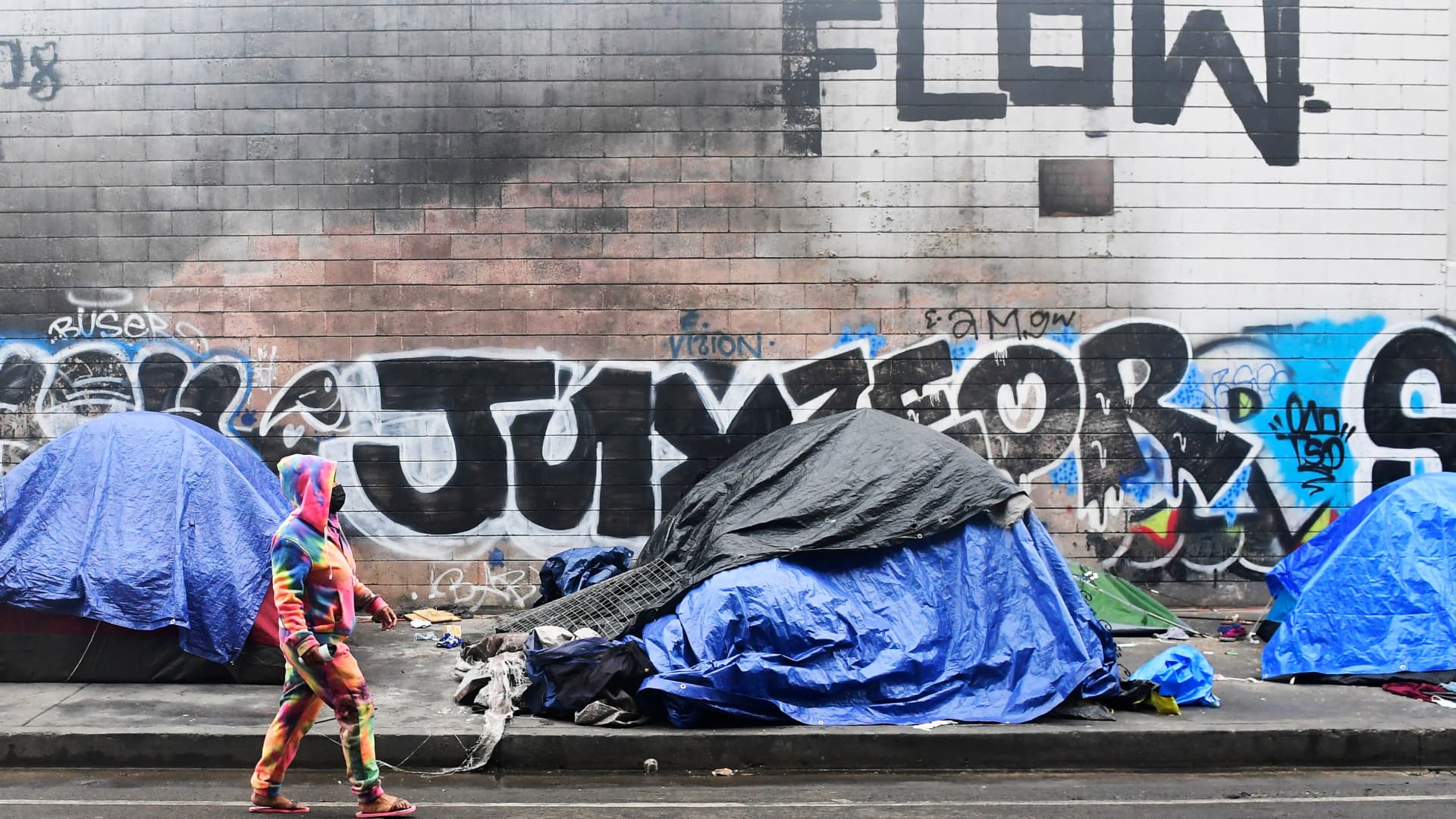
A woman walks past tents for the homeless lining a street in Los Angeles, Calif. on Feb. 1, 2021.
FREDERIC J. BROWN | AFP | Getty Images
In December of last year, single mom Courtney Peterson was laid off from her job working for a now-shuttered inpatient transitional living program. Aside from the flexibility it allowed her to sometimes bring her seven-year-old son to work, it paid enough to cover rent in a studio apartment in the Van Nuys neighborhood in Los Angeles, where they had lived for a year and a half.
Peterson said she began to research potential avenues for help, immediately concerned about making January’s rent. When her son was an infant, they lived in a travel trailer, she said, a situation she did not want to return to.
“I started to reach out to local churches or places that said they offered rent assistance,” Peterson told CNBC. “But a lot of them wanted me to have active eviction notices in order to give me assistance. I felt like I was running out of options. I’d reached out to pretty much everyone I could possibly think of with no luck.”
Instead of an eviction notice, Peterson received a letter from Homelessness Prevention Unit within the Los Angeles County Department of Health Services, offering a lifeline. The pilot program uses predictive artificial intelligence to identify individuals and families at risk of becoming homeless, offering aid to help them stabilize and remain housed.
In 2023, California had more than 181,000 homeless individuals, up more than 30 percent since 2007, according to data from the U.S Department of Housing and Urban Development. A report from the Auditor of the State of California found the state spent $24 billion on homelessness from 2018 through 2023.
Launched in 2021, the technology has helped the department serve nearly 800 individuals and families at risk of becoming homeless, with 86 percent of participants retaining permanent housing when they leave the program, according to Dana Vanderford, associate director of homelessness prevention at the county’s Department of Health Services.
Individuals and families have access to between $4,000 and $8,000, she said, with the majority of the funding for the program coming from the American Rescue Plan Act. Tracking down individuals to help and convincing them that the offer is real and not a scam can be a challenge, but once contact is established, aid is quickly put into motion.
“We often meet our clients within days of a loss of housing, or days after they’ve had a medical emergency. The timing with which we meet people feels critical,” Vanderford said. “Our ability to appear out of nowhere, cold-call a person, provide them with resources and prevent that imminent loss of housing for 86 percent of the people that we’ve worked with feels remarkable.”
Peterson said she and her son received some $8,000 to cover rent, utilities and basic needs, allowing her to stay put in her apartment while she looks for a new job. The program works with clients for four months and then follows up with them at the six-month mark and the 12-month mark, as well as 18 months after discharge. Case workers like Amber Lung, who helped Peterson, say they can see how important preventative work is firsthand.
“Once folks do lose that housing, it feels like there’s so many more hurdles to get back to [being] housed, and so if we can fill in just a little bit of a gap there might be to help them retain that housing, I think it’s much easier to stabilize things than if folks end up in a shelter or on the streets to get them back into that position,” Lung said.
Predicting Risk
The AI model was developed by the California Policy Lab at UCLA over the course of several years, using data provided by Los Angeles County’s Chief Information Office. The CIO integrated data from seven different county departments, de-identified for privacy, including emergency room visits, behavioral health care, and large public benefits programs from food stamps to income support and homeless services, according to Janey Rountree, executive director of the California Policy Lab. The program also pulled data from the criminal justice system.
Those data, linked together over many years, are what would be used to make predictions about who would go on to experience homelessness, developed during a period of time when the policy lab had the outcome to test the model’s accuracy.
Once the model identified patterns in who experienced homelessness, the lab used it to attempt to make predictions about the future, creating an anonymized list of individuals ranked from highest risk to lowest. The lab provided the list to the county so it could reach out to people who may be at risk of losing housing before it happened.
However, past research has found that anonymized data can be traced back to individuals based on demographic information. A sweeping study on data privacy, based on 1990 U.S. Census data found 87% of Americans could be identified by using ZIP code, birth date and gender.
“We have a deep, multi-decade long housing shortage in California, and the cost of housing is going up, increasingly, and that is the cause of our people experiencing homelessness,” Rountree said. “The biggest misperception is that homelessness is caused by individual risk factors, when in fact it’s very clear that the root cause of this is a structural economic issue.”
The Policy Lab provided the software to the county for free, Rountree said, and does not plan to monetize it. Using AI in close partnership with people who have relevant subject matter expertise from teachers to social workers can help to promote positive social outcomes, she said.
“I just want to emphasize how important it is for every community experiencing homelessness, to test and innovate around prevention,” she said. ” It’s a relatively new strategy in the lifespan of homeless services. We need more evidence. We need to do more experiments around how to find people at risk. I think this is just one way to do that.”
The National Alliance to End Homelessness found in 2017 a chronically homeless person costs the taxpayer an average of $35,578 per year, and those costs are reduced by an average of nearly half when they are placed in supportive housing.
Los Angeles County has had initial conversations with Santa Clara County about the program, and San Diego County is also exploring a similar approach, Vanderford said.
Government Use of Artificial Intelligence
AI in the hands of government agencies has faced scrutiny due to potential outcomes. Police reliance on AI technology has led to wrongful arrests, and in California, voters rejected a plan to repeal the state’s bail system in 2020 and replace it with an algorithm to determine individual risk, over concerns it would increase bias in the justice system.
Broadly speaking, Margaret Mitchell, chief ethics scientist at AI startup Hugging Face, said ethics around the government use of AI hinge on context of use and safety of identifiable information, even if anonymized. Mitchell also points to how important it is to receive informed consent from people seeking help from government programs.
“Are the people aware of all the signals that are being collected and the risk of it being associated to them and then the dual use concerns for malicious use against them?” Mitchell said. “There’s also the issue of how long this data is being kept and who might eventually see it.”
While the technology aims to provide aid to those in need before their housing is lost in Los Angeles County, which Mitchell said is a positive thing to do from a “virtue ethics” perspective, there are broader questions from a utilitarian viewpoint.
“Those would be concerns like, ‘What is the cost to the taxpayer and how likely is this system to actually avoid houselessness?'” she said.
As for Peterson, she’s in the process of looking for work, hoping for a remote position that will allow her flexibility. Down the road, she’s hoping to obtain her licensed vocational nursing certification and one day buy a home where her son has his own room.
“It has meant a lot just because you know my son hasn’t always had that stability. I haven’t always had that stability,” she said of the aid from the program. “To be able to call this place home and know that I’m not going to have to move out tomorrow, my son’s not going to have to find new friends right away… It’s meant a lot to both me and my son.”


Oracle CEO Clay Magouyrk appears on a media tour of the Stargate AI data center in Abilene, Texas, on Sept. 23, 2025.
Kyle Grillot | Bloomberg | Getty Images
Oracle on Friday pushed back against a report that said the company will complete data centers for OpenAI, one of its major customers, in 2028, rather than 2027.
The delay is due to a shortage of labor and materials, according to the Friday report from Bloomberg, which cited unnamed people. Oracle shares fell to a session low of $185.98, down 6.5% from Thursday’s close.
“Site selection and delivery timelines were established in close coordination with OpenAI following execution of the agreement and were jointly agreed,” an Oracle spokesperson said in an email to CNBC. “There have been no delays to any sites required to meet our contractual commitments, and all milestones remain on track.”
The Oracle spokesperson did not specify a timeline for turning on cloud computing infrastructure for OpenAI. In September, OpenAI said it had a partnership with Oracle worth more than $300 billion over the next five years.
“We have a good relationship with OpenAI,” Clay Magouyrk, one of Oracle’s two newly appointed CEOs, said at an October analyst meeting.
Doing business with OpenAI is relatively new to 48-year-old Oracle. Historically, Oracle grew through sales of its database software and business applications. Its cloud infrastructure business now contributes over one-fourth of revenue, although Oracle remains a smaller hyperscaler than Amazon, Microsoft and Google.
OpenAI has also made commitments to other companies as it looks to meet expected capacity needs.
In September, Nvidia said it had signed a letter of intent with OpenAI to deploy at least 10 gigawatts of Nvidia equipment for the San Francisco artificial intelligence startup. The first phase of that project is expected in the second half of 2026.
Nvidia and OpenAI said in a September statement that they “look forward to finalizing the details of this new phase of strategic partnership in the coming weeks.”
But no announcement has come yet.
In a November filing, Nvidia said “there is no assurance that we will enter into definitive agreements with respect to the OpenAI opportunity.”
OpenAI has historically relied on Nvidia graphics processing units to operate ChatGPT and other products, and now it’s also looking at designing custom chips in a collaboration with Broadcom.
On Thursday, Broadcom CEO Hock Tan laid out a timeline for the OpenAI work, which was announced in October. Broadcom and OpenAI said they had signed a term sheet.
“It’s more like 2027, 2028, 2029, 10 gigawatts, that was the OpenAI discussion,” Tan said on Broadcom’s earnings call. “And that’s, I call it, an agreement, an alignment of where we’re headed with respect to a very respected and valued customer, OpenAI. But we do not expect much in 2026.”
OpenAI declined to comment.
WATCH: Oracle says there have been ‘no delays’ in OpenAI arrangement after stock slide

-
 Sports2 years ago
Story injured on diving stop, exits Red Sox game
-
 Sports3 years ago
‘Storybook stuff’: Inside the night Bryce Harper sent the Phillies to the World Series
-
 Sports2 years ago
Game 1 of WS least-watched in recorded history
-
 Sports3 years ago
Button battles heat exhaustion in NASCAR debut
-
 Sports3 years ago
MLB Rank 2023: Ranking baseball’s top 100 players
-
Sports4 years ago
Team Europe easily wins 4th straight Laver Cup
-
 Environment3 years ago
Japan and South Korea have a lot at stake in a free and open South China Sea
-
 Environment1 year ago
Here are the best electric bikes you can buy at every price level in October 2024