

Fashion designer Nancy Gonzalez jailed for smuggling crocodile handbags into US for New York Fashion Week

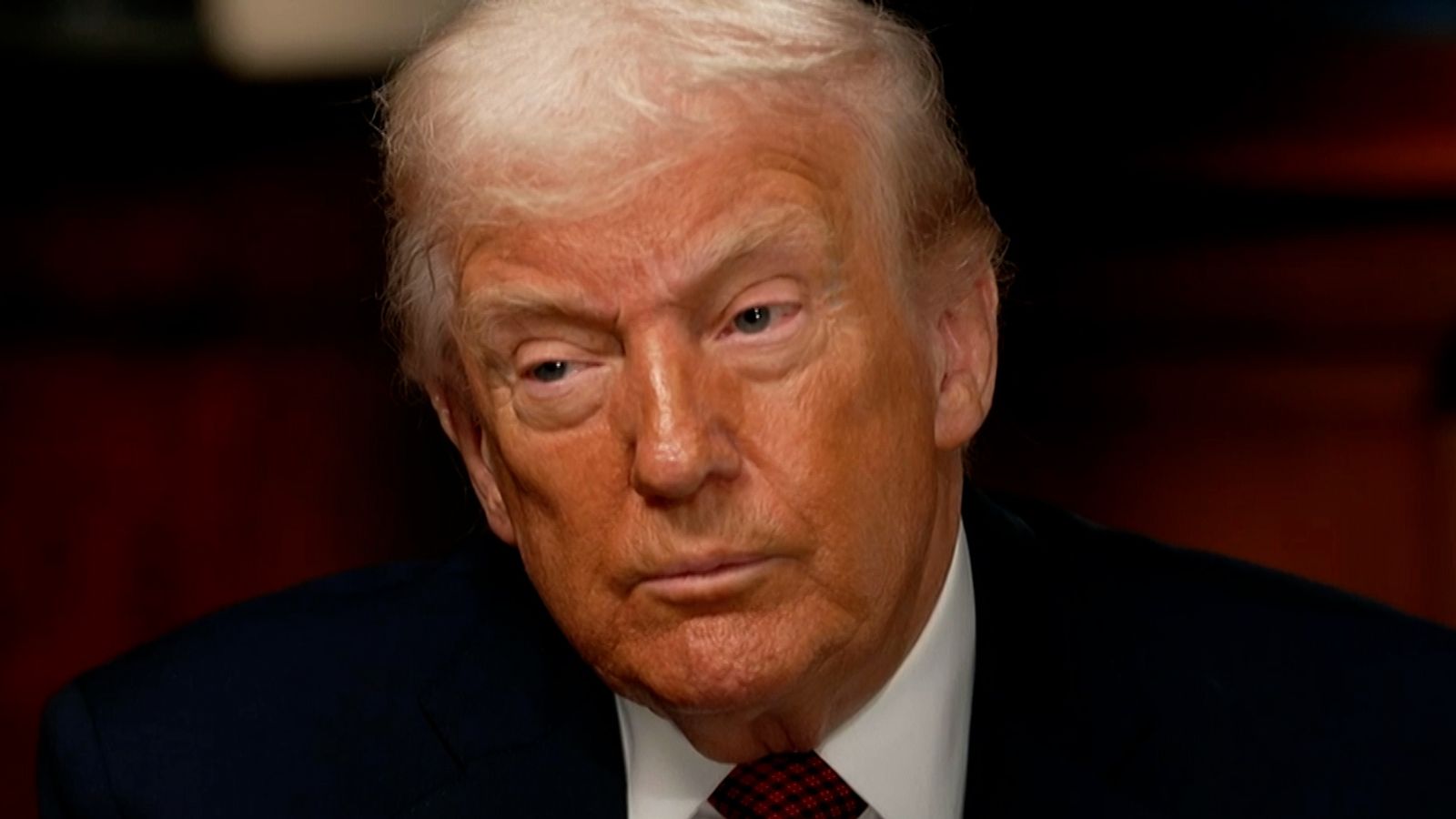
Donald Trump’s bruising assessment of Europe as “weak” and “decaying” is a bitter blow to nations already reeling from the release of his national security strategy.
At the end of the 45-minute interview with Politico, EU leaders might be forgiven for thinking, with friends like these, who needs enemies?
“Europe doesn’t know what to do,” Trump said, “They want to be politically correct, and it makes them weak.”
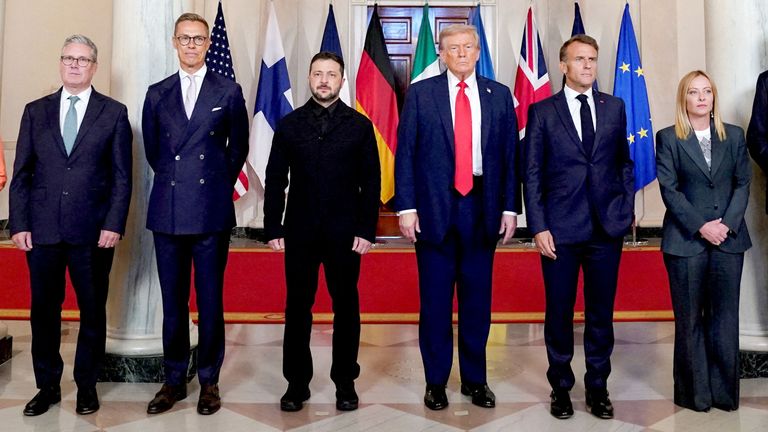
Trump meets leaders from Ukraine, Germany, France, the UK, Italy, and Finland, as well as the EU and NATO, in August Pic: Reuters
On the contrary, I would imagine some choice words were being uttered in European capitals as they waded through the string of insults.
First up, the US president criticised European leaders for failing to end the war between Russia and Ukraine.
“They talk but they don’t produce. And the war just keeps going on and on,” he said.
The fact that the Russians have shown no real commitment to stopping the invasion they started is not mentioned.
EU Flags at the European Commission Building. Pic: iStock
Instead, the blame is laid squarely at the feet of Ukraine and its allies in Europe.
“I think if I weren’t president, we would have had World War III,” Trump suggested, while concluding that Moscow is in the stronger position.
Critics claim that the White House has emboldened the Kremlin and brought Putin in from the cold with a summit and photo opportunities.
Trump highlights the fact that his return to office forced many European NATO members to increase defence spending drastically.
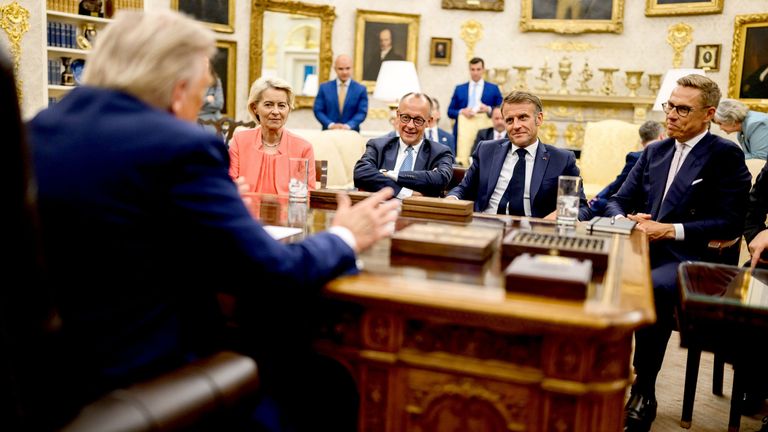
Trump meeting European leaders in the Oval Office in August. Pic: @RapidResponse47
On this, he is correct – the growing insecurity around how long America can be relied on has brought security into sharp focus.
The release of the new US national security strategy has only added to the feelings of unease.
German Chancellor Friedrich Merz on Tuesday claimed some of its contents were unacceptable from a European point of view.
“I see no need for America to want to save democracy in Europe. If it was necessary to save it, we would manage it on our own,” he told a news conference in Rhineland-Palatinate, the German state where Trump’s paternal grandfather was born.
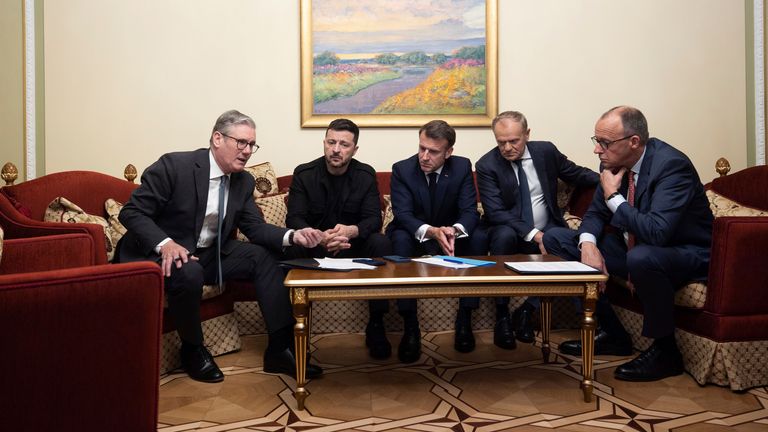
Meeting between, left to right, Keir Starmer of the UK, Volodymyr Zelenskyy of Ukraine, Emmanuel Macron of France, Donald Tusk of Poland, and Friedrich Merz of Germany. Pic: AP
The leader of the EU’s biggest power also said that the new US strategy was not a surprise and largely chimed with the vice president’s speech at the Munich Security Conference in February.
For this reason, Merz reiterated that Europe and Germany must become more independent from America for their security policies.
However, he noted, “I say in my discussions with the Americans, ‘America first’ is fine, but America alone cannot be in your interests.”
For his part, while Trump said he liked most of Europe’s current leaders, he warned they were “destroying” their countries with their migration policies.
He said: “Europe is a different place, and if it keeps going the way it’s going, Europe will not be…in my opinion, many of those countries will not be viable countries any longer. Their immigration policy is a disaster”.
He added: “Most European nations… they’re decaying.”
Read more:
Analysis: Putin preparing for more war, not less
White House: Europe ‘unrecognisable in 20 years or less’
Again, the comments echoed his security strategy, which warned immigration risked “civilisation erasure” in Europe.
There’s no doubt immigration is a major concern for many of the continent’s leaders and voters.
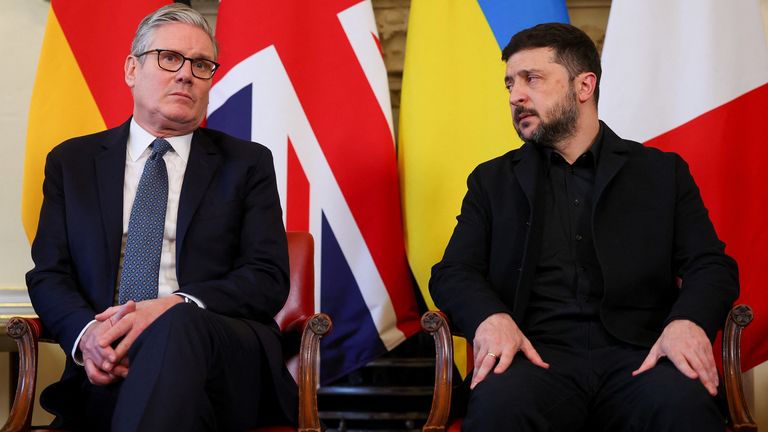
Zelenskyy meets European leaders
However, irregular crossings into the EU fell 22% in the first 10 months of 2025 according to Frontex, a fact which seems to have passed the president and his team by.
“Within a few decades at the latest, certain Nato members will become majority non-European”, his security document warned.
It also suggested “cultivating resistance” in Europe “to restore former greatness” leading to speculation about how America might intervene in European politics.
Trump appeared to add further clarification on Tuesday, saying while he did not “want to run Europe”, he would consider “endorsing” his preferred candidates in future elections.
👉 Tap to follow Trump100 wherever you get your podcasts👈
This comment will also ruffle feathers on the continent where the European Council President has already warned Trump’s administration against interfering in Europe’s affairs.
“Allies do not threaten to interfere in the domestic political choices of their allies,” Antonio Costa said on Monday.
“The US cannot replace Europe in what its vision is of free expression… Europe must be sovereign.”
So, what will happen now, and how will Europe’s leaders respond?
If you are hoping for a showdown, you will likely be disappointed.
Like him or loathe him, Europe’s leaders need Trump.
They need the might of America and want to try to secure continued support for Ukraine.
While the next few days will be filled with politely scripted statements or rejections of the president’s comments, most of his allies know on this occasion they are probably best to grin and bear it.
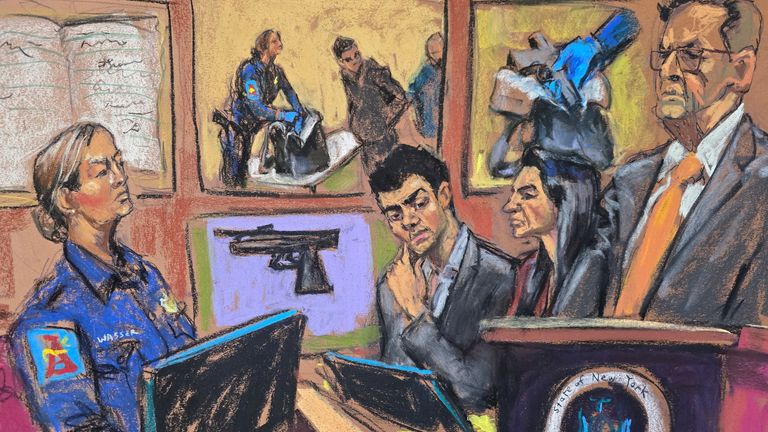
Police officers found a handgun, a silencer and a red notebook described as a “manifesto” when they arrested Luigi Mangione.
The 27-year-old was arrested in December 2024 and charged with killing UnitedHealthcare chief executive Brian Thompson in New York City.
Mangione‘s lawyers want to block prosecutors from showing or telling jurors at his eventual trial in Manhattan about statements he allegedly made and items they said police seized from his backpack during his arrest at a McDonald’s in Pennsylvania.
The objects include a 9mm handgun prosecutors say matches the one used in the killing, a silencer, a magazine with bullets wrapped in underwear and a notebook in which they say Mangione described his intent to “wack” a healthcare executive.
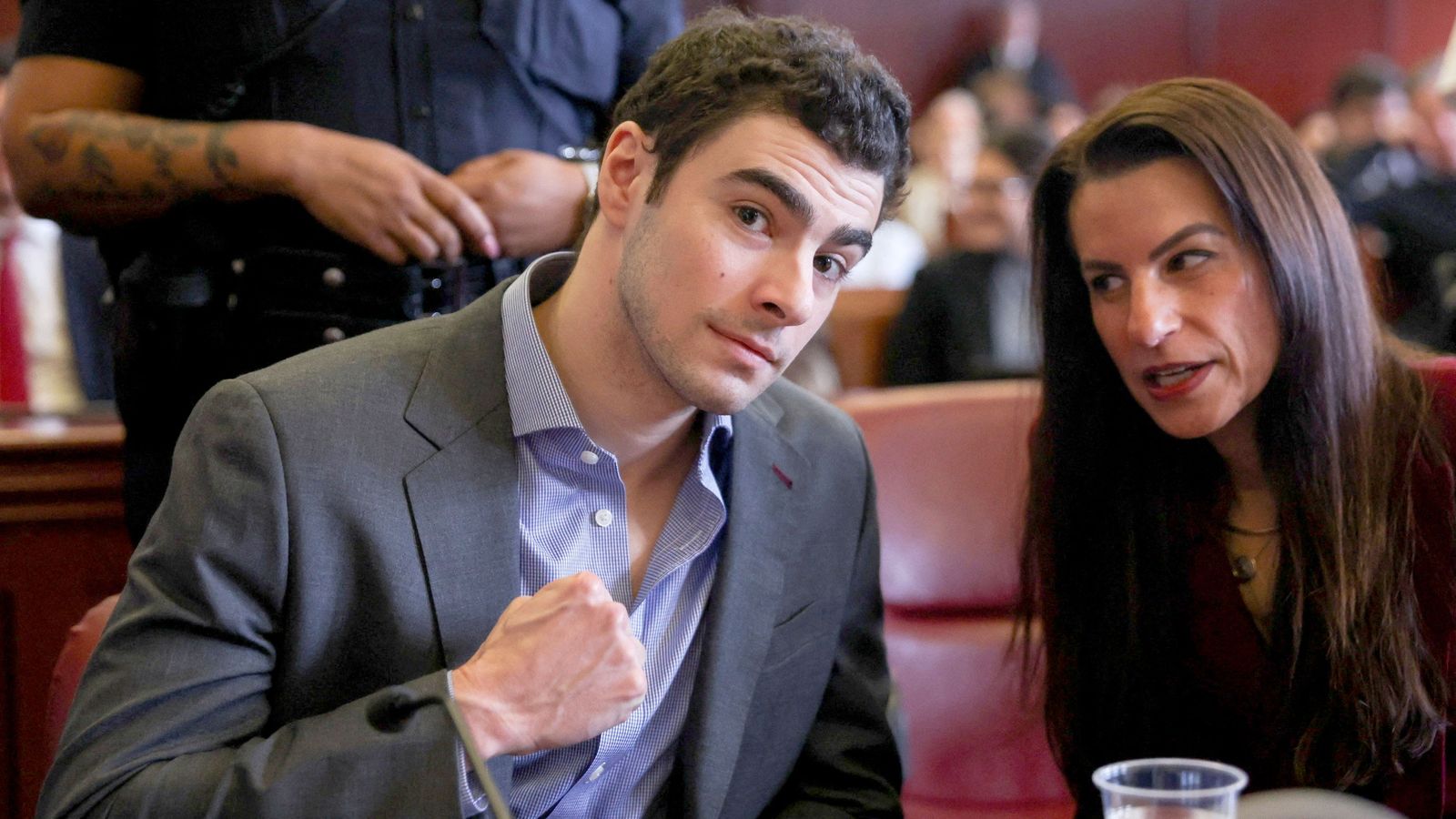
Mangione with his attorney. Pic: Reuters
The defence contends the items should be excluded because police did not get a warrant before searching Mangione’s backpack.
Prosecutors deny claims Mangione was illegally searched and questioned.
They also want to suppress some statements he made to police, such as allegedly giving a false name, because officers asked him questions before telling him he had a right to remain silent.
Last week, Mangione watched surveillance videos of the killing of Mr Thompson, 50, as he walked to a New York City hotel for his company’s annual investor conference.
Mangione has pleaded not guilty to state and federal murder charges.
The state charges carry the possibility of life in prison, while federal prosecutors are seeking the death penalty.
This week’s hearing concerns only the state case, but Mangione’s lawyers want to bar evidence from both cases.
Read more:
The reality of Trump’s trade war
Paramount launches hostile takeover bid for Warner Bros
In September, a judge dismissed two terrorism counts against Mangione, finding prosecutors had not presented enough evidence Mangione intended to intimidate health insurance workers or influence government policy.
Trial dates are yet to be set in either the state or federal cases.
-
 Sports2 years ago
Story injured on diving stop, exits Red Sox game
-
 Sports3 years ago
‘Storybook stuff’: Inside the night Bryce Harper sent the Phillies to the World Series
-
 Sports2 years ago
Game 1 of WS least-watched in recorded history
-
 Sports3 years ago
Button battles heat exhaustion in NASCAR debut
-
 Sports3 years ago
MLB Rank 2023: Ranking baseball’s top 100 players
-
Sports4 years ago
Team Europe easily wins 4th straight Laver Cup
-
 Environment3 years ago
Japan and South Korea have a lot at stake in a free and open South China Sea
-
 Environment1 year ago
Here are the best electric bikes you can buy at every price level in October 2024