Connect with us

Published

on

Doubts have been raised over the government’s ability to unveil tax cuts ahead of the next general election after official figures revealed borrowing was higher than expected in the past year.

The Treasury borrowed £120.7bn in the financial year ending March 2024 – down £7.6bn from the year before, according to provisional estimates from the Office for National Statistics (ONS).

However, the figure is £6.6bn more than forecast by the Office for Budget Responsibility (OBR) only a month ago.

Overall, government debt was around 98.3% of the UK’s annual gross domestic product (GDP) in March – up 2.6 percentage points from the previous year and at levels not seen since the early 1960s.

Ruth Gregory, an economist from Capital Economics, said: “If the chancellor was hoping March’s figures would provide more scope for tax cuts at a fiscal event later this year, he will have been disappointed.

“Just based on the larger-than-expected 2023/24 budget deficit and the recent shift up in market interest rates, he may have even less fiscal ‘headroom’ (perhaps about £5bn) for tax cuts than the £8.9bn left over in March.”

Rob Wood, from Pantheon Macroeconomics, said he still expected the chancellor to cut taxes, but warned it would leave a financial headache for the Treasury after the next election, which is expected in the autumn.

He said: “[Jeremy] Hunt can plan for another year of unrealistically weak public spending to generate ‘headroom’ against his fiscal rules and thereby manufacture the funds to cut taxes.

“The next government will, therefore, face a tricky choice between raising taxes to fix creaking public services or holding the line on the chancellor’s recent tax cuts.”

Mr Hunt cut national insurance by 2p in the budget earlier this year and has said he would like to reduce taxes further.

Read more business news:
FTSE 100 hits new record high

Thames Water warns of bills surge
Iceland boss collapses at London Marathon

Jessica Barnaby, the ONS’s deputy director for public sector finances, said: “Spending was up about £58bn, with increased spending on public services and benefits outstripping large reductions in interest payable and energy support scheme costs. But with public sector income up £66bn, overall, the deficit still fell.

“At the end of the financial year, debt remained close to the annual value of the output of the economy, at levels last seen in the early 1960s.”

The figures also revealed that benefit payments increased by £36.9bn to £291.4bn during the year, amid inflation-linked increases and extra cost of living support.

Central government wages rose by £21bn, including health and education, but inflation-linked debt fell 27% to £78.3bn.

Receipts from inheritance tax also climbed to a record high of nearly £7.5bn.

A spokesperson for the Treasury said: “Debt increased in recent years because we rightly protected millions of jobs during COVID and paid half of people’s energy bills after [Vladimir] Putin’s invasion of Ukraine sent bills skyrocketing.

“We can’t leave future generations to pick up the tab, so we must stick to the plan to get debt falling. And with inflation falling and wages rising – we have been able to cut national insurance by a third, which shows our determination to end the double taxation of work”.

Continue Reading

Business

Sir Keir Starmer to defend budget amid claims Rachel Reeves ‘lied’ about public finances

Published

on

By

Sir Keir Starmer to defend budget amid claims Rachel Reeves 'lied' about public finances

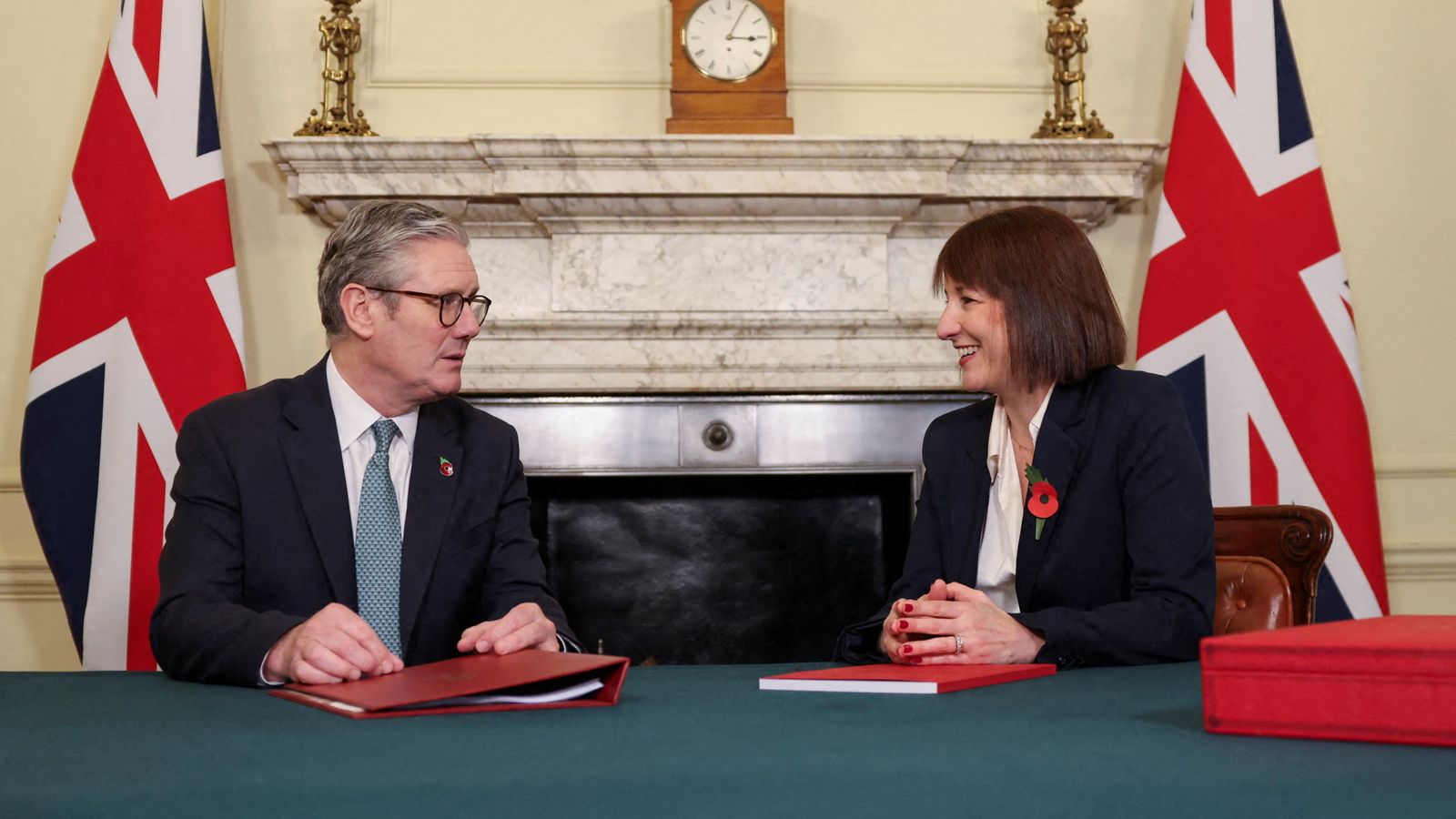
Sir Keir Starmer will deliver a speech today defending the decisions the government made in the budget, following criticisms of sweeping tax rises and accusations the chancellor lied to the country about the state of public finances.

The prime minister is expected to set out how the budget, which saw £26bn of tax rises imposed across the economy, “moves forward the government’s programme of national renewal”, and set “the right economic course” for Britain, Downing Street says.

He will also confirm that ministers will try again to reform the “broken” welfare system, after Labour MPs forced the government to U-turn on its plans to narrow the eligibility for Personal Independence Payments (PIP) earlier this year.

Sir Keir Starmer will give a speech later defending last week's budget. Pic: Reuters
Image:
Sir Keir Starmer will give a speech later defending last week’s budget. Pic: Reuters

‘Of course I didn’t’ lie about public finances, says Reeves

“We have to confront the reality that our welfare state is trapping people, not just in poverty, but out of work – young people especially. And that is a poverty of ambition,” Sir Keir will say.

“And so while we will invest in apprenticeships and make sure every young person without a job has a guaranteed offer of training or work, we must also reform the welfare state itself – that is what renewal demands.”
Please use Chrome browser for a more accessible video player

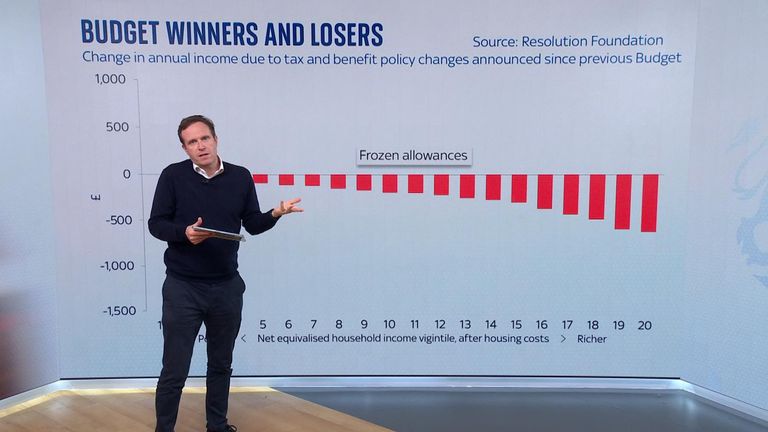
Sky’s Ed Conway looks at the aftermath of the budget and explains who the winners and losers are

The prime minister will add: “This is not about propping up a broken status quo. Nor is it because we want to look somehow politically ‘tough’. The Tories played that game and the welfare bill went up by £88bn. They left children too poor to eat and young people too ill to work. A total failure.”

More on Budget 2025

Instead, he will argue it is about “potential”, saying: “If you are ignored that early in your career, if you’re not given the support you need to overcome your mental health issues, or if you are simply written off because you’re neurodivergent or disabled, then it can trap you in a cycle of worklessness and dependency for decades, which costs the country money, is bad for our productivity, but most importantly of all – costs the country opportunity and potential.

“And any Labour Party worthy of the name cannot ignore that. That is why we have asked Alan Milburn on the whole issue of young people, inactivity and work. We need to remove the incentives which hold back the potential of our young people.”

The announcement will come after the Conservative opposition described the budget as one for “benefits street”, following the chancellor’s decision to lift the two-child benefit cap from April, at a cost of £3bn.
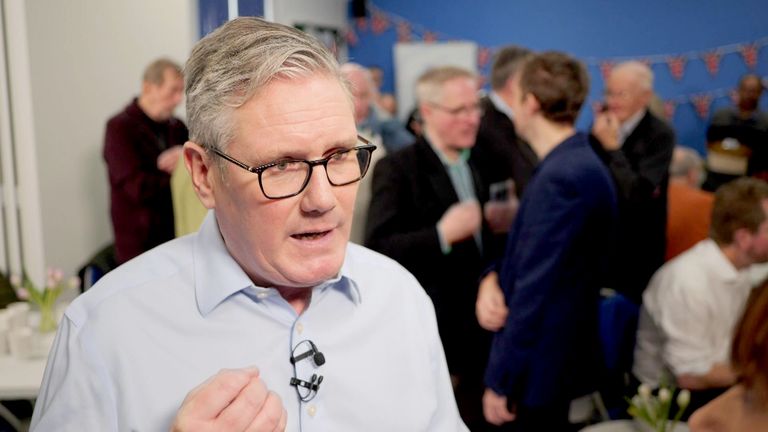
Please use Chrome browser for a more accessible video player

Prime Minister defends the budget

‘Government must go further and faster on growth’

The prime minister is also expected to launch a staunch defence of the budget overall, saying it will bear down on the cost of living through measures like money off energy bills and frozen rail fares; increase economic stability; and protect investment in public services and infrastructure that will drive economic growth.

He will argue that “economic growth is beating the forecasts”, but that the government must go “further and faster” to encourage it.

He will also reiterate his vow to scrap regulation across the economy, which he will argue is not only pro-business, but also a way to deal with the cost of living.
Please use Chrome browser for a more accessible video player

How will your personal finances change following the budget announced by the chancellor?

“Rooting out excessive costs in every corner of the economy is an essential step to lower the cost of living for good, as well as promoting more dynamic markets for business,” the prime minister will say.

He will confirm reforms to the building of nuclear power plants, after the government’s nuclear regulatory taskforce found that “pointless gold-plating, unnecessary red-tape and well-intentioned, but fundamentally misguided environmental regulation had made Britain the most expensive place to build nuclear power”.

“We urgently need to correct this,” the prime minister will say.

Business secretary Peter Kyle will be tasked with applying the same deregulatory approach to major infrastructure schemes and to accelerate the implementation of Labour’s industrial strategy.

In response, Tory shadow chancellor Sir Mel Stride said: “It is frankly laughable to hear the prime minister say Rachel Reeves’s Benefits Street budget has put the country on the right course and that he wants to fix the welfare system.

“His chancellor has just hiked taxes by £26bn to pay for a welfare splurge, penalising people who work hard and making them pay for those who don’t work at all. And she misrepresented why she was doing it, claiming there was a fiscal black hole to fill that she knew didn’t exist.

“Labour’s leadership have repeatedly shown they lack the backbone to tackle welfare and instead are just acting to placate their left-wing backbenchers.”
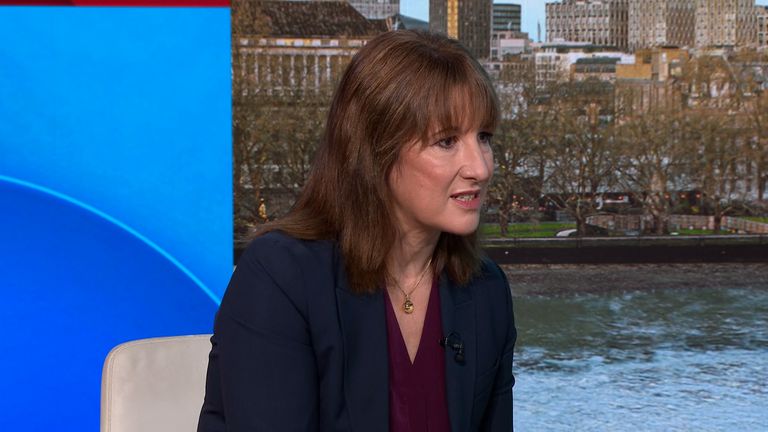
Please use Chrome browser for a more accessible video player

Rachel Reeves tells Sky News she did not lie about the state of the public finances

Chancellor accused of ‘lying’

Sir Mel is referring to the chancellor’s speech on 4 November in which she laid the ground for tax rises due to the decision by the independent Office for Budget Responsibility (OBR) to review and downgrade productivity over recent years, at a cost of £16bn, which led to a black hole in the public finances.

But the OBR revealed on Friday that it had told the Treasury days earlier that there was actually a budget surplus of £4.2bn, leading to outrage and claims that she misled the country about the state of the public finances.

Rachel Reeves was asked directly by Sky’s Trevor Phillips if she lied, and she replied: “Of course I didn’t.”
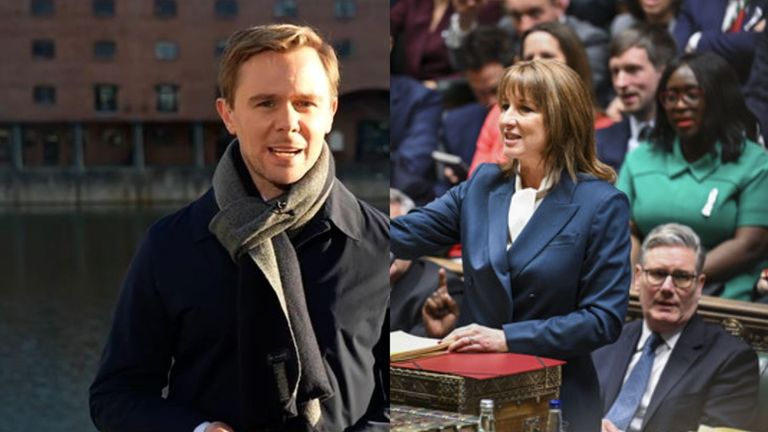
Please use Chrome browser for a more accessible video player

Why did Reeves make the situation sound ‘so bleak’?

She said: “I said in that speech that I wanted to achieve three things in the budget – tackling the cost of living, which is why I took £150 off of energy bills and froze prescription charges and rail fares.

“I wanted to continue to cut NHS waiting lists, which is why I protected NHS spending. And I wanted to bring the debt and the borrowing down, which is one of the reasons why I increased the headroom.

“£4bn of headroom would not have been enough, and it would not give the Bank of England space to continue to cut interest rates.”

Ms Reeves also said: “In the context of a downgrade in our productivity, which cost £16bn, I needed to increase taxes, and I was honest and frank about that in the speech that I gave at the beginning of November.”

Please use Chrome browser for a more accessible video player

Badenoch says Rachel Reeves should resign

But Tory leader Kemi Badenoch said: “I think the chancellor has been doing a terrible job. She’s made a mess of the economy, and […] she has told lies. This is a woman who, in my view, should be resigning.”

Report due on OBR breach

The tumultuous run-up to the 26 November budget culminated in the OBR accidentally publishing its assessment of the chancellor’s measures 45 minutes before the speech began, in what was an unprecedented breach of budget security.

👉 Listen to Sky News Daily on your podcast app 👈

The chair of the OBR, Richard Hughes, apologised for the “error”, and announced an investigation into how it happened.

The chancellor has said that she retains confidence in him, despite the “serious breach of protocol”, and confirmed to Trevor that the investigation report will be delivered to her on Monday, although it is not clear when it will be published.

Continue Reading

Business

Modella continues high street shopping spree with Wynsors deal

Published

on

By

Modella continues high street shopping spree with Wynsors deal

The investment firm which has become this year’s most prolific buyer of high street chains in Britain is targeting a takeover of a privately owned footwear retailer.

Sky News has learnt that Modella Capital is in advanced talks to buy Wynsors World of Shoes, which trades from approximately 50 standalone shops across the north of the country.

Retail industry sources said that Modella was now the likeliest buyer of Wynsors, with a deal potentially being struck before the end of the year.

Wynsors has been exploring a sale for the last two months, and hired the accountancy firm RSM to explore interest from prospective bidders.

The chain also trades from about 40 concession sites, and employs roughly 440 people.

It has a particular focus on the children’s school shoes segment of the footwear market.

Like many retailers, it is understood to have seen its recent performance adversely affected by the labour cost pressures heralded by last year’s Budget.

More from Money

If the deal is completed, it would add Wynsors to a stable of brands which includes TG Jones, the new name for WH Smith’s high street chain; Hobbycraft; and The Original Factory Shop.

Modella was also one of the bidders for Poundland, which was sold during the summer to Gordon Brothers, another specialist retail investor.

A spokesman for Modella declined to comment, while RSM has been contacted for comment, and Wynsors could not be reached for comment.

Continue Reading

Business

Netflix executive Lloyd screen-tested for top Channel 4 job

Published

on

By

Netflix executive Lloyd screen-tested for top Channel 4 job

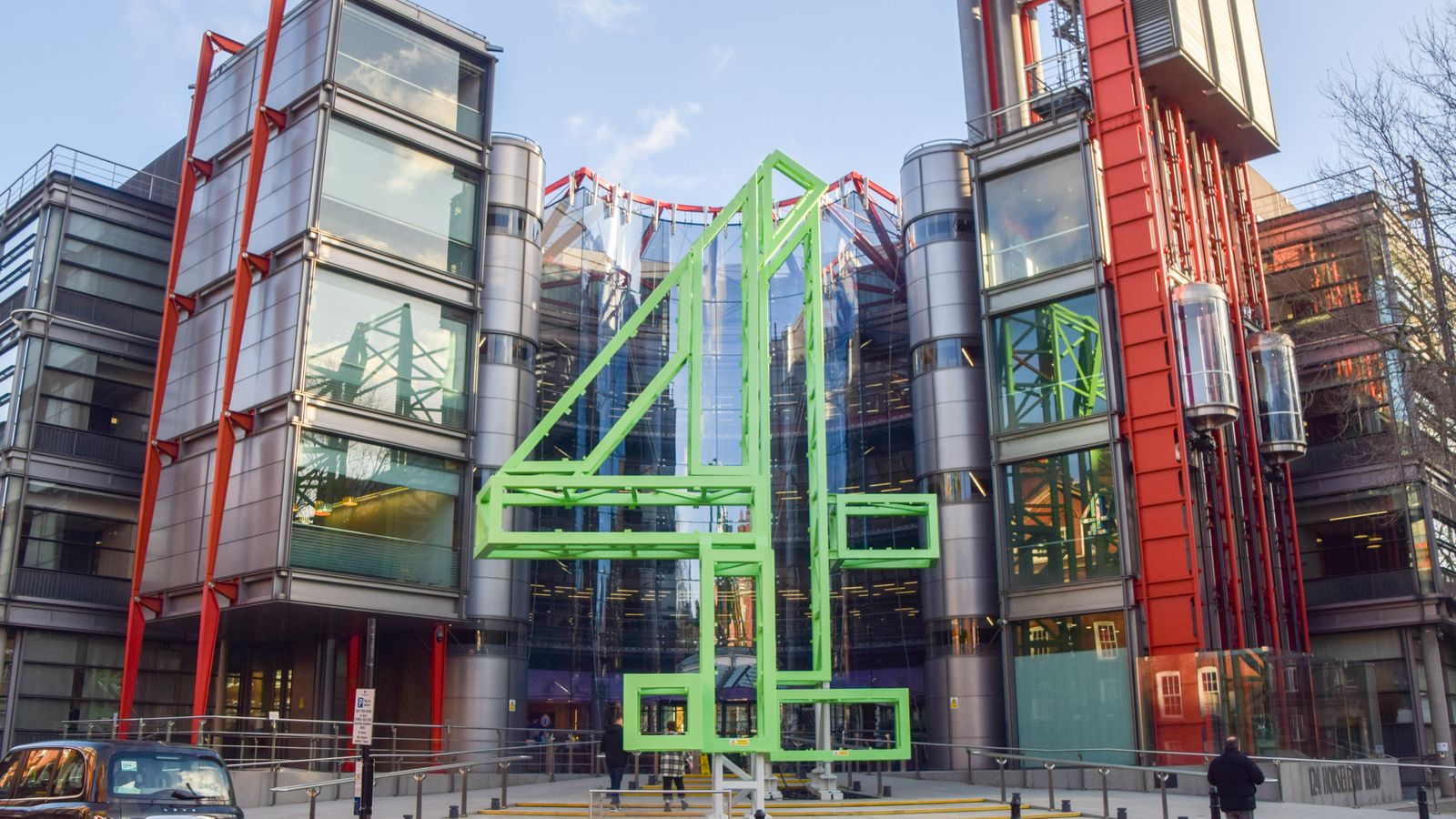
A senior executive at Netflix is among the contenders vying to become the next boss of Channel 4, the state-owned broadcaster.

Sky News has learnt that Emma Lloyd, the streaming giant’s vice-president, partnerships, in Europe, the Middle East and Africa, is one of a handful of media executives shortlisted to replace Alex Mahon as Channel 4’s chief executive.

Ms Lloyd, whose previous employers included Sky, the immediate parent company of Sky News, also served on the board of Ocado Group, from which she stepped down this month after nine years as a non-executive director.

She is understood to be a serious contender to take the helm at Channel 4, with other candidates understood to include Jonathan Allan, the interim chief executive who has also been its chief commercial officer and chief operating officer.

The identities of others involved in the recruitment process was unclear this weekend.

The appointment of a successor to Ms Mahon, Channel 4’s long-serving boss, comes at an important time for the company, and the broader public service broadcasting sector.

Recruitment to the board of Channel 4 is technically led by Ofcom, the media regulator, in agreement with the culture secretary, Lisa Nandy, although the process to land a new chief executive is being steered from within the company.

More on Channel 4

In September, Geoff Cooper, who chairs the online electrical goods retailer AO, was named Channel 4’s next chairman.

He replaced Sir Ian Cheshire, the former Kingfisher boss, who held the role for a single three-year term.

Channel 4 saw off the prospect of privatisation under the last Conservative government, with Ms Mahon a particularly vocal opponent of the move.

Nevertheless, Channel 4, which is funded by advertising revenues, faces significant financial challenges amid shifting – and in many cases waning – consumption of traditional television channels.

In the aftermath of a sale of the company being abandoned, its board last year unveiled Fast Forward, a five-year strategy designed to “elevate its impact across the UK and stand out in a world of global entertainment conglomerates and social media giants”.

“While getting ourselves into the right shape for the future is without doubt the right action to take, it does involve making difficult decisions,” Ms Mahon said at the time.

“I am very sad that some of our excellent colleagues will lose their jobs because of the changes ahead.

“But the reality of the rapid downshift in the UK economy and advertising market demand that we must change structurally.

“As we shift our centre of gravity from linear to digital our proposals will focus cost reductions on legacy activity.”

Ms Mahon’s departure earlier this year saw her quit to run Superstruct, a music festival business owned by private equity backers.

In recent weeks, her name has been linked with the BBC director-general’s post, which is soon to be vacated by Tim Davie.

Mr Davie announced this month that he would step down amid fierce criticism of the Corporation’s handling of a misleadingly edited speech made by President Donald Trump, which was included in an edition of the current affairs programme last year.

The public service broadcasting arena will also undergo significant change if a prospective bid by Sky for the television arm of ITV progresses to a definitive transaction.

Talks between the two companies emerged earlier this month.

In addition to the corporate developments in British broadcasting, the government has also confirmed a Sky News report that a search for a successor to Lord Grade, the Ofcom chairman, is under way.

On Saturday, Netflix declined to comment on Ms Lloyd’s behalf.

Continue Reading

Trending