

Labour promises publicly owned rail – as Tories slam ‘unfunded nationalisation’


Labour will promise to deliver the biggest shake-up to rail “in a generation” by establishing the long-delayed Great British Railways (GBR) organisation and bringing routes back into public ownership.
Making the announcement in a speech on Thursday, shadow transport secretary Louise Haigh will also pledge to establish a “best-price ticket guarantee” for travellers, offer automatic “delay repay” schemes and make digital season tickets available across the network.
But the proposals have been attacked by the Conservatives, who claim Labour has no plan to pay for them.
Keep up with all the latest news from the UK and around the world by following Sky News
GBR was first proposed in 2021 after a review of the railways, with the aim of simplifying the franchise system and rebuilding passenger numbers after they fell dramatically during the pandemic.
The proposed public body promised to subsume Network Rail’s responsibility for track and stations, as well as taking charge of ticketing, timetables and network planning.
But despite getting backing from Boris Johnson and his ministers, its establishment has faced continuous delays and the organisation yet to see the light of day.
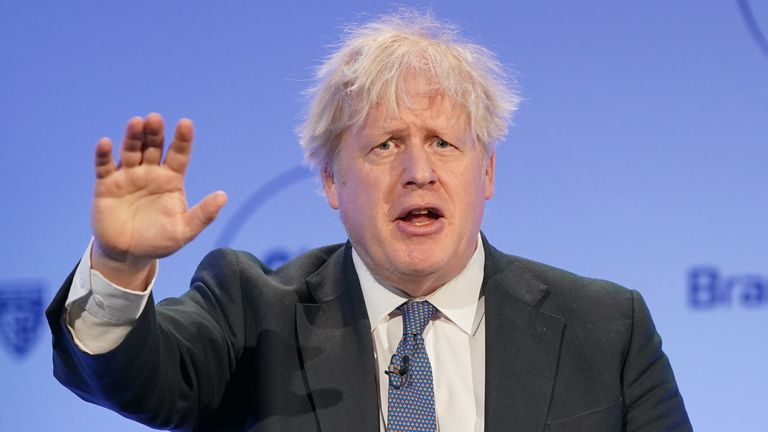
Boris Johnson backed the creation of Great British Railways in 2021. Pic: PA
Labour is now pledging to get GBR up and running if they win the next election, with some additional pledges of their own.
The party said the body, which would be run by industry experts rather than government officials, would end the “fragmentation, waste [and] bureaucracy” of the current network.
And it would “stop profits leaking out to private operators” by taking charge of passenger lines when franchises run out – leading eventually to the whole passenger network being publicly owned.
Labour said this method would prevent taxpayers from having to cover any compensation to the operators that would be due if they renationalised the railways immediately.

Shadow transport secretary Louise Haigh will outline Labour’s plans on Thursday. Pic: PA
The party also pledged to create a new independent watchdog called the Passenger Standards Authority to ensure GBR keeps up its standards.
And it committed to introducing a statutory duty on GBR to promote the use of rail freight – still owned by private firms – to cut carbon emissions and reduce lorry traffic.
Ms Haigh said: “With Labour’s bold reforms, a publicly owned railway will be single-mindedly focused on delivering for passengers and will be held to account on delivering reliable, safe, efficient, accessible, affordable and quality services.
“Labour’s detailed plans will get our railways back on track; driving up standards for passengers, bringing down costs for taxpayers, driving growth and getting Britain moving.”
The proposals have won the backing of Keith Williams – one of the experts behind the rail review – who recommended the creation of GBR three years ago.
He said its creation would “deliver a better railway for passengers and freight”, adding: “Running a better railway and driving revenue and reducing costs will deliver economic growth, jobs and housing by delivering better connectivity.”
But the Conservative rail minister Huw Merriman attacked Labour’s plans as “pointless, unfunded rail nationalisation that will do nothing to improve train reliability or affordability for passengers”, adding: “Without a plan to pay for this, it means one thing – taxes will rise on hard-working people.”
His criticism was backed up by Rail Partners chief executive Andy Bagnall – representing private operators – who said while train companies “agree that change is needed… nationalisation is a political rather than a practical solution which will increase costs over time”.


The long-awaited Digital Asset Market Clarity Act, or CLARITY Act, is moving closer to law, with a Senate markup expected in January, says White House artificial intelligence and crypto czar David Sacks.
Sacks posted to X on Thursday that Senate Banking Committee Chair Tim Scott and Agriculture Committee Chair John Boozman had confirmed that the bipartisan crypto bill will be shaped up by the Senate next month.
”We are closer than ever to passing the landmark crypto market structure legislation that President Trump has called for. We look forward to finishing the job in January!”
The CLARITY Act would define crypto securities and commodities and clarify the roles of the Securities and Exchange Commission, the Commodity Futures Trading Commission, and other financial regulators.
Backers of the bill say it will reduce regulatory uncertainty for crypto firms by establishing clearer compliance pathways and encourage innovation while strengthening investor protections.
Related: Bitcoin institutional buys flip new supply for the first time in 6 weeks
Movement of the CLARITY Act has been slower than expected, with Senator Cynthia Lummis having predicted in September that the CLARITY Act would get to President Donald Trump’s desk for his signature before the end of 2025.
The delays have largely been attributed to the record 43-day US government shutdown across October and November. However, US regulators met with executives from Coinbase, Ripple, Circle and others during that time to ensure the momentum of the bill didn’t stall.
Sacks’ post had confirmed earlier reports that the Senate markup would be pushed into the new year.
The House passed the CLARITY Act in July, and the Senate markup will debate and potentially amend the bill before it’s sent to the full chamber for a vote.
Scott will have to tackle passing the bill with a supermajority of votes to avoid it being forever stalled and essentially abandoned.
If the Senate passes it with amendments, the bill will return to the House for final approval before reaching Trump’s desk.
Magazine: Quantum attacking Bitcoin would be a waste of time: Kevin O’Leary


Representatives of the Bitcoin Policy Institute (BPI), a nonprofit Bitcoin advocacy organization, warned that US lawmakers have not included a de minimis tax exemption for Bitcoin transactions below a certain threshold.
“De Minimis tax legislation may be limited to only stablecoins, leaving everyday Bitcoin transactions without an exemption,” Conner Brown, BPI’s head of strategy, said on X, adding that the decision to exclude Bitcoin (BTC) is a “severe mistake.”
In July, Wyoming Senator Cynthia Lummis introduced a bill proposing a de minimis tax exemption for crypto transactions of $300 or less, with a $5,000 annual limit on tax-free transactions and sales.
The bill proposal also included tax exemptions for digital assets used for charitable donations and tax deferment for crypto earned through mining proof-of-work (PoW) protocols or staking to secure blockchain networks.
Allowing a tax exemption for small Bitcoin transactions would increase its use as a medium of exchange rather than just as a store of value asset, allowing a new financial system built on a Bitcoin standard, BTC advocates say.
The discussion around de minimis tax exemptions has also raised questions about whether such relief should apply to stablecoins, which are designed to maintain a stable value.
“Why would you even need a De Minimis tax exemption for stablecoins,” Marty Bent, founder of media company Truth for The Commoner (TFTC), wrote on X. “They don’t change in value. This is nonsensical.”
Cointelegraph reached out to BPI about the proposed legislation, but had not received a response at time of publication.
Related: Japan’s new crypto tax could wake ‘sleeping giant’ of retail investors
Bitcoin is gaining value, but it isn’t being used as peer-to-peer electronic cash
The Bitcoin white paper, authored by its pseudonymous creator Satoshi Nakamoto in 2019, describes Bitcoin as a “peer-to-peer electronic cash system.”
However, relatively high transaction fees, average block times of about 10 minutes, and capital gains taxes on Bitcoin stifle BTC’s use as a payment method for goods and services.
Many Bitcoin investors choose to hold BTC for the long term, sometimes borrowing fiat currency against their BTC holdings to pay expenses and fund everyday purchases.

The Bitcoin Lightning Network is a second-layer protocol designed for BTC payments, which works by locking a specific amount of BTC in a payment channel between two or more people.
Users connected through a payment channel can conduct multiple transactions offchain, with only the final net balance recorded on the Bitcoin ledger for settlement once the channel is closed.
This makes Bitcoin transactions faster and cheaper, as the users in the payment channel do not have to wait for new blocks to be mined or pay a network fee for each transaction between parties in the channel.
Magazine: The one thing these 6 global crypto hubs all have in common…


A US court is once again being asked to weigh in on maximal extractable value practices after a judge allowed new evidence to be added to a class-action lawsuit tied to a memecoin platform.
The judge granted a motion to amend and refile to include new evidence a class-action lawsuit against memecoin launch platform Pump.fun, the maximal extractable value (MEV) infrastructure company Jito Labs, the Solana Foundation, which is the nonprofit organization behind the Solana ecosystem, and others.
The motion said over 5,000 pieces of evidence in the form of internal chat logs were submitted by a “confidential informant” in September that were previously unavailable. The filing said:
“Plaintiffs assert that the logs contain contemporaneous discussions among Pump.fun, Solana Labs, Jito Labs, and others concerning the alleged scheme, and that they materially clarify the enterprise’s management, coordination, and communications.”
The lawsuit, originally filed in July, alleges that the Pump.fun platform deliberately misled retail investors by marketing memecoin launches as “fair,” but engaged in a scheme with Solana validators to front-run retail participants through maximal extractable value (MEV).
Maximal extractable value is a technique that involves reordering transactions within a block to maximize profit for MEV arbitrageurs and validators.
The plaintiffs allege that Pump.fun used MEV techniques to give insiders preferential access to new tokens at a low value, which were then pumped and dumped onto retail participants, who were used as exit liquidity by insiders.
Cointelegraph reached out to Burwick Law, the legal firm representing the plaintiffs, as well as Pump.fun, Jito Labs and the Solana Foundation, but did not receive any responses by the time of publication.

The lawsuit could set a precedent for MEV cases in the United States, as the ethics of the practice continue to be debated within the crypto industry and legal bodies struggle to define proper regulations about the highly technical subject.
Related: Pump.fun co-founder denies $436M cash out, claims it was ‘treasury management’
The MEV bot trial leaves questions unanswered
Anton and James Peraire-Bueno, the brothers accused of using a MEV trading bot to make millions of dollars in profit, went to trial in November in the US.
Prosecutors argued that the brothers tricked victims out of their funds, but defense attorneys said that they were executing a legitimate trading strategy and did not do anything illegal.
The jury struggled to reach a verdict in the case, and several jurors requested additional information to clarify the complexities surrounding the technical specifics of blockchain technology.
The case ended in a mistrial after the jury was deadlocked and failed to reach a verdict, highlighting the complexity of adjudicating legal disputes surrounding the application of nascent financial technology.
Magazine: Meet the onchain crypto detectives fighting crime better than the cops
-
 Sports2 years ago
Story injured on diving stop, exits Red Sox game
-
 Sports3 years ago
‘Storybook stuff’: Inside the night Bryce Harper sent the Phillies to the World Series
-
 Sports2 years ago
Game 1 of WS least-watched in recorded history
-
 Sports3 years ago
Button battles heat exhaustion in NASCAR debut
-
 Sports3 years ago
MLB Rank 2023: Ranking baseball’s top 100 players
-
Sports4 years ago
Team Europe easily wins 4th straight Laver Cup
-
 Environment3 years ago
Japan and South Korea have a lot at stake in a free and open South China Sea
-
 Environment1 year ago
Here are the best electric bikes you can buy at every price level in October 2024