

Morgan Stanley banker sees 10 to 15 more tech IPOs in 2024, and a ‘better year’ in 2025

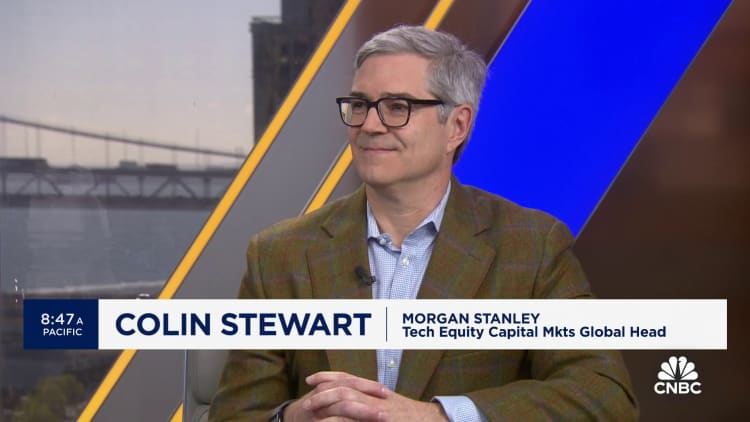
Following a long period of waiting, “the IPO market’s back.”
That’s according to Colin Stewart, Morgan Stanley’s global head of technology equity capital markets. In an interview with CNBC’s “TechCheck” on Monday, Stewart said 10 to 15 more tech companies could go public before the end of 2024, with an even “better year” in store for 2025.
“It’s been a long two and a half years, where we’ve had really nothing,” Stewart said. Recent initial public offerings have priced high and traded well, which “bodes well for the future,” he added.
The lull began in 2022, when soaring inflation and rising interest rates pushed investors out of risk, slashed tech valuations and led many tech companies to delay their plans to go public. It was a sharp contrast to the prior two years, which saw a record number of deals, including some at astronomical revenue multiples.
The IPO market cracked open in September, with the debuts of Instacart and Klaviyo. But the first real signs of momentum came last month, as Reddit became the first IPO for a major social media company since Pinterest in 2019 and data center connectivity chip company Astera Labs rocketed on its first day of trading.
Both stocks remain well above their IPO price, with Astera up about 145% as investors pour money into all things tied to artificial intelligence.
Morgan Stanley was the lead banker on the Reddit and Astera IPOs, positioning itself to collect roughly $37 million in total fees.
Wall Street rival Goldman Sachs led the latest venture-backed tech IPO last week. Rubrik, which develops data management software, jumped 16% in its New York Stock Exchange debut.
Bipul Sinha, CEO, Chairman & Co-Founder of Rubrik Inc., the Microsoft backed cybersecurity software startup, waves a flag while posing with employees during the company’s IPO at the New York Stock Exchange (NYSE) in New York City, U.S., April 25, 2024.
Brendan Mcdermid | Reuters
Stewart, who’s had a hand in some of the largest offerings of the last few decades, said it usually takes six months to take an IPO to the finish line. That means companies currently considering an IPO are likely to hold off until 2025 to avoid intersecting with the U.S. presidential election in November, he said.
As for valuations, Stewart said the market has retreated from the peak days of 2021, and multiples in software and other parts of technology are now back to levels seen in 2018 and 2019. Stewart described 2021 as an “amazing year” but also “exhausting.”
“What’s happened in the last six to 12 months is that the market has gotten more comfortable with paying for growth again,” Stewart said. “We’re not back to the levels of 2021, but we are getting a fair price for growth. And I think at those prices, you’re starting to see companies say, ‘You know, it’s actually not bad to be a public company.'”
Still, the most valuable, late-stage companies have yet to hit the exits. That list includes Elon Musk’s SpaceX along with Stripe and Databricks.
While Stewart said he’d “love to take them public,” he acknowledged that the challenge for the bigger names is “they’ve got scale, they’ve got growth, investors are giving them lots of capital” and they’re investing toward the future.
“Right now the IPO is not on their near-term horizon, unfortunately,” he said. “But when it does come they’ll be blockbuster.”
Technology
ServiceNow in talks to acquire cybersecurity startup Armis in potential $7 billion deal, Bloomberg reports


Oracle CEO Clay Magouyrk appears on a media tour of the Stargate AI data center in Abilene, Texas, on Sept. 23, 2025.
Kyle Grillot | Bloomberg | Getty Images
Oracle on Friday pushed back against a report that said the company will complete data centers for OpenAI, one of its major customers, in 2028, rather than 2027.
The delay is due to a shortage of labor and materials, according to the Friday report from Bloomberg, which cited unnamed people. Oracle shares fell to a session low of $185.98, down 6.5% from Thursday’s close.
“Site selection and delivery timelines were established in close coordination with OpenAI following execution of the agreement and were jointly agreed,” an Oracle spokesperson said in an email to CNBC. “There have been no delays to any sites required to meet our contractual commitments, and all milestones remain on track.”
The Oracle spokesperson did not specify a timeline for turning on cloud computing infrastructure for OpenAI. In September, OpenAI said it had a partnership with Oracle worth more than $300 billion over the next five years.
“We have a good relationship with OpenAI,” Clay Magouyrk, one of Oracle’s two newly appointed CEOs, said at an October analyst meeting.
Doing business with OpenAI is relatively new to 48-year-old Oracle. Historically, Oracle grew through sales of its database software and business applications. Its cloud infrastructure business now contributes over one-fourth of revenue, although Oracle remains a smaller hyperscaler than Amazon, Microsoft and Google.
OpenAI has also made commitments to other companies as it looks to meet expected capacity needs.
In September, Nvidia said it had signed a letter of intent with OpenAI to deploy at least 10 gigawatts of Nvidia equipment for the San Francisco artificial intelligence startup. The first phase of that project is expected in the second half of 2026.
Nvidia and OpenAI said in a September statement that they “look forward to finalizing the details of this new phase of strategic partnership in the coming weeks.”
But no announcement has come yet.
In a November filing, Nvidia said “there is no assurance that we will enter into definitive agreements with respect to the OpenAI opportunity.”
OpenAI has historically relied on Nvidia graphics processing units to operate ChatGPT and other products, and now it’s also looking at designing custom chips in a collaboration with Broadcom.
On Thursday, Broadcom CEO Hock Tan laid out a timeline for the OpenAI work, which was announced in October. Broadcom and OpenAI said they had signed a term sheet.
“It’s more like 2027, 2028, 2029, 10 gigawatts, that was the OpenAI discussion,” Tan said on Broadcom’s earnings call. “And that’s, I call it, an agreement, an alignment of where we’re headed with respect to a very respected and valued customer, OpenAI. But we do not expect much in 2026.”
OpenAI declined to comment.
WATCH: Oracle says there have been ‘no delays’ in OpenAI arrangement after stock slide
-
 Sports2 years ago
Story injured on diving stop, exits Red Sox game
-
 Sports3 years ago
‘Storybook stuff’: Inside the night Bryce Harper sent the Phillies to the World Series
-
 Sports2 years ago
Game 1 of WS least-watched in recorded history
-
 Sports3 years ago
Button battles heat exhaustion in NASCAR debut
-
 Sports3 years ago
MLB Rank 2023: Ranking baseball’s top 100 players
-
Sports4 years ago
Team Europe easily wins 4th straight Laver Cup
-
 Environment3 years ago
Japan and South Korea have a lot at stake in a free and open South China Sea
-
 Environment1 year ago
Here are the best electric bikes you can buy at every price level in October 2024