
Masimo’s billionaire CEO put shares on margin to get cash while keeping ownership ahead of proxy fight

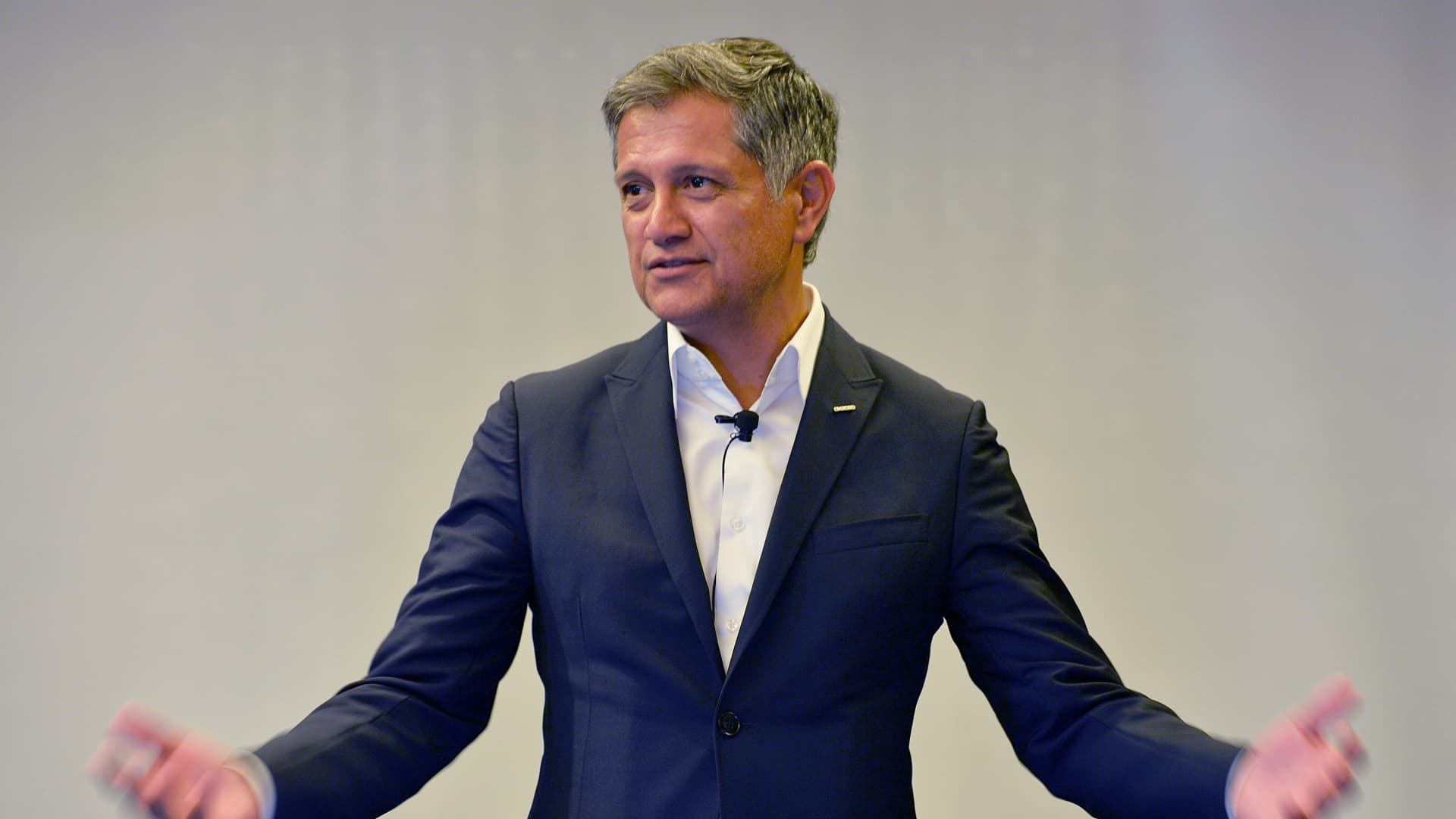
Founder and CEO of Masimo, Joe Kiani addresses a press conference in Bangalore on January 2, 2017.
Manjunath Kiran | Afp | Getty Images
Billionaire Masimo founder Joe Kiani, best known for his successful legal fight against Apple and his friendship with President Joe Biden, has borrowed against half of his $660 million stake in the health-technology company rather than sell his stock, according to corporate filings from earlier this week.
Borrowing against that much of a stake is unusual for executives, but may be helpful as the company prepares for a fight with an activist aiming to take control of the board. The move allows Kiani, the company’s CEO and chairman, to maintain his stake and voting power while also getting money he says he needs for family reasons.
Many medical-tech peers bar such moves, and it could leave Kiani susceptible to margin calls if Masimo’s stock falls below a certain threshold. Kiani has just under 4 million Masimo shares, or around 7.5% of the company, according to FactSet data.
Masimo, which makes wearables and health monitoring products, is preparing to fend off a second proxy fight waged by Quentin Koffey’s Politan Capital Management. Kiani described Koffey as “destructive” in a March CNBC interview.
Masimo shares are up 15% this year, lifting the company’s market cap past $7 billion. The stock had a volatile run in the back half of 2023, falling 47% in the third quarter before gaining 34% in the fourth.
Politan controls 8.9% of Masimo shares. While that’s bigger than Kiani’s stake, even before pledged shares are weighed, regulatory filings show that the CEO has options that could boost his holdings to 9.2% if exercised.
Politan already won two seats on Masimo’s six-person board in a contentious 2023 proxy fight, but announced last month that it would seek two more seats, including Kiani’s, to cement control.
Kiani, 59, pledged 2.97 million Masimo shares as of April, valued at $397 million, as collateral against “personal loans.” The company said in its annual filing Kiani had family “financial planning objectives” that would require him to sell his stock, but that he “did not want to diminish his shareholdings.” His objectives weren’t spelled out in the filings.
“The pledge of shares was pre-approved by the Board and reflects Mr. Kiani’s conviction in the value of Masimo stock despite the short-term decline in the stock price during the second half of 2023,” a Masimo spokesman said in an emailed statement. “Rather than sell his pledged shares, Mr. Kiani increased his pledge to maintain his stock ownership.”
The spokesperson added that Kiani purchased about $7 million worth of Masimo stock in the second half of 2022 and the first half of 2023.
The Masimo logo is displayed at Masimo headquarters on December 27, 2023 in Irvine, California.
Mario Tama | Getty Images
Kiani is a major Democratic donor who is reportedly close with President Biden. He also has an 8,000-acre winery in Santa Ynez, California, near Santa Barbara. The lending is an increase from the year before, when Kiani only pledged 400,000 shares as collateral.
Masimo’s board also includes Bob Chapek, who joined in January, almost exactly a year after was he ousted as Disney’s CEO.
Several of Masimo’s peers, like Agilent, Stryker and Medtronic, don’t allow executives to pledge their shares. Companies generally frown upon stock pledging, though some, including Masimo, permit it with board approval. Stock-backed lending, or “Lombard loans,” generally requires a borrower to sell their shares if they fall below a certain value, which in the case of large shareholders can drive a stock price down even further.
Masimo’s earlier proxy fight was marked by litigation between the two sides that led to Politan winning $18 million in legal fees after forcing the company to abandon an effort to thwart the investment firm. There were also personal attacks. In regulatory filings, the company described Koffey as someone with “hubris” that was “no different than his more prominent peer Bill Ackman.”
Major shareholders, including Vanguard, sided with the activist, which said that Masimo had been marred by poor governance practices and the acquisition of Sound United, a consumer audio company. Masimo shares plummeted 37% the day the deal was announced in February 2022.
Last month, Masimo said it would spin off its consumer business, an announcement that boosted the stock. When Politan announced its second campaign days later, shares rose even higher. Politan has said news of the spinoff, made after the bell on a Friday and shortly before the activist announced its second campaign, was “rushed” when the company learned of the activist’s plans.
Masimo has denied that claim. The company has yet to file a proxy statement or schedule an annual meeting.
Masimo has had some success in recent months. The company pursued high-profile patent litigation against Apple, alleging that the company infringed on its pulse oximeter technology for the Apple Watch. After some initial setbacks, Masimo won a ruling that restricted the sale of some watches. The two companies remain in negotiations on the matter.
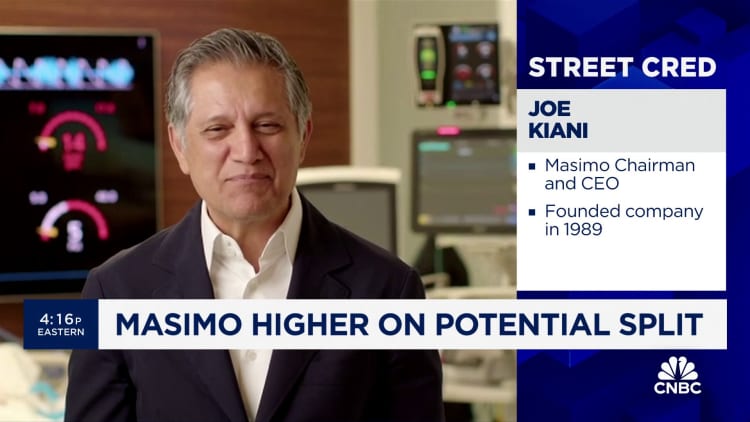
WATCH: Masimo CEO Joe Kiani on consumer spinoff and proxy fight

Technology
‘China’s Nvidia’ Moore Threads surges over 400% on trading debut after $1.1 billion listing


An illustration photo shows Moore Threads logo in a smartphone in Suqian, Jiangsu Province, China on October 30, 2025.
Cfoto | Future Publishing | Getty Images
Shares of Moore Threads, a Beijing-based graphics processing unit (GPU) manufacturer often referred to as “China’s Nvidia,” soared by more than 400% on its debut in Shanghai following its $1.1 billion listing.
The stock is currently trading at 584.98 yuan, over five times its IPO price of 114.28 yuan.
Moore Threads’ IPO was led by CITIC Securities, which served as the lead underwriter for the offering. The joint book runners on the deal were BOC International Securities, China Merchants Securities, and GF Securities.
The company, which is not yet profitable, said in its listing that the IPO proceeds are needed to accelerate several core research and development initiatives, including new-generation self-developed AI training and inference GPU chips. A portion of the funds will also be used to supplement working capital.
Moore Thread’s successful IPO comes despite it being placed under U.S. sanctions in 2023, which limited its access to advanced chip manufacturing processes and foundries.
The firm is representative of a growing cast of Chinese companies developing AI processors amid Beijing’s efforts to reduce reliance on American chip designer Nvidia.
Other companies in the space include tech giants like Huawei, as well as more specialized players like Cambricon — a firm whose shares on the Shanghai exchange have surged more than 100% year to date.
Washington has maintained varying export restrictions on Nvidia for years, preventing it from selling its most advanced AI chips to China. More recently, Beijing has also stepped in to block imports of Nvidia’s chips as it tries to encourage domestic alternatives like Moore Threads.
Newer players like Enflame Technology and Biren Technology have also entered the space, aiming to capture a share of the billions in GPU demand no longer served by Nvidia. Chinese regulators have also been clearing more semiconductor IPOs in their drive for greater AI independence.


Anthony Noto, CEO of SoFi, speaking with CNBC at the annual Allen & Co. Media and Technology Conference in Sun Valley, Idaho on July 10th, 2025.
David A. Grogan | CNBC
SoFi shares fell almost 6% in extended trading Thursday after the fintech company announced a $1.5 billion stock offering.
The company, which provides online loans and other banking services, said in a press release that it will use the proceeds for “general corporate purposes, including but not limited to enhancing capital position, increasing optionality and enabling further efficiency of capital management, and funding incremental growth and business opportunities.”
The announced offering comes after SoFi’s market cap almost doubled so far in 2025. The stock price is up more than sixfold since the end of 2022.
A company’s share price often drops on a planned share sale as the offering dilutes the value of existing holders’ stakes.
In its third-quarter earnings release in late October, SoFi reported revenue growth of 38% from a year earlier to $961.6 million, while net income more than doubled to $139.4 million. The company reported cash and equivalents of $3.25 billion.
-
 Sports2 years ago
Story injured on diving stop, exits Red Sox game
-
 Sports3 years ago
‘Storybook stuff’: Inside the night Bryce Harper sent the Phillies to the World Series
-
 Sports2 years ago
Game 1 of WS least-watched in recorded history
-
 Sports3 years ago
Button battles heat exhaustion in NASCAR debut
-
 Sports3 years ago
MLB Rank 2023: Ranking baseball’s top 100 players
-
Sports4 years ago
Team Europe easily wins 4th straight Laver Cup
-
 Environment3 years ago
Japan and South Korea have a lot at stake in a free and open South China Sea
-
 Environment1 year ago
Here are the best electric bikes you can buy at every price level in October 2024