
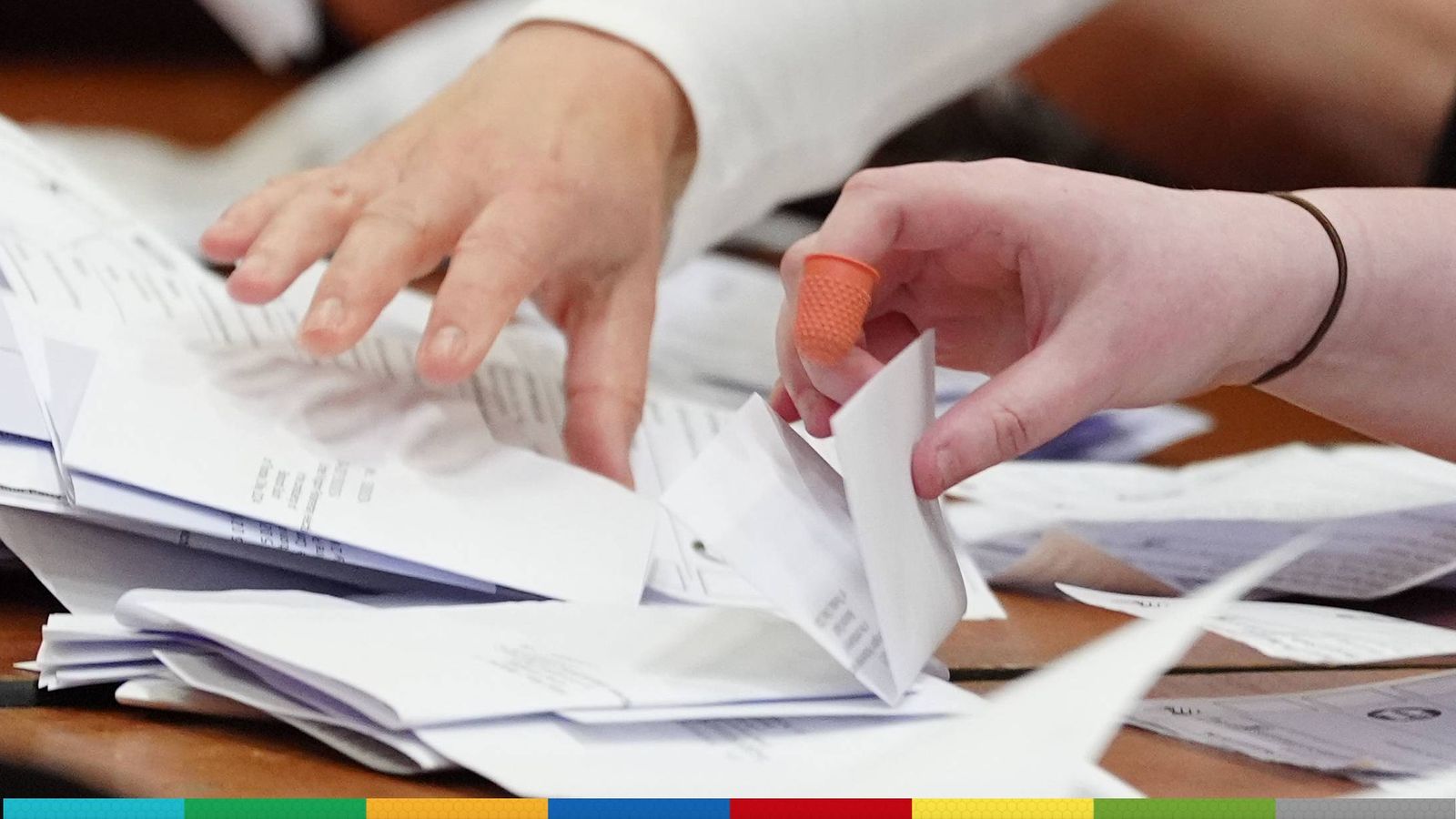
Labour wins Brexit strongholds as early local election results come in

Labour has won control of a string of Leave-voting councils as results begin to roll in from the local elections across England and Wales.
The party seized control of Rushmoor in Hampshire from the Conservatives shortly after 3am – a council the Tories had run for the last 24 years – with a spokesman calling the result “truly historic”.
They also took Hartlepool Council – the scene of a major by-election loss back in 2021, which led Sir Keir Starmer to consider quitting as leader.
A spokesperson said the win – that saw the authority move from no overall control into Labour’s hands – was “a ground-breaking moment” after the defeat three years ago.
Politics live: Follow the results as they come in
‘A good night for Labour’
Labour also claimed victory in Thurrock, Essex, from no overall control, saying it was “exactly the kind of place we need to be winning to gain a majority in a general election”.
Meanwhile, the Conservatives lost control of North East Lincolnshire after Labour won five of the seats up for grabs – with neither party now holding a majority on the council.
All four areas overwhelmingly voted Leave in the 2016 referendum, with Thurrock supporting it by 72.3%, North East Lincolnshire by 69.9%, Hartlepool by 69.6% and Rushmoor by 58.2%.
More than 2,600 council seats across 107 councils are up for grabs in England, alongside 11 mayoral elections, a parliamentary seat and police and crime commissioners throughout England and Wales – so there is still a way to go.
But early signs show Labour is winning back seats in areas it lost over the Brexit debate, as well as making gains in traditionally Tory voting councils.
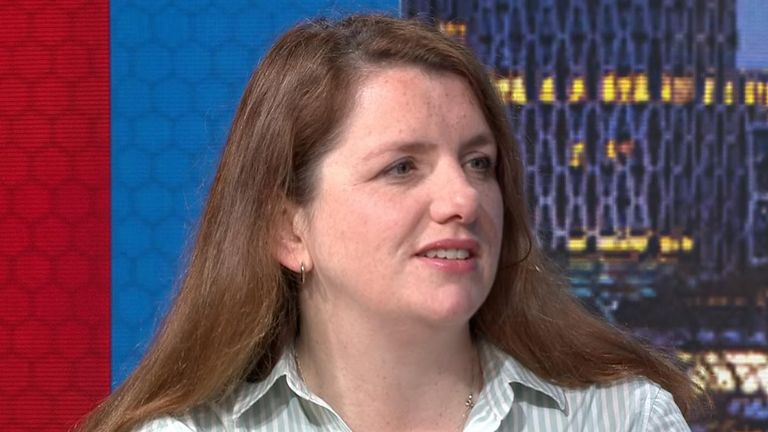
‘We’re surging, they’re sinking’
Shadow environment secretary Steve Reed told Sky News that while it was “early days”, the results so far were showing positive signs for Labour come the next general election.
“These are not polls,” he said. “These are people getting off their backsides, going out of their homes, into a polling station, putting a cross on a party that they want to govern their local area.
“People are crying out for change. I know that from speaking to people on the doorsteps and tonight, it looks like people around the country are voting for change.”
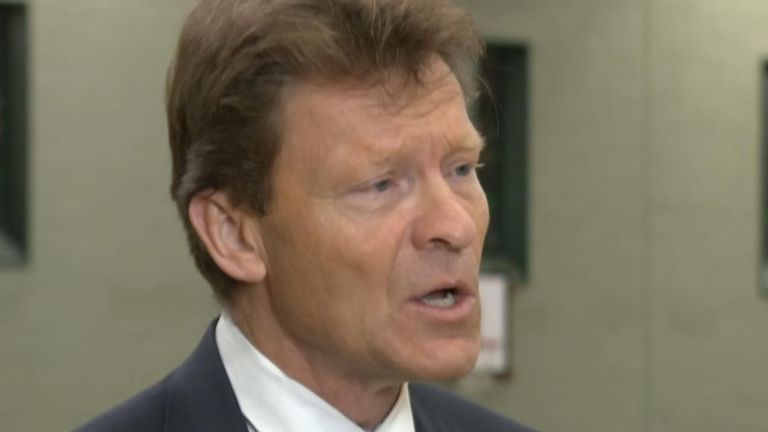
But while Tory MP James Daly said he “fully accepts” the loss of these councils, he insisted to Sky News his party could “still win in parts of the country where historically Labour have dominated” – including in Teeside, where Conservative Lord Houchen is defending his mayoralty.
Keep up with all the latest news from the UK and around the world by following Sky News
Other results in so far include Labour holding on to Sunderland Council, along with local authorities in South Tyneside, Chorley and Newcastle,
However, the Greens won a number of seats from Labour in Newcastle, with the party’s co-leader Carla Denyer telling Sky News it was over its position on the conflict in Gaza.
The Conservatives held on to Broxbourne Council in Hertfordshire – an authority it has run for its entire 52-year history.
UK
Russia trying to ‘bully’ UK and allies with attacks under threshold of all-out war, MI6 chief says
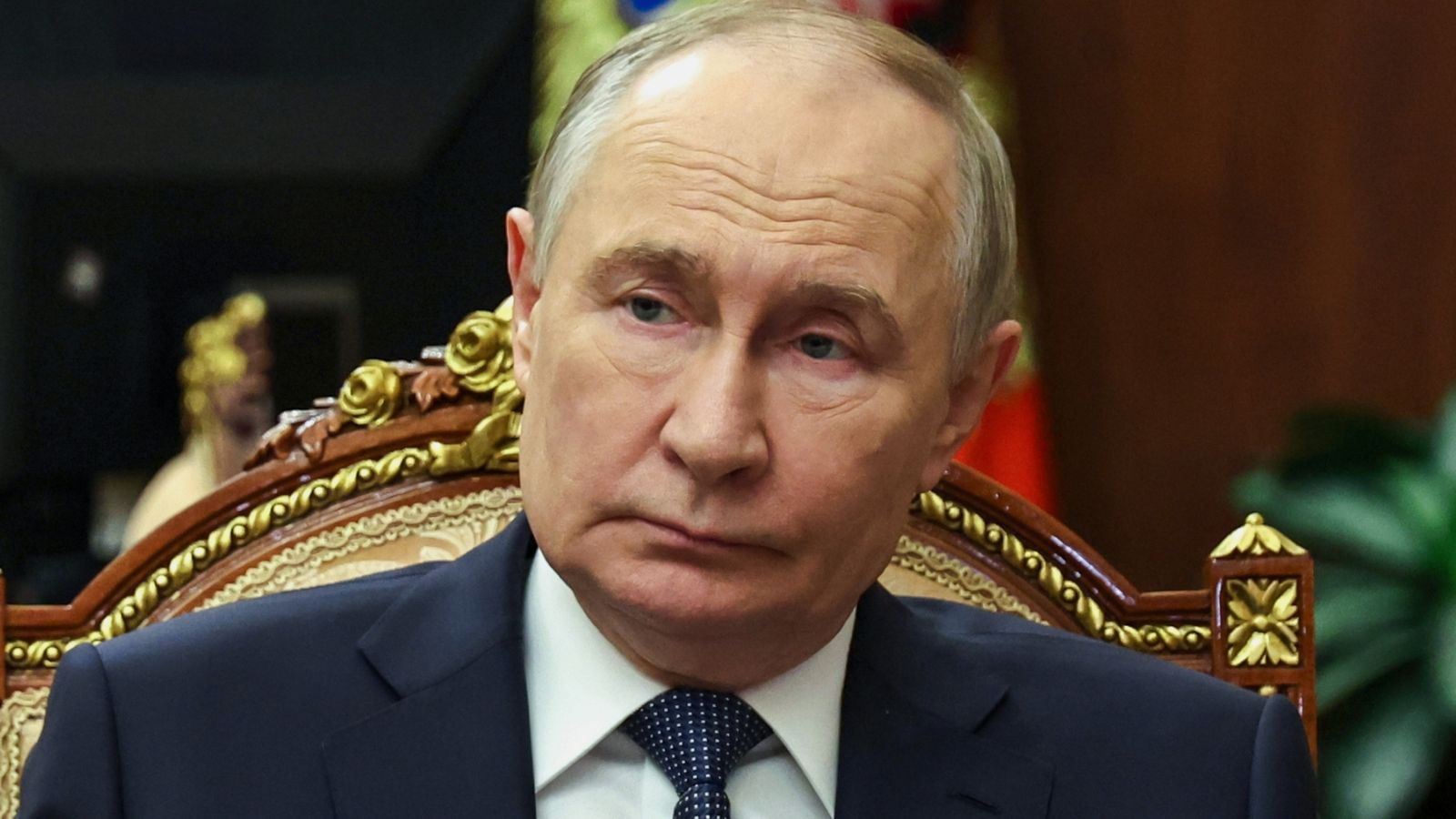

Russia is trying to “bully, fearmonger and manipulate” the UK and its allies with attacks under the threshold of all-out war, the new head of MI6 has said.
Blaise Metreweli, the first female chief of the Secret Intelligence Service (SIS), said Britain was “operating in a space between peace and war” and that everyone has a responsibility to understand the dangers because “the frontline is everywhere”.
In her first big speech on Monday, she also focused on Vladimir Putin’s devastating war in Ukraine, accusing him of “dragging out negotiations” on a peace deal and warning that Kyiv’s fate is “fundamental not just to European sovereignty and security but to global security”.
Offering her view on the evolution of global security threats, Ms Metreweli underlined the transformative role of technology, from artificial intelligence to quantum computing.
She said control over such advanced technologies is shifting from states to corporations and even individuals, making the balance of global power more “diffuse, more unpredictable”.
The spymaster did not name anyone.
Blaise Metreweli. Pic: PA
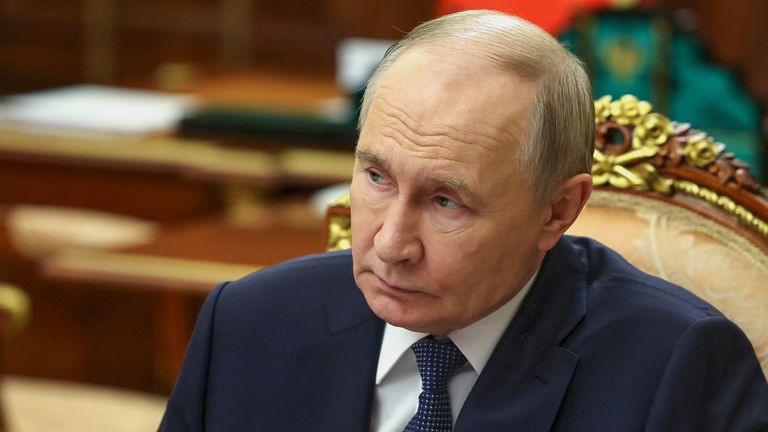
Is time running out for peace plan?
However, innovators such as Elon Musk are becoming increasingly influential, with their technologies such as his Starlink satellites and his social media site X.
The boss of MI6 was speaking at her agency’s headquarters in London, though she said that the main work of her spies was carried “many miles away from this place – out of sight, hidden from the world, undercover, recruiting and running agents who choose to place their trust in us, sharing secrets to make the UK and the world safer”.
She warned the world was “more dangerous and contested now than it has been for decades”.
Read more from Sky News:
Who were the suspected gunmen in Bondi Beach terror attack?
Jimmy Lai found guilty of national security offences in Hong Kong
The spy chief said: “Conflict is evolving and trust eroding, just as new technologies spur both competition and dependence.
“We are being contested from sea to space – from the battlefield to the boardroom. And even our brains as disinformation manipulates our understanding of each other and ourselves… We are now operating in a space between peace and war.
“This is not a temporary state or a gradual evolution. Our world is being actively remade with profound implications for national and international security.”
Breaking with a tradition by previous chiefs of offering a view on a range of threats when speaking publicly, Ms Metreweli said she was choosing to focus on Russia.
“We all continue to face the menace of an aggressive, expansionist and revisionist Russia, seeking to subjugate Ukraine and harass NATO,” she said.
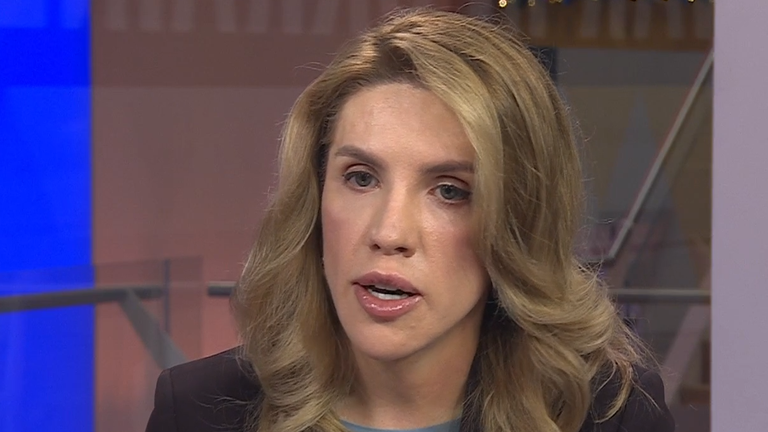
Ukrainian MP: Who will stop Putin?
On the conflict, she said Putin was “dragging out negotiations and shifting the cost of war on to his own population”.
Her comments come as Donald Trump is attempting to broker a peace deal between Moscow and Kyiv.
General Oleksandr Syrskyi, the head of Ukraine’s armed forces, told Sky News in an interview earlier this month that he believed Putin was using the US push for negotiations as “cover” while Russian troops attempted to seize more land by force.
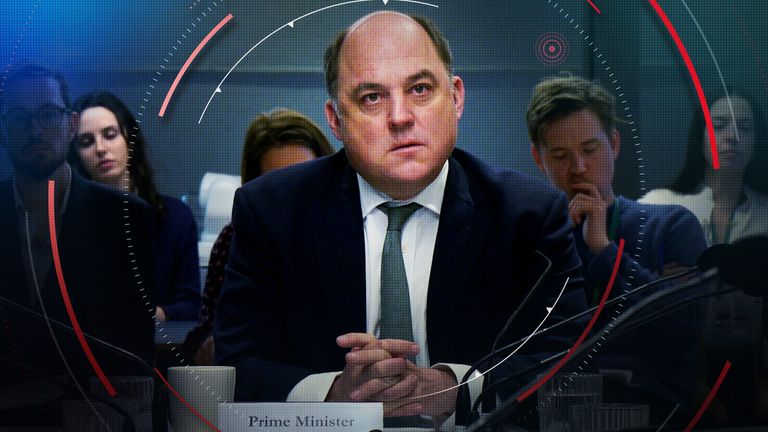
The Wargame returns with new episodes
The MI6 boss said the UK’s support for Ukraine would endure regardless of Moscow’s stalling actions.
She also flagged a growing wave of “grey zone” hostilities – deliberately carried out under the threshold of conventional armed conflict – that she attributed to Moscow.
“It’s important to understand their [Russia’s] attempts to bully, fearmonger and manipulate because it affects us all,” she said.
“I am talking about cyber attacks on critical infrastructure. Drones buzzing airports and bases. Aggressive activity in our seas, above and below the waves. State-sponsored arson and sabotage. Propaganda and influence operations that crack open and exploit fractures within societies.”
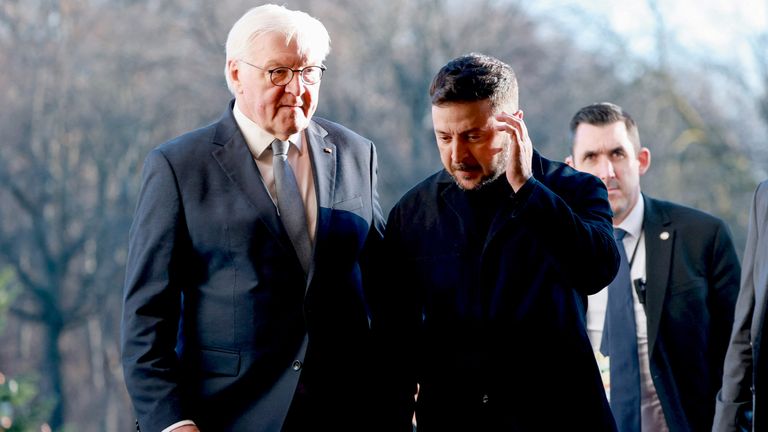
Germany’s President Steinmeier with President Zelenskyy in Berlin on Monday. Pic: Reuters
While she did not specify any particular incidents, there have been a spate of mysterious drone sightings in Denmark, Germany and Sweden; while a Russian spy ship was spotted off the coast of Scotland and acts of arson and sabotage have been carried out in the UK, such as a blaze at a warehouse in east London that was providing aid to Ukraine.
Drawing attention to another method to attack a country and its people, Ms Metreweli underlined how information is being weaponised, with falsehoods spread online that are designed to erode trust in a society and amplify divisions.
“The export of chaos is a feature not a bug in this Russian approach to international engagement and we should be ready for this to continue until Putin is forced to change his calculus,” she said.
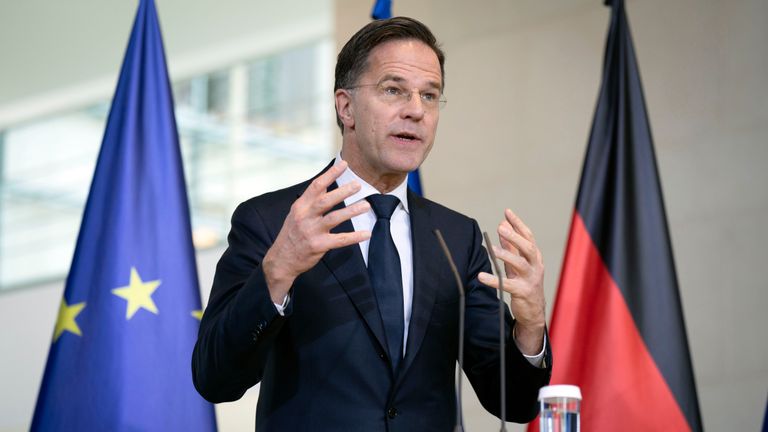
NATO boss: ‘Conflict is at our door’
MI6, she said, is adapting to respond to the evolving threats.
But unusually Ms Metroweli also said the wider British public had a role to play, such as with schools helping to educate children to spot disinformation on social media and to check sources of news “and be alive to those algorithms that trigger intense reactions like fear”.
She added: “It also means everyone in society really understanding the world we are in – a world where… the frontline is everywhere. Online, on our streets, in our supply chains, in the minds and on the screens of our citizens.”
Building on the success of the highly acclaimed podcast The Wargame, Sky News presents The Wargame: Decoded – a one-off live event that takes you deep inside the minds of the wargame’s participants. Discover how they tackled the toughest challenges, the decisions they made under intense pressure, and even experience key moments of the game for yourself.
Click here to get tickets.
Sky News’ Deborah Haynes will guide the conversation with Sir Ben Wallace, Robert Johnson, Jack Straw, Amber Rudd, Keir Giles and General Sir Richard Barrons – real-life military chiefs, former government officials and leading experts. Together, they will unpack their experiences inside The Wargame, revealing the uncertainty, moral dilemmas and real-world pressures faced by those who must make decisions when the nation is under threat.
Join us for this unique event exploring how the UK might respond in a moment of national crisis and get a rare, unfiltered glimpse into how prepared the country truly is for war.

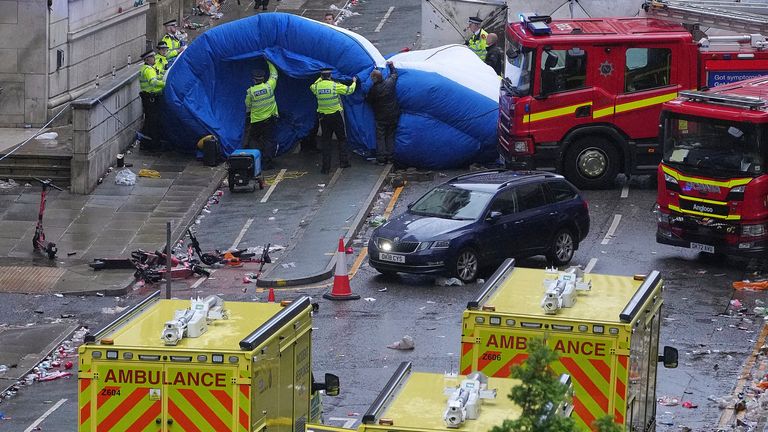
A “hero” pedestrian climbed into the car of Liverpool parade attacker Paul Doyle and stopped him, a court has heard.
Doyle, who used a car as a “weapon” to plough through more than 100 people celebrating Liverpool’s Premier League title win, told officers “I’ve just ruined my family’s life”, the court heard.
The sentencing hearing was told the 54-year-old was “in a rage” and his “anger had completely taken hold of him”.
Doyle is due to be sentenced on Tuesday after pleading guilty to 31 offences relating to seriously injuring people during the victory parade on 26 May.
Doyle, described as a “family man” by prosecutors, wept as footage of the horrific rampage was shown to the city’s crown court several times on Monday.
Paul Greaney KC, prosecuting, described the actions of Daniel Barr, who he called the “hero” of the day.
Emergency services at the scene. Pic: AP
Mr Barr, an ex-soldier, had “bravely” jumped into the back of Doyle’s Ford Galaxy and placed the vehicle into park.
He was walking up Water Street when he noted the defendant’s Ford Galaxy in the distance, said Mr Greaney, noting the crowd’s attitude changed from “joyous to desperate”.
Doyle’s vehicle then stopped next to Mr Barr “all of a sudden”.
“Daniel Barr instinctively pulled open the rear passenger-side door and climbed in. He did so with the intention of stopping the driver,” the prosecutor said.
Mr Barr leaned forward and moved the gear into “park” and “held it as hard as he could”.
Mr Greaney added: “The Galaxy did not stop immediately, but in the end it did.”
The prosecutor said police officers forced Doyle into a police van after the attack.
This, he said, was done “in the midst of a hostile crowd”, adding that officers’ behaviour was both “brave and effective”.
When Doyle was securely in the van, Mr Greaney said police body-worn camera footage picked up him saying: “I’ve just ruined my family’s life.”
Read more from Sky News:
Christmas strike by resident doctors to go ahead
Rob Reiner spoke to Eric Idle about future before he died
Doyle admitted dangerous driving, affray, 17 charges of attempting to cause grievous bodily harm (GBH) with intent, nine counts of causing GBH with intent, and three counts of wounding with intent last month.
He had previously denied the offences, which relate to 29 victims aged between six months old and 77 years old.
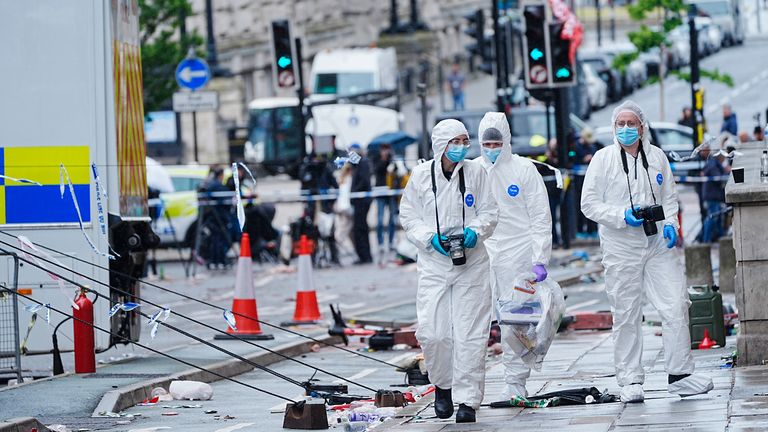
Forensic officers at the scene in Water Street.
Pic: PA
The court was shown dashcam footage taken from the defendant’s car showing the attack.
Mr Greaney warned the court: “What we are about to display on the screens is truly shocking.”
There were audible gasps in the courtroom as the footage played.
Doyle could be heard repeatedly shouting at pedestrians to “move out the f****** way” as he drove through crowds.
Consistently using his vehicle’s horn, people could be seen trying to jump out of the way, with some forced on to the bonnet of the car.
“F****** pr****,” Doyle shouts as the footage continues.
By the end of the footage, people begin to attempt to run up to the vehicle.
When the car stops, one man shouts, “get the f*** out of the car”.
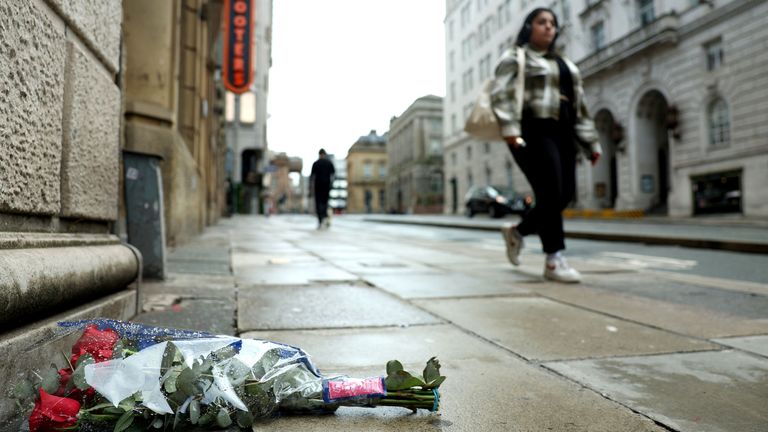
Pic: Reuters
Mr Greaney also detailed some of the injuries sustained by victims on the day of the attack.
One woman, aged 66, spent four nights in hospital after breaking six ribs and suffering fractures to her fingers on her left hand and her left wrist.
Another woman, aged 77 at the time, spent 27 days in hospital.
The prosecutor said she suffered a fractured left forearm, fractured left collar bone, three fractured ribs, a fractured pelvis, a broken nose, as well as multiple abrasions and bruising to her head, knees and back.
Another victim, who was 17, suffered bruising to their legs, shoulder and had a small fracture to their tibia.
After suffering wound infections, it took two months before the victim regained mobility, the prosecutor added.
Mr Greaney said some people at the scene on 26 May “thought that what was taking place was a terrorist attack”.
However, the prosecution ruled out that the defendant’s actions were “driven by ideology”.
Police investigations showed there was no problem with the vehicle, and Doyle was completely sober and “free of all drugs”, Mr Greaney said.
“The truth is a simple one – Paul Doyle just lost his temper in his desire to get to where he wanted to get to.
“In a rage, he drove into the crowd,” he added.
Doyle was arrested at the scene in Water Street just after 6pm and charged later that week.
The youngest victim was six-month-old Teddy Eveson, whose parents later told media he was thrown about 15ft down the road in his pram when the crash happened.
Doyle, of Croxteth, Liverpool, admitted attempting to cause grievous bodily harm to the baby.
Five other children, whom Doyle either injured or attempted to injure, cannot be named for legal reasons.
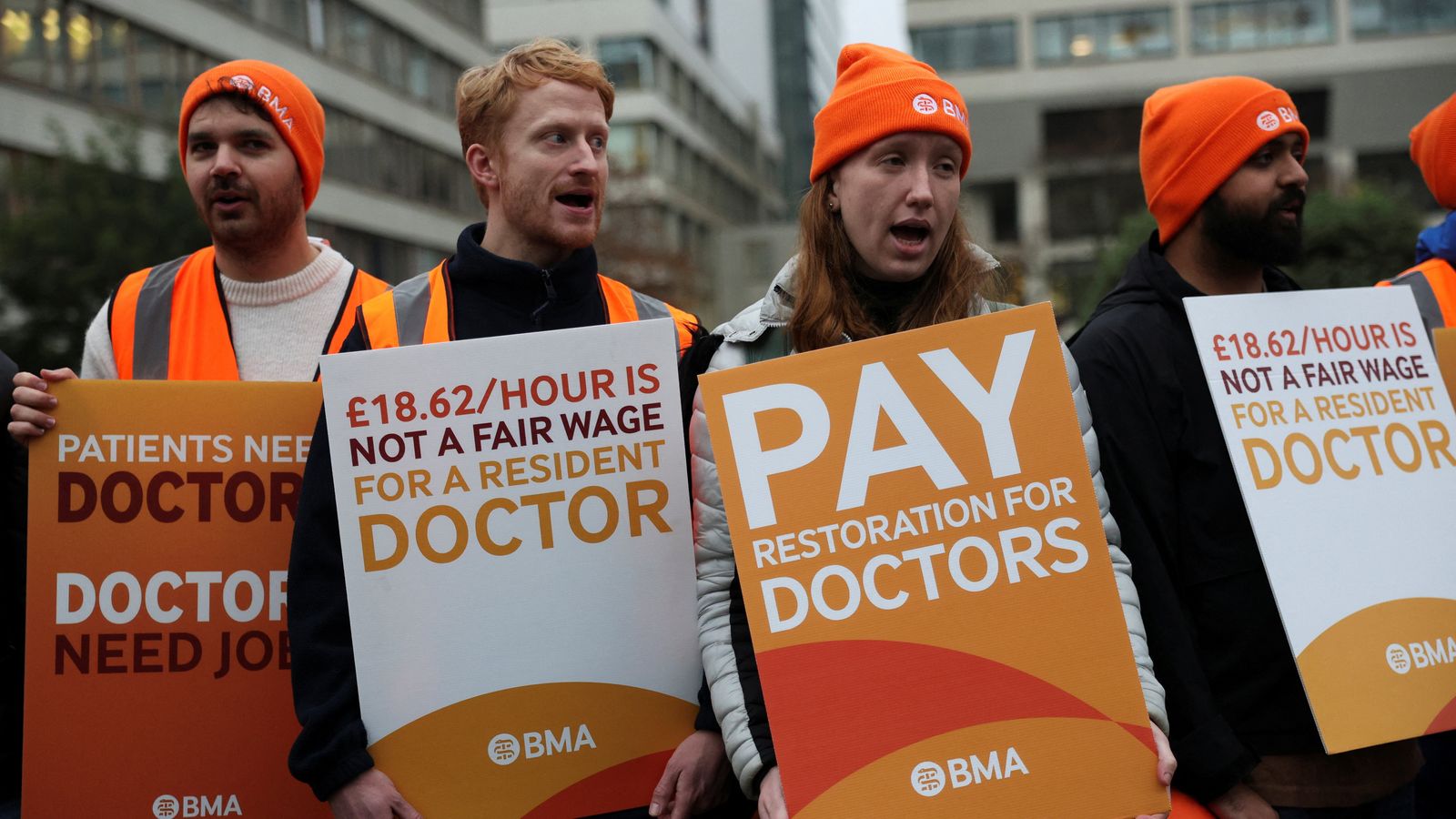
A five-day strike involving tens of thousands of doctors in England will go ahead as planned, the British Medical Association (BMA) has said.
The union said its resident doctor members had rejected the government’s offer to call off the strikes, and will stop work between 17 and 22 December.
Announcing the move, the BMA said 83.2% of those who took part in a poll rejected the offer, with a turnout of 65.34%.
The news comes after NHS England said it was facing the “worst case scenario” following a rise in flu cases of more than 55% in a week. Hospitals in England are said to be facing record levels of the disease for the time of year.
Live updates: Doctors to strike
Streeting: ‘BMA made totally unrealistic demand’
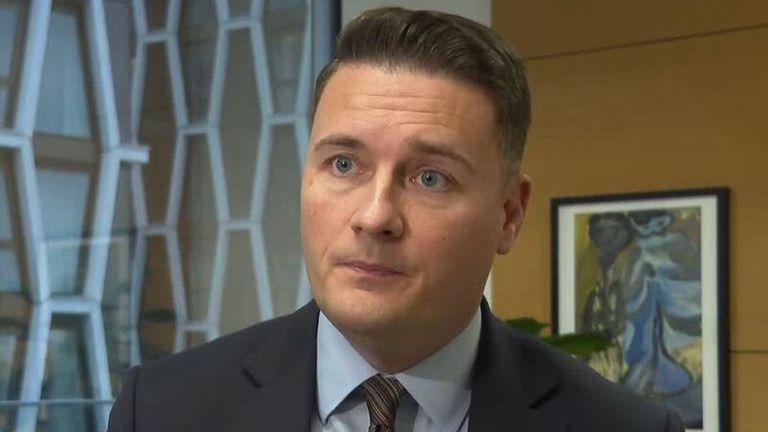
Health Secretary Wes Streeting accused the union of “shocking disregard for patient safety” for choosing to stage a walkout “to inflict damage on the NHS at the moment of maximum danger”.
He said the strikes were “self-indulgent, irresponsible and dangerous” – and said doctors would be “abandoning” patients.
Mr Streeting said the BMA had refused to postpone strikes to January and “help patients and other NHS staff cope over Christmas”. “There is no need for these strikes to go ahead this week, and it reveals the BMA’s shocking disregard for patient safety,” he added.
But the BMA said the strike was “still entirely avoidable” and that it was “willing to work to find a solution”.
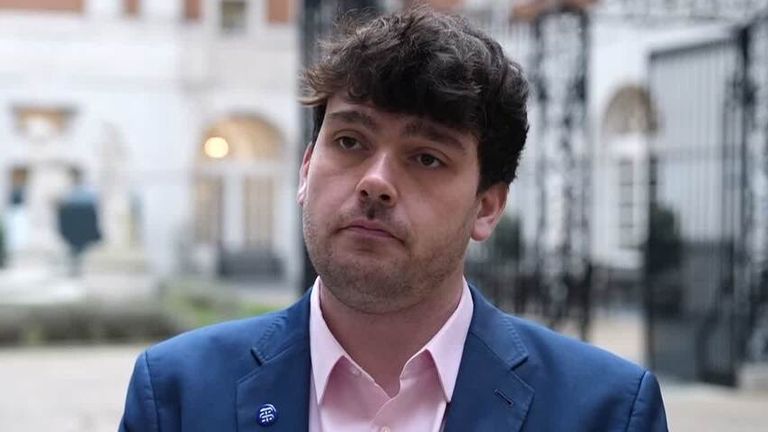
BMA: ‘Strikes are still avoidable’
BMA resident doctors committee chair Dr Jack Fletcher said: “The health secretary should now work with us in the short time we have left to come up with a credible offer to end this jobs crisis and avert the real terms pay cuts he is pushing in 2026.”
The union said it remained “committed to ensuring patient safety” and it would be in “close contact” with NHS England during the strike action to “address safety concerns if they arise”.
The government’s offer had included a fast expansion of specialist training posts as well as covering out-of-pocket expenses such as exam fees.
It did not include extra pay, but had offered to extend the union’s strike mandate to enable any walkout to be rescheduled to January.
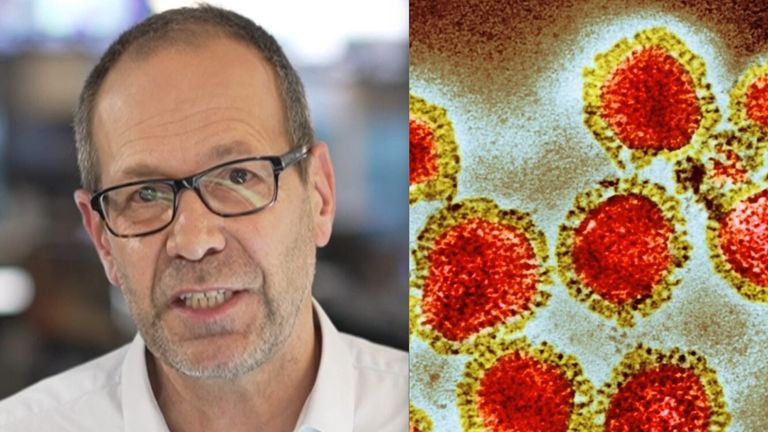
Mutated virus is behind flu surge
‘Abandoning patients in hour of greatest need’
Mr Streeting said the strike “goes against everything” a medical career is about.
He said: “The government’s offer would have halved competition for jobs and put more money in resident doctors’ pockets, but the BMA has again rejected it because it doesn’t meet their ask of a further 26% pay rise.
“Resident doctors have already had a 28.9% pay rise – there is no justification for striking just because this fantasy demand has not been met.
“I am appealing to ordinary resident doctors to go to work this week. There is a different magnitude of risk in striking at this moment.
“Abandoning your patients in their hour of greatest need goes against everything a career in medicine is meant to be about.”
Hospital leaders said the strike would come as the NHS “needs all hands on deck” – and called the action “bitterly disappointing”.
Daniel Elkeles, chief executive of NHS Providers, said: “This vote is a bitter pill which will inevitably result in harm to patients and damage to the NHS.
“We had hoped that the government’s recent updated offer would be enough to head off another walkout at a time when so many people are suffering with flu, and the NHS needs all hands on deck.”
Rory Deighton, acute and community care director at the NHS Confederation, said: “It is bitterly disappointing that the BMA has rejected this offer and chosen to continue with hugely disruptive strikes.”
Public support for the strikes is low, according to a YouGov poll released last week.
The results showed 58% of those asked either somewhat or strongly opposed the industrial action, while 33% somewhat or strongly supported it.
-
 Sports2 years ago
Story injured on diving stop, exits Red Sox game
-
 Sports3 years ago
‘Storybook stuff’: Inside the night Bryce Harper sent the Phillies to the World Series
-
 Sports2 years ago
Game 1 of WS least-watched in recorded history
-
 Sports3 years ago
Button battles heat exhaustion in NASCAR debut
-
 Sports3 years ago
MLB Rank 2023: Ranking baseball’s top 100 players
-
Sports4 years ago
Team Europe easily wins 4th straight Laver Cup
-
 Environment3 years ago
Japan and South Korea have a lot at stake in a free and open South China Sea
-
 Environment1 year ago
Here are the best electric bikes you can buy at every price level in October 2024