

Is Tesla’s reputation ruined? It depends on who you ask

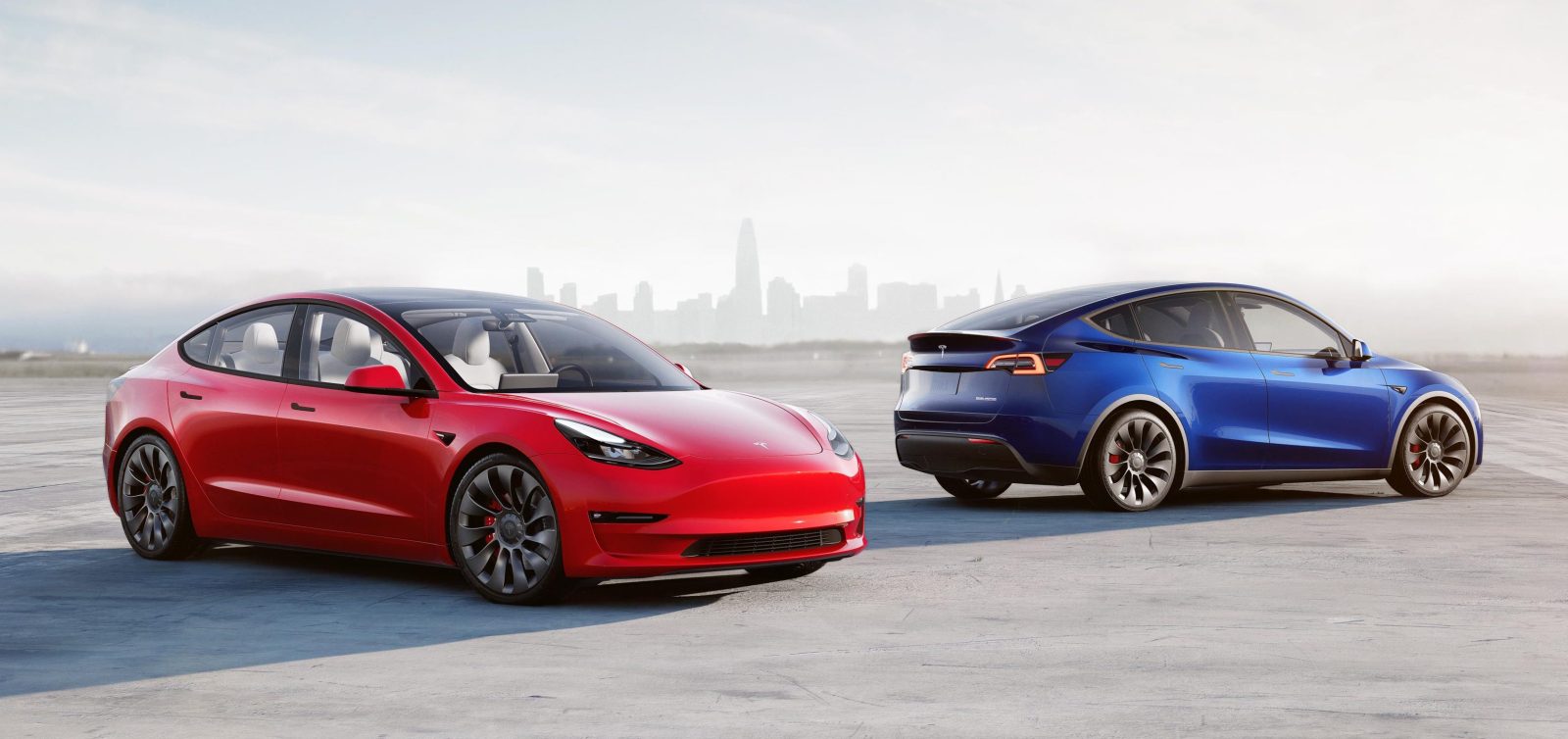
Conversations around Tesla’s reputation leaned toward the negative throughout 2023, but it depends on who you’re talking to, reports YouGov.
What’s the ‘Buzz’ about Tesla’s reputation?
The global market research firm conducted polls about what it calls the “Buzz” around Tesla – that is, what people are hearing about the brand – and whether there’s been a change in the proportion of people considering driving its EVs following recalls and recent negative headlines.
YouGov asked US adults about “Buzz” between January 2023 and April 2024:
Over the past two weeks, which of the following brands have you heard something POSITIVE / NEGATIVE about (whether in the news, through advertising, or talking to friends and family)?
Tesla’s Buzz scores stayed consistently negative through 2023 among YouGov’s “all US adults” category, with an average score of -7.1 in a score range of -20 to 90, and its scores dipped a bit further following the Autopilot ADAS recall in December.
Tesla’s customer base had considerably higher Buzz scores in 2023, meaning they were more likely to say they were hearing positive things about the brand. Current Tesla customers averaged a net Buzz score of 61.8, and that steadily increased in the early half of 2023 before stabilizing.
Would you still buy a Tesla?
Here’s where it gets interesting.
YouGov asked consumers between January and December 2023 whether they’d consider a Tesla when making a future purchase, and 70% of current Tesla owners said they would consider buying a Tesla.
In the “all US adults” category, unlike Tesla’s negative reputation results, it’s a positive percentage: 7.7% say they would consider Tesla for their next car purchase, and scores in this group have shown no significant change since Q1 2023.
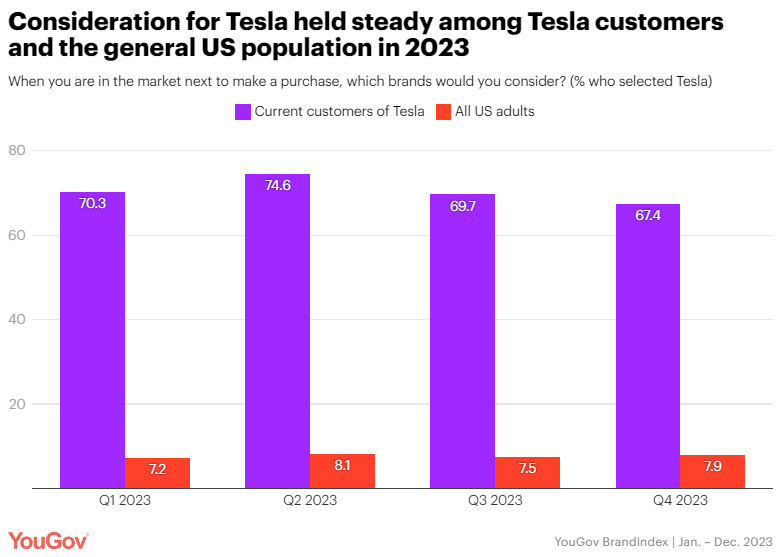
YouGov concludes that “news of brand recalls has not played a significant role in shaping consumer consideration for the brand, particularly among Tesla’s customer base.”
Electrek’s Take
This is intriguing but not shocking. Tesla has a highly loyal customer base. The lease is about to end on my Tesla Model 3. We planned to sign a new lease for a Model Y. The recalls haven’t bothered me much, but all the turmoil that Fred and Jamie have reported on in recent weeks has. It’s most definitely killed my Tesla buzz.
When I leased this Model 3, I felt excited and proud. Now I feel disappointed and deflated by what’s happened at Tesla in recent weeks, thanks to Elon Musk’s layoffs and his bizarre decision to wipe out the entire Supercharger team. One of the best things about driving a Tesla is the Supercharger network.
Plus, it’s important to note that YouGov’s poll about next car purchases doesn’t extend into 2024, so it’d be interesting to see how all the recent drama has affected Tesla’s reputation with Tesla drivers.
I’m still considering a Tesla for my next car selection because, well, Tesla drivers know why. But I’d have to hold my nose while making that choice – I know it’s probably still good for me, but it’s now a bitter pill to swallow.
Read more: I just bought my very first Tesla. Here’s what happened
To limit power outages and make your home more resilient, consider going solar with a battery storage system. In order to find a trusted, reliable solar installer near you that offers competitive pricing, check out EnergySage, a free service that makes it easy for you to go solar. They have hundreds of pre-vetted solar installers competing for your business, ensuring you get high quality solutions and save 20-30% compared to going it alone. Plus, it’s free to use and you won’t get sales calls until you select an installer and you share your phone number with them.
Your personalized solar quotes are easy to compare online and you’ll get access to unbiased Energy Advisers to help you every step of the way. Get started here. – ad*
FTC: We use income earning auto affiliate links. More.


More than 25% of new cars sold globally in 2025 are now electric, according to new analysis from energy think tank Ember. This growth is increasingly driven by emerging markets that, only a few years ago, had minimal adoption of EVs.
Where the EVs sold in 2025
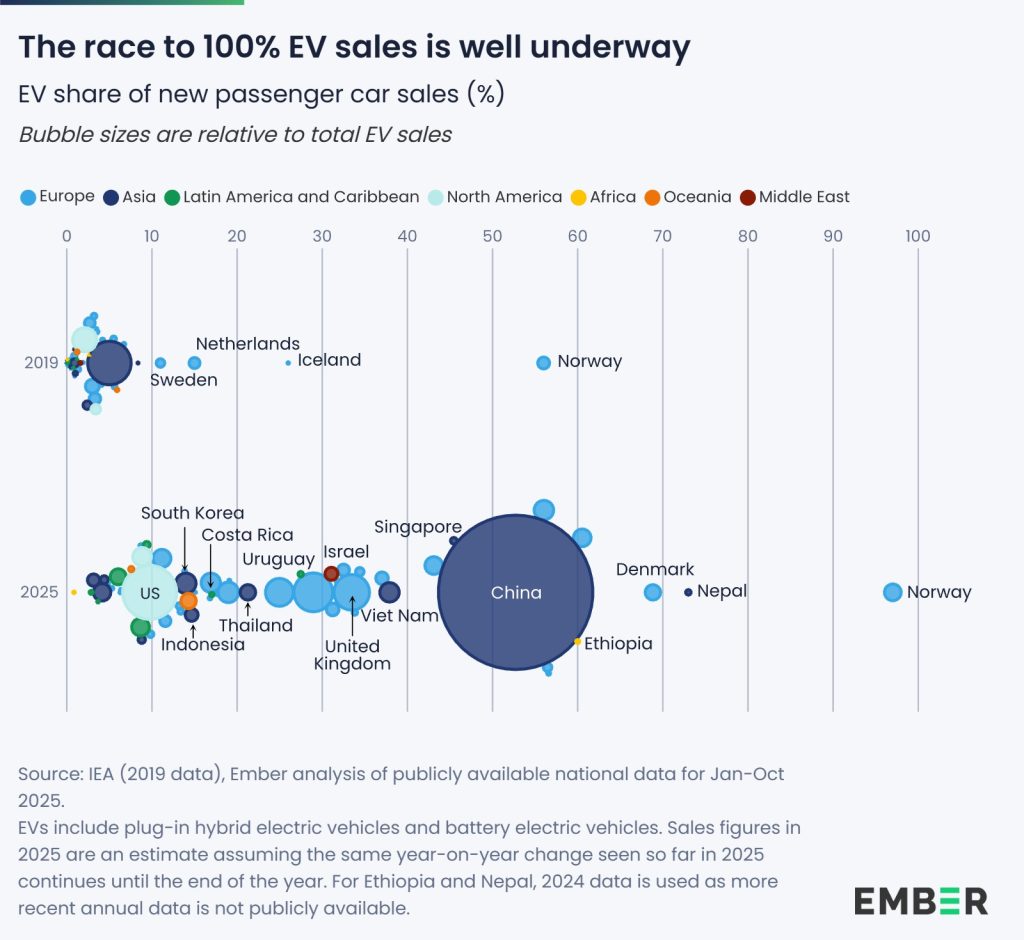
The analysis reveals that the EV race has truly gone global. There are now 39 countries where EVs make up more than 10% of new car sales, compared with just four in 2019.
The Association of Southeast Asian Nations (ASEAN) became a significant force in global EV adoption in 2025. Singapore and Vietnam have reached EV sales shares of around 40%, overtaking levels seen in the UK and the EU.
Indonesia has reached 15% this year, surpassing the US for the first time. Thailand has reached 20% and has sold more EVs in the first three quarters of 2025 than Denmark. These shifts demonstrate how rapidly the region is transitioning from a low base to a position of leadership.
Euan Graham, electricity and data analyst at Ember, said: “This is a major turning point. In 2025, the center of gravity has moved. Emerging markets are no longer catching up; they are leading the shift to electric mobility. These countries see the strategic advantages of EVs, from cleaner air to reduced fossil fuel imports.”
Other regions are also gaining momentum. In Latin America, Uruguay has reached a 27% EV share, roughly in line with the EU. Mexico and Brazil continue to show steady growth, now surpassing Japan, where the EV share has remained around 3% since 2022. Türkiye has reached 17%, overtaking Belgium to become Europe’s fourth-largest BEV market by volume.
Emerging markets are buying Chinese EVs
Since mid-2023, almost all the growth in Chinese EV exports has come from non-OECD markets. Brazil, Mexico, the UAE, and Indonesia are among the top 10 destinations for Chinese EV exports this year, as their governments have introduced policies to support EV adoption, including reduced taxes and incentives for domestic manufacturing.
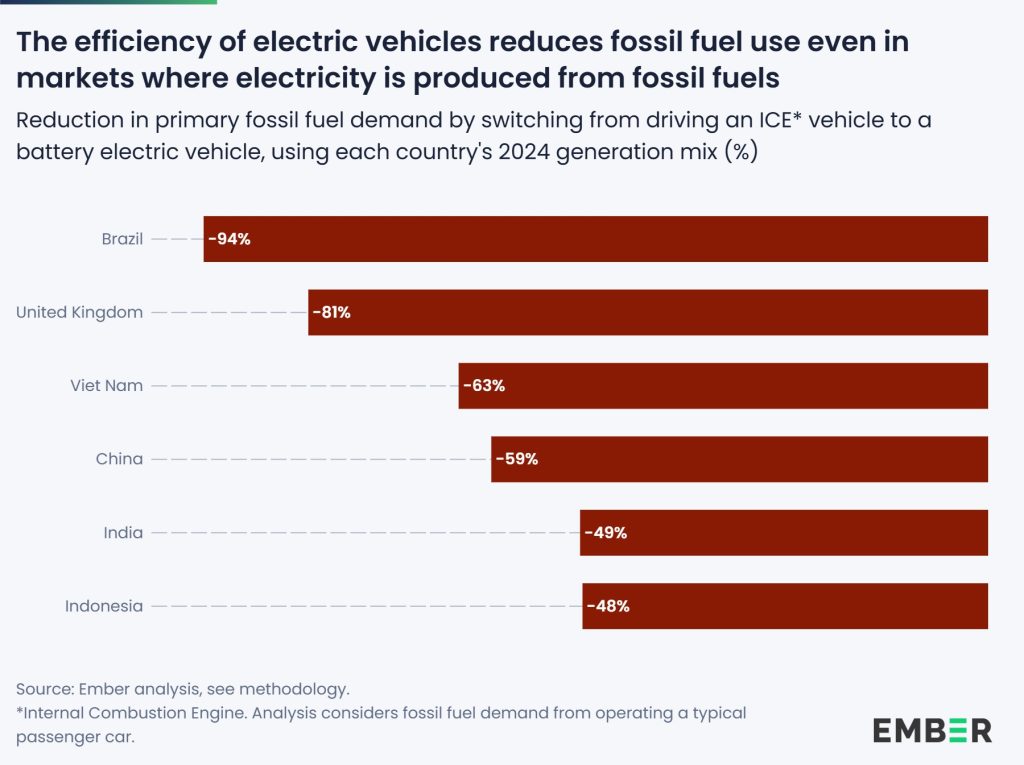
As more countries take up EVs, the impact on fossil fuel demand is already tangible. EVs are three times more efficient than ICE vehicles, which means they deliver significant reductions in oil use even in countries that still rely heavily on fossil fuels for power generation. In Brazil, where electricity is mostly clean, BEVs cut fossil fuel demand by around 90%. In Indonesia, the number was reduced by nearly half.
Graham said, “Emerging markets will shape the future of the global car market. The choices made now on charging infrastructure and early support will determine how fast this momentum continues.”
Read more: LAZ Parking plans EV chargers in 50,000 everyday parking spots

If you’re looking to replace your old HVAC equipment, it’s always a good idea to get quotes from a few installers. To make sure you’re finding a trusted, reliable HVAC installer near you that offers competitive pricing on heat pumps, check out EnergySage. EnergySage is a free service that makes it easy for you to get a heat pump. They have pre-vetted heat pump installers competing for your business, ensuring you get high quality solutions. Plus, it’s free to use!
Your personalized heat pump quotes are easy to compare online and you’ll get access to unbiased Energy Advisors to help you every step of the way. Get started here. – *ad


FTC: We use income earning auto affiliate links. More.


Brian Armstrong, chief executive officer of Coinbase Global Inc., speaks during the Messari Mainnet summit in New York, on Thursday, Sept. 21, 2023.
Michael Nagle | Bloomberg | Getty Images
Coinbase is making its biggest push yet to reposition itself as a mainstream trading and financial platform, moving beyond crypto and into the broader retail investing stack as competitors show there’s real money in always-on engagement products.
The digital asset exchange announced Wednesday that it’s rolling out a major slate of new products designed to turn Coinbase into a one-stop financial app, expanding into stocks, more advanced trading, and prediction markets, while doubling down on its on-chain ecosystem and new tools for businesses, developers, and automated financial guidance.
While many of these offerings have been telegraphed for months, Coinbase says the products are now built, and ready to go.
CEO Brian Armstrong is looking to make his platform the place to trade everything.
That includes stocks, a streamlined futures and perpetuals experience, and prediction markets through Kalshi, alongside a tokenization roadmap aimed at eventually bringing more traditional assets on-chain, including equities.
The area of prediction markets, in particular, is quickly getting crowded.
DraftKings has moved to buy its own exchange, FanDuel is teaming up with CME, and Polymarket is entering the U.S. through a newly approved venue. Robinhood, meanwhile, is putting LedgerX at the center of its regulated push.
The defining rivalry in the space remains Kalshi versus Polymarket, regulated rails versus crypto-native liquidity.
Armstrong said the category’s appeal isn’t just trading, but its insight into sentiment, and what people think will happen next on any given topic.
“If you look at things like economic indicators … or elections, people are using prediction markets to try to figure out what is going to happen next month,” Armstrong told CNBC. “Maybe1% of people use it as an asset class to trade, and 99% of people are using it as a way to figure out what’s going to happen — almost like a competitor to traditional media or maybe even entertainment.”
In the company’s third-quarter earnings call with analysts in October, Armstrong showed just how easily prediction market wagers can be manipulated, rattling off several words that were being bet on.
“I was a little distracted because I was tracking the prediction market about what Coinbase will say on their next earnings call,” Armstrong said. “And I just want to add here the words bitcoin, ethereum, blockchain, staking and Web3 to make sure we get those in before the end of the call.”
Robinhood underscored that shift this week by expanding prediction markets into sports-style contracts that resemble parlays and prop bets, and by touting the category as its fastest-growing business by revenue.
Coinbase is now bringing the same kind of outcome trading into its own ecosystem, but as a part of a much wider bet that the next-generation brokerage is a single app that blends traditional assets, derivatives, and on-chain rails.
Coinbase is pairing the trading expansion with a tokenization roadmap that signals where it wants the platform to go next, bringing more traditional assets on-chain, including equities.
The company is launching Coinbase Tokenize, an institutional stack intended to support real-world asset tokenization.
Armstrong framed the expansion as a bridge to something bigger.
Trading stocks, he said, is “a good first step,” but the real goal is tokenized equities. If Coinbase can get tokenized equity live, he said, it could “democratize access for people over the world,” and unlock new market structure in the U.S., including more robust, professional futures markets tied to equities.
“So this is the starting point,” he said.
The announcement also extends Coinbase’s push to become a provider of on-chain liquidity — not just a venue for listed tokens.
For businesses and developers, Coinbase is widening its platform story beyond retail trading. The company said Coinbase Business is becoming available to eligible customers in the U.S. and Singapore, and it’s rolling out an expanded API suite spanning custody, payments, trading, and stablecoins.
Armstrong’s broader thesis is that crypto isn’t a niche category, it’s an upgrade cycle for the financial system itself.
“Crypto is updating all financial services,” he said, suggesting that every major asset class will move on-chain over time, from prediction markets and equities to commodities, and eventually real-world assets like real estate.
Even the largest asset managers, he said, are signaling they want to migrate funds on-chain, positioning Coinbase as a central platform for that transition.
Coinbase is also introducing “custom stablecoins” for companies that want branded stablecoin rails, and spotlighting x402, a payments standard the company says is meant to make stablecoin payments easier to attach to web requests — including for automated commerce and agent-driven transactions.
The strategic throughline is retention and diversification.
Coinbase already owns a large crypto-native audience, and it wants that customer to stay on its platform for every asset class, even when crypto volumes cool and transaction revenue compresses.
WATCH: What to know about Robinhood’s new prediction market features
Environment
First savings hits Navee XT5 Pro long-range off-road e-scooter for $1,400, Anker SOLIX 60,000mAh power station $108, Lectric, more


Our mid-week Green Deals is headlined by a surprise first-ever holiday deal on the brand-new Navee XT5 Pro Long-Range Off-Road Electric Scooter at $1,400, which boasts some serious premium upgrades. Right behind it, we have Anker’s SOLIX C200 DC Compact Power Station, and its larger C300 counterparts, that start from $108, as well as a roundup of Lectric’s three e-bikes getting up to $500 price cuts and $220 bundles that start from $1,399, Bluetti’s current 48-hour Christmas flash sale through December 18, and much more waiting for you below. And don’t forget about the hangover deals that are collected together at the bottom of the page, like yesterday’s Velotric Christmas e-bike Gift Season Sale, the new $999 low on Heybike’s dual-battery Hauler cargo e-bike, and more.
Head below for other New Green Deals we’ve found today and, of course, Electrek’s best EV buying and leasing deals. Also, check out the new Electrek Tesla Shop for the best deals on Tesla accessories.
First savings just hit Navee’s newest feature-packed XT5 Pro long-range off-road electric scooter for $1,400
Navee’s official Amazon storefront is undercutting the brand’s direct Christmas Sale pricing on its brand-new XT5 Pro Long-Range Off-Road Electric Scooter for $1,399.99 shipped, after clipping the on-page $200 off coupon. This model just hit the market early last month with a $1,500 price tag, which is where it’s still priced direct from the brand. At Amazon, however, it started off priced at $1,700 and dropped to $1,600 right before Black Friday, with today’s deal being the first official chance at cash savings that we’ve spotted. While this deal lasts, you’re getting $100 off the going rate that sets the bar for future discounts, while also upgrading your commutes/joyrides with the brand’s take on a superscooter.
The most high-end of Navee’s e-scooter lineup that even outpaces the flagship ST3 Pro, this new XT5 Pro Long-Range Electric Scooter is an off-roading superscooter that comes with bolstered durability from its carbon steel frame, while also being the second series to boast the brand’s unique damping arm suspension system. It arrives equipped with a 750W motor that can peak as high as 2,200W for seriously monstrous power, with the entire thing powered by a 596.7Wh battery. This combination gives it a travel range of up to 46.6 miles on a single six-hour charge (with a 1.5-hour flash charging feature available), maxing out at 31 MPH top speeds for the thrill seekers amongst you. It even comes with an add-on option through a 468Wh external battery (sold separately) that increases the mileage with up to 34 miles of extra travel.
As Navee’s XT5 Pro electric scooter is a more premium commuter, it should be no surprise that it comes loaded with a premium array of features, including smart features like Apple Find My, Bluetooth proximity locking/unlocking, app-based setting customization, and more. Your riding experience is also further heightened by the stock features that include a triple braking system (dual front and rear disc brakes, as well as a rear regenerative EABS brake), 12-inch off-road tubeless tires, an auto-on headlight, mecha-style logo lamps in the stem, a brake-activated taillight, front and rear built-in turn signals, the brand’s traction control system, a 5-inch full color display, and much more.
As I mentioned, alongside this surprise Navee XT5 electric scooter deal, the brand also has its ongoing Christmas Sale with up to 30% discounts still going right now, which offers its e-scooters at some of the best rates starting from $200.
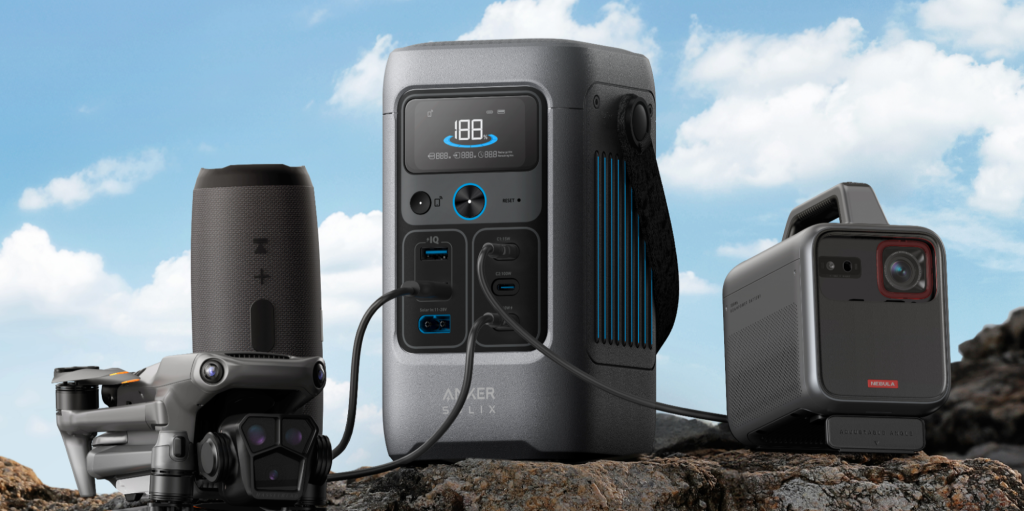
Get 60,000mAh/192Wh support for devices from Anker’s SOLIX C200 DC power station at $108 for Xmas, more from $162
As part of its ongoing Christmas Sale, Anker SOLIX is offering its C200 DC 60,000mAh/192Wh Compact Power Station at $108.49 shipped, which matches in price at Amazon while also beating out the current price of the predecessor PowerCore Reserve by $7. While it carries a $200 MSRP, you can find it starting lower at $170 at Amazon, with discounts over the year having taken the costs as low as $100, most recently during Black Friday through Cyber Monday over two weeks ago. You’re looking at the third-best price we have tracked while the $62 savings last ($92 off the MSRP), only beaten out by that $100 low and $105 rates that sporadically pop up. If you want to go bigger, you can also find the C300 DC and C300 AC 90,000mAh models starting from $162.
If you want to learn more about these compact power stations, be sure to check out our original coverage of these Christmas deals here. You can also go even larger by taking advantage of Anker’s current SOLIX Christmas Sale deals, with up to 65% discounts across its entire power station lineup that starts from $162.
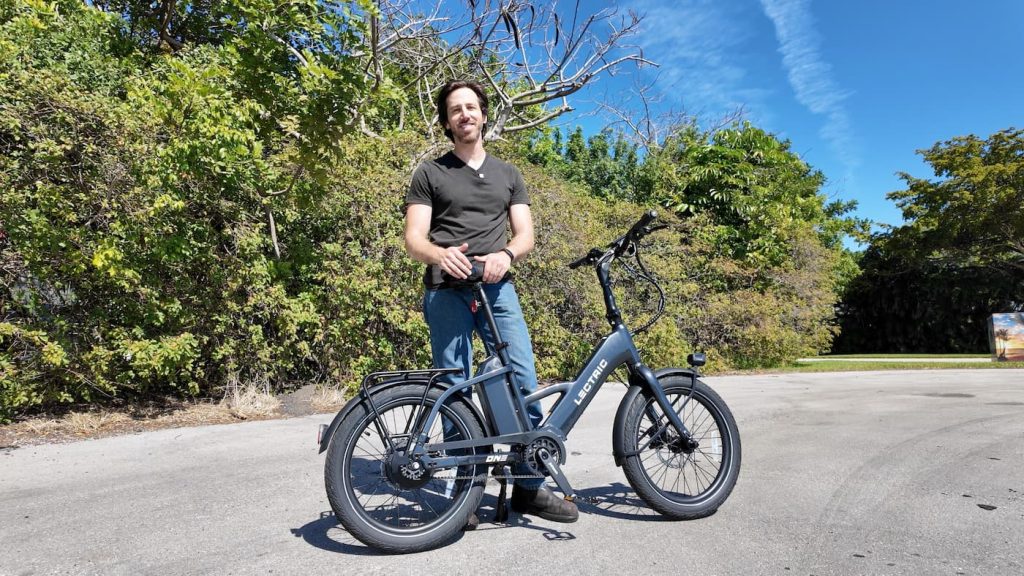
Save up to $720 on these three Lectric e-bikes with price cuts to lows starting from $1,399 for Xmas
Looking back in on Lectric’s ongoing Christmas Holiday Sale event, we wanted to shine a spotlight on the three e-bikes receiving rare price cuts over the usual free bundle packages – a first for so many models at once. The biggest of these price cuts that also retains a bundle is Lectric’s ONE e-bike Long-Range Belt-Drive Commuter e-bike with a $220 FREE bundle of gear at $1,899 shipped. This entire package would normally run you $2,619 at full price, with a repeat of the $500 price cut we’ve been seeing more frequently since Labor Day to its all-time lowest tracked price, along with a FREE rear cargo rack and fender set. While the deadline to receive it before Christmas has passed, you can still secure it and all the other e-bikes with some of their best deals to kick-off your new year with a new commuting option.
If you want to learn more about this premium e-bike, or the other models getting Christmas price cuts, be sure to check out our original coverage of these deals here, while you can also browse the brand’s full Christmas lineup here.

For 48 hours, you can pick up Bluetti’s latest Elite 10 Mini power station at a new $109 Xmas flash sale low (Save $90), more
As part of its ongoing Christmas Sale, Bluetti has a 48-hour flash sale running that is taking up to $199 off three different offers, with a notable standout in the Elite 10 Mini Power Station for $109 shipped, which sadly cannot be stacked with the exclusive 5% off savings code, but does beat out its Amazon pricing by $10. While carrying a $239 MSRP direct from the brand, you can find it starting lower at Amazon for $199, with the holiday discounts that started last week having only taken the costs down to $149, before falling to $119 and then $109 during this flash sale window. While these $90 savings ($130 off the MSRP) last through December 18, you’re able to score it at a new all-time low price, with another flash offer being two of these stations for $199 shipped.
If you want to learn more about this mini power station, or browse the full lineup of temporary deals, be sure to check out our original coverage of this flash sale here.








Best Winter EV deals!
- Velotric Nomad 2X e-bike (camo) with DELTA 3 Plus station: $3,048 (Reg. $3,298)
- Velotric Nomad 2X e-bike (sage or fig) with DELTA 3 Plus station: $2,948 (Reg. $3,298)
- Heybike Hero 750W Mid-Drive Carbon-Fiber All-Terrain e-bike: $2,099 (Reg. $3,099)
- Segway Xyber e-bike (at lowest price): $2,900 (Reg. $3,300)
- Lectric XPedition 2.0 35Ah Cargo e-bike w/ $893 bundle: $1,999 (Reg. $2,761)
- Ride1Up TrailRush German Mid-Drive e-bike: $1,995 (Reg. $2,095)
- Heybike Hero 1,000W Carbon-Fiber All-Terrain e-bike: $1,899 (Reg. $2,599)
- Tenways Wayfarer e-bike with $366 bundle: $1,899 (Reg. $2,199)
- Velotric Fold 1 Plus e-bike with DELTA 2 station: $1,898 (Reg. $2,198)
- Segway Xafari e-bike (at lowest price): $1,800 (Reg. $2,400)
- Aventon Aventure 3 Smart All-Terrain e-bike: $1,799 (Reg. $1,999)
- Aventon Aventure 3 Smart Step-Through All-Terrain e-bike: $1,799 (Reg. $1,999)
- Velotric Summit 1 Versatile Multi-Terrain e-bike w/ 160 bundle: $1,799 (Reg. $2,059)
- Lectric XPedition 2.0 26Ah Cargo e-bike w/ $744 bundle: $1,799 (Reg. $2,543)
- Lectric XP Trike2 750 Long-Range eTrike: $1,699 (Reg. $1,799)
- Aventon Level 3 Step-Over Smart Commuter e-bike: $1,699 (Reg. $1,899)
- Aventon Level 3 Step-Through Smart Commuter e-bike: $1,699 (Reg. $1,899)
- Lectric XPeak 2.0 Long-Range Off-Road e-bike: $1,599 (Reg. $1,699)
- Aventon Abound Cargo e-bike: $1,599 (Reg. $1,999)
- Ride1Up VORSA Modular Multi-Use e-bike: $1,595 (Reg. $1,695)
- Navee’s new XT5 Pro Long-Range Off-Road Electric Scooter: $1,400 (Reg. $1,500)
- Lectric XP Trike2: $1,399 (Reg. $1,499)
- Lectric XPeak 2.0 Standard Off-Road e-bike: $1,399 (Reg. $1,499)
- Lectric XPedition 2.0 13Ah Cargo e-bike with $346 bundle: $1,399 (Reg. $1,745)
- Heybike ALPHA All-Terrain e-bike with $266 bundle: $1,299 (Reg. $1,699)
- Lectric XPress 750 Commuter e-bikes with $518 bundle: $1,299 (Reg. $1,817)
- Lectric XP4 750 LR Folding Utility e-bikes with $514 bundle: $1,299 (Reg. $1,813)
- Lectric XP Lite 2.0 JW Black LR e-bike with $350 bundle: $1,099 (Reg. $1,449)
- Heybike Hauler Dual-Battery Cargo e-bike with $89+ bundle (new low): $999 (Reg. $1,413)
- Lectric XP4 Standard Folding Utility e-bikes with $227 bundle: $999 (Reg. $1,226)
- Lectric XP Lite 2.0 Long-Range e-bikes with $350 bundles: $999 (Reg. $1,349)
- Segway ZT3 Pro All-Terrain Electric Scooter: $850 (Reg. $1,000)
- Segway E3 Pro Electric Scooter: $600 (Reg. $700)

Best new Green Deals landing this week
The savings this week are also continuing to a collection of other markdowns. To the same tune as the offers above, these all help you take a more energy-conscious approach to your routine. Winter means you can lock in even better off-season price cuts on electric tools for the lawn while saving on EVs and tons of other gear.
- Get up to $562 savings on Velotric e-bikes + $100 gift card promotion for Christmas – deals start from $1,099
- Carry packages, people, more on Heybike’s 85-mile dual-battery Hauler cargo e-bike with FREE gear/gifts at a new $999 low
- Bluetti Elite 30 V2 288Wh LiFePO4 power station and its many colorways start from $204 and arrive before Xmas
- Autel’s MaxiCharger Home 40A level 2 EV charging station arrives ahead of Christmas for $319 (Reg. $470)
- Hiboy’s Christmas Sale offers EV commuting solutions at up to 50% off + bonus savings codes – all starting from $150
- Pass lawn mowing to ECOVACS’ Goat O1000 RTK robot while at a new $699 low for Xmas (Reg. $1,000)
- Off-season savings take EGO’s 56V 15-inch rapid reload string trimmer down to $149 annual low ($50 off)
- Save up to $175 on Goal Zero’s compact Yeti 700 or 500 power stations at best prices in months from $375
- Electrified Weekly – Christmas sales from Lectric, Velotric, Rad Power, Anker SOLIX, EcoFlow, Bluetti, and so much more
FTC: We use income earning auto affiliate links. More.
-
 Sports2 years ago
Story injured on diving stop, exits Red Sox game
-
 Sports3 years ago
‘Storybook stuff’: Inside the night Bryce Harper sent the Phillies to the World Series
-
 Sports2 years ago
Game 1 of WS least-watched in recorded history
-
 Sports3 years ago
Button battles heat exhaustion in NASCAR debut
-
 Sports3 years ago
MLB Rank 2023: Ranking baseball’s top 100 players
-
Sports4 years ago
Team Europe easily wins 4th straight Laver Cup
-
 Environment3 years ago
Japan and South Korea have a lot at stake in a free and open South China Sea
-
 Environment1 year ago
Here are the best electric bikes you can buy at every price level in October 2024