
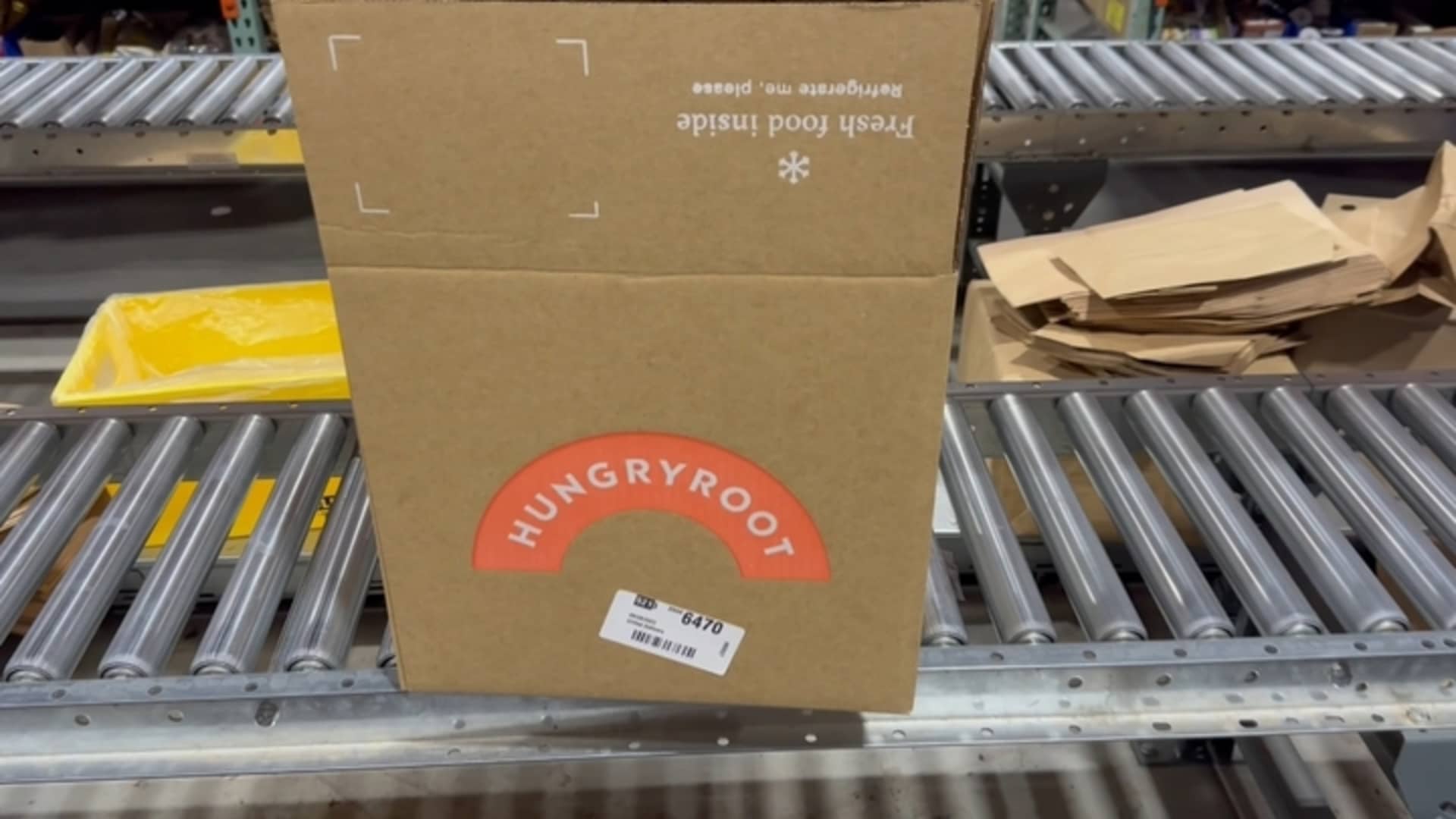
Food startup Hungryroot uses AI to reduce waste, a major climate offender


Food waste is so prolific in the U.S. that roughly one-third of the amount produced ends up in landfills rather than in stomachs. That adds up to excess production, packaging, storage and delivery requirements, all negatively contributing to climate change.
A recent study published in the journal Science found that food production accounts for 26% of global greenhouse gas emissions.
Food delivery services like HelloFresh, Blue Apron and EveryPlate reduce that somewhat by sending consumers what they need for specific recipes.
A New York-based startup called Hungryroot is going one step further. The 9-year-old company — using artificial intelligence — is providing a more curated experience and delivering the precise amount of food a consumer will use.
Customers answer a slew of questions about their food likes and dislikes, allergies and health goals. They also answer questions on how and when they cook. Taking those answers, Hungryroot’s technology infers what recipes and grocery items are best for each customer.
“Hungryroot is entirely designed to give you just the foods that you’re going to need for your week,” Ben McKean, the company’s CEO, told CNBC. “And it gives you simple recipes, so you know exactly what to do with them, and as a result, food waste with our customers is significantly reduced.”
Hungryroot sends users a list of what’s in their weekly cart, allowing them to approve or change items.
The company can reduce its own waste as well. If it determines that a user has no preference between broccoli and Brussels sprouts, and the company happens to have more broccoli in its warehouse, that’s what they’ll recommend.
The company said these processes help lead to 80% less food waste at its facilities compared with a traditional supermarket.
Investors say the unique model is also good for its bottom line.
“They have been profitable for three or four years now, which is unusual for a lot of these e-commerce, food businesses,” said Jeremy Liew, a partner at Lightspeed Venture Partners. “They’ve been able to drive that through efficiency of spend, and because they have built a business that customers really love.”
In addition to Lightspeed, Hungryroot is backed by L Catterton, Crosslink Capital, KarpReilly and Lerer Hippeau. The company has raised a total of $75 million.
— CNBC climate producer Lisa Rizzolo contributed to this piece.


Thomas Trutschel | Getty Images
Shopify was hit with an outage on Cyber Monday, leaving some businesses unable to manage transactions during one of the biggest shopping days of the year.
In an update to its status page, the Canadian e-commerce company said select merchants were experiencing issues logging into Shopify, while others were unable to access point-of-sale systems, a critical portal used to manage transactions and other backend processes.
Later in the day, Shopify said its services were beginning to recover, but that some merchants may still observe some disruptions to its POS and Admins tools.
“We have found and fixed an issue with our login authentication flow, and are seeing signs of recovery for admin and POS login issues now,” the company said in an update at 2:31 p.m. EST. “We are continuing to monitor recovery.”
A Shopify spokesperson pointed CNBC to its status page when reached for comment.
The Downdetector website showed thousands of users reporting problems with Shopify around 1:15 p.m. EST, after roughly 4,000 cases were reported by users at its peak at 11:00 a.m. EST.
Shopify sells software for merchants who run online businesses as well as services such as advertising and payment processing tools.
Shopify says it handles more than 10% of all e-commerce transactions in the U.S.
The company made its name as a platform for small businesses and direct-to-consumer brands, but it increasingly hosts online storefronts for larger retailers like Reebok, Mattel, Barnes & Noble and Nestle.
The outage coincided with the Cyber Monday discount bonanza, when holiday shoppers rushed to snap up discounted products.
Adobe Analytics estimates that U.S. shoppers will spend $14.2 billion online Monday, up 6.3% from a year earlier.
American shoppers spent $11.8 billion on Black Friday, marking a 9.1% jump from last year, according to Adobe.


Sam Altman, CEO of OpenAI, attends the annual Allen and Co. Sun Valley Media and Technology Conference at the Sun Valley Resort in Sun Valley, Idaho, on July 8, 2025.
David A. Grogan | CNBC
OpenAI on Monday announced it is taking an ownership stake in Thrive Holdings, a company that was launched by one of its major investors, Thrive Capital, in April.
The startup said it will embed engineering, research and product teams within Thrive Holdings’ companies to help accelerate their AI adoption and boost cost efficiency.
Thrive Holdings buys, owns and runs companies that it believes could benefit from technologies like artificial intelligence. It operates in sectors that are “core to the real economy,” starting with accounting and IT services, according to its website.
OpenAI, which is valued at $500 billion, did not disclose the financial terms of the agreement.
“We are excited to extend our partnership with OpenAI to embed their frontier models, products, and services into sectors we believe have tremendous potential to benefit from technological innovation and adoption,” Joshua Kushner, CEO and founder of Thrive Capital and Thrive Holdings, said in a statement.
It’s the latest example of OpenAI’s circular dealmaking.
In recent months, the company has taken stakes in infrastructure partners like Advanced Micro Devices and CoreWeave.
The partnership is structured in a way that aligns the incentives of OpenAI and Thrive Holdings long term, according to a person familiar with the deal, who asked not to be named because the details are private.
If Thrive Holdings’ companies succeed, the size of OpenAI’s stake will grow.
It also acts as a way for OpenAI to get compensated for its services, according to another person familiar with the agreement who declined to be named because the details are confidential.
“This partnership with Thrive Holdings is about demonstrating what’s possible when frontier AI research and deployment are rapidly deployed across entire organizations to revolutionize how businesses work and engage with customers,” OpenAI COO Brad Lightcap said in a statement.
OpenAI also announced a collaboration with the consulting firm Accenture on Monday.
The startup said its business offering, ChatGPT Enterprise, will roll out to “tens of thousands” of Accenture employees.
-
 Sports2 years ago
Story injured on diving stop, exits Red Sox game
-
 Sports3 years ago
‘Storybook stuff’: Inside the night Bryce Harper sent the Phillies to the World Series
-
 Sports2 years ago
Game 1 of WS least-watched in recorded history
-
 Sports3 years ago
Button battles heat exhaustion in NASCAR debut
-
 Sports3 years ago
MLB Rank 2023: Ranking baseball’s top 100 players
-
Sports4 years ago
Team Europe easily wins 4th straight Laver Cup
-
 Environment3 years ago
Japan and South Korea have a lot at stake in a free and open South China Sea
-
 Environment1 year ago
Here are the best electric bikes you can buy at every price level in October 2024