
Tesla must provide NHTSA with Autopilot recall data by July or face up to $135 million in fines

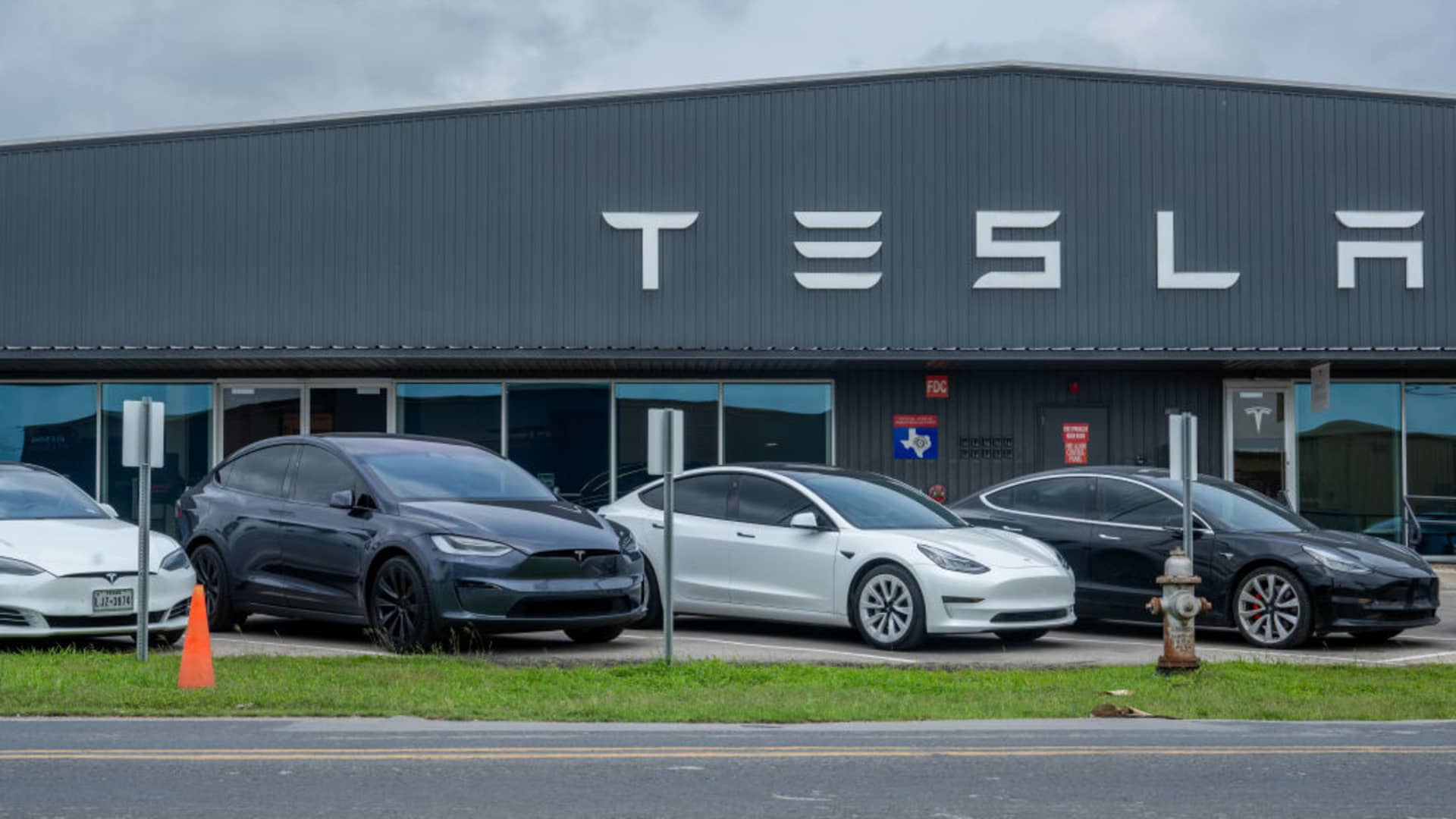
Tesla vehicles sit on the lot at a Tesla dealership in Austin, Texas, on April 15, 2024.
Brandon Bell | Getty Images
The National Highway Traffic Safety Administration is pressing Tesla for answers about changes the company made to its Autopilot driver assistance system following a voluntary software recall in December that affected about 2 million vehicles in the U.S.
Tesla must meet a deadline of July 1 to provide information to the regulator or face fines up to $135.8 million, according to a letter sent by the NHTSA to company on May 6.
The recall was intended to improve Tesla’s driver-engagement systems, which are used to monitor whether drivers are safely using features like traffic aware cruise control, lane keeping and auto steering — part of Autopilot. Since the recall, at least 20 Tesla vehicles have been involved in crashes in which the system was thought to be in use, according to a filing on the NHTSA’s website.
The “recall remedy” probe follows a three-year investigation by the agency that found safety issues with Tesla Autopilot contributed to at least 467 collisions and 14 deaths from January 2018 through August 2023.
The NHTSA had concluded that drivers involved in those crashes “were not sufficiently engaged in the driving task and that the warnings provided by Autopilot when Autosteer was engaged did not adequately ensure that drivers maintained their attention on the driving task.”
Driver-engagement systems, sometimes known as driver-monitoring systems, in Tesla vehicles include torque sensors in the steering wheel to detect whether drivers are keeping their hands on the wheel, and in-cabin cameras that monitor a driver’s gaze. They should alert any inattentive driver to pay attention and stay ready to steer or brake at any time.
The NHTSA is seeking detailed crash data from the electric vehicle maker since the agency issued the recall update on Autopilot, including data and video stored in or streamed from its cars and retained by the company.
They’re also asking for records about Tesla’s engineering teams and their approach to “safety defect determination decision making,” “issue investigation,” “action design including human factors considerations (initial and modifications),” and “testing.”
Tesla is in the middle of a massive reorganization and sweeping layoffs. The company hasn’t disclosed how many jobs in its Autopilot and vehicle-safety engineering teams may have been cut.
For about a decade, CEO Elon Musk has been promising that Tesla is on the cusp of a self-driving breakthrough. With sales of Tesla EVs dropping in the first quarter, Musk has been focusing investors’ attention on his dream of a future full of Tesla artificial intelligence products, including robotaxis and “sentient” humanoid robots that can do factory work.
Tesla shares fell 3.8% on Tuesday to $177.81 and are down 28% year to date.


Sundar Pichai, chief executive officer of Alphabet Inc., during the Bloomberg Tech conference in San Francisco, California, US, on Wednesday, June 4, 2025.
David Paul Morris | Bloomberg | Getty Images
With the AI talent wars heating up between companies like OpenAI, Meta and Anthropic, one way Google has been competing is by aggressively rehiring former employees.
Some 20% of software engineers working on artificial intelligence that Google hired in 2025 were so-called boomerang employees, an increase from prior years, CNBC has learned. A Google spokesperson confirmed the statistic remains accurate as of December, and said the company saw a jump in the number of AI researchers coming from major competitors compared to 2024.
“We’re energized by our momentum, compute, and talent — engineers want to work here to keep building groundbreaking products,” the spokesperson said in a statement.
John Casey, Google’s head of compensation, recently told employees in a meeting about the rehiring. Casey said AI-focused software engineers are drawn to Google’s deep pockets and hefty computational infrastructure that’s needed to perform advanced AI work, according to audio reviewed by CNBC.
Google has a large pool of ex-employees to mine, particularly after its largest ever round of layoffs in early 2023, when parent company Alphabet cut 12,000 jobs, reducing headcount by 6%. That followed a market downturn driven by soaring inflation and rising interest rates. Google has since continued with rolling layoffs and buyouts.
Across the industry, employee boomerangs are up, according to data published earlier this year by ADP Research, with the sector it classifies as information showing the starkest numbers.
Google has been racing to catch up in generative AI after a slow start that followed OpenAI’s release of ChatGPT in late 2022. After fumbling a number of product rollouts, the company has bounced back this year, thanks to hefty investments in AI infrastructure and the success of its Gemini app. Google announced its latest model, Gemini 3, last month.
Alphabet’s stock price is up more than 60% this year, outperforming all of its megacap peers.
As a historical hotbed of engineering and innovation, Google has long been a place where competitors have turned to try and poach talent. That’s still the case.
Earlier this year, Microsoft hired around two dozen employees from Google’s DeepMind AI research lab, CNBC reported in July. OpenAI, meanwhile, has opened its wallets wide, along with Meta. OpenAI CEO Sam Altman told employees in June that Meta had been offering $100 million signing bonuses, and that he was aggressively trying to retain staffers.
Late last year, Google brought back a major figure in AI: Noam Shazeer.
Shazeer and Daniel De Freitas left Google in 2021 to start AI platform Character.AI, reportedly departing after Google rebuffed their attempts to try and get the company to push its internal chatbot forward.
Along with other members of the Character.AI research team, Shazeer and De Freitas rejoined DeepMind in August 2024 under a licensing deal for the startup’s technology.
Over the last year, Google has taken more risks, shipping products more quickly, even if they aren’t viewed as completely ready. Google has also made a companywide effort to remove bureaucracy, enacting widespread employee buyouts and eliminating more than one-third of its managers overseeing small teams, CNBC reported in August.
Google co-founder Sergey Brin, who came out of retirement in 2023, has at times personally reached out to prospective candidates to recruit them, according to people familiar with the matter who asked not to be named because they weren’t authorized to speak to the media. Meta CEO Mark Zuckerberg has also reportedly reached out to researchers on behalf of his company.
WATCH: OpenAI’s Sam Altman says Google is still a huge threat


Dado Ruvic | Reuters
Palo Alto Networks will migrate key internal workloads to Google Cloud as part of a new multibillion-dollar agreement, the companies announced on Friday.
The companies said the deal is an expansion of their existing strategic partnership and will deepen their engineering collaboration.
Palo Alto Networks is now using Google’s Gemini artificial intelligence models to power its copilots, and it is also using Google Cloud’s Vertex AI platform, according to a release.
“Every board is asking how to harness AI’s power without exposing the business to new threats,” BJ Jenkins, president of Palo Alto Networks, said in a statement. “This partnership answers that question.”
Palo Alto Networks, which offers a range of cybersecurity products, already has more than 75 joint integrations with Google Cloud and has completed $2 billion in sales through the Google Cloud Marketplace.
As part of the new phase of the partnership, Palo Alto Networks customers will be able to protect live AI workloads and data on Google Cloud, maintain security policies, accelerate Google Cloud adoption and simplify and unify their security solutions, the companies said.
Shares of Palo Alto Networks were up 1% on Friday. Google shares were mostly flat.
“This latest expansion of our partnership will ensure that our joint customers have access to the right solutions to secure their most critical AI infrastructure and develop new AI agents with security built in from the start,” Google Cloud President Matt Renner said in a statement.
WATCH: Google unveils ‘Gemini 3 Flash’ AI model focused on speed and cost
-
 Sports2 years ago
Story injured on diving stop, exits Red Sox game
-
 Sports3 years ago
‘Storybook stuff’: Inside the night Bryce Harper sent the Phillies to the World Series
-
 Sports2 years ago
Game 1 of WS least-watched in recorded history
-
 Sports3 years ago
Button battles heat exhaustion in NASCAR debut
-
 Sports3 years ago
MLB Rank 2023: Ranking baseball’s top 100 players
-
Sports4 years ago
Team Europe easily wins 4th straight Laver Cup
-
 Environment3 years ago
Japan and South Korea have a lot at stake in a free and open South China Sea
-
 Environment1 year ago
Here are the best electric bikes you can buy at every price level in October 2024