
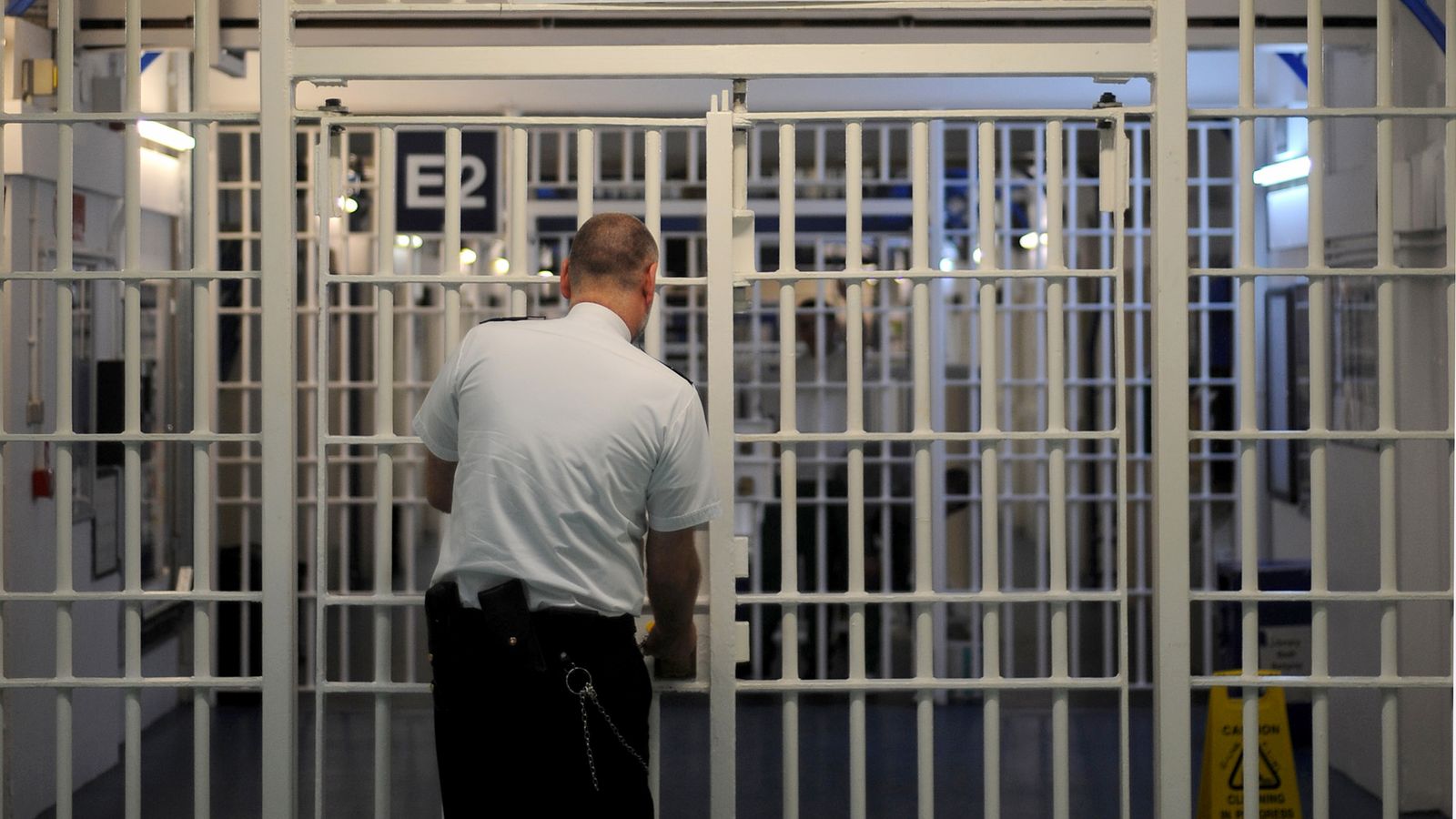
Early release prison scheme causing ‘high-risk’ offenders to be let out, new report finds

An early release prison scheme, used to free up space in jails across England and Wales, is causing “high-risk” offenders to be let out, some of whom are a “risk to children”, according to a new report.
The examination of HMP Lewes, by the chief inspector of prisons, found that “safe risk management” is being undermined.
The findings, published on Tuesday, were part of a wide-ranging inspection at the East Sussex prison in February, but some similar problems were highlighted in a parallel report into Chelmsford prison published last week.
The government says that those guilty of serious crimes, such as terrorism or sexual offences, plus those serving sentences of more than four years, are not eligible for early release.
But this inspection at Lewes found an example of a prisoner who had their release date brought forward under the early release scheme despite deeming him a “risk to children” and “having a history of stalking, domestic abuse, and being subject to a restraining order”.
Another example cited a “high-risk prisoner with significant class A drug misuse issues” being released without a home.
“This release took place despite appeals for the decision to be reversed and staff having serious concerns for his and the public’s safety,” it said.
The report makes clear that the inspection was done only months into the scheme launching in October, and hopes the “serious concerns” they raised about its implementation were “teething troubles”.
However, these findings follow Sky News exposing widespread concern among the probation service about the early release measure, which has been regularly revised and updated since it was launched in October.
Labour is calling for the government to be more transparent about the parameters of the scheme.
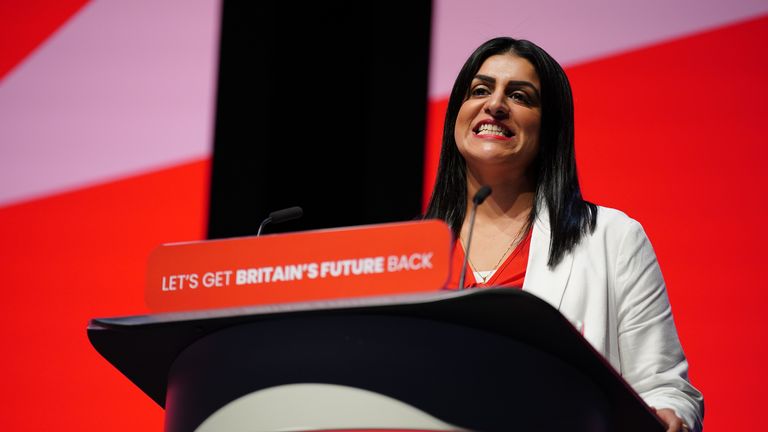
“The public will rightly be worried to hear of cases where violent prisoners are being released without a proper assessment of the risk they pose to the public, and specifically children,” said the shadow justice secretary, Shabana Mahmood.
Shabana Mahmood speaking during the Labour Party Conference in Liverpool last October. Pic: PA
“It’s being left to prison inspectors to tell the public the truth because this government is refusing to level with them on the scale of the prisons and probation crisis,” she said.
Prisons across England and Wales are under pressure, and severely overcrowded.
Figures published on Friday showed 87,691 people are currently behind bars in England and Wales.
The number of people that can be held in “safe and decent accommodation” in prison, known as the “certified normal accommodation” or “uncrowded capacity”, is considered by the Ministry of Justice (MoJ) to be 79,507.
That means the current overall system is at 110% capacity, or overcrowded.
Read more:
King Charles discusses cancer treatment side effects
Health secretary unable to guarantee no more maternity scandals
Rwanda law disapplied by NI court
Responding to the inspectorate report, the chief executive of the Howard League, Andrea Coomber, said: “This is the latest in a seemingly never-ending line of inspection reports revealing major problems in a prison system that has been asked to do too much, with too little, for too long.”
“While action to ease pressure on jails is necessary, this temporary measure is no substitute for what is really needed: a more sensible response to crime that puts fewer people behind bars and more money into services that can help them,” she said.

Keep up with all the latest news from the UK and around the world by following Sky News
As of 23 May, eligible male prisoners across 84 prisons in England and Wales can be freed up to 70 days before the end of their sentence. This has been extended from the original 18 days as overcrowding pressures in prisons continue.
A Ministry of Justice spokesperson said: “While we will always ensure there is enough capacity to keep dangerous offenders behind bars, this scheme allows us to ease short-term pressures on prisons by moving some lower-level offenders at the end of their custodial term on to licence.
“These offenders will continue to be supervised under strict conditions such as tagging and curfews, and the prison service can block the earlier release of any individual who poses a heightened risk.”
UK
Details of King Charles’s Christmas message revealed – as he chooses to deliver it away from palace
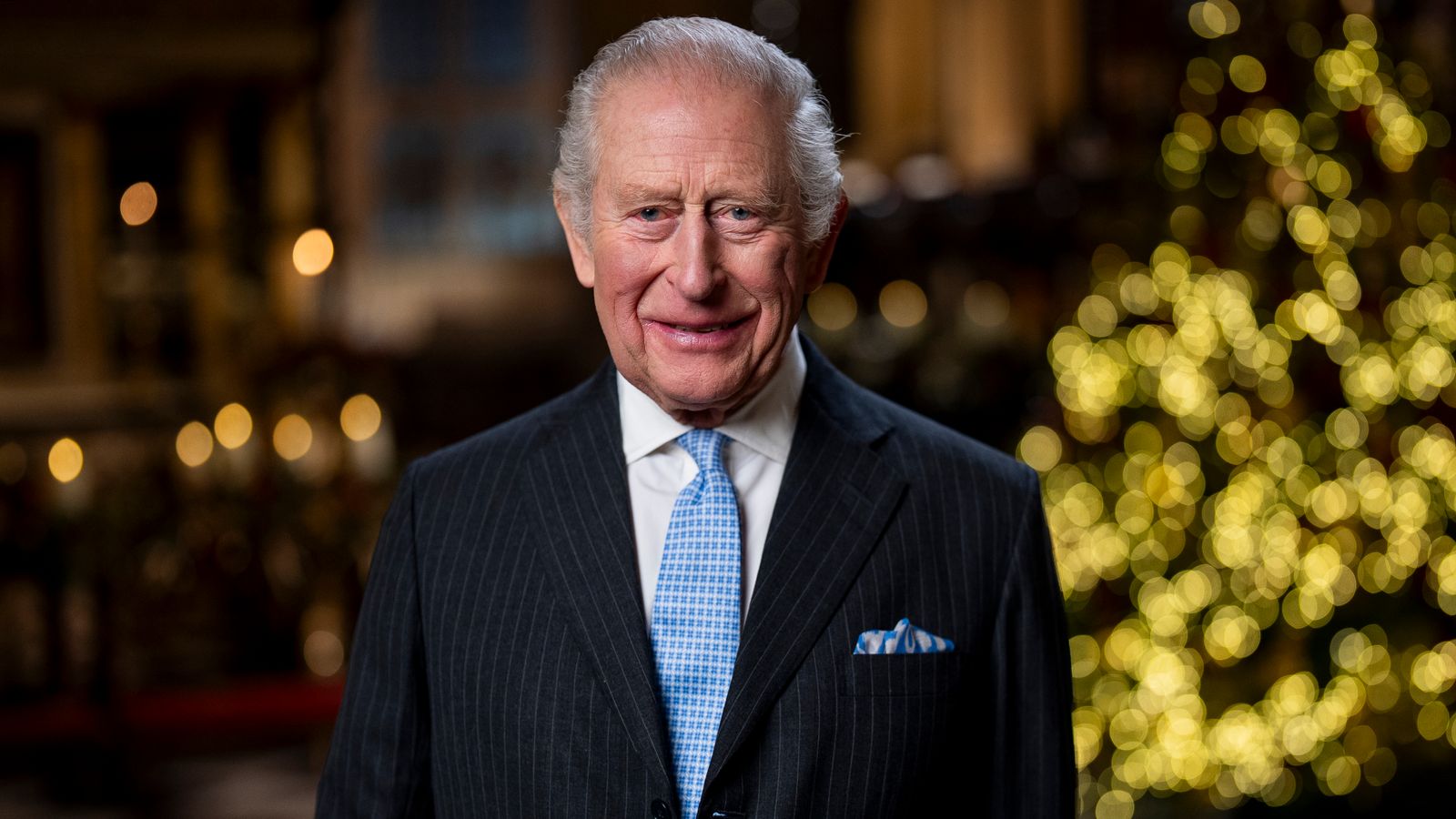

A photograph has been released by Buckingham Palace showing the King delivering his Christmas message again outside of traditional palace walls.
This year the annual address was filmed in the Lady Chapel inside Westminster Abbey, the second time the monarch has recorded it away from a royal residence.
The palace has revealed the abbey was chosen for the setting this year to reflect a major theme of the message, pilgrimage.
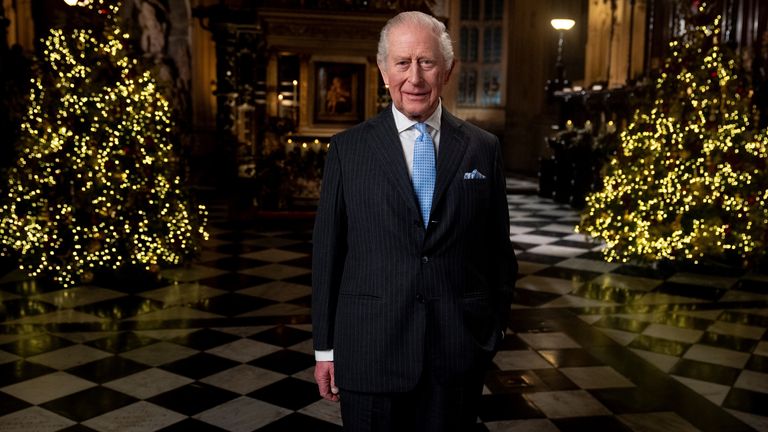
The Lady Chapel in Westminster Abbey, central London. Pic: PA
The full details of what he says are always kept secret until it is broadcast at 3pm on Christmas Day. The message is always seen as a deeply personal one from the monarch, as a rare speech delivered by the King without advice from, or consultation with, the government.
Westminster Abbey was seen as a perfect location to reflect the theme of pilgrimage with pilgrims visiting every year to remember the legacy of Edward the Confessor, whose shrine lies at the heart of the abbey. Around the walls of the Lady Chapel are 95 statues of saints dating from the building of the chapel in the 16th century.
Pic: PA
The abbey, as the site of the King’s own coronation and that of every monarch since 1066, also has royal significance. The Henry VII Lady Chapel is the burial place of 15 Kings and Queens including Elizabeth I, Mary I and Mary Queen of Scots. Below the central aisle is the Hanoverian vault where George II and members of his family are buried. The Stuart vault is in the south aisle where Charles II, William III and Mary II, and Queen Anne lie buried.
Read more:
William and Kate reveal Christmas card featuring family photo
King reveals cancer treatment will be reduced in the new year
It is understood the King takes a particular interest in where the message is filmed each year, favouring different locations outside of royal palaces over the past two years.
In the photograph, taken during filming, you can also see brightly lit Christmas trees used for another royal event in December. They were still inside the abbey following the filming of the Princess of Wales’s Together at Christmas carol service, which will be broadcast on Christmas Eve.
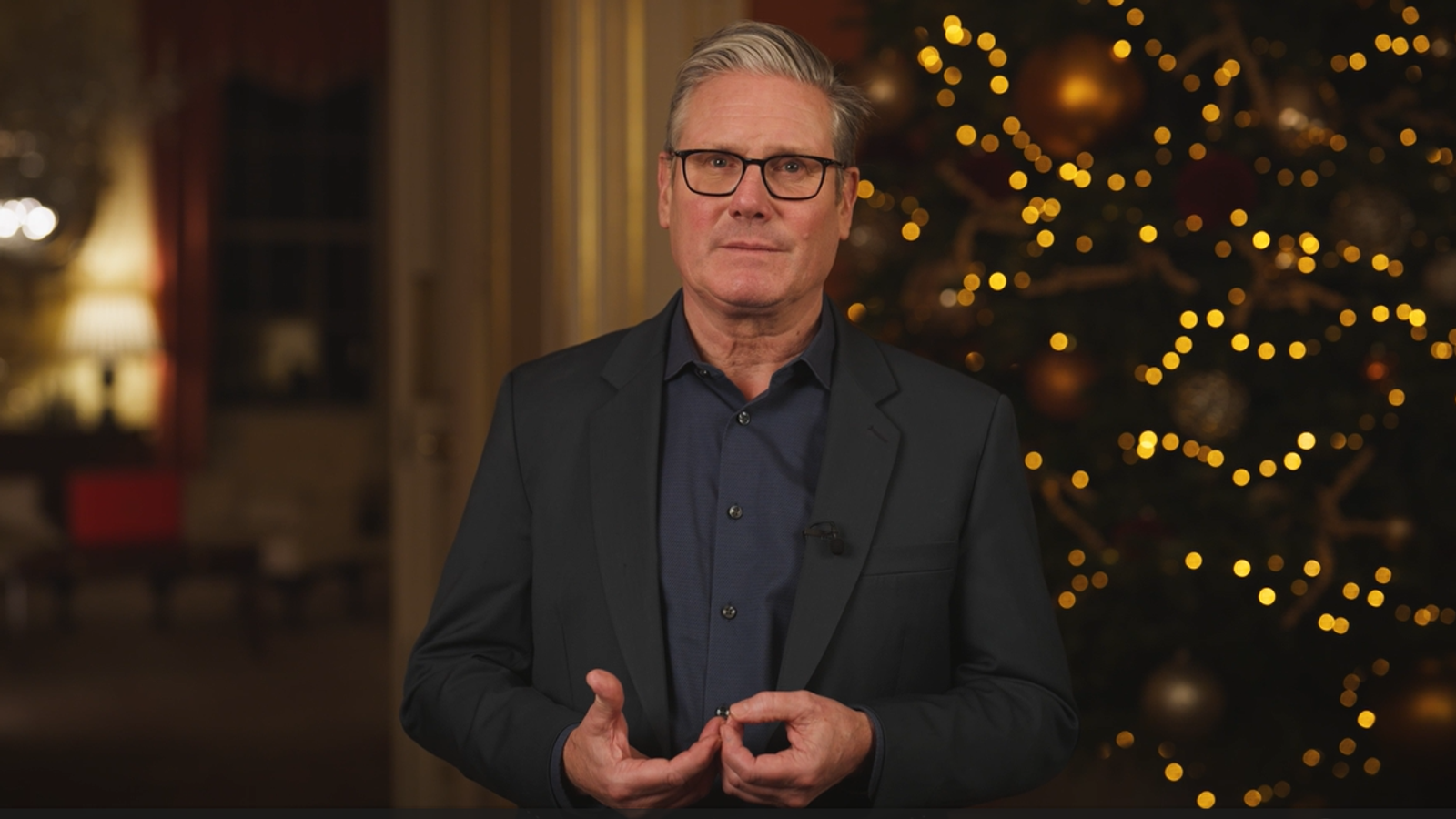
The prime minister has acknowledged Britons’ cost-of-living struggles in his Christmas message – and vowed that helping with the issue is his “priority”.
Sir Keir Starmer also urged members of the public to “each do our bit” and “reach out” to friends, relatives and neighbours during the festive period.
His message comes at the end of a difficult year for his government, with economic growth stuttering and Chancellor Rachel Reeves facing criticism over tax rises in the budget.
In a message recorded inside 10 Downing Street, Sir Keir said: “I know many across Britain are still struggling with the cost of living. Helping with that is my priority.
“But at this time of the year, which celebrates love and abundance, loss or hardship can feel even more acute.
“So call around to a neighbour. Check in on a friend or a relative who you haven’t heard from for a while. Reach out. It can make a huge difference.
“That is what Christmas is about.”
Sir Keir Starmer delivers his Christmas message from inside Downing Street. Pic: Downing Street
The prime minister thanked NHS workers along with members of the military and the emergency services who will be on duty on Christmas Day.
“Just as so many put their feet up, some truly special people will be pulling on their uniforms and heading out to work,” he said.
“Our NHS staff emergency services and the brave men and women of our armed forces, all playing their part, doing their bit to care for the nation and to keep us safe.
“Many volunteers will be out there as well. Serving food. Reaching out to help those lonely or in need.
“So on behalf of the whole country, I want to say a big thank you.
“As a nation, we should raise a glass to you this Christmas. But more than that, we should each do our bit as well.”
Read more from Sky News:
How does your Christmas compare to rest of UK? Take our quiz
The famous faces we said goodbye to this year
Conservative leader Kemi Badenoch used her Christmas message to talk about “Christian values” and thanked “everyone who has supported me during my first year as leader of the opposition”.
“It’s been the biggest challenge of my life,” she said. “But it’s also been a wonderful year. I can’t wait to get back to work next year to create a better United Kingdom.”
Liberal Democrat leader Sir Ed Davey spoke about the Christmas tree in London’s Trafalgar Square – an annual gift from Norway to thank the UK for its support during the Second World War – in his message.
While saying the tree may “look a little underwhelming” on first glance, the Liberal Democrat leader said it was a reminder of “friendship and loyalty”.
He added: “It makes me think about people standing together in tough times – whether against the Nazis in the 1940s, or right now in Ukraine.
“And yeah, it might not be perfect, but this tree in Trafalgar Square makes me think about families and friends looking out for one another right here at home.
“I can’t think of a better symbol of the Christmas spirit of generosity, love and hope. Of light in the darkness.”
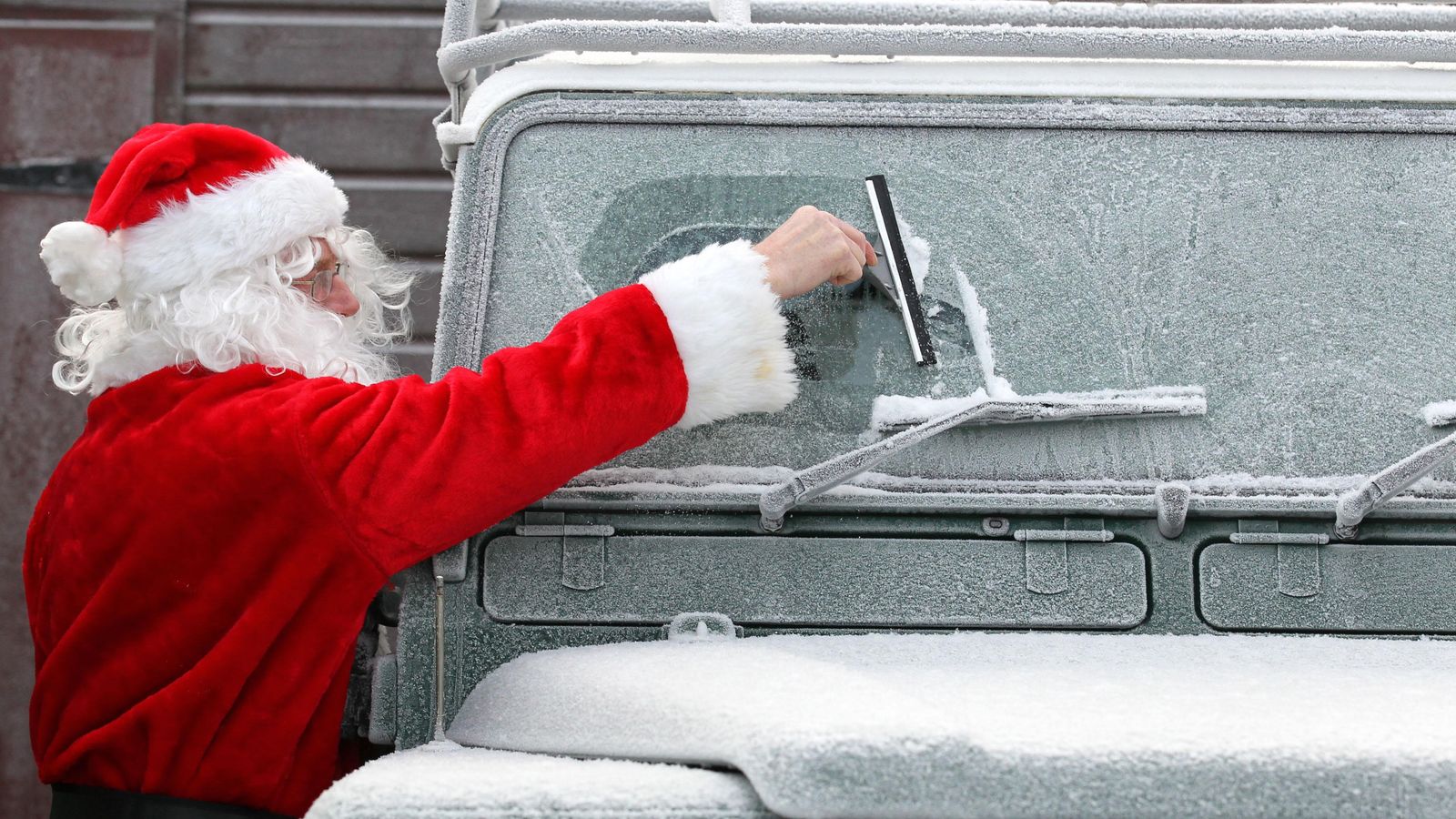

Many in the UK will wake up to a frosty morning on Christmas Day – but don’t hold out hope for snow, forecasters have said.
The Met Office says the 24 and 25 December will be dry and sunny for most, but a brisk wind picking up from Christmas Eve will make this year slightly below-average temperature wise.
It adds that for most of the country, it will feel close to freezing, with temperatures peaking at 4-5C across the festive period.
In Scotland, temperatures are forecast to plummet below freezing across much of the country, with the north of the country potentially reaching -5C.
Get the Sky News weather forecast for your area
Keen swimmers looking for a bracing dip in the sea on Christmas Day and Boxing Day may potentially face big waves, due to easterly winds.
Despite the chillier temperatures, a white Christmas is not looking likely, with only a small chance of snowfall in Dartmoor and a 10% chance of “winter flurries” on the south coast of England.
Pic: iStock
“All we need, of course, is for a flake of snow to fall anywhere across the UK for it to technically be termed a ‘white Christmas’, so something to keep an eye on across the far south of England,” Met Office meteorologist Marco Petagna previously said.
Last year, not one snowflake was recorded anywhere in the UK on Christmas Day. In fact, temperatures were above zero everywhere.
The last time all four UK nations had a white Christmas was back in 2010, the year snow lay most widely across the UK since 1959.
Read more from Sky News:
Starmer makes cost-of-living promise
Details of King’s Christmas message revealed
On Boxing Day, some southern counties could see more cloud, but elsewhere is expected to remain largely dry with sunny spells.
Similar weather is expected right up until New Year’s Eve, Met Office meteorologist Becky Mitchell said.
“It’s a bit colder than average, not unusual for the time of year, but in terms of averages it would be a bit below,” she added.
“The weather’s all very similar really, out towards New Year’s Eve. The Christmas period is quite a nice forecast.”
-
 Sports2 years ago
Story injured on diving stop, exits Red Sox game
-
 Sports3 years ago
‘Storybook stuff’: Inside the night Bryce Harper sent the Phillies to the World Series
-
 Sports2 years ago
Game 1 of WS least-watched in recorded history
-
 Sports3 years ago
Button battles heat exhaustion in NASCAR debut
-
 Sports3 years ago
MLB Rank 2023: Ranking baseball’s top 100 players
-
Sports4 years ago
Team Europe easily wins 4th straight Laver Cup
-
 Environment3 years ago
Japan and South Korea have a lot at stake in a free and open South China Sea
-
 Environment1 year ago
Here are the best electric bikes you can buy at every price level in October 2024