


Broadcom CEO Hock Tan.
Lucas Jackson | Reuters
Broadcom’s quarterly results and guidance sailed past Wall Street estimates. It didn’t matter.
The chipmaker’s shares plummeted 11% on Friday, on pace for their worst day since January, as investors ran for the exits on the artificial intelligence trade. Oracle dropped 4% a day after plunging 10% following its earnings report.
AI has been the driver for the stock market and the broader economy this year, so any negative sentiment has potentially far-reaching consequences. The Nasdaq on Friday fell about 1.4%, and the S&P 500 declined declined by nearly 1%.
The companies getting hit the hardest are the ones most closely tied to AI infrastructure, which has been booming as hyperscalers build out their data centers to try and meet what they describe as insatiable demand for compute-intensive AI services. Broadcom makes custom chips for many of the the largest tech companies, and saw its market cap about double each of the past two years before rallying again in 2025.
“This stock is up 75-80% year to date. You’re seeing a little bit of a pullback,” Vijay Rakesh, an analyst at Mizuho, told CNBC’s “Squawk on the Street” on Friday. “We would be buyers on this pullback.”
Mizuho raised its price target on the stock to $450 from $435. It was trading below $364 as of Friday afternoon.
“This is still where the growth is,” Rakesh said. “They are still the big supplier to Google on their entire hardware stack, to Meta, to Anthropic and even OpenAI coming down the road.”
Broadcom reported revenue growth of 28% during the quarter, largely due to a 74% increase in AI chip sales, to a total of $18.02 billion, topping the $17.49 billion average analyst estimate, according to LSEG. Adjusted earnings per share of $1.95 adjusted topped the $1.86 average estimate.
CEO Hock Tan said Broadcom expects AI chip sales this quarter to double from a year earlier to $8.2 billion, both from custom AI chips as well as semiconductors for AI networking.
One concern among investors is that margins are coming down, at least in the short term, due to higher upfront costs. CFO Kirsten Spears said on the earnings call that “gross margins will be lower” for some of Broadcom’s AI chip systems because the company will have to buy more parts to produce the server racks.
Broadcom also said it had a $73 billion backlog of AI orders over the next 18 months. Part of that is from $21 billion of orders from Anthropic, which the company revealed as a key customer on Thursday.
While OpenAI has been a highly touted customer following a multibillion-dollar agreement announced in October, Tan doused some hope for the deal, telling investors late Thursday that, “We do not expect much in ’26.”
Bernstein analyst Stacy Rasgon said in a note on Friday that “AI angst” was driving Broadcom’s shares lower.
“Frankly we aren’t sure what else one could desire as the company’s AI story continues to not only overdeliver but is doing it at an accelerating rate,” Rasgon, who recommends buying the stock and raised his price target, wrote in the note.
Oracle has been facing more extreme skepticism. The stock is now down more than 40% from its record reached in September. The company beat on earnings but missed on revenue in its report on Wednesday, and investors were disappointed they didn’t get more detail on how Oracle will finance its massive buildout that so far has required mounds of debt.
CoreWeave, which is investing in data centers to offer cloud-based AI services, sank 9% on Friday and has lost more than half its value since peaking in June.


-
Greg Wyshynski
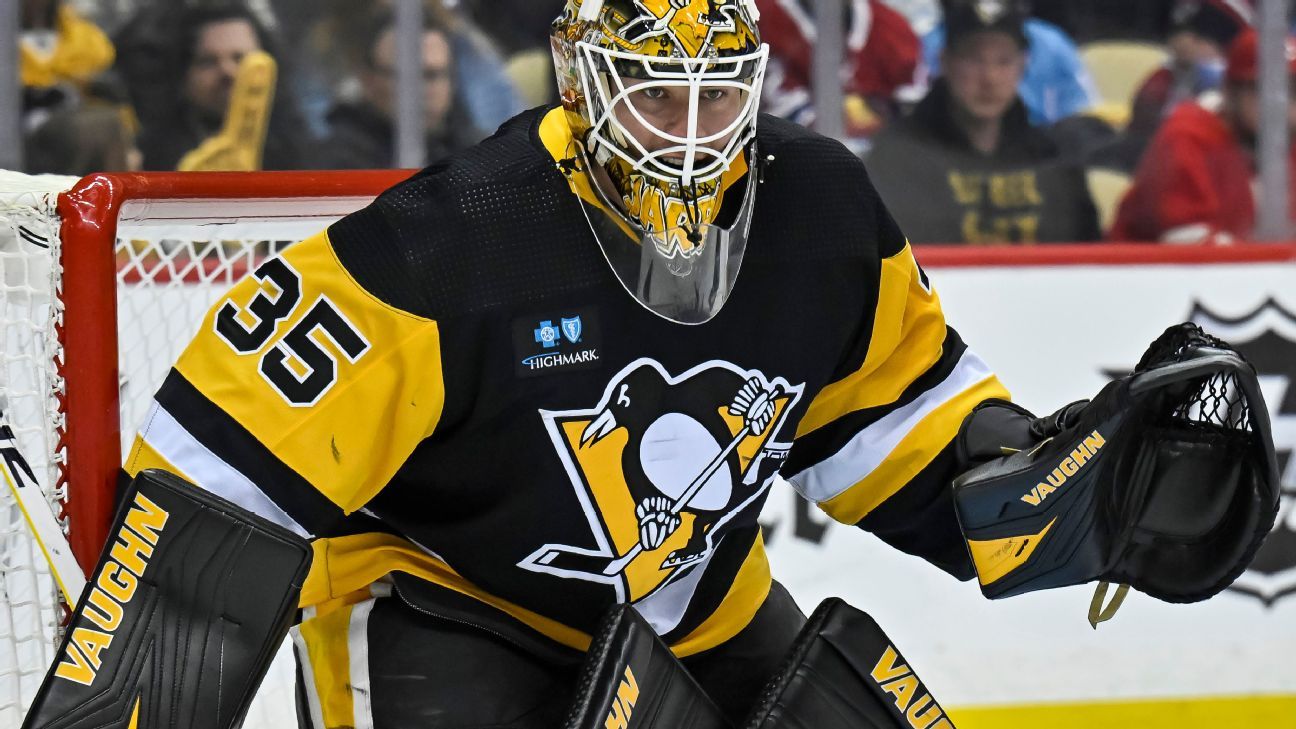
The Edmonton Oilers finally addressed their multiple-season problem in goal by acquiring Pittsburgh Penguins netminder Tristan Jarry on Friday.
The Oilers sent goalie Stuart Skinner, defenseman Brett Kulak and a 2029 second-round pick to Pittsburgh for Jarry and forward Sam Poulin.
Edmonton also made another trade Friday, sending a 2027 third-round pick to the Nashville Predators for defenseman Spencer Stastney.
Jarry, 30, is in his 10th NHL season, all with the Penguins. He had helped Pittsburgh to a surprising start that put it in a playoff seed through Thursday’s games. He was 9-3-1 in 14 games with Pittsburgh this season with a .909 save percentage and a 2.66 goals-against average with one shutout. MoneyPuck had him at 9.8 goals saved above expected.
Edmonton has the second-worst team save percentage in the NHL this season (.873). The Oilers have appeared in back-to-back Stanley Cup Finals, losing both times to the Florida Panthers. Each run has been plagued by goaltending inconsistency, with Skinner and backup Calvin Pickard unable to provide championship-caliber stability. The Oilers would have preferred adding a veteran goalie to a tandem with Skinner, but that would have been a challenge under the salary cap.
Jarry is signed through the 2027-28 season with a $5.375 million cap hit.
Skinner is signed through this season, and his contract carries an average annual value of $2.6 million. Kulak is also signed through 2025-26, and his contract carries an average annual value of $2.75 million. Both are set to be unrestricted free agents next summer.
-
 Sports2 years ago
Story injured on diving stop, exits Red Sox game
-
 Sports3 years ago
‘Storybook stuff’: Inside the night Bryce Harper sent the Phillies to the World Series
-
 Sports2 years ago
Game 1 of WS least-watched in recorded history
-
 Sports3 years ago
Button battles heat exhaustion in NASCAR debut
-
 Sports3 years ago
MLB Rank 2023: Ranking baseball’s top 100 players
-
Sports4 years ago
Team Europe easily wins 4th straight Laver Cup
-
 Environment3 years ago
Japan and South Korea have a lot at stake in a free and open South China Sea
-
 Environment1 year ago
Here are the best electric bikes you can buy at every price level in October 2024