
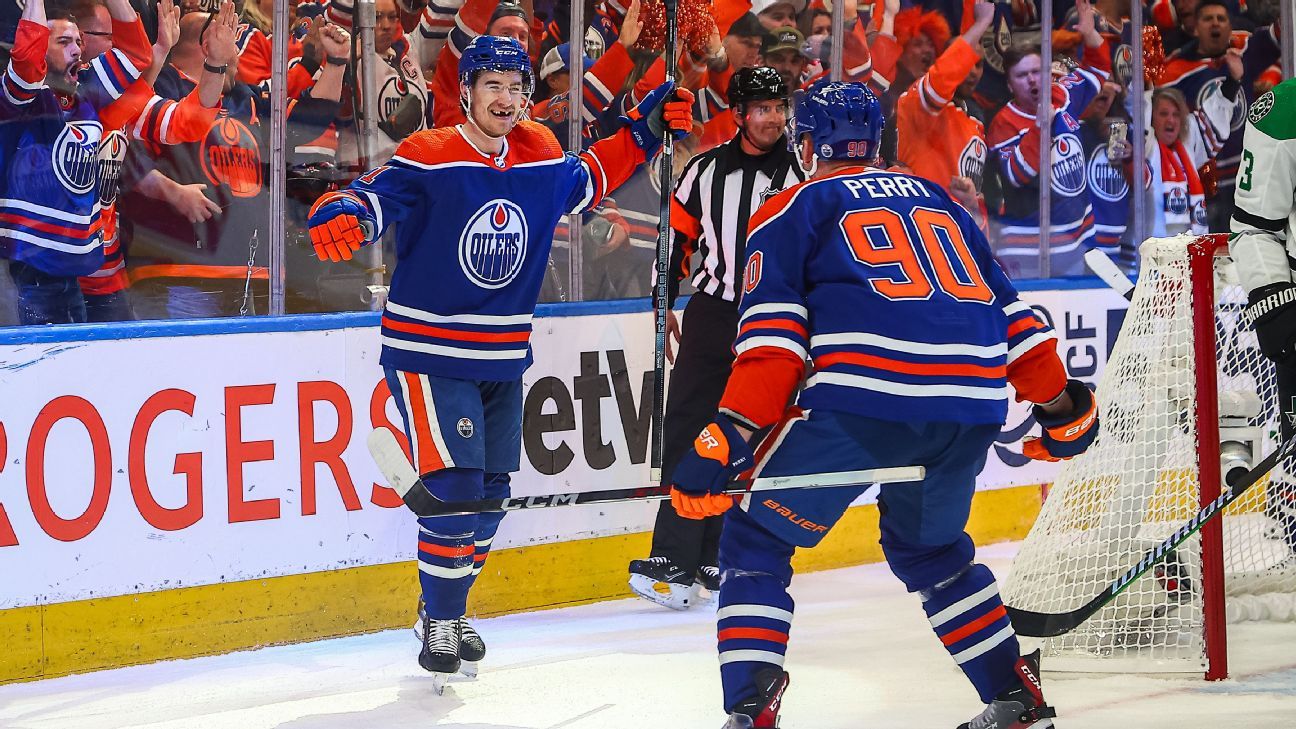
Grades, takeaways from the Oilers’ Game 4 win — and the big question for Game 5


-
Greg Wyshynski, ESPN
The Edmonton Oilers faced a 2-1 series deficit heading into Game 4, and after two Dallas Stars goals in the first 5:29 of the game, it looked like that could grow to 3-1.
Then the tide turned, significantly.
Ryan McLeod and Evan Bouchard scored in the first, followed by goals from Mattias Janmark and Leon Draisaitl in the second — and an empty-net capper from Mattias Ekholm for good measure. The series is now 2-2 and headed back to Dallas for Game 5 on Friday (8:30 p.m. ET, TNT).
What stood out the most from this game? What trends will continue? And who are the key players to monitor with the series now down to a best-of-3?


Oilers grade: A-
Game 4 was the perfect encapsulation of the Oilers.They had a terrible start, going down 2-0 in the first 5:29 of a must-win game. They roared back to score five unanswered goals, controlled play by limiting Dallas to 22 shots, killed two power plays and scored a shorthanded goal. Goalie Stuart Skinner looked like he was about to fall apart but made key saves — including a great one on Tyler Seguin — to ensure Dallas didn’t score that third goal.
No team in the postseason can look as bad and as good as the Oilers, frequently in the same 20 minutes.
Coach Kris Knoblauch also deserves his flowers for shaking up his roster for Game 5. He swapped in forwards Corey Perry and Ryan McLeod, as well as defenseman Philip Broberg; and swapped out forwards Sam Carrick and Warren Foegele, as well as defenseman Vincent Desharnais. Once again, Knoblauch pushed the right buttons: McLeod scored Edmonton’s first goal to cut the Dallas lead to 2-1, on an assist from Perry; and their line with Leon Draisaitl outshot the Stars 6-1 while on the ice at 5-on-5.
The Oilers credit Knoblauch with saving their season. He’s continued those heroics in the playoffs.
1:20
Oilers take lead with 2 goals in 51 seconds
Mattias Janmark and Leon Draisaitl score in less than a minute of each other to give the Oilers a 4-2 lead over the Stars.

Stars grade: C-
Blowing a 2-0 first-period lead wasn’t the problem. Watching the Oilers score two goals in 51 seconds — a Mattias Janmark shorthanded goal and Leon Draisaitl’s 10th of the postseason — wasn’t the problem.
The problem was just how meekly the Stars lost Game 4 in Edmonton. Dallas had one high-danger shot attempt in the third period against Stuart Skinner.
No passion, no pushback. Now the Oilers have new life in the series.
What we learned in Game 4
Goalies can make stick saves even when they don’t have sticks in their hands.
Late in the first period, Stars goalie Jake Oettinger lost his stick while scrambling to make two saves on an Edmonton power play. Oilers winger Zach Hyman nudged the stick with his skate back off of Oettinger, and it eventually settled with the stick blade draped across the goal line.
Connor McDavid got the puck to Oettinger’s right, saw some daylight between the goalie and the net and fired the puck … directly off the abandoned stick and out of harm’s way for Dallas. McDavid had a look of stunned disbelief on the bench in a 2-2 game.
0:46
‘Unbelievable!’ Jake Oettinger’s unattended stick somehow blocks goal
Jake Oettinger’s stick somehow is placed in the right path to block the Oilers from taking a lead in the first period.
According to the NHL’s official scoresheet, it counted as a missed shot by McDavid rather than a save for Oettinger, which we believe is a serious underestimation of Otter’s precognitive powers.
Players to watch in Game 5

Darnell Nurse. The Edmonton defenseman was a target of derision locally after Game 3, with some openly questioning his future with the team based on his ineffectiveness. He was on the ice for the Stars’ first two goals, including an Esa Lindell shot that deflected off Nurse and into the net to make it 2-0.
But he kept battling. He assisted on McLeod’s goal. He was a physical presence. He delivered 12 hits but didn’t take a minor penalty in 19:19 of ice time. It was a critical performance for an important player.

Jason Robertson. Was the Roberts-issance one and done? The Stars winger went 10 playoff games without a goal before tallying a hat trick in Game 3, thanks in part to the return of Roope Hintz. But Robertson was a minus-2 with no points in Game 4, the sixth time in the postseason he was held without a point and the seventh in which he had a minus-rating.
With the Stars still looking for their first power-play goal of the series, they need the Robertson who showed up for Game 3, with the action shifting back to Dallas for Game 5.
Big question for Game 5: Is Chris Tanev OK?
The Stars defenseman blocked an Evander Kane shot with his right foot with 7:38 left in the second period, and did not return to the game with a lower-body injury. A key acquisition at the trade deadline, Tanev has been a critical part of the Stars’ top four on defense, averaging 23:26 of ice time per game.
He has 68 blocked shots to lead all players in the postseason. Dallas is hoping he’ll be available to block a few more in Game 5. If not, it’s a massive blow to the thinnest area of the Stars’ lineup, and could impact their penalty kill, which is the last thing you want against the Oilers.
After the game, coach Pete DeBoer said “fingers crossed” that Tanev is OK for Game 5.

-
Dan Murphy
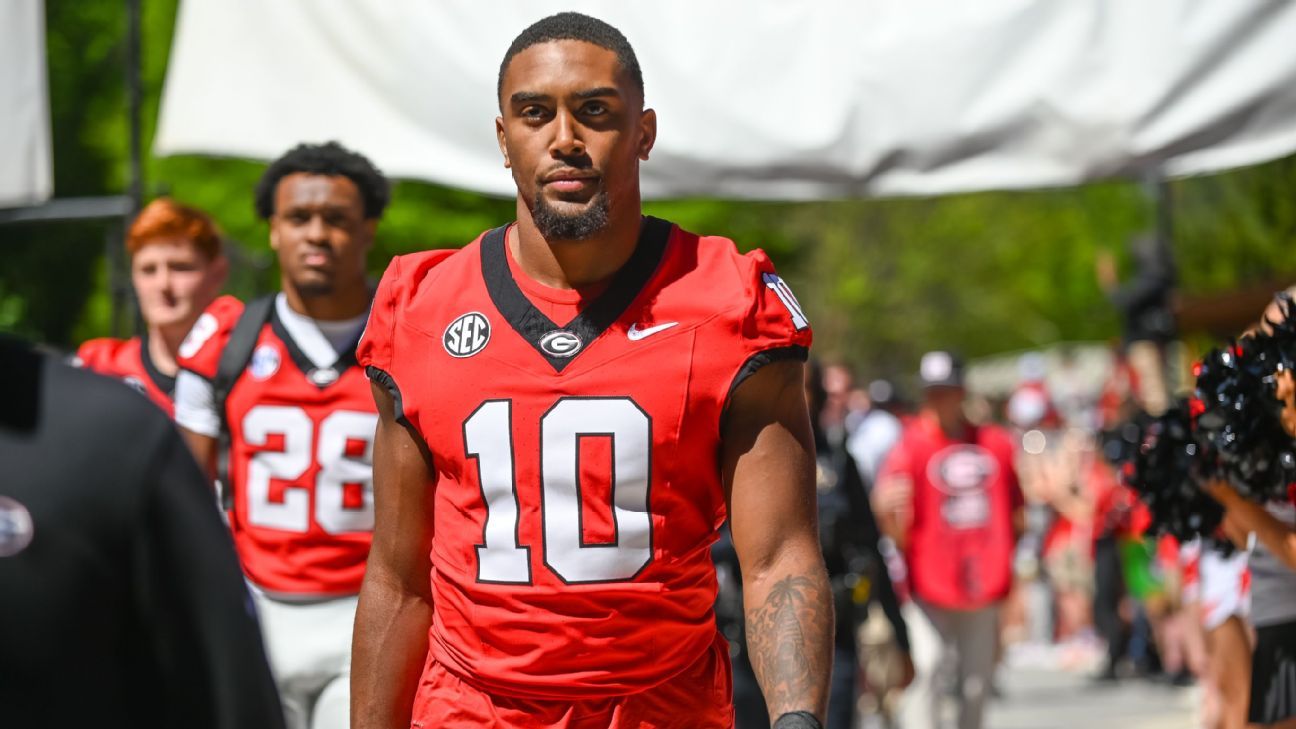
Georgia‘s athletic department is headed to court to try to obtain $390,000 in damages from a former standout defensive end who transferred from the school after his sophomore season in a potentially precedent-setting case.
The Bulldogs have asked a judge to force former defensive end Damon Wilson, currently the top pass rusher on Missouri‘s defensive line, to enter into arbitration to settle a clause in his former contract that serves effectively as a buyout fee for exiting his deal early. Wilson played for Georgia as a freshman and sophomore before transferring to Missouri in January, two weeks after signing a new deal with Georgia’s Classic City Collective.
Many schools and collectives have started to include liquidated damages clauses in their contracts with athletes to protect their investment in players and deter transfers. Georgia is one of the first programs to publicly try to enforce the clause by filing suit against a player.
“When the University of Georgia Athletic Association enters binding agreements with student-athletes, we honor our commitments and expect student-athletes to do the same,” athletics spokesperson Steven Drummond said in a statement to ESPN on Friday.
Wilson was served last week in Missouri with a summons to appear in court, according to legal documents.
“After all the facts come out, people will be shocked at how the University of Georgia treated a student athlete,” said Bogdan Susan, a Missouri-based attorney who is representing Wilson along with attorney Jeff Jensen. “It has never been about the money for Damon, he just wants to play the game he loves and pursue his dream of playing in the NFL.”
Susan and Jensen did not represent Wilson when he negotiated his contact with Georgia. He and his lawyers have 30 days from the time he received his court summons to provide a response.
The Bulldogs paid Wilson a total of $30,000 from the disputed contract. Because of the way the deal was crafted, Georgia says Wilson owed it $390,000 in a lump sum within 30 days of his decision to leave the team. Drummond declined to comment when asked why the damages being sought are much higher than the amount Wilson was paid.
Wilson signed a term sheet with Classic City Collective in December 2024, shortly before Georgia lost in a quarterfinal playoff game to Notre Dame, ending his sophomore season. The 14-month contract — which was attached to Georgia’s legal filing — was worth $500,000 to be distributed in monthly payments of $30,000 with two additional $40,000 bonus payments that would be paid shortly after the NCAA transfer portal windows closed.
The deal states that if Wilson withdrew from the Georgia team or entered the transfer portal, he would owe the collective a lump-sum payment equal to the rest of the money he’d have received had he stayed for the length of the contract. (The two bonus payments apparently were not included in the damages calculation.) Classic City signed over the rights to those damages to Georgia’s athletic department July 1 when many schools took over player payments from their collectives.
Georgia’s filing claims Wilson received his first $30,000 payment Dec. 24, 2024. Less than two weeks later, he declared his plans to transfer.
Legal experts say Georgia’s attorneys will have to convince an arbitrator that $390,000 in damages is a reasonable assessment of the harm the athletic department suffered due to Wilson’s departure. Liquidated damages are not legally allowed to be used as punishment or primarily as an incentive to keep someone from breaking a contract.
In one of the only other examples of a school trying to enforce a similar clause, Arkansas‘ NIL collective filed a complaint in the spring against quarterback Madden Iamaleava and wide receiver Dazmin James after both players transferred out of the program. The Iamaleava case was “resolved to Arkansas’s satisfaction,” according to a source familiar with the matter. James’ attorney, Darren Heitner, told ESPN that the wide receiver “stood his ground” and that Arkansas has not moved forward to date with further attempts to collect damages.
“To me, [these clauses] are clearly penalty provisions masquerading as liquidated damages,” Heitner said.
Several attorneys who have reviewed athlete NIL contracts for ESPN in the past say they believe schools and their collectives are using liquidated damages clauses in bad faith to punish players who break their contract early.
Schools and collectives have not used the negotiated buyout clauses that typically appear in coaching contracts for athletes because the teams aren’t technically paying them to play their sport. Instead, the school pays players for the right to use their name, image and likeness in promotional material. Paying for play could make it more likely that courts would deem athletes to be employees, which almost all college sports leaders want to avoid.
Wilson’s case could help set a precedent on whether liquidated damages clauses will serve as an effective, defensible substitute for more traditional buyout fees.

-
Eli Lederman
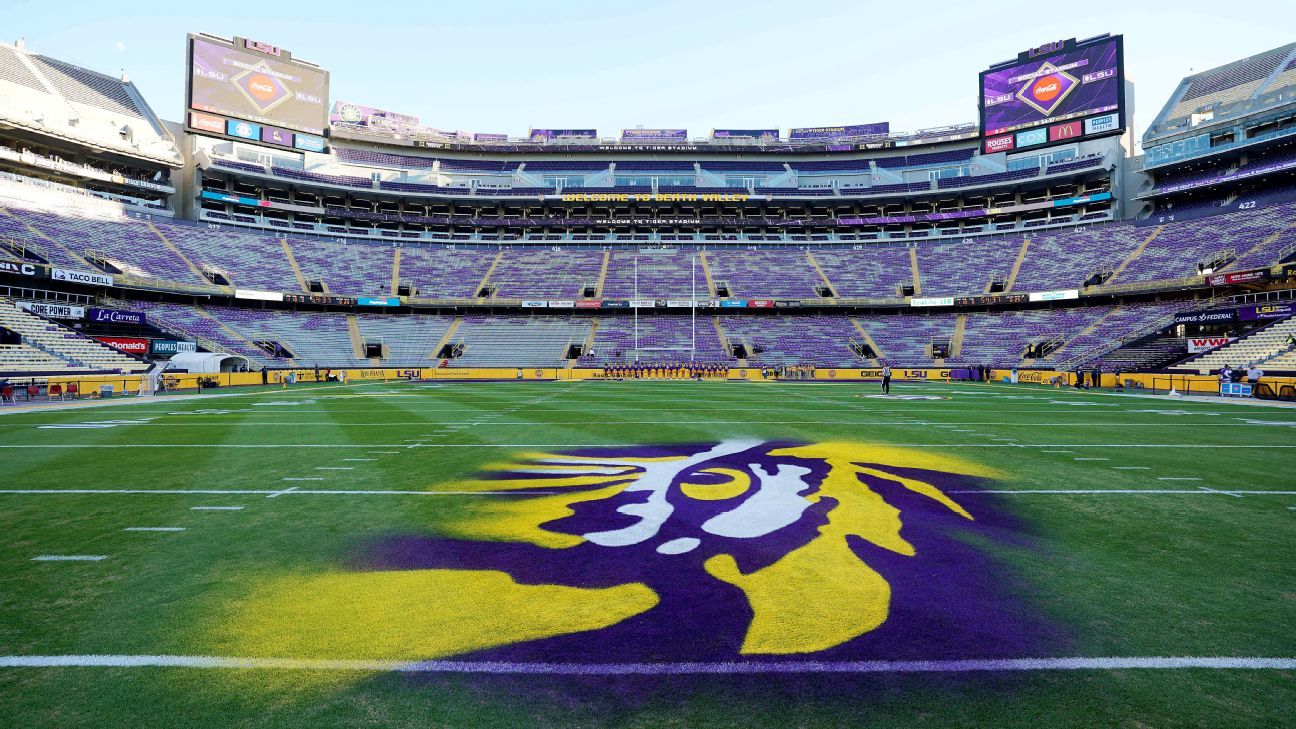
LSU and coach Lane Kiffin closed a busy early signing period with a bang Friday, officially securing the signature of defensive tackle Lamar Brown, ESPN’s No. 1 overall 2026 recruit.
Brown, a 6-foot-5, 285-pound defender from Erwinville, Louisiana, signed his letter of intent on the final day of the three-day period, the program announced, formally joining Kiffin and the Tigers as the program’s first No. 1 overall addition since Leonard Fournette in 2014.
Committed to the program since July, Brown was not initially expected to sign this week following meetings between Brown’s representatives and members of the LSU staff Tuesday.
While Brown remained verbally committed to the program, sources told ESPN that his camp harbored reservations over Kiffin’s to-be-completed coaching staff. Uncertainty hanging over the futures of Tigers interim coach Frank Wilson and defensive coordinator Blake Barker marked a particular concern for Brown, who attends high school on the LSU campus and developed close relationships with the program’s previous staff during his recruitment.
As of Friday afternoon, the Tigers have not publicly announced plans for the program’s defensive staff. The statuses of Wilson and Baker, a reported candidate for multiple head coach openings across the country, remain unclear, too. But according to ESPN sources, Brown and the Tigers progressed toward his signing through talks across Wednesday and Thursday, culminating in the program officially landing his signature Friday afternoon.
Within an impressive Tigers defensive class in 2026, Brown was not alone in initially holding off on signing this week before ultimately submitting the official paperwork.
LSU officially announced the signing of ESPN 300 defensive tackle Richard Anderson (No. 90 overall) on Thursday after questions swirled over his signature on the opening day of the signing period. Top 60 defensive linemen Deuce Geralds (No. 39) and Trenton Henderson (No. 60) each pushed their signings to Friday. Henderson, amid late flip efforts from Auburn and Florida State, gave the Tigers his signature Friday morning. Geralds, ESPN’s No. 2 defensive tackle in 2026, followed in the afternoon, minutes before the program announced Brown’s signing.
For Kiffin, who officially arrived Sunday, Brown’s signature closes LSU’s class of ESPN 300 additions and marks a strong finish to a hectic first week on the recruiting trail with the Tigers.
Uncertainty surrounding Brown and the program’s top defensive pledges hung over early-week commitments from wide receiver Brayden Allen and former Ole Miss pledges J.C. Anderson (No. 165 in the ESPN 300) and Ryan Miret. Pass catcher Corey Barber, another ex-Rebels commit, also signed with the Tigers on Wednesday. LSU also lost five commitments following Kiffin’s arrival, headlined by safety Dylan Purter (No. 266), who flipped to Florida on Thursday.
Kiffin & Co. took some big swings, as well. Sources tell ESPN that the Tigers made late efforts to flip USC tight end signee Mark Bowman (No. 29 overall) and four-star South Carolina quarterback signee Landon Duckworth (No. 186). LSU also attempted to sway No. 1 wide receiver Chris Henry Jr., who affirmed his pledge to Ohio State and signed Friday.
With Brown officially in the fold, the Tigers will close the early signing period with the nation’s No. 14 signing class in ESPN’s latest class rankings for the cycle.
-
 Sports2 years ago
Story injured on diving stop, exits Red Sox game
-
 Sports3 years ago
‘Storybook stuff’: Inside the night Bryce Harper sent the Phillies to the World Series
-
 Sports2 years ago
Game 1 of WS least-watched in recorded history
-
 Sports3 years ago
Button battles heat exhaustion in NASCAR debut
-
 Sports3 years ago
MLB Rank 2023: Ranking baseball’s top 100 players
-
Sports4 years ago
Team Europe easily wins 4th straight Laver Cup
-
 Environment3 years ago
Japan and South Korea have a lot at stake in a free and open South China Sea
-
 Environment1 year ago
Here are the best electric bikes you can buy at every price level in October 2024