
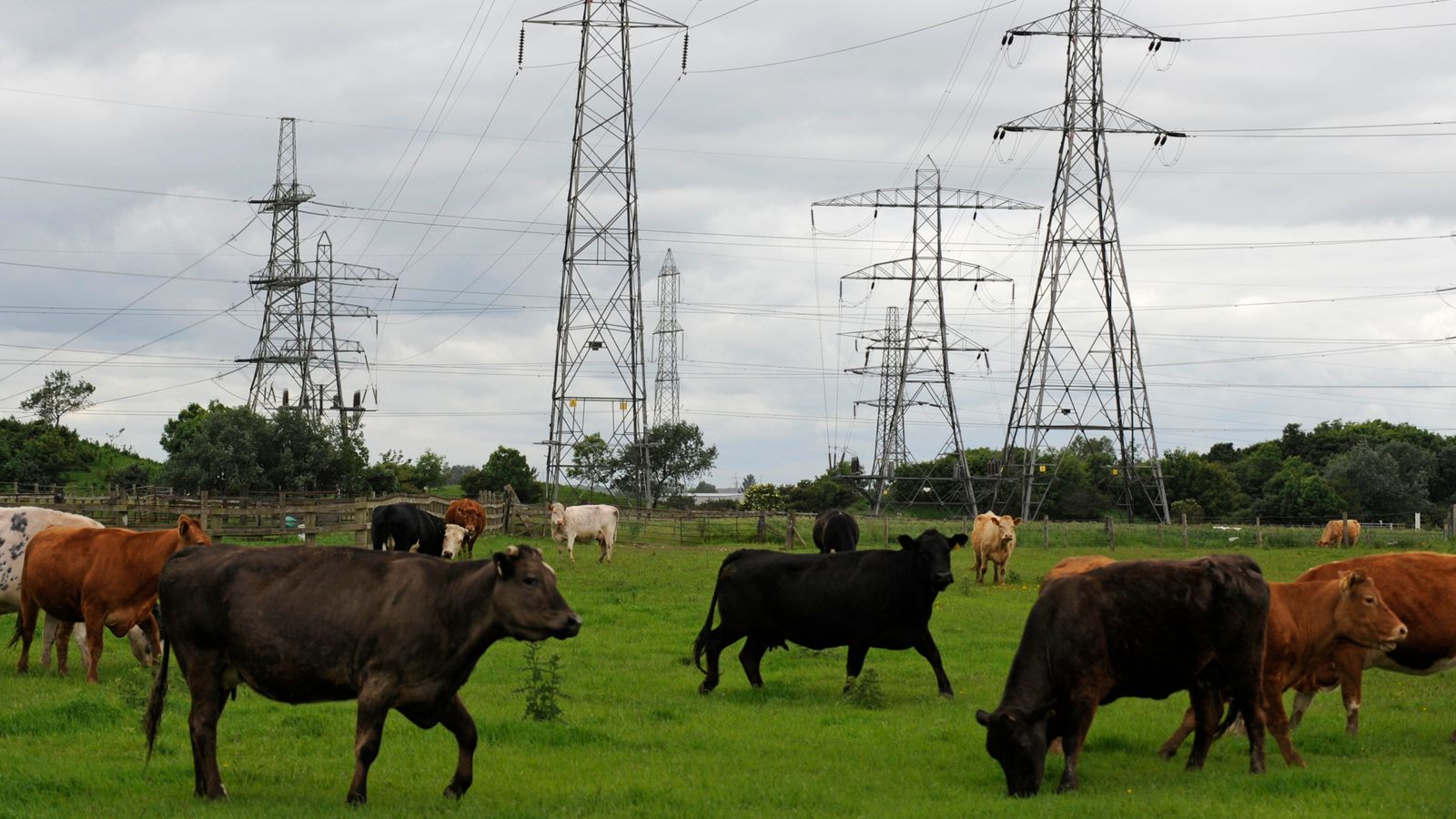
Labour has launched its Great British Energy policy – do we need it?


The establishment of Great British Energy is among the last remnants of the ‘green prosperity plan’ devised and championed by Ed Miliband, the shadow secretary of state for energy security and net zero, three years ago.
The former Labour leader’s vision was to spend £28bn per year in the first five years of an incoming Labour government on decarbonising the UK economy.
However, as the current leader Sir Keir Starmer recognised, the issue was swiftly weaponised by the Conservatives because all the money – as Mr Miliband himself had made clear – would have been borrowed.
More importantly, the plan did not survive contact with Rachel Reeves, the shadow chancellor, who has made fiscal responsibility her priority.
The £28bn-a-year spending pledge was watered down in February this year to one of £23.7bn over the life of the next parliament.
A sizeable chunk of that will be on Great British Energy, described by Mr Miliband as “a new publicly owned clean power company”, which Labour has said will be initially capitalised at £8.3bn.
And, instead of the money being borrowed, Labour is now saying “it will be funded by asking the big oil and gas companies to pay their fair share through a proper windfall tax”.
What’s a windfall tax and what’s it got to do with green energy?
Before going further, it’s worth explaining what the current windfall tax is.
The existing ‘temporary energy profits levy‘ was launched by Rishi Sunak, as chancellor, in May 2022 and imposed an extra 25% tax on the profits earned by companies from the production of oil and gas in the UK and on the UK Continental Shelf in the North Sea.
Due to expire at the end of 2025, it raised £2.6bn during its first year.
Jeremy Hunt, as chancellor, raised the levy to 35% from the beginning of last year and extended its life to the end of March 2028. That ‘sunset clause’ was extended to the end of March 2029 in Mr Hunt’s spring budget earlier this year.
It effectively means that the total tax burden on North Sea oil and gas producers is now 75%.
Labour made clear in February this year that this would rise to 78%. It also plans to remove some of the investment incentives Mr Sunak put in place when it announced the current windfall tax.
That will undoubtedly have consequences.
Offshore Energies UK, the industry body, has said that, in its first year, the existing energy profits levy led to more than 90% of North Sea oil producers cutting spending. It has warned that Labour’s plans could cost 42,000 jobs in the North Sea and some £26bn in economic value.
Read more:
UK’s largest consumer-owned wind farm powering up in Scotland this month
Rapid steps needed for Britain to compete in green industrial revolution – IPPR says
So the increase in the windfall levy will have consequences for the overall tax take.
It is therefore important for Labour to make clear what changes in investment and hiring it is factoring in from companies operating in the North Sea as a result of higher taxation.
The big operators are already deserting the region. It was reported this week that Shell and Exxon Mobil are close to selling their jointly-controlled UK North Sea gas fields – marking the US giant’s final exit from the North Sea after 60 years.
And Harbour Energy, the biggest independent operator in the North Sea, has slashed investment in the region, along with hundreds of jobs, since the energy profits levy was introduced. It too is seeking to diversify away from the North Sea – having seen the energy profits levy wipe out its entire annual profits during the first year of the impost.
What will Great British Energy even own?
The second big question is what assets will be owned by Great British Energy.
Labour said overnight: “Great British Energy’s early investments will include wind and solar projects in communities up and down the country as well as making Scotland a world-leader in cutting edge technologies such as floating offshore wind, hydrogen, and CCS (carbon capture and storage).”
Keep up with all the latest news from the UK and around the world by following Sky News
What is unclear, though, is whether this will involve buying existing assets from private sector operators, building new assets from scratch or co-investing in new projects.
It is worth asking the question because only the latter of these two options will actually add to the UK’s energy generation and storage capacity.
And, if it is to be the second or third options, the question is what return on capital employed Great British Energy will be seeking to achieve.
A risk that money could be wasted
All commercial operators seek to achieve a return on capital which exceeds their cost of capital.
Now, as a sovereign debt issuer with a good credit rating, the UK government enjoys a lower cost of capital than most corporates. But there will still be a nagging concern – given the traditionally poor stewardship of state-owned enterprises in the UK – that, without the discipline imposed by having shareholders, some of the money will be wasted.
Investments of this kind are risky and volatile.
An example of this came last week when SSE, one of the UK’s biggest and best-run renewable energy generating companies, admitted that Dogger Bank A, its giant wind project off the Yorkshire coast, will not be fully operational until next year rather than this year.
Is it needed when billions are being spent on green investments?
A third question is why, precisely, Great British Energy is needed at all.
The UK is already decarbonising more rapidly than any other major economy and is also investing heavily.
The Department for Energy and Net Zero recently estimated that there will be some £100bn worth of private investment put towards the UK’s energy transition by 2030.
National Grid announced only last week that it plans to invest £31bn in the UK on the transition between now and the end of the decade.
SSE is investing £18bn in renewable capacity in the five years to 2026-27. Scottish Power, another of the big renewable energy companies, recently announced plans to invest £12bn between now and 2028.
So it is not entirely obvious why a comparatively small state-owned company is even necessary.
Energy security and cost
Labour’s justification is partly based on energy security – Sir Keir has in the past queried why a Swedish state-owned power company, Vattenfall, should be the biggest investor in onshore wind in Wales – and partly on prices.
It said overnight: “Great British Energy is part of our mission to make Britain a clean energy superpower by 2030 – helping families save £300 per year off their energy bills.”
Again, though, this raises further questions.
Mark McAllister, the chairman of energy regulator Ofgem, told the Financial Times this week that energy bills were unlikely to fall substantially over the decade partly due to the costs of building out the electricity network to support the transition to renewables.
He told the FT: said: “As we build in more and more renewables, we’re also building in the price, amortised over many years, of the networks as well.
“If we look at the forecasts for wholesale prices and then build on top of that the costs of the network going forward, I think we see something in our view that is relatively flat in the medium term.”
And that begs the biggest question of all, not just for Labour, but for all the parties: why is it being left to a regulator, rather than the politicians, to spell out the costs to households of the energy transition?

The first-ever Capture case has been delayed at the Court of Appeal as the Post Office asks for an extension to respond, Sky News has learned.
Pat Owen, a former sub postmistress who has since passed away, was convicted of stealing in 1998 based on evidence from computer software.
The system, known as Capture, was used in up to 2,500 branches in the 1990s, before the infamous Horizon system was introduced.
Hundreds of sub-postmasters were wrongfully convicted between 1999 and 2015 as part of the Horizon scandal.
Earlier this year, Sky News unearthed a 1998 report showing the Capture software was also faulty.
That report, commissioned by the solicitors acting for Mrs Owen in 1998, was served on the Post Office and may never have been seen by the jury in her case.
‘All we want is her name cleared’
Ms Owen was given a suspended prison sentence and fought to clear her name subsequently – but died in 2003.
Her case was referred by the Criminal Cases Review Commission (CCRC) to the Court of Appeal in October.
The Post Office had until 5 December to respond to papers put forward by Mrs Owen’s defence team but they have now asked for an extension until 30 January.
Ms Owen’s daughter, Juliet Shardlow, described the family’s suffering at the lengthening wait.
“I need to emphasise the profound impact the ongoing delay is having on our family,” she said.
“The continuous uncertainty only compounds our heartache, stress, and anxiety.
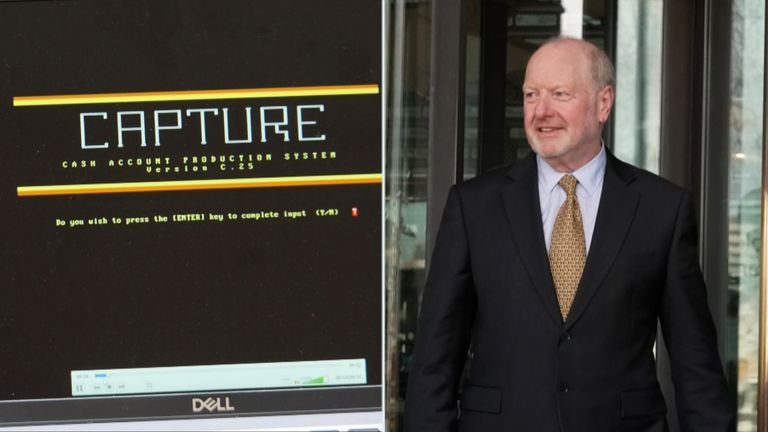
Alan Bates: New redress scheme ‘half-baked’
“It has become the last thing I think about before I go to sleep and the first thing when I wake up.
“We have waited 27 years for justice, and this additional wait feels never-ending.”
Ms Owen’s case is the first time a conviction based on Capture has reached the Court of Appeal since the scandal was exposed.
Read more from Sky News:
Corporate manslaughter charges considered in Post Office scandal
21 ‘Capture’ cases investigated for miscarriages of justice
Lawyers have said that if Ms Owen is exonerated posthumously, it may “speed up” the handling of others.
CCRC chair Dame Vera Baird also told Sky News in the summer it could be a “touchstone case” for other victims.
The CCRC is also continuing to investigate around 30 other “pre-Horizon” convictions.
A Post Office spokesperson said: “We have sought an extension of time to fully consider and respond to the CCRC’s Statement of Reasons in Ms Owen’s case.
“We deeply regret the impact our request for further time will have on Ms Owen’s family.
“We have a duty to carefully consider the evidence presented in the Statement of Reasons submitted by the CCRC and do everything we can to fully assist the Court when it considers this conviction.”
Meanwhile, the first-ever redress scheme for victims of the Post Office Capture IT scandal was launched this autumn.
The Capture Redress Scheme will provide payments of up to £300,000, and more in “exceptional” cases, to former postmasters who suffered financial losses.
-
 Sports2 years ago
Story injured on diving stop, exits Red Sox game
-
 Sports3 years ago
‘Storybook stuff’: Inside the night Bryce Harper sent the Phillies to the World Series
-
 Sports2 years ago
Game 1 of WS least-watched in recorded history
-
 Sports3 years ago
Button battles heat exhaustion in NASCAR debut
-
 Sports3 years ago
MLB Rank 2023: Ranking baseball’s top 100 players
-
Sports4 years ago
Team Europe easily wins 4th straight Laver Cup
-
 Environment3 years ago
Japan and South Korea have a lot at stake in a free and open South China Sea
-
 Environment1 year ago
Here are the best electric bikes you can buy at every price level in October 2024