
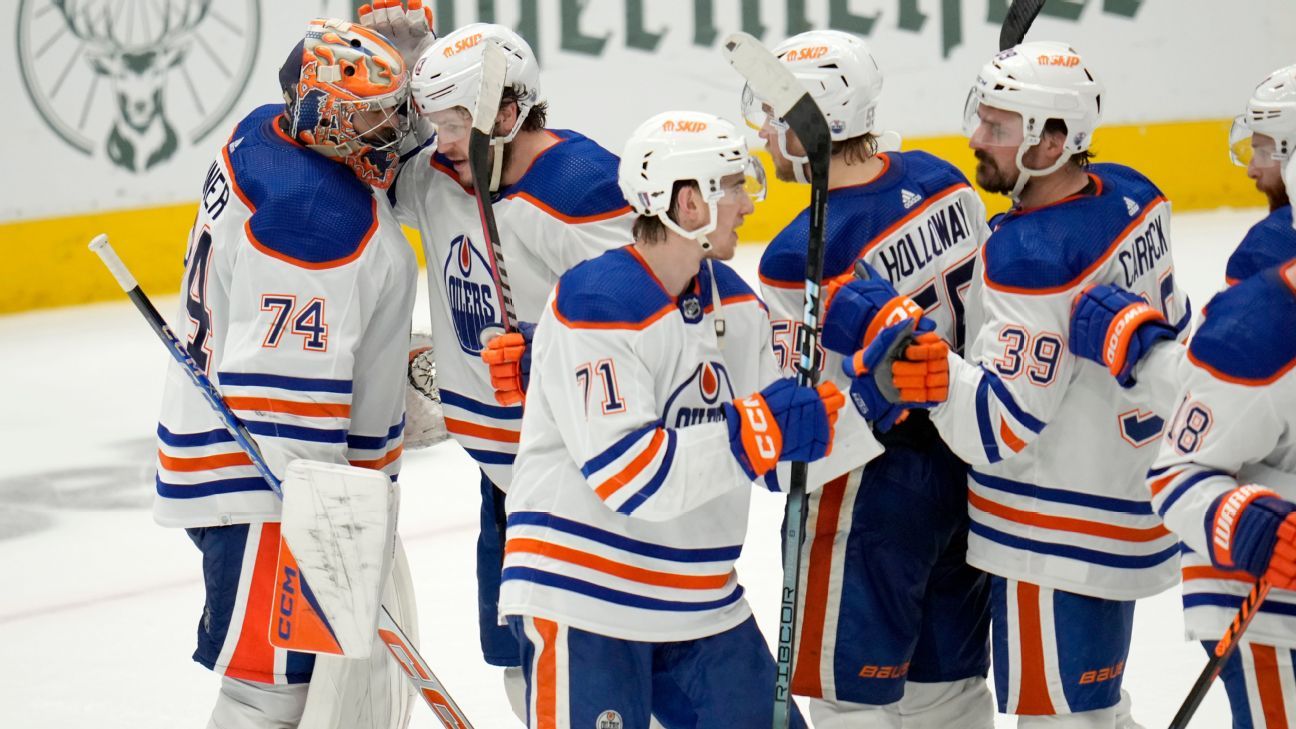
Oilers one win from Cup Final: Game 5 takeaways, early look at Game 6


-
Greg Wyshynski, ESPN
The Edmonton Oilers and Dallas Stars entered Game 5 in Dallas tied 2-2 in their Western Conference finals series. The Oilers beat the Stars 3-1 and will head home up 3-2 with a chance to end the series Sunday.
Here’s what stood out from Edmonton’s win and what to look for in Game 6, including key players for each team.


Oilers grade: A
Even the most optimistic supporters of the Edmonton Oilers in the Western Conference finals probably couldn’t have imagined they’d control play and out-defend the Dallas Stars like they did in Game 5. They limited the Stars to four shots on goal in the first period. Dallas went 9:43 without a shot on goal in the second period.
The Oilers were solid in all three zones, got their killer instinct back on the power play and got every save they needed out of Stuart Skinner, who had one of his best games of the postseason.
They squandered a chance to win Game 5 against Vancouver after building a lead. As they’ve done throughout the playoffs, they learned from their mistakes. “You can’t play decent, you can’t play good — you have to play great and you have to do it for a longer period of time than the opposing team were doing it,” defenseman Mattias Ekholm said.
0:37
Ryan Nugent-Hopkins slaps home his 2nd goal for Oilers
Ryan Nugent-Hopkins scores his second goal to pad the Oilers’ lead.

Stars grade: D+
Where was the intensity? The feeding off the crowd? The pushback after a Game 4 where the Oilers dominated, as Ekholm put it, for 52 minutes of a 60 minute game.
“The first two periods weren’t good enough. We have to generate more, obviously. And third period, we had some looks, but you’re down three by then,” said center Matt Duchene, who called the Stars’ offense “disjointed.”
Coach Pete DeBoer crudely pushed back when he believed a member of the media was questioning his team’s character after the loss. If only his players showed that much fire.
What we learned in Game 5
That one questionable call can change it all. With 6:09 left in the first period, Stars defenseman Ryan Suter gave Connor McDavid a shove from behind near the boards. McDavid hit the ice and the referee across the zone signaled for a penalty. It was a roughing call that might not rise to the level of a minor penalty in the playoffs.
The Oilers power play was 0-for-6 in the series heading into Game 5. All that meant was that they were due. It took 18 seconds for Ryan Nugent-Hopkins to score for the 1-0 lead. The Nuge struck again just 1:06 into the second period after Miro Heiskanen took a delay of game penalty for a 2-0 lead that sucked the wind out of the Stars’ sails — and their home crowd.
“If you’re going to draw a road game, that’s pretty much what you want to do, right?” DeBoer said. “They want to come out, get two power-play goals early in the game, get the lead and then defend well all night. So it’s tough to crack through.”
Players to watch in Game 6

Stuart Skinner. He got a lot of support from a terrific Edmonton defensive effort, but don’t sleep on how Skinner shut the door on the Stars in Game 5 with his 19-save effort.
He robbed Wyatt Johnston on the power play at the end of the second period and flashed his pad to stop a great Logan Stankoven chance later in the game.
He has quietly had a strong series, including 2.2 goals saved above expected in Game 1. He has given up two goals or fewer in four of the five games of the series. As the Stars face elimination, they have to find a way to solve Skinner. You read that correctly.
0:25
Stuart Skinner’s impressive save keeps the Stars scoreless in the 3rd
Oilers’ goalie Stuart Skinner denies the Stars to keep them scoreless in the third period.

Wyatt Johnston. The only player to beat Skinner in Game 5, Johnston now has 10 goals in the postseason for Dallas, four more than any teammate.
The second-year forward has a knack for postseason heroics and the Stars could certainly use some with their back against the wall. A power-play goal would be nice, as Dallas is 0-for-11 in the series with the man advantage.
How good has he been? Johnston became the fifth active player to score 10 goals in a playoff year at age 21 or younger, joining Sidney Crosby (15 in 2009), Nikita Kucherov (10 in 2015), Patrick Kane (10 in 2010) and Evgeni Malkin (10 in 2008).
Big question for Game 6: Can the Dallas offense find cohesion?
The Stars averaged 3.59 goals per game in the regular season. They’ve scored two goals or fewer in their three losses in the conference finals.
Duchene said the Stars aren’t playing as a five-man unit. “It looks like we were on our heels a little too much,” he said. “Sometimes when you want something so bad, you want to try and be too perfect.”
If the Stars can’t find that chemistry, they’ll have all summer to think about what happened to a very good offensive team.
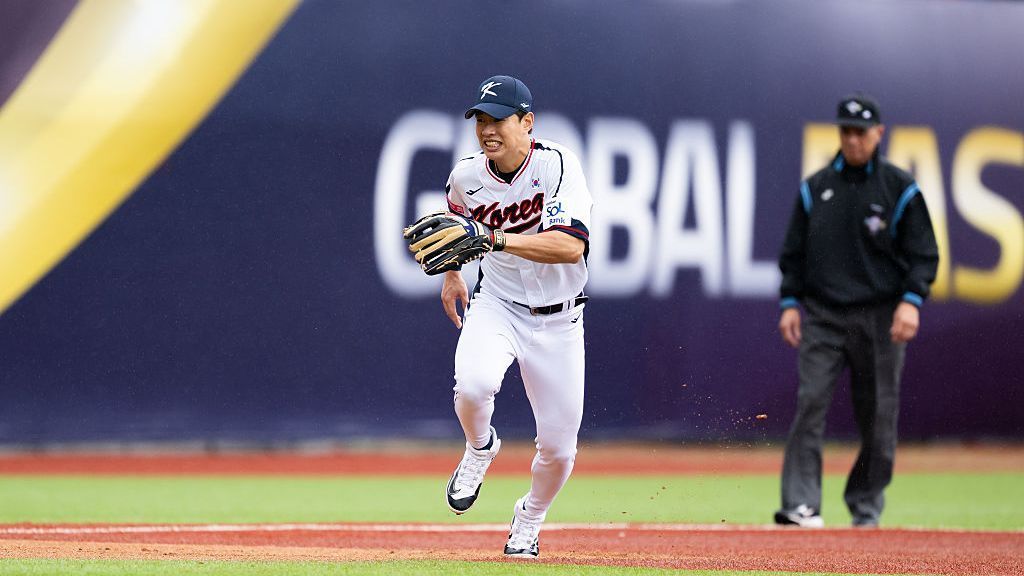

South Korean infielder Sung-mun Song and the San Diego Padres finalized a $15 million, four-year contract on Sunday.
Song will receive a $1 million signing bonus in two equal installments, in 30 days and on Jan. 15, 2027, and salaries of $2.5 million next year, $3 million in 2027 and $3.5 million in 2028.
Song’s deal includes a $4 million player option for 2029 and a $7 million mutual option for 2030 with a $1 million buyout.
If Song wins a Rookie of the Year award, his salary the following season would escalate by $1 million. If he finishes among the top five in MVP voting, his salary in all remaining years of the contract would increase by $1 million each.
He will be a free agent at the end of the contract, and the team will pay for an interpreter and round trip airline tickets from South Korea.
Song hit .315 with a career-high 26 homers and 90 RBIs this year for South Korea’s Kiwoom Heroes. Primarily a third baseman, the 29-year-old left-handed hitter has a .284 average with 80 homers and 454 RBIs in nine seasons with Nexen (2015, 2017-19) and Kiwoom (2021-25).
Under MLB’s posting agreement with the Korean Baseball Organization League, the Padres will pay the Heroes a $3 million posting fee. San Diego would owe a supplemental fee of 15% of any escalators triggered.
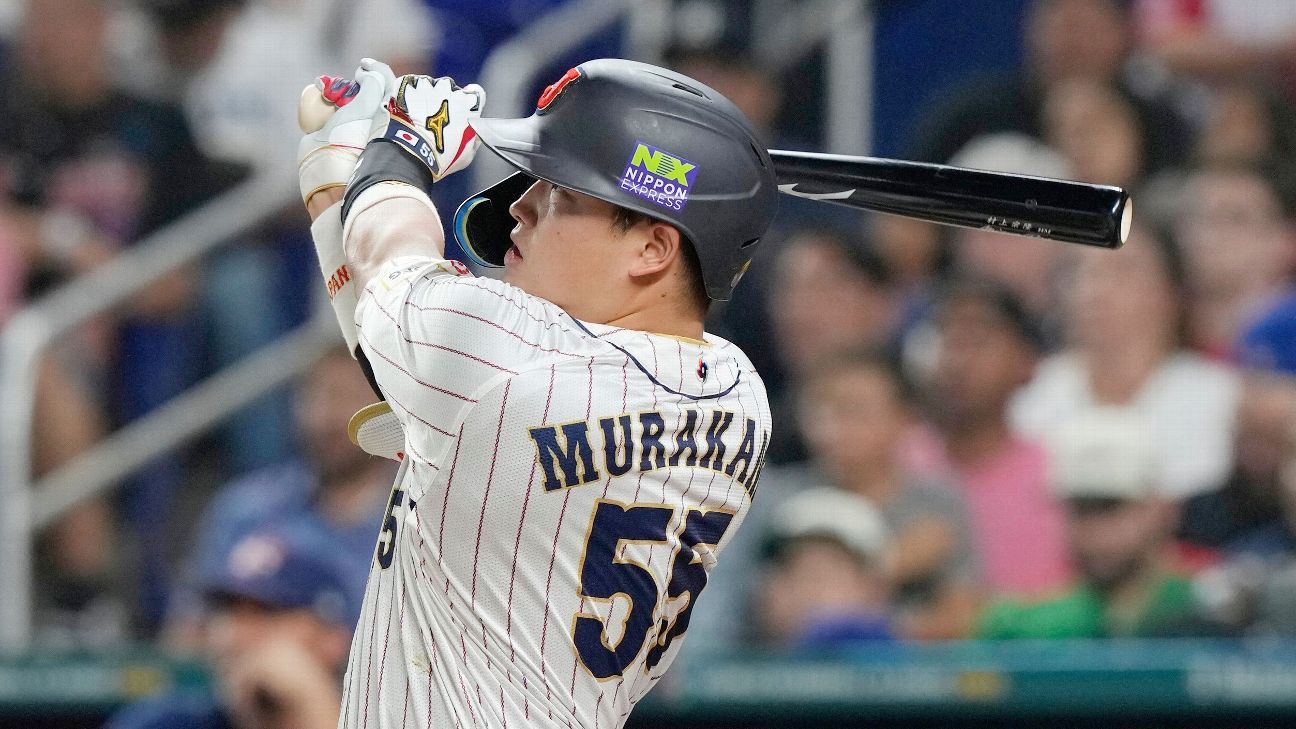

Japanese slugger Munetaka Murakami is joining the Chicago White Sox, landing the home run record-setter in Nippon Professional Baseball with a rebuilding team making its first free agent splash in years.
The White Sox announced Murakami’s addition Sunday, with sources telling ESPN the sides agreed on a two-year, $34 million contract.
Murakami, 25, was arguably the most fascinating player to hit free agency this winter. A 6-foot-2, 230-pound left-handed slugger with elite exit velocity, he was the youngest player on the market, and he now heads to Major League Baseball with 246 home runs in his eight seasons for the Tokyo Yakult Swallows.
He has been a star in Japan since he hit 36 home runs as a 19-year-old in 2019. He followed that up with 56 home runs in 2022, breaking the record for a Japan-born player set in 1964 by Sadaharu Oh. Murakami, a two-time Central League MVP, missed time last season with an oblique injury but hit 22 home runs in 56 games with a .273/.379/.663 slash line.
While projections for Murakami to hit a financial jackpot preceded his free agency, concerns about his defense — he can play third base or first base — and his propensity to swing and miss at pitches in the zone caused a slower market than anticipated ahead of his 5 p.m. ET Monday deadline to sign.
Though teams tried to get in for lower-dollar long-term deals, Murakami opted for a higher-dollar short-term offering, allowing himself to prove his ability to adjust to superior MLB pitching.
Should he do so, Murakami would hit the market again at 27 and be primed to cash in on a megadeal, similar to how other free agents in recent seasons with softer-than-expected markets parlayed short-term contracts into long-term paydays.
The leap in Murakami’s strikeout rate over the past three years (over 28% each season) and his 72.6% in-zone contact rate (would have been second lowest in MLB this year) illustrate the potential downside in his offensive game. But San Francisco Giants slugger Rafael Devers remains productive with a high whiff rate, and Chicago saw the opportunity to bring in the sort of talent it typically does not have access to with a low payroll and a prospect-hoarding mentality.
Murakami’s 90th-percentile exit velocity would have been fifth in MLB, his maximum exit velocity 12th and his hard-hit rate first. For a White Sox team two years removed from the most losses in MLB history, adding Murakami to a lineup that includes promising young hitters in shortstop Colson Montgomery, catchers Kyle Teel and Edgar Quero, infielder Miguel Vargas, and second baseman Chase Meidroth brings even more hope after winning the draft lottery at the winter meetings.
The overwhelming favorite to go No. 1 in the July draft is UCLA shortstop Roch Cholowsky, giving the White Sox a potential abundance of young infielders in the coming years.
Whether Murakami is manning first or third, he will be in the middle of a White Sox lineup in desperate need of power. With 165 home runs last season, the White Sox finished 14th of 15 American League teams, just ahead of the Kansas City Royals. In his eight seasons with the Swallows following his debut as an 18-year-old, Murakami hit .270/.394/.557 with a walk rate of greater than 16% and a strikeout rate nearing 26%.
Highlight reels of his home runs have long circulated on the internet in anticipation of Murakami’s arrival in MLB. He played a vital role in Japan’s victory in the 2023 World Baseball Classic, hammering a game-winning two-run double in the ninth inning of a semifinal win against Mexico.
Chicago saw that version of Murakami and will add him to perhaps the most uniquely constructed roster in baseball, with five players signed — Murakami, Luis Robert Jr. ($20 million), Andrew Benintendi ($17.1 million), Anthony Kay ($5 million) and Derek Hill ($900,000) — none eligible for arbitration and the remainder making around the major league minimum.
Murakami’s deal will cost the White Sox $40.575 million in total, with the Swallows receiving a $6.575 million posting fee to transfer him to Chicago.
ESPN’s Kiley McDaniel contributed to this report.
-
 Sports2 years ago
Story injured on diving stop, exits Red Sox game
-
 Sports3 years ago
‘Storybook stuff’: Inside the night Bryce Harper sent the Phillies to the World Series
-
 Sports2 years ago
Game 1 of WS least-watched in recorded history
-
 Sports3 years ago
Button battles heat exhaustion in NASCAR debut
-
 Sports3 years ago
MLB Rank 2023: Ranking baseball’s top 100 players
-
Sports4 years ago
Team Europe easily wins 4th straight Laver Cup
-
 Environment3 years ago
Japan and South Korea have a lot at stake in a free and open South China Sea
-
 Environment1 year ago
Here are the best electric bikes you can buy at every price level in October 2024