

Hyundai teases its new INSTER EV for the first time, the latest affordable electric car

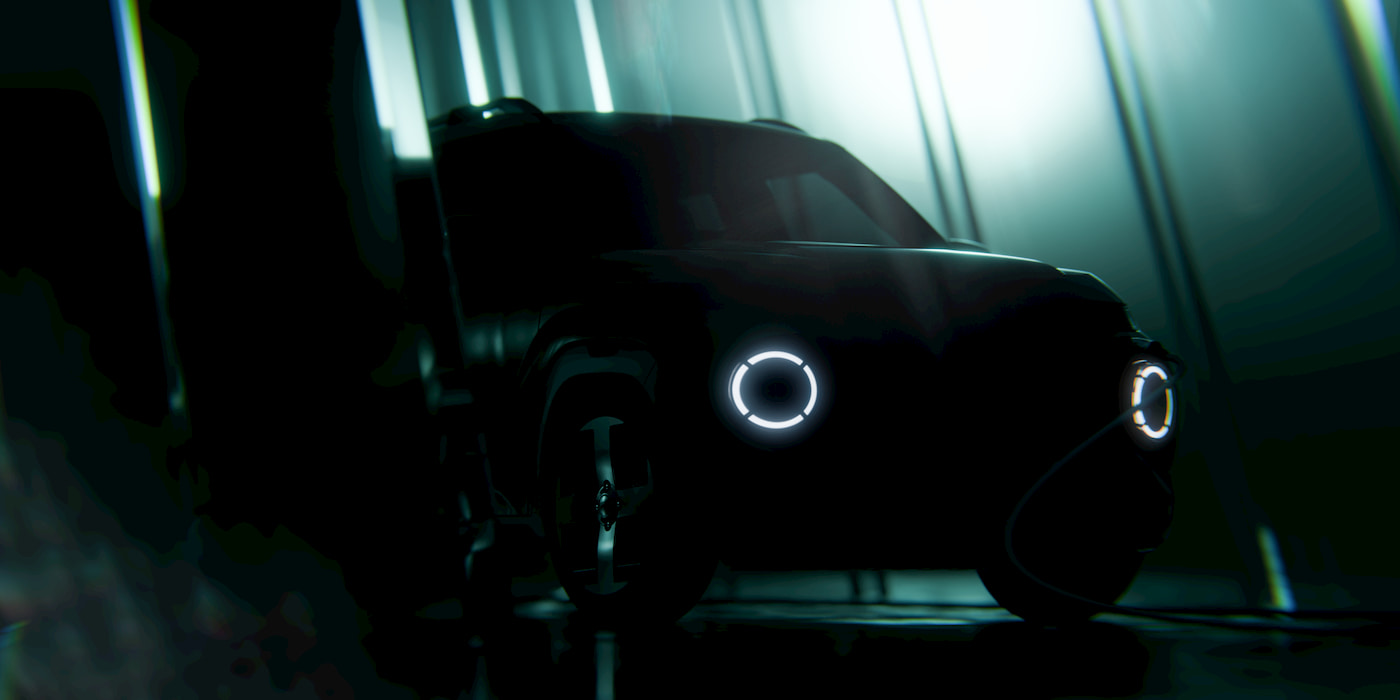
A new low-cost Hyundai EV will be revealed later this month. Hyundai is teasing the first images of its new INSTER EV ahead of its official debut at the Busan International Mobility Show. The all-electric city car is expected to be the latest affordable EV to hit the market, but will it make it to the US?
Hyundai is off to a hot start in 2024. Last month, Hyundai sold over 17,000 EVs globally, maintaining its momentum.
In the US, Hyundai is chipping away at Tesla’s (wide) lead in the EV market. Hyundai Motor, including Kia, accounted for 11.2% of the US EV market through May. According to data from the Korean Automobile & Mobility Association, Hyundai Motor has sold 48,383 EVs in the US through the first five months of 2024.
Tesla still holds a 40.5% lead over Hyundai in the US, but that gap has narrowed from nearly 53% last year.
Hyundai is building momentum in the US and globally with dedicated EVs based on its E-GMP platform.
Hyundai’s EVs, like the IONIQ 5 and IONIQ 6, offer over 300 miles range, fast charging capabilities in under 20 mins, and a sleek new design. Perhaps, most importantly, they are some of the most affordable and fuel-efficient available.
After releasing the first look at its new INSTER EV Tuesday, Hyundai is adding another all-electric vehicle to its lineup.

Hyundai teases the first look at its new INSTER EV
Hyundai dropped the first images of its new “A-segment sub-compact EV” Tuesday, the INSTER EV.
The Hyundai INSTER EV is an evolution of the gas-powered CASPER model sold in Korea. Hyundai claims the new electric car will “set new standards” in driving range, tech, and safety.

From the first look, you can see the INSTER EV takes influence from the CASPER but with a modern upgrade.
With Hyundai’s signature daytime running lights, plus added pixel graphic turn signals and tail lights, the INSTER is unmistakenly an EV (and a Hyundai).

Hyundai expects the new electric city car to feature up to 220 miles (355 km) WLTP range. Although prices are yet to be confirmed, with the gas-powered CASPER selling for under $15,000 in Korea, the new EV is expected to hit the market with an affordable price tag.
Although demand for affordable EVs is climbing in the US, it’s unclear if Hyundai will bring the INSTER to the states yet.

With production at its first EV and battery plant in the US expected to start later this year, Hyundai could make the move. With Kia’s EV3 set to hit the market, Hyundai may consider launching the low-cost electric car to rival it in the US. Kia’s EV3 is expected to start at around $30,000 to $35,000.
Volkswagen also just finished design work on its affordable ID. 2 all-electric car, which is expected to debut later this year starting around $27,000 (€25,000).
Check back for more info as Hyundai’s new electric car will make its official global debut at the Busan International Mobility Show, starting June 27, 2024.
FTC: We use income earning auto affiliate links. More.


I recently attended Strutt’s Demo Day to check out the company’s new EV1 mobility device, and even if you’ve never paid attention to electric wheelchairs before, you’ll still probably find this interesting.
The EV1 isn’t really a wheelchair in the traditional sense. It’s closer to an autonomous robot that just happens to take the form of a chair. Imagine a self-driving car fused with a humanoid robot, shrunk down to indoor-outdoor mobility scale. That’s the EV1. And after having spent some seat time in it, I can tell you that this technology is going to change lives.
This isn’t my normal scene – you’re much more likely to see me testing out wild new e-bikes or powerful electric motorcycles. But I was intrigued by the idea of a new type of electric mobility device that had the potential to change not just the way people get around, but the way they live. And I’m glad I followed that hunch and visited Strutt’s Demo Day.
If you want to experience the demos and live testing yourself, or rather vicariously through me, then check out my video below. It’s a fascinating experience.
Then keep reading for my complete thoughts.
At its core, the EV1 is a mobility device that can drive itself and think for itself. But the level of tech onboard goes far beyond basic autonomy. It uses a full suite of sensors – lidar, vision cameras, ultrasonic sensors, and more – to constantly map its environment.
As the engineers explained to us, it’s actually a much trickier problem to solve than a self-driving car like Waymo, since self-driving cars generally stick to the simplified world of car lanes. But a mobility device needs to be able to autonomously navigate everything from a packed shopping mall to a grassy park path to the livingroom – all without accidentally driving itself down the stairs or over the family dog. That means the EV1 gets an array of overlapping sensors that would make a Tesla jealous.
And despite all that tech, the entire machine breaks down into five major pieces without tools, without unplugging wires, and without any fuss. In about 30 seconds, it’s ready to be lifted into the trunk of a car. Or for those with a vehicle large enough, it can just drive itself up the ramp and park itself in a vehicle all by itself.
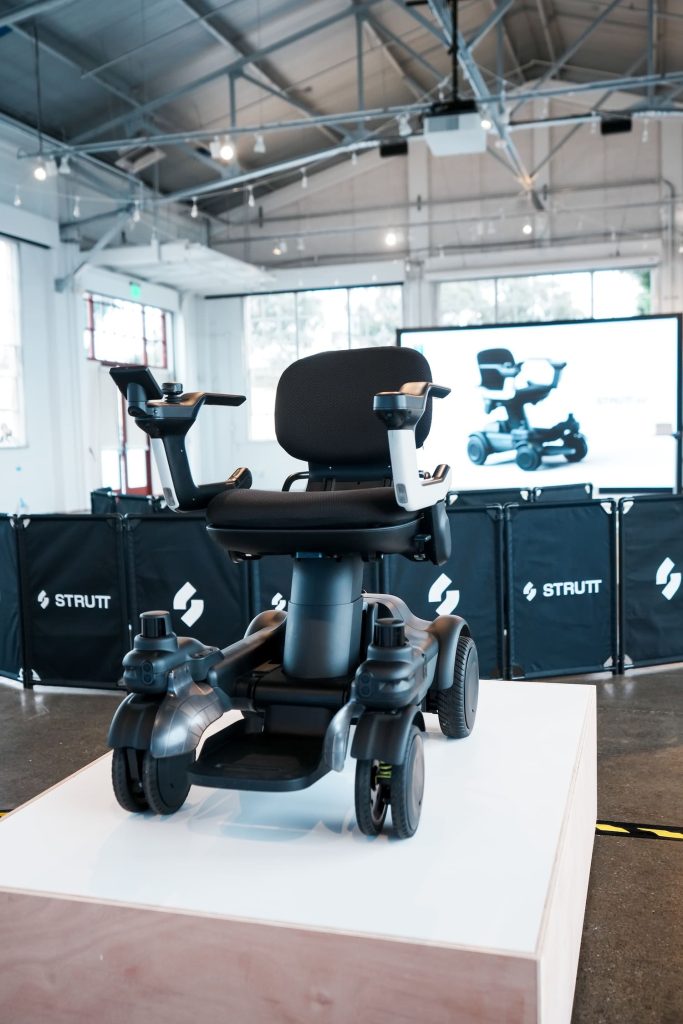
It also includes built-in AI navigation. You can literally tell it where you want to go, like asking it to take you into the kitchen to grab a drink, and it will plan the route and drive you to your fridge. That may sound like a demo-party gimmick until you consider how transformative it could be for people who currently have to navigate narrow, cluttered, or inaccessible spaces by carefully inching forward with both hands on a joystick. Hands-free indoor navigation could be a game changer.
You can even tap a location on the live-view map shown on the display and the EV1 will just start taking you there, completely hands-free. Or you can summon it from another room, for example if you’re sleeping in bed and need the chair to come pick you up in the bedroom. This is autonomous driving on another level.
There’s also a mode called Co-Pilot, which lets the user take control to navigate themselves, but will constantly monitor for obstacles and make corrections if the user is about to hit something. For example, you can drive right through a narrow doorway without worrying about precision steering, since it won’t let you graze the edges of the door frame (and if you’ve ever seen the doorframes in the home of a wheelchair user, you’ll know what a game changer that would be).
Strutt demonstrated this mode by having a user blindfolded while driving through a curved hallway. He was simply pressing forward on the controls, but the EV1 smoothly followed a curved path on its own instead of letting him run into the wall when it began to curve. I tried it myself, and it’s uncanny how natural it feels.
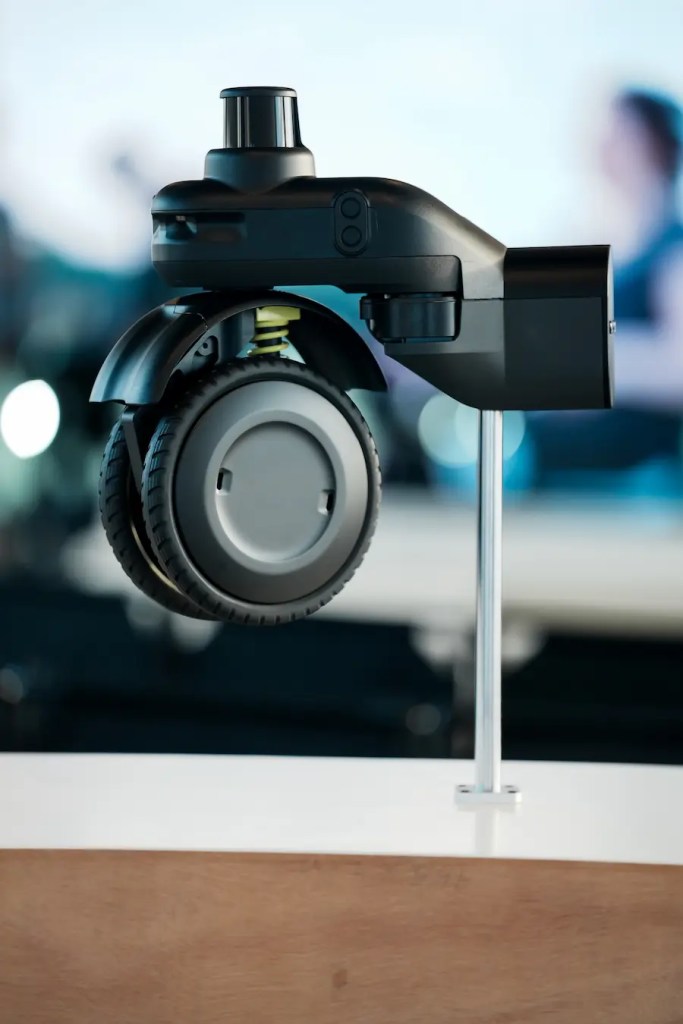
But the EV1 isn’t limited to indoor environments. Strutt built in several clever innovations that make it surprisingly capable off pavement. There’s real suspension. The front wheels are actually dual wheels, helping them roll over gaps and rails such as those found in city trolley systems. Those same front wheels aren’t passive casters; they each have their own motors, giving the EV1 proper power steering instead of relying on tank-turning from the rear wheels. It drives like something purpose-built rather than hacked together. And that allows it to handle terrain and inclines not possible from other devices, such as off-camber turns that would send others sliding sideways down an incline.

During the demo, I asked if I could take the EV1 outside the fancy exhibition hall to see how it handled the real world. As I approached the door, trying to figure out how to open it while driving through at the same time, one of the Strutt staff told me, “Just ram it.”
I hesitated, worried I’d scratch up their expensive prototype, but he assured me it would be fine. Turns out, it was very fine. Then I remembered the clip in the presentation they shared of the EV1 towing a Tesla with a tow strap, so I guess the power was never really going to be an issue.
Speed-wise, Strutt had the units limited to 12 km/h (7.5 mph), but even at that speed they feel legitimately fast. Fast enough, in fact, that I switched into manual mode to really get a feel for it.
With a bunch of YouTubers flying around in fancy electric mobility devices, you can imagine that a drag race pretty quickly materialized. I won’t tell you who won, you’ll have to watch the video above to see. But let’s just say that my putting it in manual override mode to remove all the safety features temporarily might have been a dirty trick that gave me an advantage.

All the while, though, I found myself ping-ponging emotionally. On one hand, I’m having a blast riding a futuristic robot-chair hybrid. On the other hand, I’m constantly reminded that for many people, devices like this aren’t toys – they’re essential tools that allow them to navigate a world that wasn’t built for them. Many of the very people who helped Strutt beta test the device during development were there at the presentation, EV1), it was also a stark reminder that while I’m goofing off racing these things, this is technology meant to help people that need it in order to navigate a world not designed for them.
But maybe those two feelings don’t have to be in conflict. Why shouldn’t a device that empowers people also be enjoyable to use? Why can’t a life-changing device like this bring more than just mobility? Why can’t it actually be… fun? I’ve never looked at a mobility chair and thought it looked like a blast to use. This one genuinely is!

But the last bit here that will be critical, and something we just don’t yet know yet, is what it will cost. Considering traditional powered wheelchairs already run a few thousand dollars for relatively clunky designs, this level of advanced robotics likely won’t come cheap.
Strutt says pricing will be revealed early next year, and has just launched an early reservation program offering 35% off the first 200 units (more info in their Facebook group here). Hopefully the final price ends up within reach for the people who most need it. And like many early-stage technologies, costs will likely come down over time as production scales.
For now, though, the EV1 represents something new in mobility: a device that’s powerful, capable, intuitive, and – unexpectedly – pretty darn fun.


FTC: We use income earning auto affiliate links. More.
Environment
Putin says Russia is willing to supply ‘uninterrupted’ fuel to India, as U.S. pressures New Delhi to cut back


Russian President Vladimir Putin is welcomed by Indian Prime Minister Narendra Modi upon arrival at the Palam Air Base in New Delhi, India December 4, 2025.
Grigory Sysoev | Via Reuters
Russian President Vladimir Putin has underlined Moscow’s willingness to provide “uninterrupted shipments of fuel” to India, as the U.S. pressures New Delhi to give up importing their oil.
Putin made the offer during a joint address with Indian Prime Minister Narendra Modi on Friday, part of his first visit to the country since Russia’s full-scale invasion of Ukraine in 2022, which triggered widespread sanctions.
The sanctions forced Russia to seek new customers for its exports. India has become the second biggest buyer of Russian crude oil, after China, with a report Finland-based Centre for Research on Energy and Clean Air showing India bought 38% of Russian crude exports in October.
In October, President Donald Trump sanctioned two of Russia’s largest oil companies, Rosneft and Lukoil. This followed a tariff of 25% on India for buying Russian oil in August. But India has to walk a tightrope because it has close ties to the U.S. while also relying on Russia for fuel and access to military hardware.
Putin questioned U.S. pressure on India in an interview to an Indian television channel on Thursday.
The United States still buys nuclear fuel from Russia for its own nuclear power plants, Putin said in the interview, adding: “If the U.S. has the right to buy our fuel, why shouldn’t India have the same privilege?”
While Trump has acknowledged that India has cut back its Russian oil imports, experts told CNBC that this may be a temporary trend.
Apart from crude oil, Russia’s Rosatom is also delivering reactors and reportedly fuel for India’s Kudankulam nuclear power plant in Tamil Nadu, which has a combined capacity of 6000MW.
India and Russia have an energy partnership, the Russian president said, adding that Moscow had been is reliable supplier of “oil, gas, coal and everything that is required for the development of India’s energy”.
Last month, India announced a “historic deal” with Washington, in which Indian state-owned oil companies signed a one-year deal to import around 2.2 million tonnes per annum of liquefied petroleum gas from the U.S.

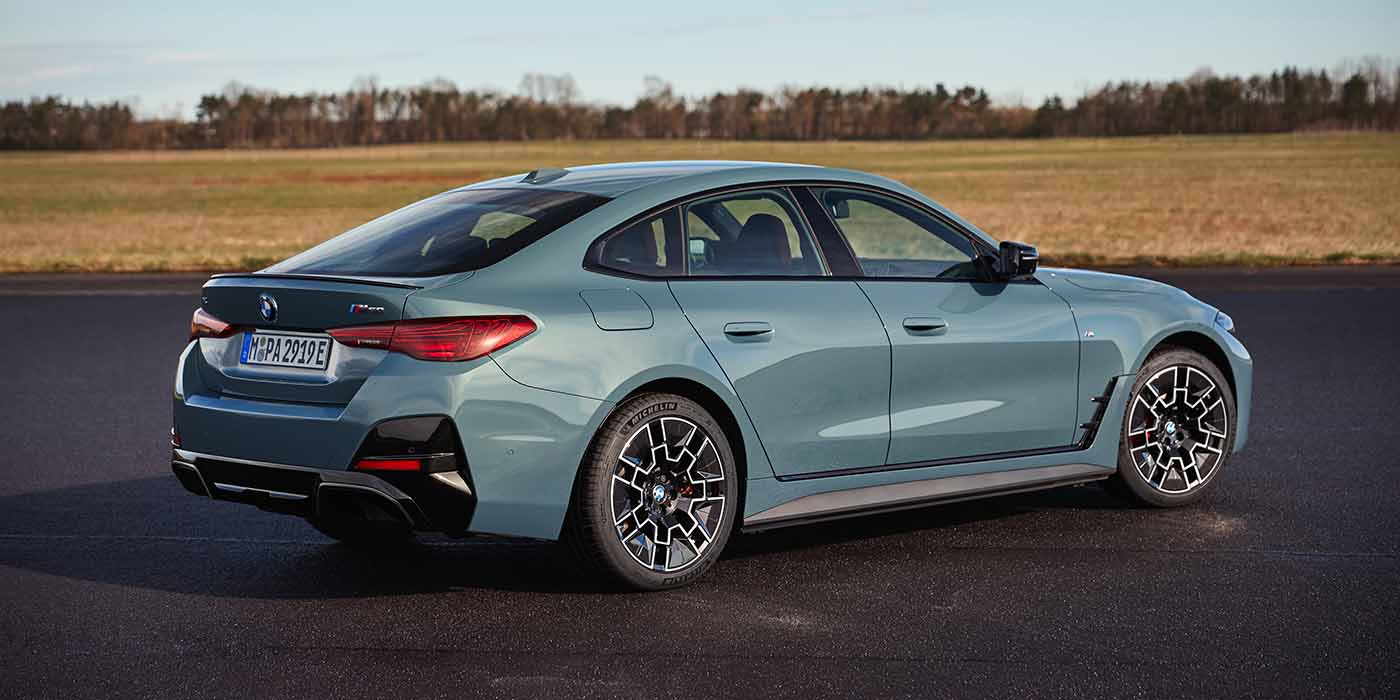
Yes, Virginia, there are still great EV lease deals to be had in December. Hyundai continues to offer EV leases for under $200 a month, and the BMW i4 can be leased for the same price it was when the federal tax credit was still in effect. With 2025 models disappearing fast, this might be your last shot to snag a year-end lease deal on an EV. Check out the standouts below.
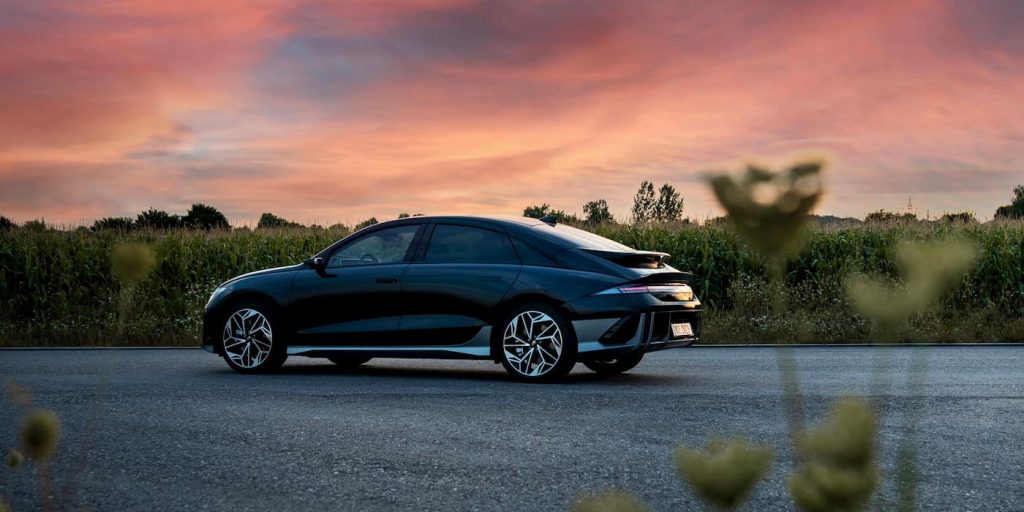
2025 Hyundai IONIQ 6 lease from $189/month
The 2025 Hyundai IONIQ 6 remains a fantastic deal: the IONIQ 6 SE Standard Range can be leased from $189 per month for 24 months with a $3,999 due at signing (12,000 miles per year). Its effective cost is just $356, and this month’s IONIQ 6 SE lease includes $13,000 in lease cash that you can’t get elsewhere. The offer is good until January 2.
Our friends at CarsDirect report that the SEL trim is actually a better deal at $239 with $3,999 at signing, with an effective cost of $406. Even though its MSRP is over $7,700 higher than the SE, it’s just $50 more a month to lease. The SE Standard Range has a range of 240 miles, whereas other styles have a range of up to 342.
As usual, offers vary according to location, and this is a regional offer based in California.
Click here to find a local dealer that may have the Hyundai IONIQ 6 in stock. –trusted affiliate link

2025 Hyundai IONIQ 5 lease from $189/month
Believe it or not, the 2025 Hyundai IONIQ 5 SE Standard Range RWD, which starts at $44,200, can still be leased through January 2 for $189 a month for 36 months (10,000 miles per year) with $3,999 due at signing. That works out to an effective monthly cost of about $300.
The IONIQ 5 SE RWD Standard Range offers an EPA-estimated 245 miles of range, and this particular offer is available in the Los Angeles and greater California metro areas (I’ve seen it at dealers in Carlsbad and Santa Monica, for example). And if you’re tempted by an upgrade, the SEL RWD trim is just $50 more per month under the same terms.
Click here to find a local dealer that may have the Hyundai IONIQ 5 in stock. –trusted affiliate link
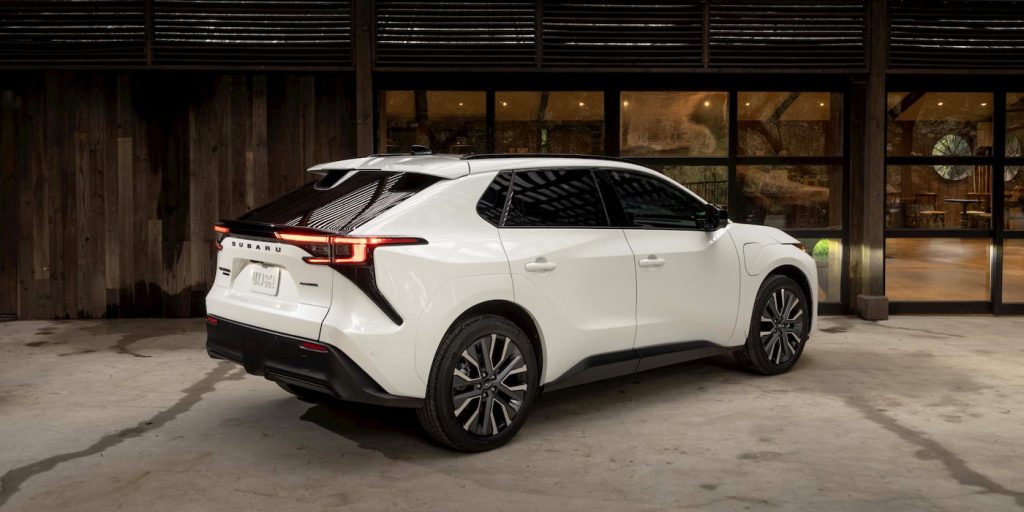
2026 Subaru Solterra 5 lease from $299/month
In several regions, the 2026 Subaru Solterra Premium can be leased for $299 per month for 36 months, with a down payment of $2,799 due at signing, resulting in an effective monthly cost of $377. That makes it $95 per month cheaper to lease than a 2026 Toyota bZ, which is $472. (These figures are for California.)
A $500 loyalty discount is available to returning lessees. It doesn’t require a trade-in and can be transferred to household members. If you factor in the loyalty discount, the Solterra’s effective cost drops to $363. The offer ends January 2.
Subaru’s advertised lease prices are based on 10,000 miles a year, but that’s changeable. However, a larger mileage allowance will lower the EV’s residual value, making it more expensive.
Click here to find a local dealer that may have the Subaru Solterra in stock. –trusted affiliate link
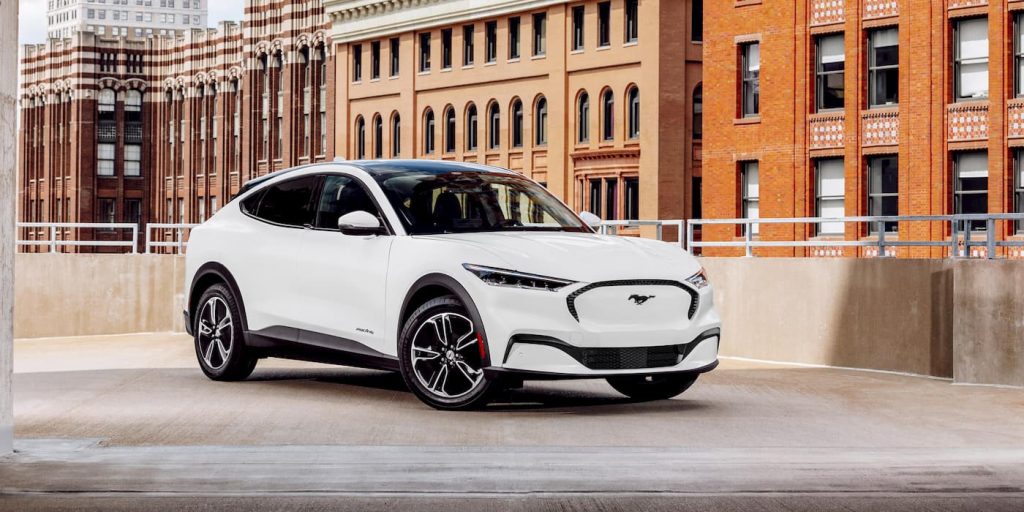
2025 Ford Mustang Mach-E from $219/month
The 2025 Ford Mustang Mach-E can still be leased for $219 per month for 24 months with a $4,499 due at signing (10,500 miles per year) until January 5. In this configuration, the Mach-E has a range of up to 300 miles.
This is a regional offer for California, but the great deal isn’t limited to just that state. The example includes a total of $8,750 in lease cash; however, the catch is that if you opt for the lease cash, you have to decline the free home charger with installation or Ford’s $2,000 public charging credit.
Click here to find a local dealer that may have the Ford Mustang Mach-E in stock. –trusted affiliate link
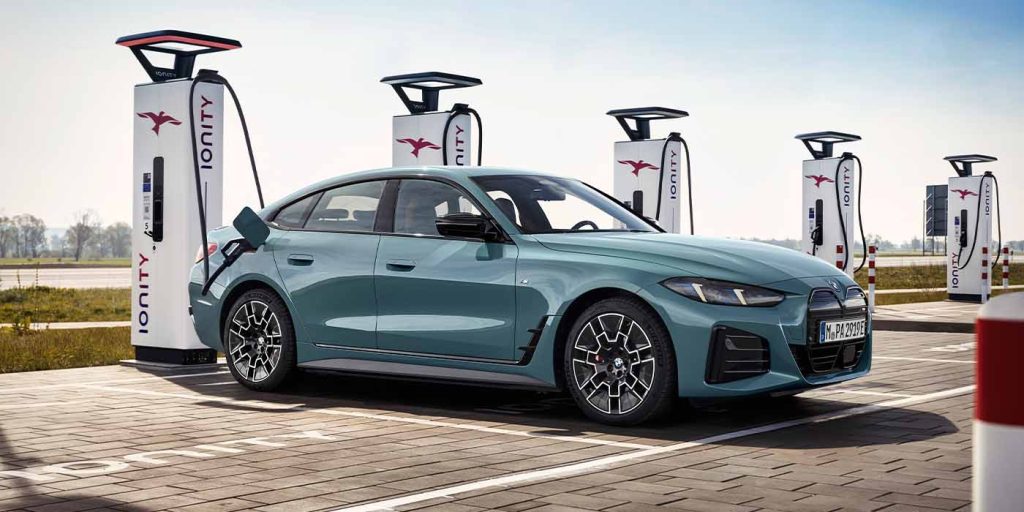
2025 BMW i4 from $399/month
Remarkably, the 2025 BMW i4 is still leasing for the same price as it was when the federal tax credit was still in effect. In many regions, the eDrive40 can be leased for $399 for 36 months with $4,999 due at signing (10,000 miles per year). Its effective cost is just $538 per month, which is impressive when you consider that the i4’s retail price is over $60,000.
The offer, available until January 2, includes a $7,500 lease credit, and a $1,000 loyalty discount is also available for returning lessees. With the loyalty bonus, the i4’s effective monthly cost could be as low as $510.
In this configuration, the i4 has an EPA-estimated range of 318 miles. As before, BMW’s lease includes two years or 1,000 kWh of free charging with Electrify America.
Click here to find a local dealer that may have the BMW i4 in stock. –trusted affiliate link

The 30% federal solar tax credit is ending this year. If you’ve ever considered going solar, now’s the time to act. To make sure you find a trusted, reliable solar installer near you that offers competitive pricing, check out EnergySage, a free service that makes it easy for you to go solar. It has hundreds of pre-vetted solar installers competing for your business, ensuring you get high-quality solutions and save 20-30% compared to going it alone. Plus, it’s free to use, and you won’t get sales calls until you select an installer and share your phone number with them.
Your personalized solar quotes are easy to compare online and you’ll get access to unbiased Energy Advisors to help you every step of the way. Get started here.
FTC: We use income earning auto affiliate links. More.
-
 Sports2 years ago
Story injured on diving stop, exits Red Sox game
-
 Sports3 years ago
‘Storybook stuff’: Inside the night Bryce Harper sent the Phillies to the World Series
-
 Sports2 years ago
Game 1 of WS least-watched in recorded history
-
 Sports3 years ago
Button battles heat exhaustion in NASCAR debut
-
 Sports3 years ago
MLB Rank 2023: Ranking baseball’s top 100 players
-
Sports4 years ago
Team Europe easily wins 4th straight Laver Cup
-
 Environment3 years ago
Japan and South Korea have a lot at stake in a free and open South China Sea
-
 Environment1 year ago
Here are the best electric bikes you can buy at every price level in October 2024