
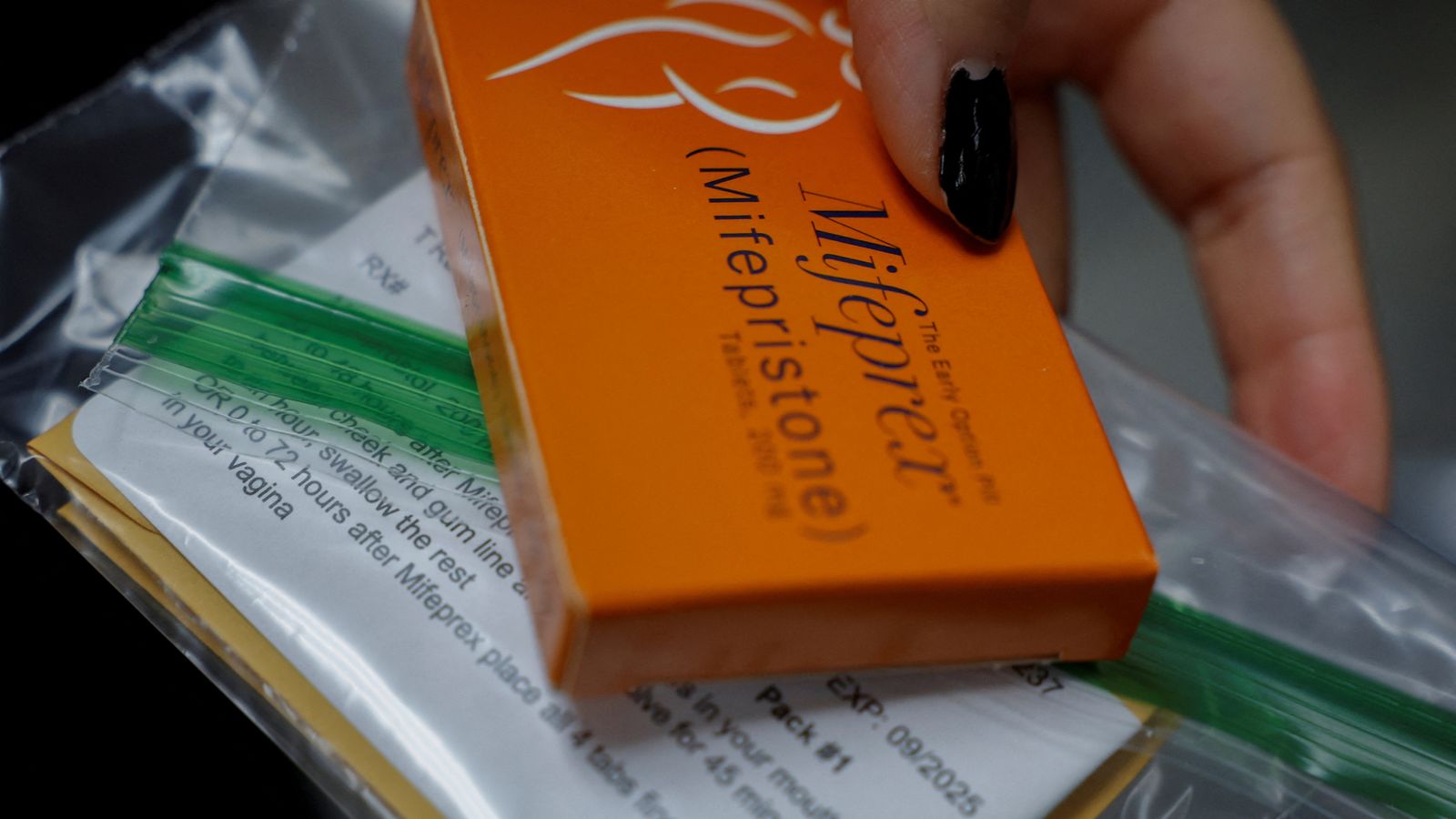
US Supreme Court rejects bid to restrict access to abortion pill mifepristone

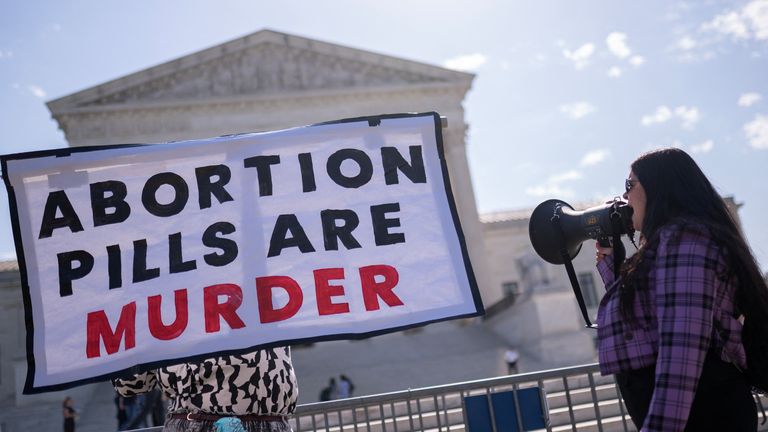
Americans will still be able to buy an abortion pill after the US Supreme Court threw out a bid by campaign groups to restrict access to it.
The decision was made by the same court that two years ago overturned Roe v Wade – which had previously given women rights to terminate a pregnancy.
The drug – mifepristone – was first approved by the Food and Drug Administration (FDA) in September 2000 for medical termination up to seven weeks into pregnancy, extended to 10 weeks in 2016.
It was ruled the plaintiffs behind the lawsuit challenging mifepristone lacked the necessary legal standing to pursue the case, which required they show they have been harmed in a way that can be traced to the FDA.
The plaintiffs wanted an end to rules introduced in 2016 and 2021 that permitted medication abortions at up to 10 weeks of pregnancy instead of seven, and for mail delivery of the drug without a woman first seeing a doctor in-person.
The suit initially had sought to reverse FDA approval of mifepristone, but that aspect was thrown out by a lower court.
Mifepristone is taken with another drug called misoprostol to perform medication abortions – now the most common method of terminating pregnancies in the US.
Read more: Why were there calls to ban abortion drug?
Anti-abortion activists outside the Supreme Court in April 2023. Pic: Reuters
The FDA said that after decades of use by millions of women in the US and around the world, mifepristone has proven “extremely safe” and that studies have demonstrated that “serious adverse events are exceedingly rare”.
The plaintiffs, known as the Alliance for Hippocratic Medicine, argued the FDA acted contrary to its mandate to ensure medications are safe when it eased the restrictions on mifepristone.
They also accused the administration of violating a federal law governing the actions of regulatory agencies.
US District Judge Matthew Kacsmaryk broadly sided with them in a 2023 decision that would have effectively pulled the pill off the market.
Read more on Sky News:
What’s changed since Roe v Wade decision was overturned?
However, after the FDA appealed, the New Orleans-based 5th US Circuit Court of Appeals did not go as far as Kacsmaryk but still ruled against its move to widen access to the pill.
This decision was placed on hold pending the Supreme Court’s review.
The plaintiffs said they had legal standing to sue because their member doctors would be forced to violate their consciences due to “often be called upon to treat abortion-drug complications” in emergency settings.
The Justice Department said these claims relied on an impermissibly speculative chain of events.
Following the decision, Joe Biden said in a statement: “Today’s decision does not change the fact that the fight for reproductive freedom continues.
“It does not change the fact that the Supreme Court overturned Roe v Wade two years ago, and women lost a fundamental freedom.
“It does not change the fact that the right for a woman to get the treatment she needs is imperiled if not impossible in many states.”
Keep up with all the latest news from the UK and around the world by following Sky News
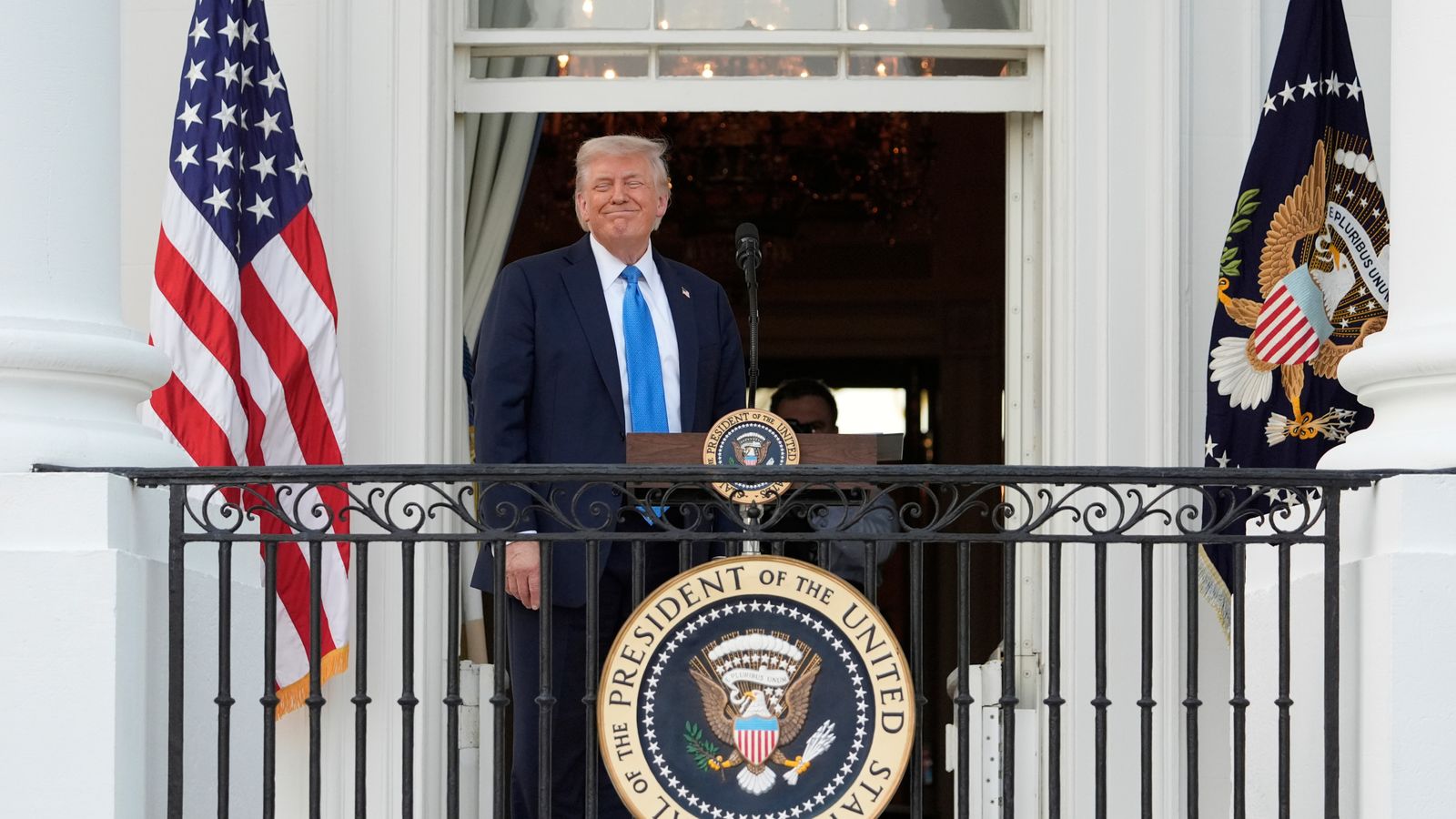
Meanwhile, Mr Trump – speaking at a campaign event – acknowledged the issue had cost Republicans and that it is too important to ignore.
The presidential hopeful said it was his preference for the decision to be made by the people and individual states.
The mifepristone dispute is not the only abortion case the Supreme Court is due to decide during this presidential election year.
It also is expected to rule by the end of June on the legality of Idaho’s strict Republican-backed abortion ban that forbids terminating a pregnancy even if necessary to protect the health of a pregnant woman facing a medical emergency.
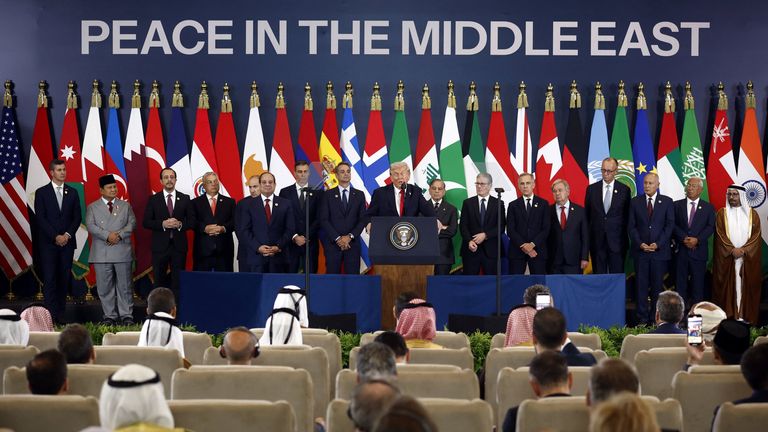
President Trump’s “America First” agenda has been spelt out in a new White House National Security Strategy that should make stark reading for allies and foes of the United States alike.
The new 33-page document outlines an upending of American foreign policy objectives and priorities which have stood largely unchanged through different administrations stretching back decades.
The document says American strategy went “astray” over many years. It seeks to reframe America’s strategic interests as being far narrower now than at any time in its modern history.
Among the key points, the document says:
• Europe faces “civilizational erasure” and could be “unrecognisable in 20 years or less”
• “Certain NATO members will become majority non-European” within a few decades
• America will “shift away” from the “burden” of the Middle East seeing it now as a “source and destination of international investment”
• In the Western hemisphere, America should pursue a policy of “enlist and expand… restoring American pre-eminence”
• In Africa, American policy focus should be on trade not “providing and spreading liberal ideology”
America will ‘shift away’ from the ‘burden’ of the Middle East. Pic: Reuters
In black-and-white, the text articulates a dramatic strategic shift which has been playing out at lightning speed over the past year.
The document underlines the end of the concept of America as an arbiter of the democratic rules-based order.
“American foreign policy elites convinced themselves that permanent American domination of the entire world was in the best interests of our country. Yet the affairs of other countries are our concern only if their activities directly threaten our interests,” the paper says.
Every US administration publishes at least one National Security Strategy during a presidential term.
The focus of this one is starkly different from that published by President Biden in 2022.
It’s also notably different from the document which President Trump published during his first term. His 2017 paper cast the world as a contest between “repressive regimes” and “free societies”.
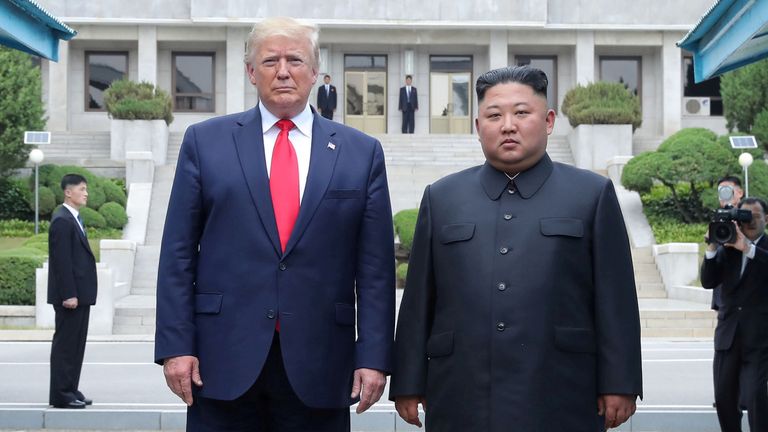
Trump doesn’t want the US to be the arbiter of the democratic rules-based order. Pic: Reuters
This new one places the necessity to do trade above the imposition of values.
“We seek good relations and peaceful commercial relations with the nations of the world without imposing on them democratic or other social change that differs widely from their traditions and histories.”
Mass migration and Europe
The new document is highly critical of mass migration.
It warns that uncontrolled migration is destroying the concept of nation states which could impact America’s strategic alliances and the countries it counts as reliable allies.
The paper is particularly critical of Europe, of the European Union as a concept and of individual European nations.
“Should present trends continue, the continent will be unrecognizable in 20 years or less,” the paper says.
It continues: “As such, it is far from obvious whether certain European countries will have economies and militaries strong enough to remain reliable allies.
“Many of these nations are currently doubling down on their present path. We want Europe to remain European, to regain its civilizational self-confidence, and to abandon its failed focus on regulatory suffocation.”
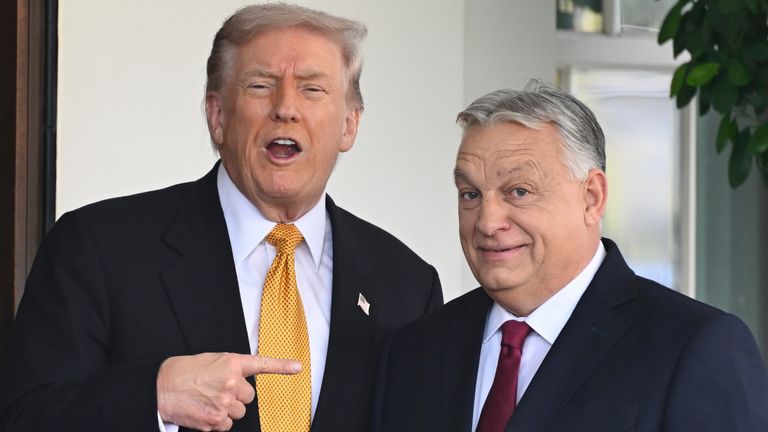
Trump will seek to support ‘patriotic European parties’. Pic: AP
The document’s language around the politics of governing parties across Europe is particularly stark.
Regarding Ukraine, the document says: “The Trump Administration finds itself at odds with European officials who hold unrealistic expectations for the war perched in unstable minority governments, many of which trample on basic principles of democracy to suppress opposition.
“A large European majority wants peace, yet that desire is not translated into policy, in large measure because of those government’s subversion of democratic processes.”
👉 Tap to follow Trump100 wherever you get your podcasts👈
The document outlines how his administration will seek to support “patriotic European parties”.
This is entirely in line with President Trump’s rhetoric but still represents a major departure from the longstanding principle of not interfering in the politics of allies.
It says: “American diplomacy should continue to stand up for genuine democracy, freedom of expression, and unapologetic celebrations of European nations’ individual character and history.
“America encourages its political allies in Europe to promote this revival of spirit, and the growing influence of patriotic European parties indeed gives cause for great optimism.”

Trump has at times had a fiery relationship with Ukraine’s President Zelenskyy. Pic: Reuters
Ukraine and Russia
On European-Russia relations, the document raises the prospect of war but curiously does not presume that such a conflict would involve America.
“Managing European relations with Russia will require significant US diplomatic engagement, both to reestablish conditions of strategic stability across the Eurasian landmass, and to mitigate the risk of conflict between Russia and European states.”
Read more from Sky News:
Germany introduces controversial military service law
Netflix agrees $72bn deal for Warner Bros studios
By contrast, President Biden’s National Security Strategy, published in 2022, underlined repeatedly the “iron-clad” commitment the United States had to Europe’s security.
Chinese risk and opportunity
The document presents Asia and the Indo-Pacific region as a source of opportunity for strategic and economic cooperation.

Maintaining US military strength over China is also outlined. Pic: Reuters
“President Trump is building alliances and strengthening partnerships in the Indo-Pacific that will be the bedrock of security and prosperity long into the future…”
And specifically on China, the paper presents a goal of “economic vitality” achieved through a balanced economic relationship between the two countries combined with an “ongoing focus on deterrence to prevent war”.
Deterrence would be achieved, it outlines, by maintaining preeminent military strength over China.
It says: “This combined approach can become a virtuous cycle as strong American deterrence opens up space for more disciplined economic action, while more disciplined economic action leads to greater American resources to sustain deterrence in the long term.”
Hemispheres of influence
In line with President Trump’s focus on spheres of influence, particular focus is given to the western hemisphere.
There are clear references to the impact of drugs from south and central America into the US and more subtle references to control of the arctic.
“The United States will reassert and enforce the Monroe Doctrine to restore American pre-eminence in the Western Hemisphere, and to protect our homeland and our access to key geographies throughout the region,” the paper says.
It continues: “We will deny non-Hemispheric competitors the ability to position forces or other threatening capabilities, or to own or control strategically vital assets, in our hemisphere.”
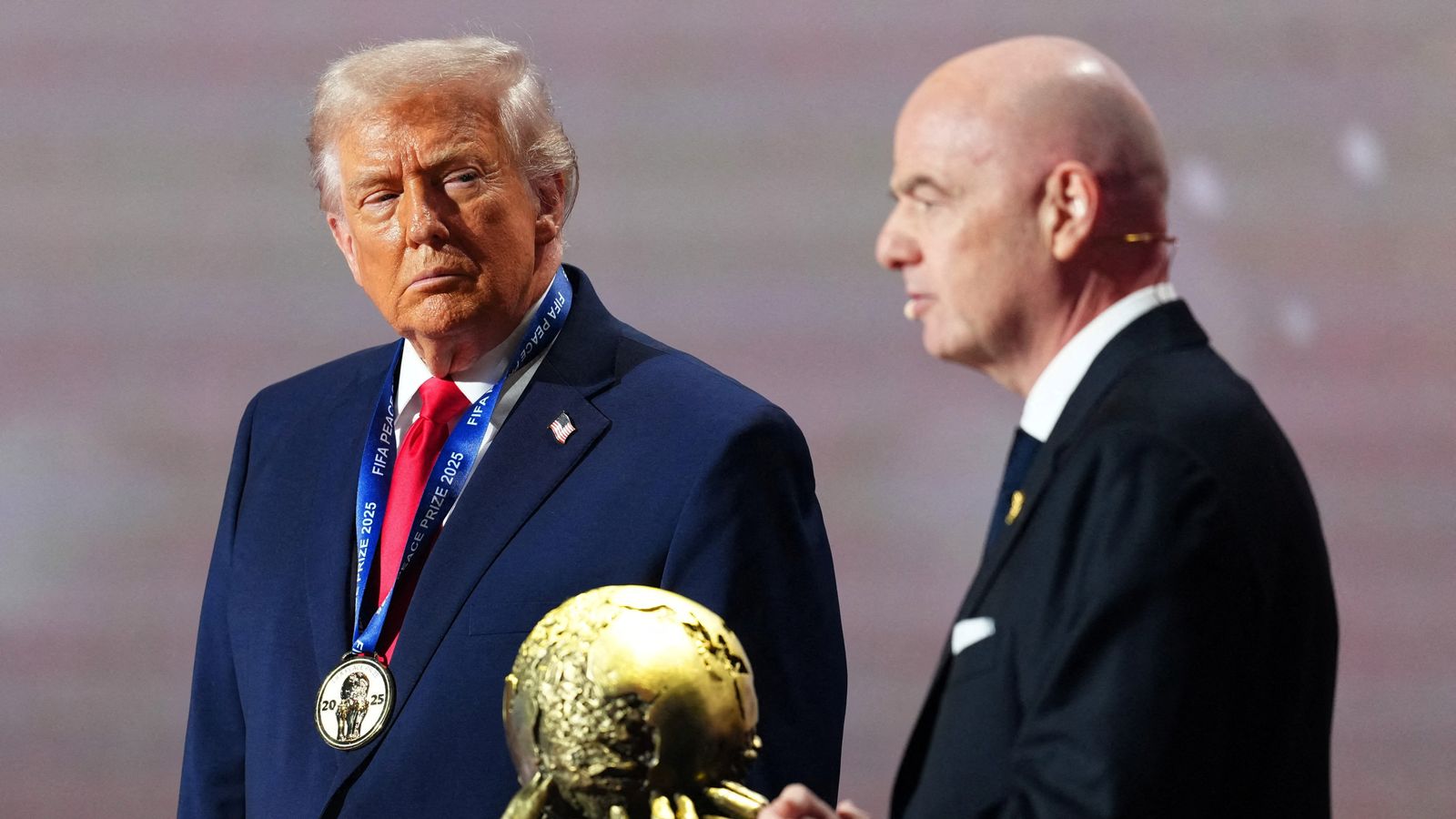
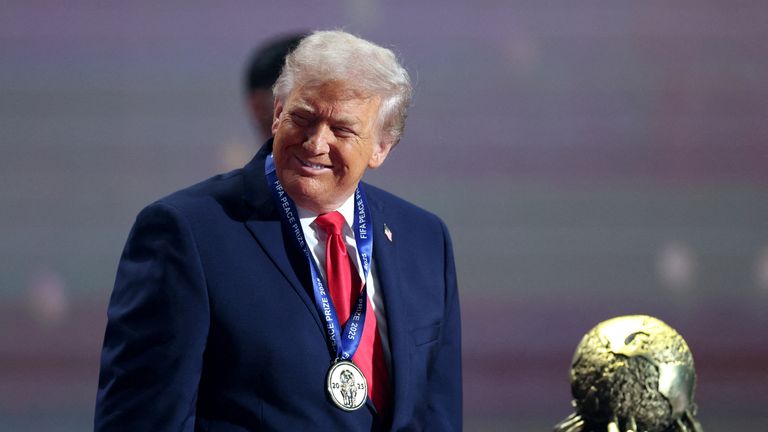
US President Donald Trump has been awarded FIFA’s new peace prize at the draw for next year’s World Cup.
FIFA President Gianni Infantino presented Mr Trump with a large golden trophy – formed of hands holding the earth – and a gold medal, which he wore around his neck.
The certificate, which Mr Infantino handed over at Washington DC’s Kennedy Center on Friday, recognises the US president for his actions to “promote peace and unity around the world”.
World football’s governing body, which announced the annual award last month, said it would be given to “individuals who have taken exceptional and extraordinary actions for peace”.
World Cup draw latest: Home nations and Republic of Ireland await fate
Mr Trump said it was “truly one of the greatest honours of my life”.
He said: “We saved millions and millions of lives. The Congo is an example – over 10 million people killed. It was heading for another 10 million very quickly.”
US President Donald Trump. Pics: Reuters
He also pointed to India and Pakistan, saying, “so many wars that we were able to end, in some cases a little before they started”.
Ahead of the draw, Mr Trump told reporters he did not care about the prize, but noted that he had “settled eight wars” in nearly 11 months in office.
The United States, along with Canada and Mexico, will host the tournament in 2026.
Mr Infantino, who has built up a strong relationship with the US president, backed him for the Nobel Peace Prize earlier this year.
Read more from Sky News:
Netflix agrees blockbuster $72bn deal for Warner Bros studios
Several sites go down after Cloudfare outage
“This is what we want from a leader – a leader that cares about the people,” Mr Infantino said of Mr Trump.
The FIFA leader said to Mr Trump, “this is your prize, this is your peace prize”.
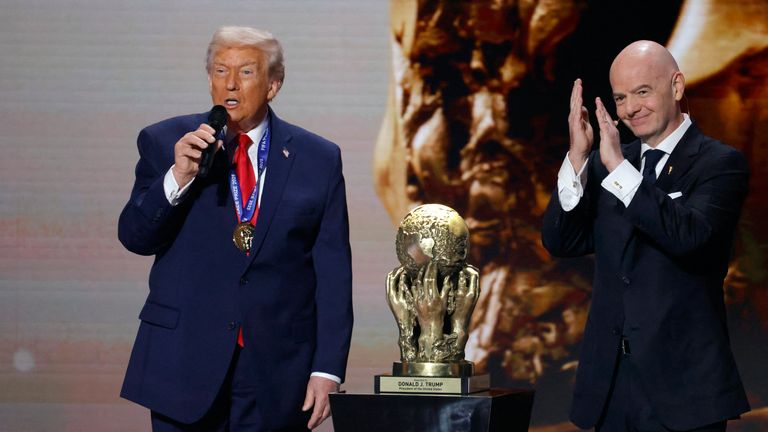
US President Donald Trump and FIFA President Gianni Infantino. Pic: Reuters
Mr Trump thanked his family, including his wife, first lady Melania Trump, and praised the leaders of the other two host nations – Canadian Prime Minister Mark Carney and Mexican President Claudia Sheinbaum – in his brief remarks.
Mr Infantino has often spoken about football as a unifier for the world, but the prize is a departure from the federation’s traditional focus on sport.
FIFA has described the prize as one that rewards “individuals who have taken exceptional and extraordinary actions for peace, and by doing so have united people across the world”.
The award comes during a week where Mr Trump’s administration has been under scrutiny for lethal strikes on alleged drug boats in the Caribbean and as Mr Trump hardens his rhetoric against immigrants.
The Nobel Peace Prize this year was eventually awarded to Venezuelan opposition leader Maria Corina Machado, who said shortly after receiving the prize that she was dedicating it in part to Mr Trump for “his decisive support of our cause”.


Netflix has agreed a $72bn (£54bn) deal to secure Warner Bros Discovery’s film and TV studios and supercharge its library through rights to top franchises including Harry Potter and Game Of Thrones.
It had been reported that the US streaming giant was in exclusive talks over the deal following a bidding war for the assets.
Paramount Skydance and Comcast, the ultimate owner of Sky News, were the rival suitors for the bulk of WBD that also includes HBO, the HBO Max streaming platform and DC Studios.
Money latest: Budget airline launches six new routes
While Netflix has agreed a $27.75 per share price with WBD, which equates to the $72bn purchase figure, the deal gives the assets a total value of $82.7bn.
It will see WBD come under Netflix ownership once its remaining Discovery Global division, mostly legacy cable networks including CNN and the TNT sports channels, is separated.
However, the agreement is set to attract scrutiny from competition regulators, particularly in the United States and Europe.
Both WBD and Netflix do not see the prospect of the deal being completed until late 2026 or 2027.
The main stumbling block is likely to be the fact that Netflix, which has hits including Stranger Things and Squid Game, is already the world’s biggest streaming service.
Stranger Things is one of Netflix’s biggest hits. Pic: Netflix
Further drama could come in the form of a complaint by Paramount, which had previously made a bid for the whole company.
CNBC reported this week that Paramount had claimed the auction process was biased in favour of Netflix.
Entertainment news provider Variety has also reported that major studios fear an institutional crisis for Hollywood unless the move is blocked.
Ted Sarandos, the co-chief executive of Netflix, said: “By combining Warner Bros’ incredible library of shows and movies – from timeless classics like Casablanca and Citizen Kane to modern favourites like Harry Potter and Friends – with our culture-defining titles like Stranger Things, KPop Demon Hunters and Squid Game, we’ll be able to do that even better.
“Together, we can give audiences more of what they love and help define the next century of storytelling.”
Netflix shares were trading down more than 3% in pre-market deals but recovered much of that loss when Wall Street opened. Those for WBD were up by more than 2%.
David O’Hara, managing director at the advisory firm MKI Global Partners, said of the proposed deal: “The 12-18 month timeline signals a long antitrust review, but despite the overlap between Netflix and HBO Max, there is a path to approval through possible HBO divestment.
“Netflix would not accept a $5.8bn break fee if it didn’t see at least a small chance of the deal closing.”
-
 Sports2 years ago
Story injured on diving stop, exits Red Sox game
-
 Sports3 years ago
‘Storybook stuff’: Inside the night Bryce Harper sent the Phillies to the World Series
-
 Sports2 years ago
Game 1 of WS least-watched in recorded history
-
 Sports3 years ago
Button battles heat exhaustion in NASCAR debut
-
 Sports3 years ago
MLB Rank 2023: Ranking baseball’s top 100 players
-
Sports4 years ago
Team Europe easily wins 4th straight Laver Cup
-
 Environment3 years ago
Japan and South Korea have a lot at stake in a free and open South China Sea
-
 Environment1 year ago
Here are the best electric bikes you can buy at every price level in October 2024