

General election: Voters annoyed at government’s broken promises, admits minister


People are “really annoyed” the government has not always kept its promises, a Tory minister has said as he acknowledged the election was “tough” after 14 years in power.
Speaking to Sky News Johnny Mercer admitted the campaign had been “up and down”, but insisted the polls showing the party lagging behind were not reflected on the doorstep.
Rishi Sunak pictured with Johnny Mercer (left). Pic: PA
He warned voters against giving Labour “unchecked power” by backing Nigel Farage’s Reform UK, after a poll put his party one percentage point above the Conservatives.
It comes after a survey by YouGov for The Times put Reform UK at 19%, compared to the Conservatives at 18%.
Latest general election updates
The veterans minister and former army officer, who is battling to be re-elected to the Devon seat of Plymouth Moor View, also disputed the findings of an IPSOS survey that indicated six in 10 people would accept higher taxes if it meant more money for the NHS.
He made his comments as Rishi Sunak remained away from the campaign trail for another day after attending the G7 summit in Italy.
The prime minister was also due to attend the Trooping the Colour ceremony to celebrate the official birthday of the King before jetting off again to attend a Ukraine Peace summit in Switzerland.
Mr Mercer told Sky News: “I’ve never found six out of ten people on the doors who want to pay more in tax in Plymouth.
“I respect all these surveys. I respect all the polls. There’s one poll that matters on 4 July.
“I don’t find six out of 10 people want to pay more tax. I find they want to bring their taxes down.
“They want better public services. They understand the challenge in the NHS.
“They also understand it’s got record funding and record numbers of doctors and nurses. But we’re up against a huge rise in demand, particularly under the pandemic, which is really, really difficult.”
He added: “Of course, people are annoyed. People are really annoyed that we’ve made promises and that we haven’t always met them.
“I think we’ve got a job of work to get over how hard the prime minister works on this, how difficult government is.
“But, no, I think people want to pay less tax. You have a clear choice in this election now, haven’t you.
“You have got the Conservatives clearly saying we’re going to reduce and continue to reduce tax… and a Labour government coming in, who is clearly going to raise taxes.”

Keep up with all the latest news from the UK and around the world by following Sky News
Mr Mercer went on: “This election is tough, right? And it was always going to be tough after 14 years in power, and clearly the campaign’s been up and down as well.”
Read more on Sky News:
Election midpoint: Lonely Sunak fights battle on three fronts
Analysis: What the polls tell us about what will happen on election day
But insisting the Tories had a “bold plan”, he warned: “If you vote for Reform, you’re going to get a Labour government, you’ll get unchecked power from a Labour government to come in and change the face of this country into something that I don’t believe it is, I don’t think it is a left-wing country.”
? Click here to follow Electoral Dysfunction wherever you get your podcasts ?
Mr Mercer rejected the Tory brand was “toxic” as he defended the absence of Conservative branding in his election literature.
He said: “Anyone looking at those leaflets can see that I’m in the Conservative Party and everybody has always known I’m in the Conservative Party.”
He added: “It’s blue… It’s got me on there talking about my record in government. So which part of it is not clear that I’m in the Conservative Party?
“I think it does say on the back who I’m campaigning for. “
Meanwhile, Labour’s shadow work and pensions secretary Liz Kendall defended her party’s claim NHS waiting lists could rise to 10 million despite a thinktank saying it was “highly unlikely”.
Responding to the Institute for Fiscal Studies’ criticism, Ms Kendall told Sky News: “We’re saying that if there’s another five years of the Conservatives, you could see 10 million people waiting in pain or feeling they have to try and pay to go private to deal with their problem.”
She said it was a “reasonable assumption” that was based on what had already happened under the Conservatives and “if the trend continues in the future, as it has done in the past, that’s what we’re likely to see”.
The Tories have dismissed the Labour attack as “scaremongering”.
Elsewhere, Liberal Democrat leader Sir Ed Davey is on the campaign trail in Surrey as he continues his party’s efforts to chip away at the “blue wall”, a collection of typically safe Conservative seats in southern England.
Other candidates in Plymouth Moor View are:
Shaun Hooper, Reform UK
Sarah Martin, Liberal Democrat
Georgia Nelson, Greens
Fred Thomas, Labour
UK
Sex offences against women not given same response as other high-priority crimes, inquiry after Sarah Everard murder finds
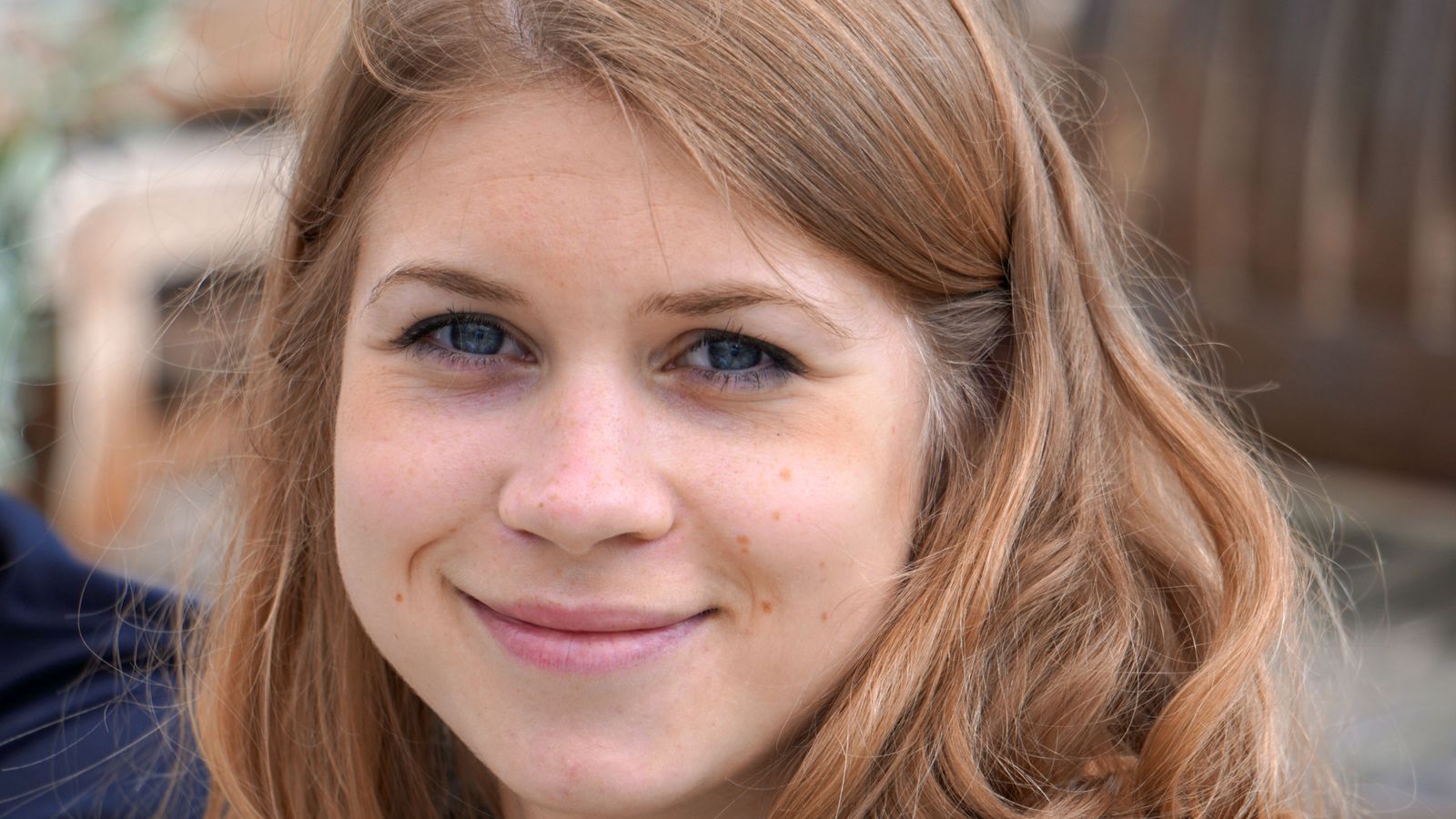
Sexually motivated crimes against women in public are not afforded the same response as other high-priority crimes, an inquiry into the rape and murder of Sarah Everard by off-duty police officer Wayne Couzens has found.
The inquiry was launched after Ms Everard’s death to investigate how Couzens was able to carry out his crimes, and look at wider issues within policing and women’s safety.
Ms Everard’s mother told the inquiry of her unrelenting grief, saying she was going “through a turmoil of emotions – sadness, rage, panic, guilt and numbness”.
Sarah Everard. Pic: PA
“After four years the shock of Sarah’s death has diminished but we are left with an overwhelming sense of loss and of what might have been,” Susan Everard said.
“All the happy ordinary things of life have been stolen from Sarah and from us – there will be no wedding, no grandchildren, no family celebrations with everyone there.
“Sarah will always be missing and I will always long for her.”
She added: “I am not yet at the point where happy memories of Sarah come to the fore. When I think of her, I can’t get past the horror of her last hours. I am still tormented by the thought of what she endured.”
Ms Everard, a 33-year-old marketing executive, was abducted by Couzens as she walked home from a friend’s house in south London in March 2021.
He had used his status as a police officer to trick Ms Everard into thinking he could arrest her for breaking lockdown rules.
‘No better time to act’
Publishing her findings on Tuesday, Lady Elish Angiolini, a former solicitor general for Scotland, said: “There is no better time to act than now. I want leaders to, quite simply, get a move on. There are lives at stake.”
The second part of the independent inquiry is split into two reports, with the first focusing on the prevention of sexually motivated crimes against women in public spaces.
Despite violence against women and girls being described as a “national threat” in the 2023 strategic policing requirement and it being mentioned as a high priority for the current government, Lady Elish found the “response overall lacks what is afforded to other high-priority crimes”.
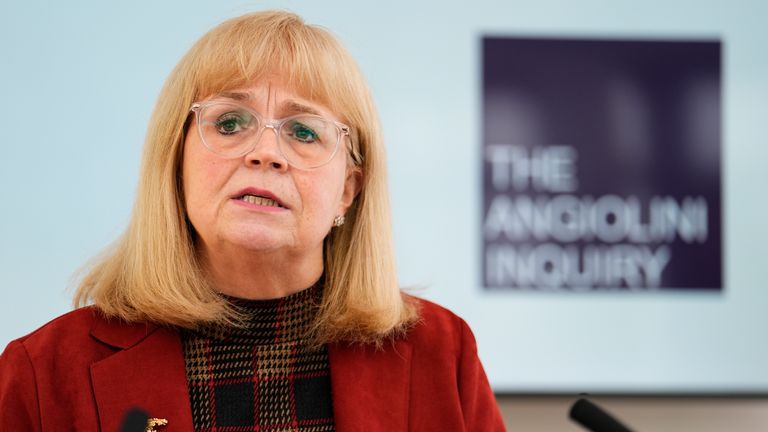
Lady Elish Angiolini announcing her findings. Pic: PA
She said her recommendation in the first part of the inquiry, that those with convictions and/or cautions for sexual offences should be barred from policing, has not yet been implemented.
Additionally, 26% of police forces have yet to implement basic policies for investigating sexual offences, including indecent exposure.
Lady Elish said: “Prevention in this space remains just words. Until this disparity is addressed, violence against women and girls cannot credibly be called a ‘national priority’.”
‘Women deserve to feel safer’
The inquiry chair said with a greater spotlight on the safety of women in public, women should feel safer – “but many do not”.
“Women change their travel plans, their routines, and their lives out of fears for their safety in public, while far too many perpetrators continue to roam freely,” Lady Elish said after her report was published.
“Women deserve to feel safer. They deserve to be safer.”
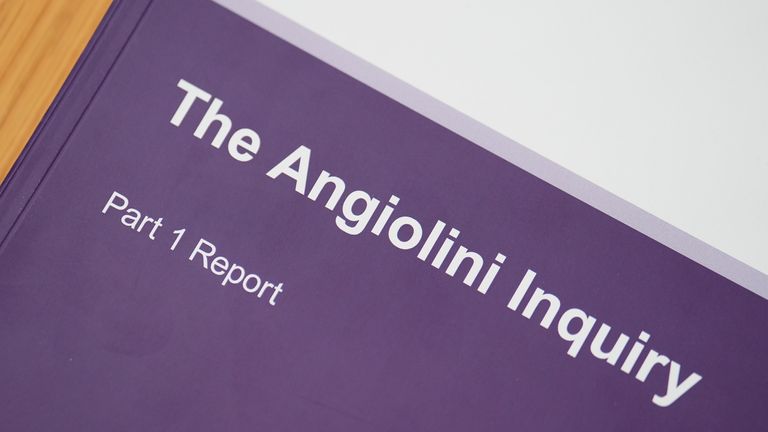
The cover of The Angiolini Inquiry, Part 1 Report, on a desk at the Chartered Institute of Arbitrators.
Pic: PA
The report found that there was a lack of data on sexually motivated crimes against women in public spaces, with Lady Elish calling it a “critical failure” that data on these offences is “difficult to obtain, patchy and incomplete”.
In the inquiry’s public survey of 2,000 people, 76% of women aged 18 to 24 reported feeling unsafe in public because of the actions or behaviour of a man or men.
A similar study for UN Women UK in 2021 found that 71% of women in the UK had experienced some form of sexual harassment in public, with higher rates of 86% for younger women aged 18 to 24.
‘No silver bullet’
She said sexually motivated crimes against women in public spaces are a whole society issue that requires a whole society response, involving government, police and other agencies working together to fix an “unacceptable” and “deeply disappointing” level of inconsistency in responses.
Recognising sexually motivated crime against women as a public health matter as well as a criminal matter was crucial, as these crimes were “not inevitable”.
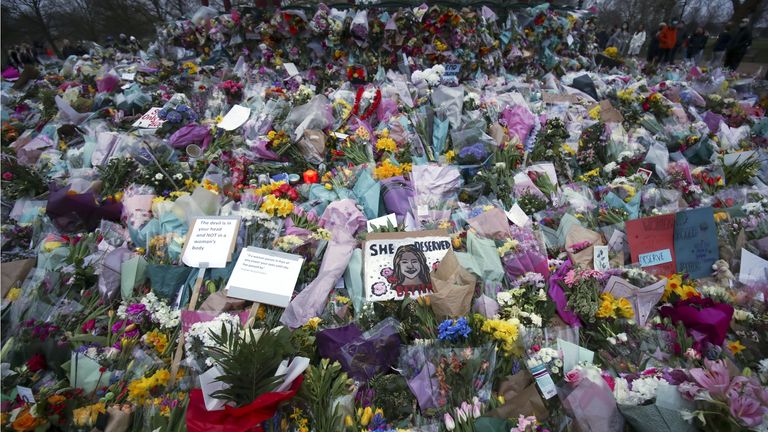
Floral tributes and a drawing of Sarah Everard were left at the Bandstand on Clapham Common, London. Pic: PA
The inquiry considers that “there is not one silver bullet” in tackling these crimes, instead calling for a “long-term commitment, cross-party agreement and a steady course in preventing these crimes – through education, thorough investigations and swift arrests – always with an unswerving focus on the perpetrators”.
Lady Elish’s 13 recommendations include:
• Focus on better collection and sharing of data at a national level
• Better and more consistent targeted messaging around the issues, which is to be managed centrally
• An information and intervention programme for men and boys – to be coordinated between the departments of education and social care as well as the Home Office – to create a culture of positive masculinity
• Improving the investigation of sexually motivated crimes against women and girls – recommending that the home secretary mandates police forces to follow particular procedures
‘Justice cannot only respond after harm’
Zara Aleena, a 35-year-old law graduate, was killed as she walked home from a night out in east London.
Her killer, Jordan McSweeney, was freed from prison nine days before he attacked Ms Aleena as she walked home in Ilford on 26 June 2022.
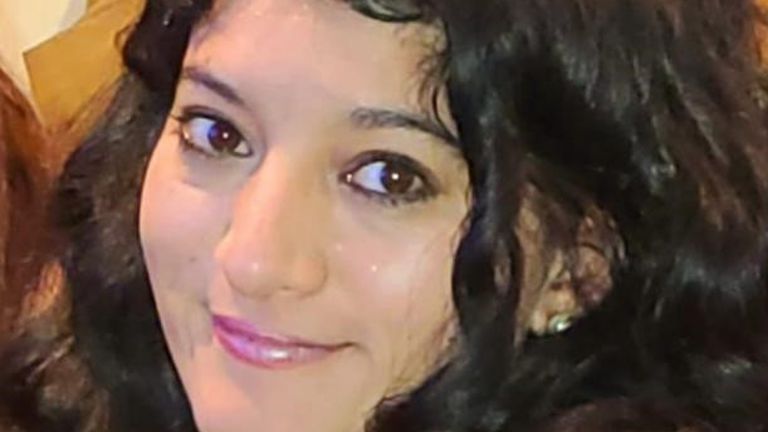
Zara Aleena. Pic: PA
Her aunt Farah Naz said after Lady Elish’s second report was published: “My niece, Zara Aleena, was walking home. That is all she was doing. Her death, like Sarah’s, was preventable.
“It occured because warnings were missed, risks were overlooked, and systems intended to safeguard the public did not function as they should. Zara’s case reflects the wider patterns identified so clearly in this report: systemic failure rather than isolated tragedy.”
She added: “Sarah’s death exposed a system compromised from within. Zara’s death shows that the gaps persisted – with fatal consequences.
“Sarah deserved safety. Zara deserved safety. Every woman deserves safety. Justice cannot only respond after harm – it must prevent harm.”
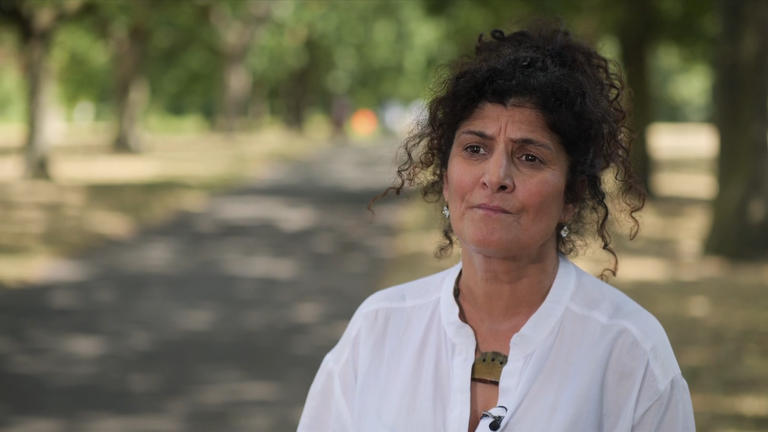
Farah Naz said Sarah Everard and her niece Zara Aleena ‘deserved safety’
‘Women can’t trust a system failing to change’
End Violence Against Women director Andrea Simon: “It is deeply concerning that, nearly two years on, policing has still not implemented basic reforms such as a ban on officers with sexual offence histories.”
“Women cannot be expected to trust a system that resists naming misogyny and racism and continually fails to change,” she added.
Deputy Assistant Commissioner Helen Millichap, director of the National Centre for Violence Against Women and Girls and Public Protection (NCVPP), said that the centre was already working “proactively to recognise, intervene and interrupt predatory behaviour in public spaces”.
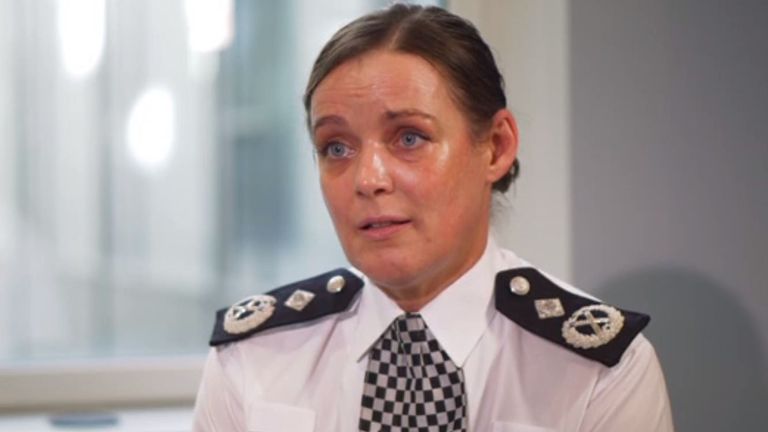
Deputy Assistant Commissioner Helen Millichap
“We should not wait for a crime to be reported to act and we have seen some very effective joint operations with partners that target the right places and work together to make them safer,” she said.
“We want this to feel consistent across policing and we know that sometimes it doesn’t. This report rightly challenges us to create that consistency, implementing what works and the NCVPP will play a critical role in setting national standards.”
Responding to the latest Angiolini Inquiry report, Home Secretary Shabana Mahmood said the report made it clear that women do not feel safe going about their lives today.
“This is utterly unacceptable and must change. A new £13.1 million centre will strengthen the police response to these crimes and drive real change, but more needs to be done,” she said, adding that the government would “carefully” the inquiry’s recommendations.
Stop ‘another Couzens’
The first part of the inquiry, published in February 2024, investigated how Couzens was able to abduct, rape and murder Ms Everard.
The report found Couzens should never have been a police officer, stressing there needs to be a “radical overhaul” of police recruitment to stop “another Couzens operating in plain sight”.
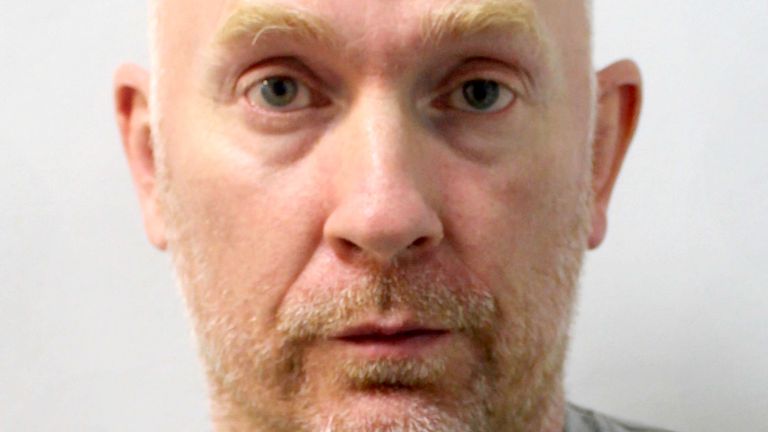
Wayne Couzens. Pic: PA
It examined Couzens’ career and highlighted how major red flags about him were “repeatedly ignored” by police vetting and investigations.
After the publication of the second report, Ms Everard’s family said in a statement that the report “shows how much work there is to do in preventing sexually motivated crimes against women in public spaces”.
They added: “Sarah is always in our thoughts, of course, and we feel the inquiry continues to honour her memory.
“So too does it speak for all women who have been the victim of sexually motivated crimes in a public space and all those at risk.”
Read more:
Women still feel unsafe on Britain’s streets
How Sarah Everard’s killer was caught
Timeline: Wayne Couzen’s behaviour and crimes
The second report of Part 2 of the inquiry will investigate police culture in regards to misogynistic and predatory attitudes and behaviours.
Following the sentencing of former Met Police officer David Carrick in February 2023, Part 3 of the inquiry was established to examine Carrick’s career and conduct.
Last month, Carrick was handed his 37th life sentence with a minimum term of 30 years to run concurrently after he was found guilty of molesting a 12-year-old girl and raping a former partner.
UK
Hillsborough report finds police guilty of ‘complacency, failure and concerted effort’ to blame fans
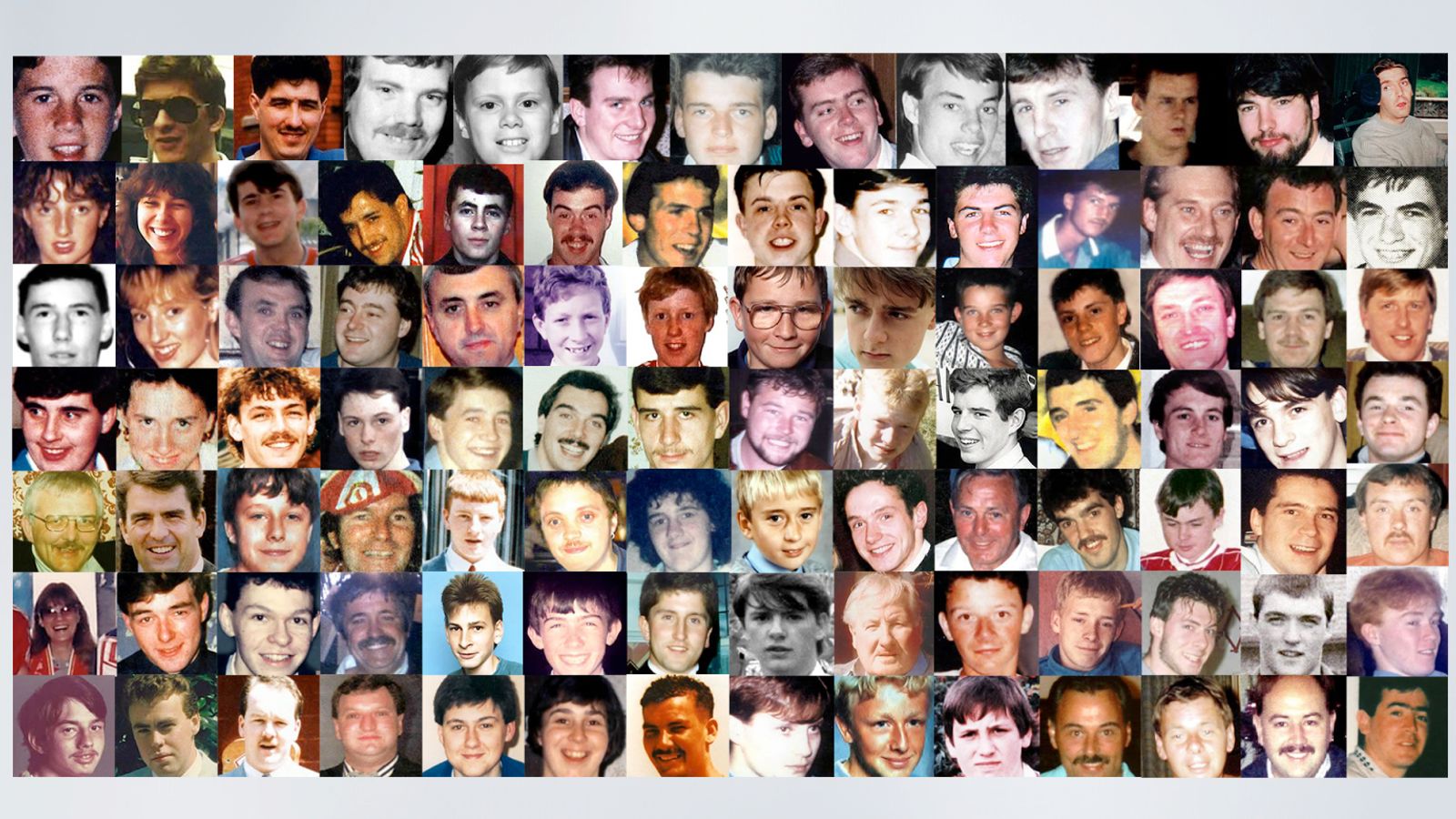
Police were guilty of “deep complacency”, “fundamental failure” and a “concerted effort” to blame fans during and after the Hillsborough disaster, according to a report from the police watchdog.
The Independent Office for Police Conduct has spent 13 years carrying out the largest ever independent investigation into alleged police misconduct and criminality.
Its report identified a dozen officers – including the then-chief constable of South Yorkshire Police – who would have had a case to answer for gross misconduct had they still been serving. A 13th officer would have potentially faced a misconduct case.
The faces of the 97 victims of the Hillsborough disaster
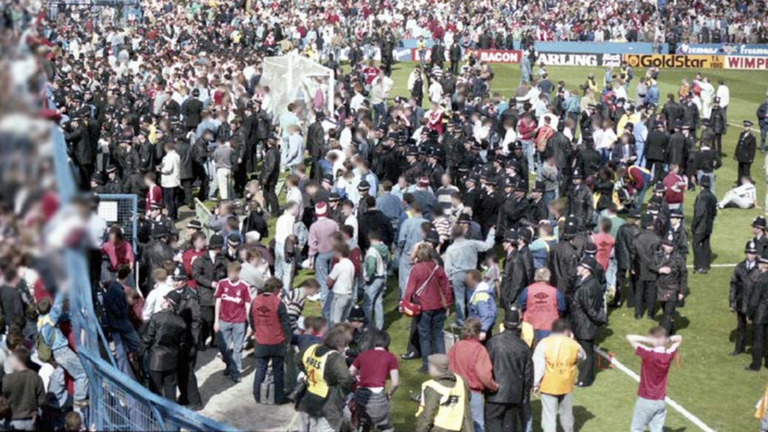
The scene in front of the West Terrace at Hillsborough at 3.11pm on the day of the disaster. Pic: South Yorkshire Police
Hillsborough remains to this day the worst disaster in British sporting history.
A crush on the terraces during the FA Cup semi-final at the stadium in Sheffield resulted in the death of 97 Liverpool fans on April 15 1989.
The men, women and children were aged from 10 to 67.
What the victims’ families have endured ever since, said IOPC deputy director general Kathie Cashell, was “a source of national shame”.
Ms Cashell said: “The 97 people who were unlawfully killed, their families, survivors of the disaster and all those so deeply affected, have been repeatedly let down – before, during and after the horrific events of that day.
“First by the deep complacency of South Yorkshire Police in its preparation for the match, followed by its fundamental failure to grip the disaster as it unfolded, and then through the force’s concerted efforts to deflect the blame on to the Liverpool supporters, which caused enormous distress to bereaved families and survivors for nearly four decades.”
The IOPC report also found that South Yorkshire Police “fundamentally failed in its planning for the match, in its response as the disaster unfolded and in how it dealt with traumatised supporters and families searching for their loved ones”.
The force “attempted to deflect the blame” and “this included allegations about the behaviour of supporters, which have been repeatedly disproven”.
Police initially blamed Liverpool supporters, arriving late, drunk and without tickets, for causing the disaster but, after decades of campaigning by families, that narrative was debunked.
In April 2016, new inquests – held after the original verdicts of accidental death were quashed in 2012 – determined that those who died had been unlawfully killed.
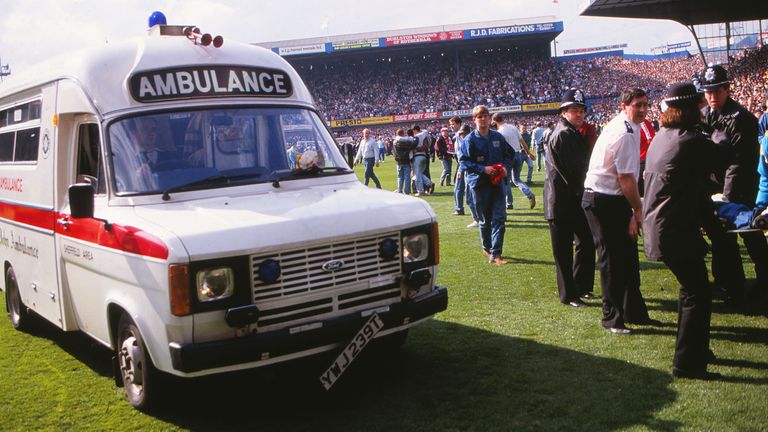
Pic: Colorsport/Shutterstock
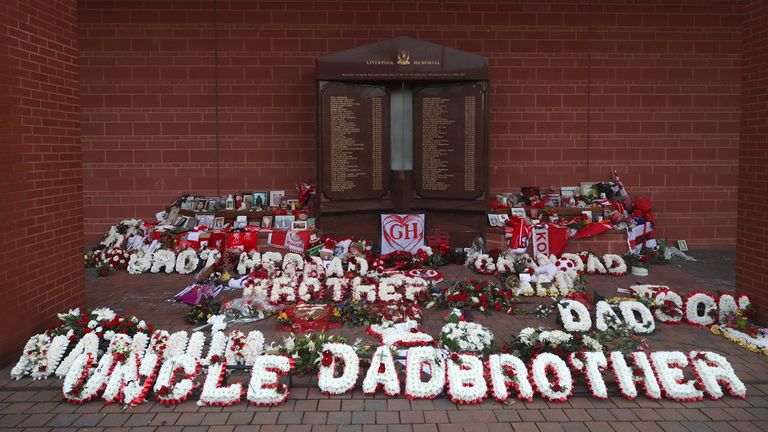
Tributes at Anfield in December 2020 to victims of the 1989 Hillsborough disaster. Pic: PA
The IOPC also examined the actions of West Midlands Police, which investigated the disaster and supported Lord Justice Taylor’s inquiry that followed. It found the force’s investigation was “wholly unsatisfactory and too narrow”.
The report names 12 officers who would have had a case to answer for gross misconduct.
They include the then-South Yorkshire chief constable Peter Wright “for his part in attempting to minimise culpability and deflect blame for the disaster away from SYP and towards Liverpool supporters”. Peter Wright died in 2011.
Also named is the match commander on the day, Chief Supt David Duckenfield.
He was cleared by a jury of gross negligence manslaughter at a retrial in November 2019, after the jury in his first trial was unable to reach a verdict.
Dozens of allegations of misconduct against officers have been upheld but none will face disciplinary proceedings because they have all left the police service.
Emotional PM talks about Hillsborough
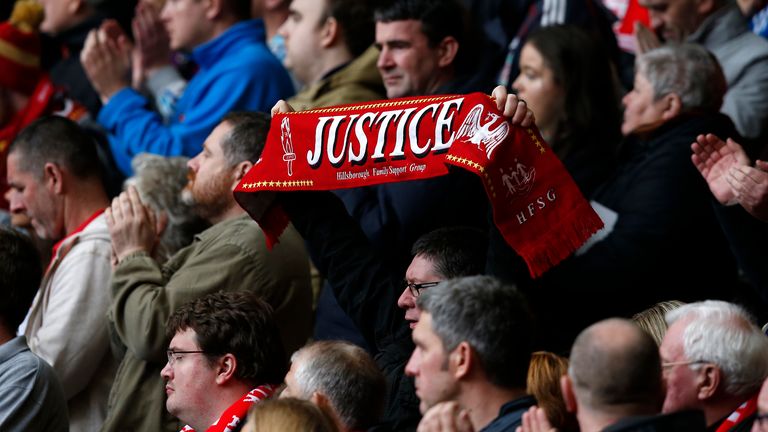
The Hillsborough 27th Anniversary Memorial Service at Anfield, Liverpool in 2016. Pic: PA
Legislation in place at the time did not require the police to have a duty of candour.
But the report has received a lukewarm reception from some of the victims’ families.
Read more on Sky News:
What is the ‘Hillsborough Law?’
Jail ‘the only way to stop cover-ups’
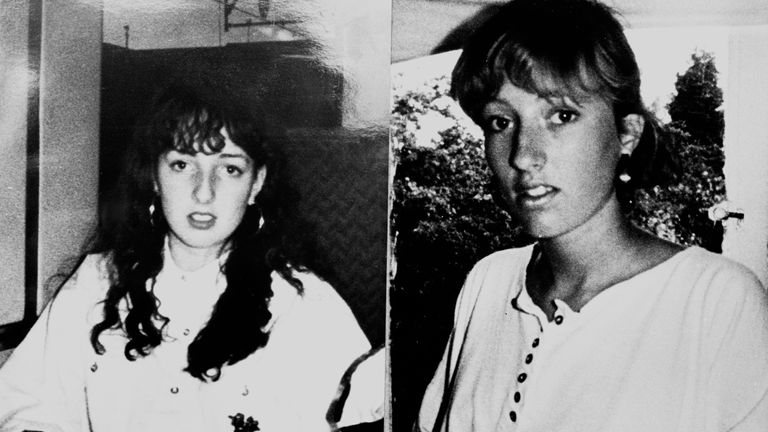
Sisters Victoria and Sarah Hicks died in the tragedy. Pic: PA
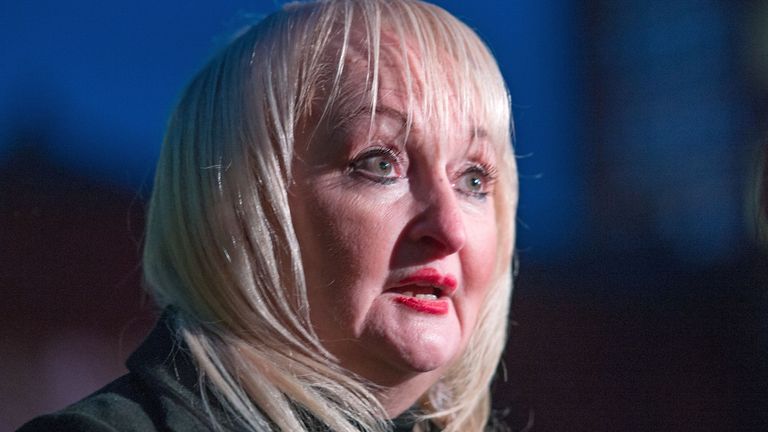
Jenni Hicks. Pic: PA
Jenni Hicks, whose teenage daughters Sarah and Vicki died at Hillsborough, questioned why action had not been taken against those officers when police failings were first revealed by the Taylor inquiry just months after the disaster.
She said: “I can’t believe, having seen the 370-odd page report, how on earth it can have taken them 13 years to write. There’s very little in this report that I didn’t know already. It’s not, in my opinion, about telling the families anything.”
In September, the government introduced the so-called Hillsborough Law to the House of Commons. It will include a duty of candour, forcing public officials to act with honesty and integrity at all times or face criminal sanctions.

Andrew Mark Brookes
But Louise Brookes, whose brother Andrew Mark Brookes died at Hillsborough, dismissed both the IOPC report and the new law.
“Nothing will ever change. There will be another cover-up, there will be another disaster, and until things change at the very top, and I include MPs, chief constables, CEOs of organisations, until they’re the ones who stop protecting and covering up for themselves, nothing will ever change.”
Nicola Brook, a solicitor at Broudie Jackson Canter acting for several bereaved families, said it was a “bitter injustice” that no one would be held to account.
She said: “This outcome may vindicate the bereaved families and survivors who have fought for decades to expose the truth – but it delivers no justice. Instead, it exposes a system that has allowed officers to simply walk away, retiring without scrutiny, sanction or consequence for failing to meet the standards the public has every right to expect.
“Yes, the law has now changed so this loophole cannot be used in future. But for those affected by this case, that is no consolation.
“They are left with yet another bitter injustice: the truth finally acknowledged, but accountability denied.”
In her statement, published with the IOPC report, Kathie Cashell said: “As I have expressed to those closely affected, this process has taken too long – those who campaigned for so many years deserve better.
“If a legal duty of candour had existed in 1989, it could have helped ensure that all relevant evidence was shared fully and promptly. The families of those who were unlawfully killed would have experienced a far less traumatic fight for answers about what happened to their loved ones. Had that duty existed, our investigations may not have been necessary at all.”
What has the reaction been?
Charlotte Hennessy, whose father James was among the 97 killed in the tragedy, said Liverpool fans were “wrongfully blamed by the people who should have protected them” on the day of the disaster.
Steve Kelly, whose brother was killed at Hillsborough, said the Public Office (Accountability) Bill will ensure people will not go unpunished if a similar tragedy occurs.
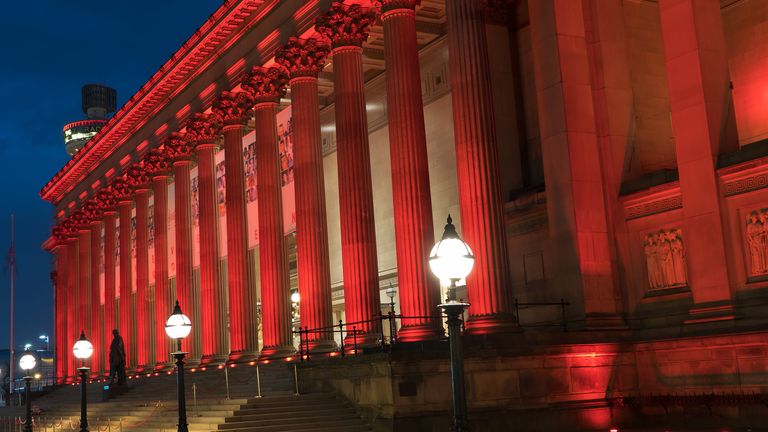
Liverpool’s St George’s Hall lit up in red in 2019 on the 30th anniversary of the disaster. Pic: Shutterstock
Also known as the Hillsborough Law, the bill is intended to make sure authorities will face criminal sanctions if they attempt to cover up the facts behind disasters.
“No one should be beaten by the passage of time,” Mr Kelly said. “We should have truth, justice and accountability within at least in that person’s lifetime. It can’t happen again.”
Sue Roberts, secretary of the Hillsborough Family Support Group, lost her brother in the tragedy.
During a press conference on Tuesday afternoon, she was asked if she was upset that the police officers named in the report would not face any punishment for their roles in the disaster.
“It’s very frustrating,” she said. “But at least they’ve been named now, so their families can feel the shame of what went on.”
‘Deep regret and shame’
Home Secretary Shabana Mahmood has called the Hillsborough disaster a “stain on our nation’s history”.
She said today “serves as a stark reminder of one of the most significant failings in policing the country has ever seen”.
Following the publication of Tuesday’s report, South Yorkshire Police Chief Constable Lauren Poultney said its findings will “always be a point of deep regret and shame” for the force.
She said: “There is nothing I can say today which can take away the years of pain and hurt caused by the force I now lead.
“On behalf of South Yorkshire Police, I fully accept the IOPC report which highlights a litany of failures and am so deeply sorry for the pain and heartache caused.
“The report is clear in that people attended a football match in Sheffield and therefore, they were in our care. The force failed them and also failed their loved ones in the days, months and years after.
“This will always be a point of deep regret and shame for South Yorkshire Police. Those who lost their lives will always be in my thoughts.”
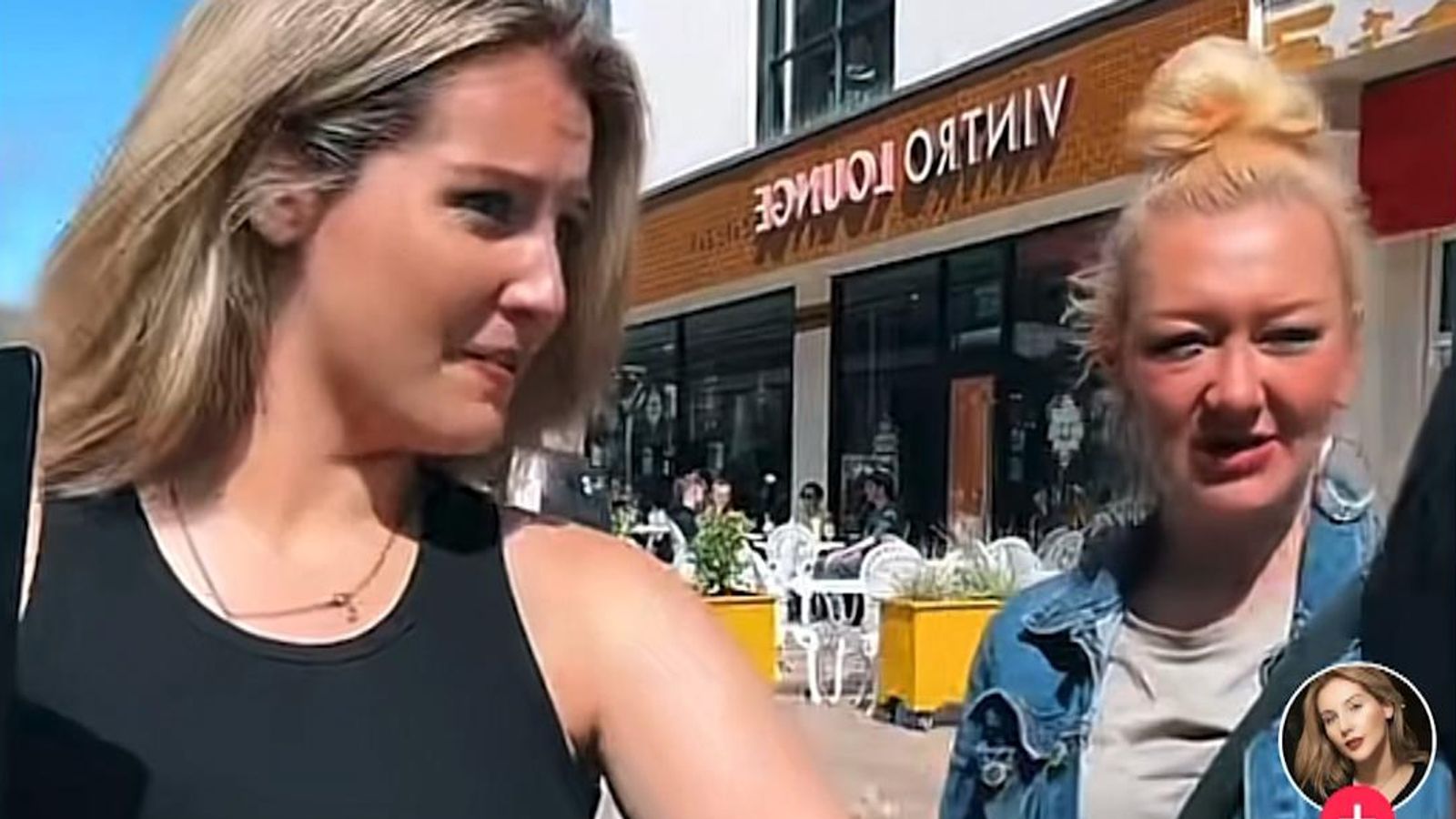
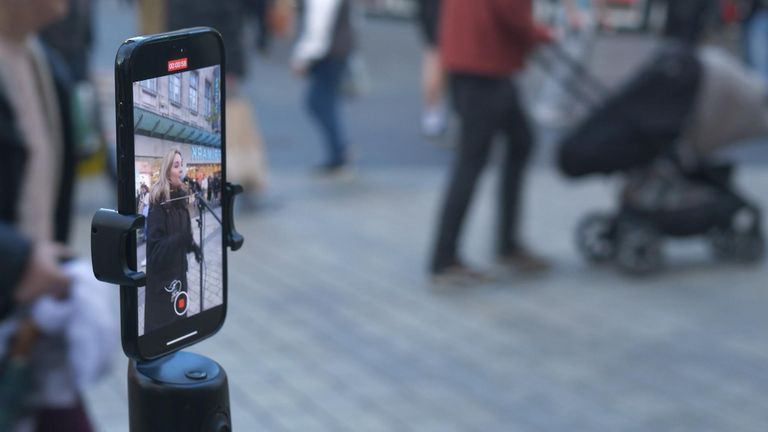
In the middle of Liverpool city centre, musician Ami Alex is showing me a TikTok she posted while busking on the street.
But instead of showcasing her singing, it shows a man approaching her repeatedly, coming closer and closer. He reaches out and touches her – wiping something wet on her arm.
“At first I thought it was coffee,” she says. “But when I watched the video back – you can hear him saying ‘that’s my pee’. My jaw dropped. I was horrified.”
It’s hard to believe what she’s showing me, but she says this kind of behaviour is “unfortunately standard for a woman doing this kind of work”.
She has many more videos – of men touching her without her consent, or demanding hugs or kisses for the money they’ve given.
“I’ve gotten a lot better at dealing with it,” she says. “When I was 21, 22, when I first started doing this, I would go home in tears.
“It’s just so degrading. It makes you feel objectified. Like – is that all you think of me?”

Sarah Everard’s murder in 2021 caused outrage across the country. There was an outpouring of anger as women shared their stories of feeling unsafe, threatened and sexualised on the streets.
At the time there were promises – assurances to women that things would have to change. But four years on, many women here in Merseyside say they have the same feelings they did then.
“Men are honestly shocked when we tell them ‘we don’t feel safe’,” says Kate Chadwick, from the Wirral charity Tomorrow’s Women. “Pretty much every woman has had some kind of experience.”
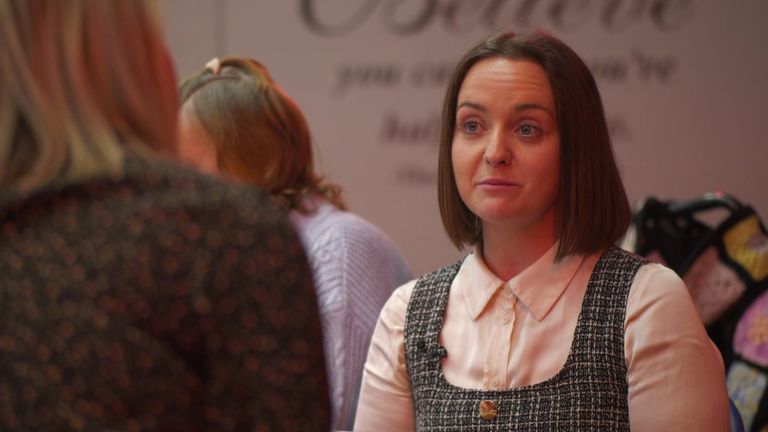
Kate Chadwick
I meet her at a regular lunch club they host – at their building where men are not allowed inside. It’s intended as a safe space for their members, who they are helping through everything from domestic violence to sexual assault. There’s a medical clinic here, beauty treatment rooms, a computer lab – all staffed by women.
Kate shows me the pocket rape alarm they give out to the women who come here. She hopes they never have to use it, but “it makes them feel safer just having it”.
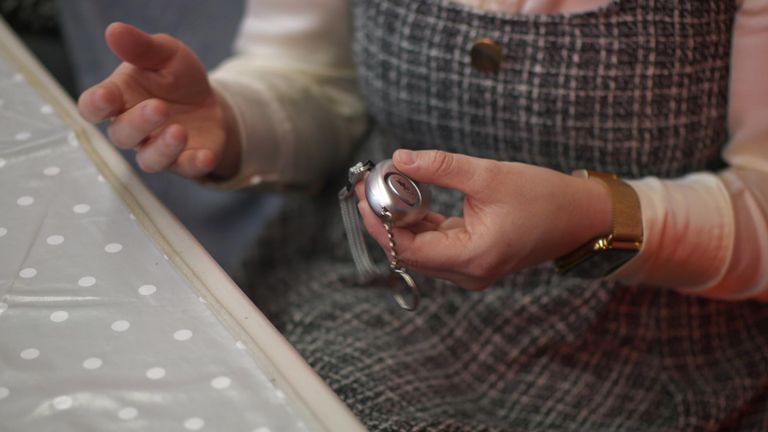
Women helped by the charity are given pocket rape alarms
“As a woman, in the winter it’s a hard time just to exist,” Kate says. “Women don’t feel safe coming out of their homes. Routines will change. They don’t want to walk in certain places.
“One of our members gets two buses home because it’s safer than waiting at a dark bus stop to just get the one.”
They are about to launch a photography exhibition around stalking and harassment. For this, they gave their members a camera and asked them to submit photos that show their experience being a woman.
There are several photos of dimly lit streets, bus stops with no one else there. One photo is a fist holding a key through the knuckles – an image most women will recognise.

Another picture is of an outfit laid out on the floor – a T-shirt, denim skirt and tights. It’s titled What Were They Wearing?
“This can often be the first question in a sexual assault case,” Kate says. “It really doesn’t matter what the woman was wearing.”
“It’s definitely not getting better,” she says. “In 2024, violence against women and girls was declared a national emergency. The statistics you read every day are shocking.”
Later that evening, back in Liverpool, we meet Girls on the Go – a running club started with the express purpose of allowing women to exercise safely in the winter. It’s 5.15pm when we meet for the run, and already dark.
The women running here list a collection of similar experiences. They have been catcalled, yelled at from cars, even chased while out running alone.
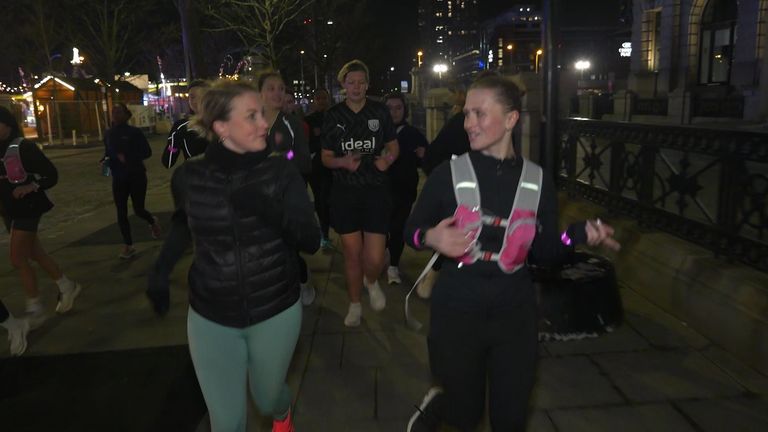
Girls on the Go helps women exercise safely in winter
Run leader Madeline Cole tells me that, as a women-only club, they have had to modify their warm-ups because “as soon as you bend over to touch your toes, or go into a squat, the shouting starts”.
Founder Steph Barney says she started the club because it is still “intimidating running alone as woman”.
“Far too many women experience harassment and catcalling – we wanted to create a group where women would feel safer doing it together” she says. “Even in the summer you get sexualised just for wearing shorts. You have to restrict what you do. None of my male friends have ever had to worry about that.”
I ask if anything would help them feel safer when out on their runs. “Better street lighting is a really obvious one,” she says. “And one of the issues is that it’s still not taken seriously by society. When you’re catcalled, it feels embarrassing to say ‘this is scary’.
“If it was taken more seriously – more women would speak out. And more could be done.”
Read more UK news:
OBR chief resigns after budget leak investigation
King officially strips Andrew of two more titles
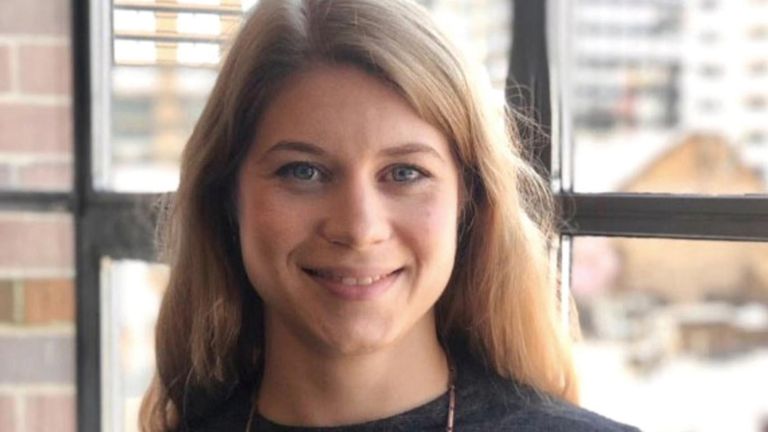
Sarah Everard
The Angiolini Inquiry – which was established to investigate the circumstances surrounding Sarah Everard’s murder – is due to publish its latest report later today.
It is examining whether there a risk of it happening again, police culture, and broader concerns surrounding women’s safety in public spaces.
-
 Sports2 years ago
Story injured on diving stop, exits Red Sox game
-
 Sports3 years ago
‘Storybook stuff’: Inside the night Bryce Harper sent the Phillies to the World Series
-
 Sports2 years ago
Game 1 of WS least-watched in recorded history
-
 Sports3 years ago
Button battles heat exhaustion in NASCAR debut
-
 Sports3 years ago
MLB Rank 2023: Ranking baseball’s top 100 players
-
Sports4 years ago
Team Europe easily wins 4th straight Laver Cup
-
 Environment3 years ago
Japan and South Korea have a lot at stake in a free and open South China Sea
-
 Environment1 year ago
Here are the best electric bikes you can buy at every price level in October 2024