
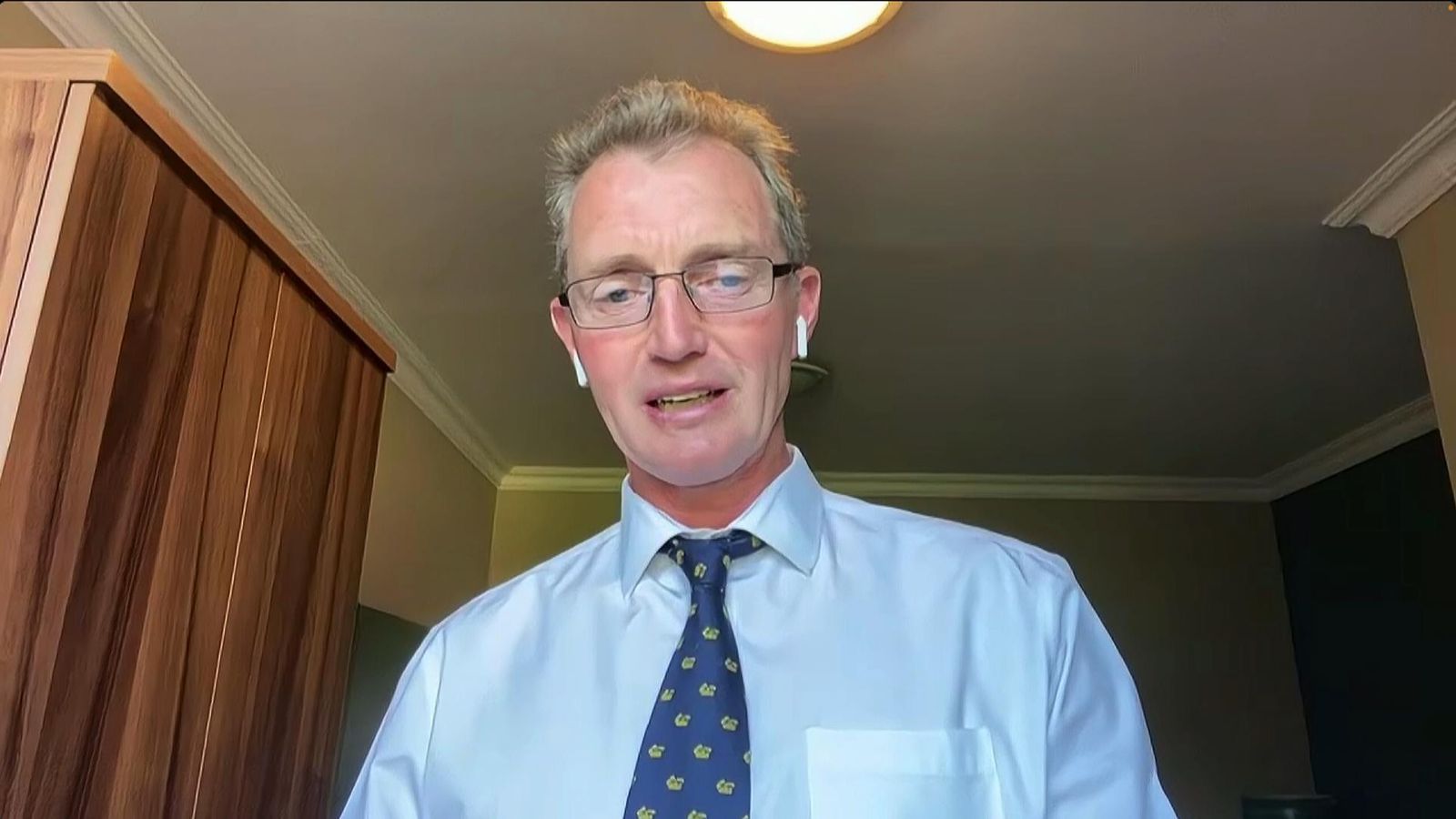
Tory Welsh Secretary puts ‘on record’ that he did not place bet on election date

The Conservative Welsh secretary has “put on record” that he did not place a bet on the date of the general election as Rishi Sunak continues to face questions about a growing scandal.
David TC Davies told Sky News he had not bet on the date of the election after two Conservative candidates were placed under investigation by the Gambling Commission for allegedly doing so.
Mr Davies said the news that two candidates were being investigated came as a “complete surprise to me”.
Election latest:
Sunak ‘incredibly angry’ as scandal engulfs campaign
Laura Saunders, the Tory candidate for Bristol North West, is being investigated by the Gambling Commission alongside her husband, Tony Lee, the party’s director of campaigns.
Ms Saunders said she “will be co-operating with the Gambling Commission” probe, while her husband “took a leave of absence” from his role on Wednesday night, a Conservative Party spokesman told Sky News.
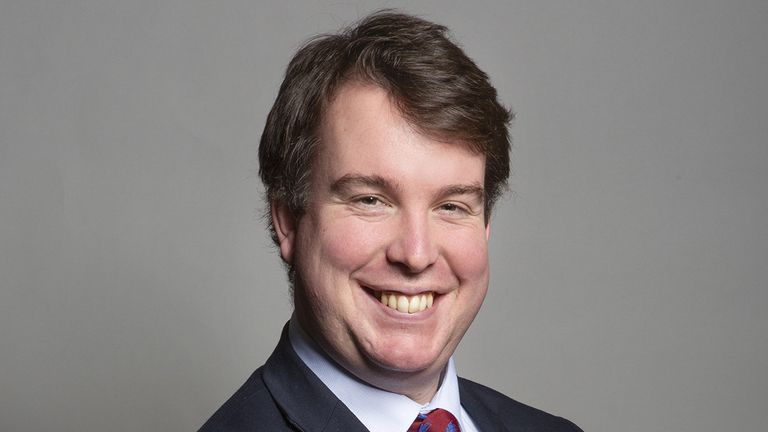
It comes a week after the prime minister’s close parliamentary aide Craig Williams, the Tory candidate in Montgomeryshire and Glyndwr, admitted to putting a “flutter” on the election, saying this has resulted in “some routine inquiries” which he was co-operating with “fully”.
Craig Williams admitted to betting on the election date. Pic: PA
Mr Sunak’s close protection officer has also been arrested and suspended over alleged bets about the timing of the election.
A gambling industry source told Sky News that “more names” are being looked at, though police “are not involved” in those cases.
But Mr Davies said he had “absolutely no idea” whether more names were going to emerge as part of the commission’s investigation.
“The news of those two is a complete surprise to me,” he said.
“I just want to put on record – I certainly haven’t bet myself and in fact I haven’t made any bets on anything for many years.
“I didn’t know the election was coming until probably the morning. I had an inclination, I wasn’t absolutely certain even then, and I’ve no idea who – if anyone – has placed any bets and what further investigation is going on.”
? Click here to follow Electoral Dysfunction wherever you get your podcasts ?
Mr Davies added: “What I will say, I will repeat the prime minister’s words – it’s totally unacceptable if people have broken the rules in any way, there is an investigation going on by the Gambling Commission and I welcome that, and anyone who is found to have broken the rules will be kicked out of the Conservative Party.”
The prime minister told the BBC Question Time leader’s special on Thursday he was “incredibly angry” to learn of the allegations, calling it a “really serious matter”.
Pressed on why those under suspicion haven’t been suspended, Mr Sunak said an investigation had to take place first – but anyone guilty would be “booted out” of the party.
Read more:
Sunak’s good, bad and ugly Question Time
Former Tory minister says he’ll vote Labour

Pic: BBC

Keep up with all the latest news from the UK and around the world by following Sky News
The Labour Party has called on Mr Sunak to suspend those involved immediately.
Shadow science secretary Peter Kyle told Sky News: “Keir Starmer said very clearly yesterday that had this been anything involving in a Labour candidate, then their feet wouldn’t have touched the ground. They’d be out.”
Put to him that the prime minister believed the investigation should be allowed to progress, Mr Kyle said: “We are in the general election campaign. In two weeks’ time, the country will go to the voting booths and they will cast their vote.
“And Rishi Sunak is quite clear… quite comfortable campaigning alongside MPs… allowing members of staff to be putting to the country a prospectus for the future, which is a message being carried by people who are under investigation.”
The full list of candidates in Bristol North West:
• Caroline Gooch – Liberal Democrats
• Darren Jones – Labour Party
• Scarlett O’Connor – Reform UK
• Mary Page – Green Party
• Laura Saunders – Conservative and Unionist Party
• Ben Smith – Social Democratic Party
The full list of candidates in Montgomeryshire and Glyndwr:
• Jeremy Brignell-Thorp – Green Party
• Oliver Lewis – Reform UK
• Glyn Preston – Liberal Democrats
• Elwyn Vaughan – Plaid Cymru (The Party Of Wales)
• Craig Williams – Conservative and Unionist Party
• Steve Witherden – Labour Party


Gemini, the cryptocurrency exchange founded by billionaire twins Tyler and Cameron Winklevoss, has rolled out prediction markets in the United States after securing key regulatory approval.
Gemini launched its in-house prediction market, Gemini Predictions, across all 50 US states, the exchange announced in an X post on Monday.
Provided via affiliate Gemini Titan, Gemini Predictions enables users to trade on the outcomes of real-world events with “near instant execution” and full transparency.
The launch came shortly after Gemini Titan obtained a designated contract market license from the Commodity Futures Trading Commission (CFTC) on Wednesday, authorizing the company to offer prediction markets in the US.
Rising trend for building “everything apps”
The arrival of Gemini Predictions marks the company’s latest step in building a “one-stop super app,” allowing users to not only trade crypto, but also stake assets, earn rewards, buy tokenized stocks and participate in prediction markets.
The move aligns with a broader industry trend toward all-in-one platforms in crypto, with rival exchanges like Coinbase also rushing to introduce a wide range of services, including trending prediction markets and tokenized stocks.
The trend has also been picked up by self-custodial wallets like MetaMask and Trust Wallet, as well as major decentralized exchanges (DEX) like PancakeSwap, which released a new BNB Chain-based prediction platform Probable on Tuesday.
Related: Phantom taps Kalshi to offer regulated prediction markets in wallet
The project adds to a growing portfolio of prediction markets backed by YZi Labs, the venture capital firm founded by Binance co-founder Changpeng “CZ” Zhao, including Opinion, which topped volume rankings in November.
Major providers had faced issues in the US
The industry’s push to launch prediction markets follows years of regulatory uncertainty in the United States, with major providers such as Polymarket resuming local operations after previously facing a ban in 2022.
The platform started rolling out its relaunch in the US in early December, announcing that waitlisted users would be the first to access its US app.

In another sign of a warming US stance toward prediction markets, a group of providers, including Kalshi, Robinhood and Crypto.com, recently received a temporary reprieve after a judge intervened following cease and desist orders issued by the state of Connecticut in early December.


Crypto industry executives have urged the US Securities and Exchange Commission to shift its thinking on blockchain privacy tools, pitching that there are legitimate applications for them outside of criminal use.
The SEC hosted crypto and finance executives for a discussion and panel on financial surveillance and privacy on Monday, the agency’s sixth crypto-focused roundtable this year, as it seeks to overhaul its approach to crypto.
StarkWare general counsel Katherine Kirkpatrick Bos, who participated in a panel discussion, told Cointelegraph after the event that a major takeaway was that there shouldn’t be an assumption that those using and creating privacy tools are “overwhelmed by wrongdoers.”
“Why is the assumption that an individual needs to affirmatively prove that they are compliant or they’re using the tool for good?”
“As opposed to it being the other way around, where the assumption is that this individual is using the tool for good until there is some sort of indication that they’re using it for bad,” she said.
Kirkpatrick Bos added that “of course, wrongdoers were using, or are using those tools, but there needs to be a balance.”
During the roundtable, Wayne Chang, the founder and CEO of the credential management company SpruceID, said some percentage of users of stablecoins, a crypto tool that is slowly becoming mainstream, will want privacy.
“There are a ton of stablecoins that aren’t onchain yet that would come onchain if there is privacy,” he said. “We’re going to see an increase in demand for privacy-preserving blockchains.”
“My hope is that regulators continue to engage industry, and we can have those discussions on how to keep privacy for folks while also having tools that are useful,” Chang said.
Customer checks are becoming outdated
Kirkpatrick Bos said a discussion on Know Your Customer (KYC) and Anti-Money Laundering (AML) measures focused on whether current rules are sufficient in the age of artificial intelligence.
“The question arose and was debated on the panel, well, what is necessary for Anti-Money Laundering?” she said. “Now we have AI. It’s made manual, AML and KYC antiquated. How do we solve for that?”
“There was a sense that the current system of AML and KYC is antiquated, it’s problematic, it’s ineffective,” she added. “But there needs to be some sort of check when it’s a centralized entity facilitating flows of money to ensure that they’re not helping wrongdoers.”
Many financial institutions request a picture of a user’s driver’s license for its KYC checks, which Kirkpatrick Bos said was “absurd, because an individual can go on the internet and develop a fake driver’s license in a matter of seconds.”
“So the question is, can cryptography-based tools improve that and make it harder for bad guys to do that? But can they also do that and make it harder for bad guys while preserving an individual’s privacy and not revealing data like an address, where it is not necessary to vet the legality of the funds?” she added.
Some projects have begun to test crypto-based solutions for proving identity while claiming to preserve privacy, such as Sam Altman’s World, which gives users a cryptographic key they can use to prove they’re human.
SEC’s Atkins warns of potential for crypto mass surveillance
SEC chair Paul Atkins had given opening remarks at the roundtable, warning that if “pushed in the wrong direction, crypto could become the most powerful financial surveillance architecture ever invented.”
“If the instinct of the government is to treat every wallet like a broker, every piece of software as an exchange, every transaction as a reportable event, and every protocol as a convenient surveillance node, then the government will transform this ecosystem into a financial panopticon,” he added.
Related: SEC ’eased up on’ 60% of crypto enforcement cases under Trump: Report
Atkins said that crypto allows for “privacy-preserving tools that the analog world could not provide,” which some institutions depend on to build positions or test strategies without “instantly telegraphing that activity to competitors.”
He added that some of the technology could balance the government’s interest in deterring security threats and the public’s privacy.
“But to best strike this balance, we must make certain that Americans can use these tools without immediately falling under suspicion.”
Magazine: 2026 is the year of pragmatic privacy in crypto — Canton, Zcash and more
-
 Sports2 years ago
Story injured on diving stop, exits Red Sox game
-
 Sports3 years ago
‘Storybook stuff’: Inside the night Bryce Harper sent the Phillies to the World Series
-
 Sports2 years ago
Game 1 of WS least-watched in recorded history
-
 Sports3 years ago
Button battles heat exhaustion in NASCAR debut
-
 Sports3 years ago
MLB Rank 2023: Ranking baseball’s top 100 players
-
Sports4 years ago
Team Europe easily wins 4th straight Laver Cup
-
 Environment3 years ago
Japan and South Korea have a lot at stake in a free and open South China Sea
-
 Environment1 year ago
Here are the best electric bikes you can buy at every price level in October 2024