
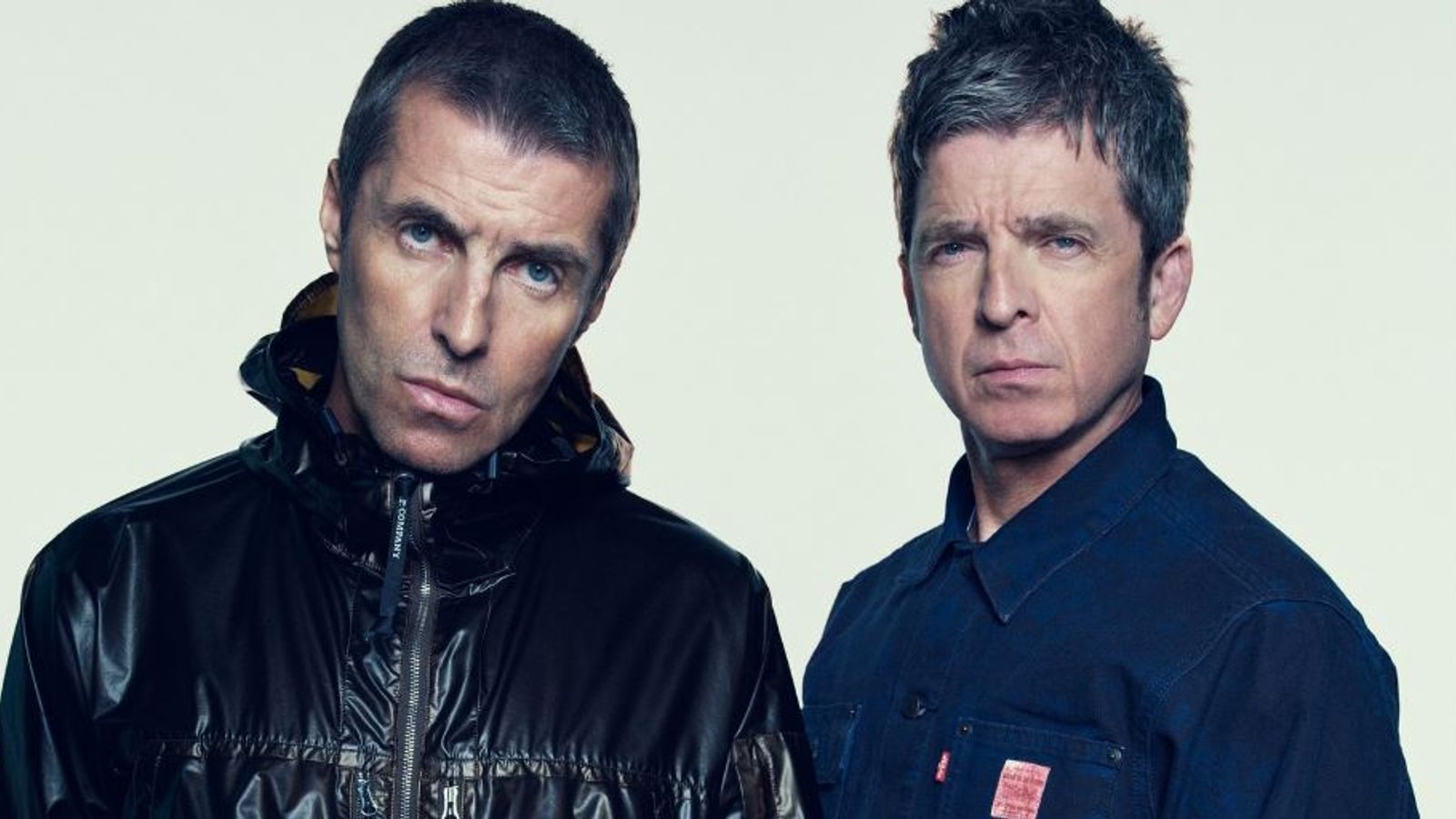
Oasis announce two extra Wembley Stadium shows

Oasis have announced two extra Wembley Stadium shows after their tour sold out over the weekend – and addressed the controversy over sales for the first time.
Both Noel and Liam Gallagher, as well as Ticketmaster, came under fire over the initial release, after fans spent hours in virtual queues and some tickets ended up costing more than double due to “in demand” pricing for the reunion tour.
Amid the backlash over prices, the Competition and Markets Authority (CMA) announced an “urgent review” of dynamic pricing to ensure consumers are being treated fairly, while Culture Secretary Lisa Nandy promised a government review and the European Commission also said it would examine the issue.
Now, Oasis have announced two further dates at Wembley Stadium in September. There will be a staggered “special invitation-only ballot ticket sale strategy”, the band said, devised “as a small step towards making amends for the situation”.
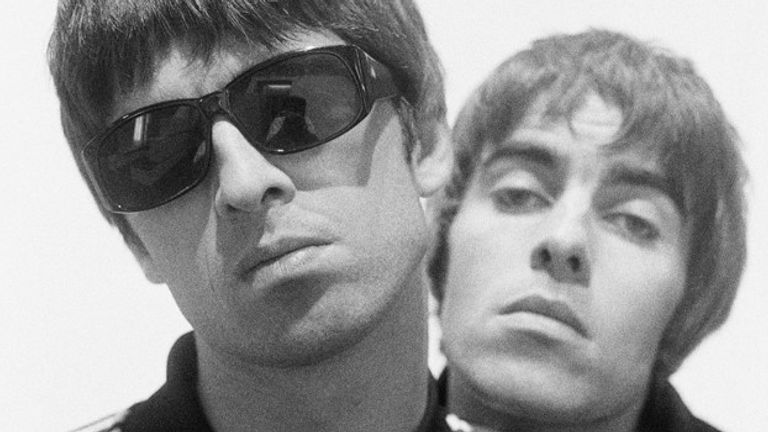
The brothers pictured in 1994. Pic: Paul Slattery
They said it needed “to be made clear” the band “leave decisions on ticketing and pricing entirely to their promoters and management, and at no time had any awareness that dynamic pricing was going to be used”.
Applications to join the ballot for the September shows will be opened first to fans who were unsuccessful in the initial sale, they said.
“Inevitably interest in this tour is so overwhelming that it’s impossible to schedule enough shows to fulfil public demand,” the band’s statement continued. “But this ticket sale strategy will make the process far smoother for fans by reducing the stress and time it takes to obtain one of the hottest tickets of our time.”
Prior meetings between promoters, Ticketmaster and the band’s management “resulted in a positive ticket sale strategy”, which would have been a fair experience for fans, they said – including dynamic ticketing “to help keep general ticket prices down as well as reduce touting”. However, “the execution of the plan failed to meet expectations”.
They added: “All parties involved did their utmost to deliver the best possible fan experience, but due to the unprecedented demand this became impossible to achieve.”
The frenzy for tickets for the initial shows started way before they went on sale at 9am (8am for two gigs in Dublin) on Saturday, as Manchester-based promoter SJM Concerts’ website Gigs and Tours, Ticketmaster and See Tickets all told website visitors they would need to wait for the page to refresh to join a queue.
After the initial sale opened, tickets worth £148 were being sold for £355 on Ticketmaster within hours of release, due to the dynamic pricing systems which can raise costs in the event of high demand and limited supply.
Ticketmaster has said it does not set prices and its website says this is down to the “event organiser” who had “priced these tickets according to their market value”.

Behind the scenes images from the first photo shoot were released after the announcement. Pic: Simon Emmett
Formed in the early 1990s, Oasis rose to fame with songs such as Supersonic, Cigarettes & Alcohol and Live Forever, before second album (What’s The Story) Morning Glory gave them their first number one single, Some Might Say, the following year.
With other hits including Wonderwall, Don’t Look Back In Anger, Stand By Me, Lyla and The Importance Of Being Idle, they became one of the biggest bands in British music history.
Read more:
Oasis are back – but what has happened behind the scenes?
Noel Gallagher jokes about Oasis break-up
Hotels accused of cancelling booking on concert night
But tensions between the Gallagher brothers often ran high, and Noel eventually quit the band ahead of a show in Paris in 2009, saying he “simply could not go on working with Liam a day longer”.
The feud continued over the years, with the pair exchanging insults publicly but reportedly never speaking in person.
Fans had long hoped for a reunion – and now, finally, the brothers appear to have put their differences behind them.
While those who did get tickets were happy to ensure their place at the gigs, the sales controversy had somewhat tainted the long hoped-for reunion announcement.


The Oscars will be streamed live on YouTube from 2029 after being broadcast on the ABC network for decades.
It means the annual film awards will be available to the video-sharing platform’s two billion users for free around the world in four years.
The Academy of Motion Picture Arts and Sciences announced the deal with Google-owned YouTube on Wednesday, saying the streaming giant will have the exclusive global rights to the Hollywood awards from 2029 to 2033.
YouTube will effectively be the home to all things Oscars, including red-carpet coverage, the Governors Awards and the Oscar nominations announcement.
The Academy Awards ceremony has been broadcast by ABC for most of its history, but 2028 will be its last year showing the Oscars as they celebrate their 100th anniversary.
“The Oscars, including red carpet coverage, behind-the-scenes content, Governors Ball access, and more, will be available live and for free to over two billion viewers around the world on YouTube, and to YouTube TV subscribers in the United States,” an announcement on the Academy Awards’ website read.
“We are thrilled to enter into a multifaceted global partnership with YouTube to be the future home of the Oscars and our year-round academy programming,” said academy chief executive Bill Kramer and academy president Lynette Howell Taylor.
They said the new partnership with the platform “will allow us to expand access to the work of the academy to the largest worldwide audience possible”.
File pic: Reuters
‘Inspiring new generation of creativity and film lovers’
“The Oscars are one of our essential cultural institutions, honouring excellence in storytelling and artistry,” said YouTube chief executive Neal Mohan.
“Partnering with the academy to bring this celebration of art and entertainment to viewers all over the world will inspire a new generation of creativity and film lovers while staying true to the Oscars’ storied legacy.”
Read more from Sky News:
Paramount backer pulls out of Warner Bros takeover bid
Sydney Sweeney on challenges women face to ‘have it all’
The awards will be available with audio tracks in many languages, in addition to closed captioning.
Last year’s Academy Awards were watched by 19.7 million viewers on the Disney-owned ABC, a five-year high but far below the show’s biggest audience of 57 million in 1998.
The network has been the broadcast home to the Oscars for almost its entire history. NBC first televised the Oscars in 1953, but ABC picked up the rights in 1961.
Aside from a period between 1971 and 1975, when NBC again aired the show, the Oscars have been on ABC.
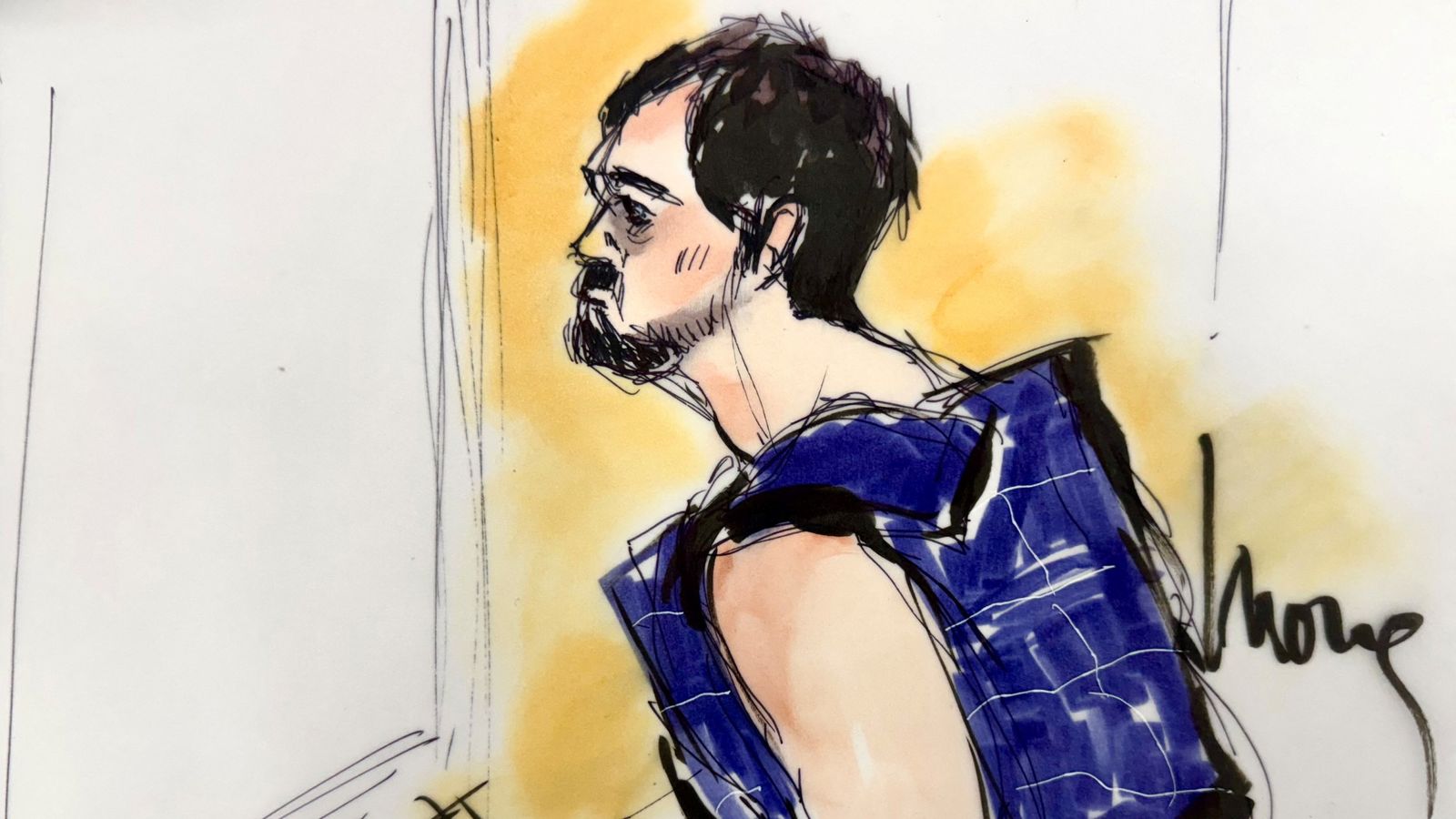
Rob Reiner’s son Nick made his first court appearance on Wednesday on two counts of first-degree murder in the killing of his parents.
Wearing a suicide prevention smock and shackles, the 32-year-old did not enter a plea as he appeared from behind the glass wall of a custody area.
His next court appearance will be on 7 January.
As it happened: Nick Reiner makes first court appearance
Nick Reiner makes his first court appearance on murder charges in this courtroom sketch. Pic: Reuters/Mona Edwards
Nick Reiner spoke only to say, “yes, your honour” to agree to the date.
He was charged Tuesday with killing the 78-year-old actor and director Rob Reiner and his wife, Michele Singer Reiner, Los Angeles County District Attorney Nathan Hochman announced at a news conference.
Nick Reiner is being held without bail and could face the death penalty.
Along with the two counts of first-degree murder, prosecutors added a special circumstance of multiple murders, as well as an allegation that he personally used a dangerous and deadly weapon, a knife.
Speaking outside the court, Nick Reiner’s lawyer, Alan Jackson, called on the public not to “rush to judgement”.
Mr Jackson pointed to “complex and serious issues that are associated with this case” that needed to be thoroughly and “very carefully dealt with and examined”.
He added that it was a “devastating tragedy that has befallen the Reiner family”.
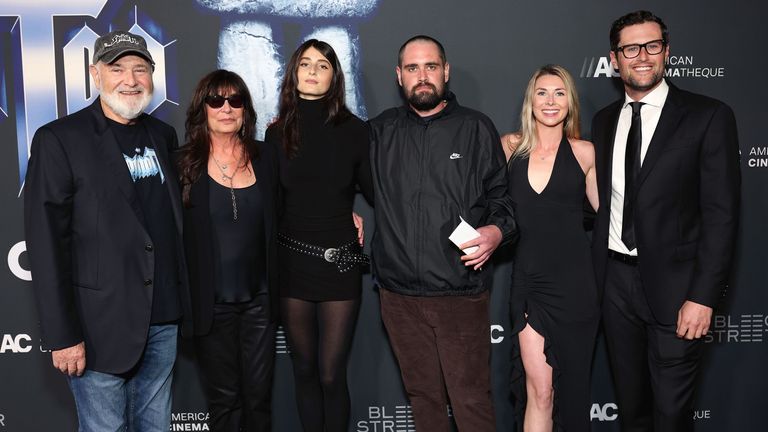
Rob Reiner, Michele Singer Reiner, Romy Reiner, Nick Reiner, Maria Gilfillan and Jake Reiner. Pic: JanuaryImages/Shutterstock
‘Unimaginable pain’
Nick Reiner’s two siblings Jake and Romy have released a statement, saying “words cannot even begin to describe the unimaginable pain we are experiencing every moment of the day”.
“The horrific and devastating loss of our parents, Rob and Michele Reiner, is something that no one should ever experience,” they said.
“They weren’t just our parents; they were our best friends. We are grateful for the outpouring of condolences, kindness, and support we have received not only from family and friends but people from all walks of life.”
The two asked for “respect and privacy” and for speculation to be treated with “compassion and humanity”.
Authorities have not disclosed a motive for the killings.
Rob Reiner and Michele Singer Reiner were found dead from apparent stab wounds in their home in the upscale Brentwood neighbourhood of Los Angeles.

The area near Rob Reiner’s home. Pic: AP
Read more from Sky News:
Moment Nick Reiner arrested for murder of his parents
Could Reiner actually face the death penalty?
Nick Reiner did not resist when he was arrested hours later near the University of Southern California, about 14 miles (22.5 kilometres) from the crime scene, according to police.
Rob Reiner was a celebrated director, whose work included some of the most memorable films of the 1980s and 1990s, including This Is Spinal Tap, The Princess Bride, When Harry Met Sally and A Few Good Men.
He met Michele Singer, a photographer, movie producer and advocate for LGBTQ+ rights, in 1989, while directing When Harry Met Sally.
Warner Bros is reportedly set to reject a hostile $108bn (£81bn) takeover bid from Paramount, with one of the prospective buyer’s financing partners confirming it’s pulled out of the offer.
A spokesman for investment firm Affinity, owned by Donald Trump‘s son-in-law Jared Kushner, told Sky News’ US partner network NBC News “the dynamics of investment have changed significantly”.
It had backed Paramount’s bid, along with funds from Saudi Arabia and other Middle Eastern countries.
Bloomberg and The Wall Street Journal report the Warner Bros Discovery board are set to advise shareholders to reject Paramount‘s bid – paving the way for Netflix, which had struck a $72bn (£54bn) deal.
If the takeover goes through, it would give the streaming giant the rights to hit Warner franchises like Harry Potter, Batman, and Game Of Thrones, as well an extensive back catalogue of classic films.
Money latest: Oil prices fall to lowest level since 2021
Pic: iStock
It is the latest twist in a takeover saga where the winner will acquire a huge advantage in the streaming wars.
In June, Warner announced its plan to split into two companies – one for its TV, film studios and HBO Max streaming services, and one for the Discovery element of the business, which primarily comprises legacy TV channels that show cartoons, news, and sports.
Netflix agreed a $27.75 per-share price with the firm, which equates to the $72bn purchase figure deal to secure its film and TV studios, with the deal giving the assets a total value of $82.7bn.
However, Paramount said its offer would pay $30 (£22.50) cash per share, representing $18bn (£13.5bn) more in cash than its rival offered. The offer was made directly to shareholders, asking them to reject Netflix’s deal, in what is known as a hostile takeover.
The Paramount deal would involve rival US news channels CBS and CNN being brought under the same parent company.
Read more:
Why is Warner Bros for sale and how is Trump involved?
The US government will have a big say on the final deal, with the winning company likely facing the Department of Justice’s (DOJ) Antitrust Division, a federal agency which scrutinises business deals to ensure fair competition.
-
 Sports2 years ago
Story injured on diving stop, exits Red Sox game
-
 Sports3 years ago
‘Storybook stuff’: Inside the night Bryce Harper sent the Phillies to the World Series
-
 Sports2 years ago
Game 1 of WS least-watched in recorded history
-
 Sports3 years ago
Button battles heat exhaustion in NASCAR debut
-
 Sports3 years ago
MLB Rank 2023: Ranking baseball’s top 100 players
-
Sports4 years ago
Team Europe easily wins 4th straight Laver Cup
-
 Environment3 years ago
Japan and South Korea have a lot at stake in a free and open South China Sea
-
 Environment1 year ago
Here are the best electric bikes you can buy at every price level in October 2024