
The most frustrating and infuriating play in football? Dropping the ball before the end zone


-
Kyle Bonagura, ESPN Staff Writer
AUTZEN STADIUM WAS in a state of pandemonium Saturday night after Oregon‘s Noah Whittington bolted 100 yards on a kickoff return for what was presumed to be a game-tying, fourth-quarter touchdown against Boise State.
But just as the Ducks were about to kick the extra point to make the score 34-34, referee Chris Coyte waved for a stoppage and turned on his microphone.
“The play is under review,” he said. “The runner may have let the ball go before crossing the goal-line plane.”
Gasp.
Sure enough, replay showed Whittington had committed one of football’s cardinal sins, letting go of the ball just shy of the end zone as he began to celebrate.
But within seconds, Coyte popped back on the microphone with a confusing explanation: “After review, the ruling on the field is confirmed,” he said. “It’s a touchdown.”
The initial replays on the television broadcast were incomplete. They showed Whittington dropping the ball but left out the key element that followed. Oregon’s Jayden Limar, part of Whittington’s escort down the sideline, briefly ran past the fumbled ball, but he turned around and quickly picked it up to avoid a disaster of epic proportions. (He was officially credited with a 0-yard kickoff return for a touchdown.)
Nearby on the sideline, Ducks coach Dan Lanning cycled through the gamut of emotions as anger turned to relief.
“Believe it or not, it’s a situation that we coach a lot, and obviously we don’t coach it well enough,” he said. “That ball should make it all the way in the end zone and be handed to the official. But I promise we’ll be coaching that really hard here moving forward.”
The act of dropping the ball before the end zone isn’t exactly an epidemic in college football, but it happens regularly enough — maybe a few times a season — to instill collective fear across the country. Several coaches emphasized to ESPN this summer that it’s a real concern and something many of them address regularly with their players throughout the year.
“I see it all the time on TV, and I cringe because I have not been a part of it yet,” Kansas State coach Chris Klieman said.
“Yet,” as in this embarrassing play is always looming, ready to disrupt a football game at the most inopportune moment.
WHEN OREGON FANS heard Coyte’s reason for stopping the game Saturday, it would have been only natural for them to recall perhaps the most consequential act of “Dropping the Ball Before the End Zone” in college football history.
In fact, it’s a safe bet many people looked to the person next to them and asked, “Did he just pull a Kaelin Clay?”
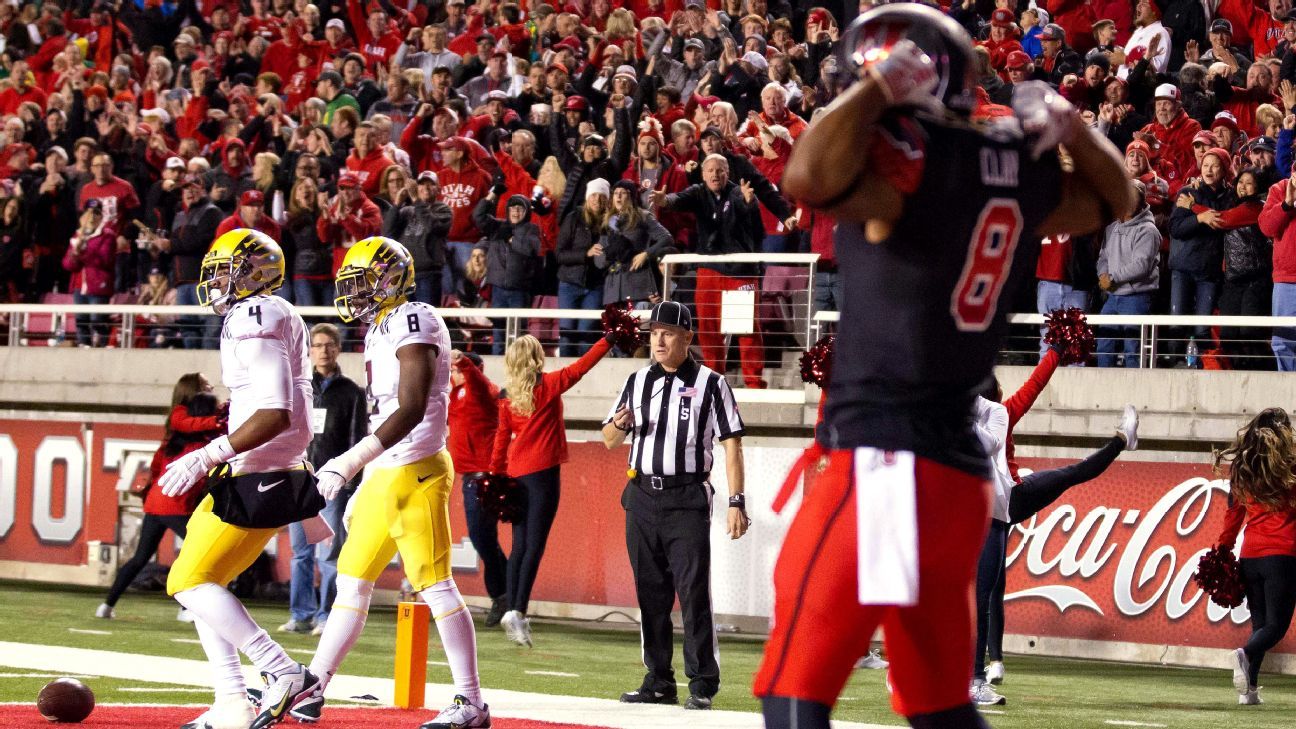
On Nov. 8, 2014, No. 4 Oregon visited No. 17 Utah for a game that would have massive postseason implications in the first season of the College Football Playoff. The Ducks (8-1) were led by the eventual Heisman Trophy winner, Marcus Mariota, and needed to avoid a second loss to stay in the playoff mix.
Utah jumped out to a 7-0 lead, and on the first play of the second quarter, quarterback Travis Wilson hit Clay on a deep pass and he raced for what appeared to be a game-changing 79-yard score. Fireworks were set off in the stadium, and for 15 seconds, the TV broadcast focused on the celebration before awkwardly transitioning to an aerial shot of Oregon’s Joe Walker running with the ball in the other direction.
4:11
Utah WR Drops Ball Before Scoring, Oregon Runs It Back
Travis Wilson completes a 78-yard pass to Kaelin Clay, but Clay fumbles just before scoring. Oregon DB Erick Dargan recovers the ball and fumbles, and LB Joe Walker returns it 100 yards for a TD.
Walker was on the opposite 15-yard line before broadcaster Brad Nessler spoke for everyone by asking, “What’s going on on the field here?”
Clay’s fumble was obstructed in the live television shot, but the replay showed he had let go of the football before crossing the plane. Oregon’s Erick Dargan initially attempted to pick it up before Walker got possession and — in one of the most heads-up plays of all time — flipped what appeared to be a 14-point deficit into a tie game.
It’s impossible to say how things would have played out if Utah had gone up 14-0, but the Ducks quickly built on their good fortune and built a 24-7 second-quarter lead before winning 51-27.
“A huge turn of events, obviously, on the fumble going into the end zone,” Oregon coach Mark Helfrich said at the time. “A great lesson for all of us.”
Oregon would win its next three games to secure the Pac-12 title and the No. 2 seed in the playoff, where it beat Florida State before losing to Ohio State in the title game.
For Utah, it’s a moment that lives in infamy.
“It’s something that you certainly teach and practice and drill and hope to never have it occur, particularly in a game, but it did,” Utah coach Kyle Whittingham said. “And Kaelin is a heck of a football player; he felt worse about it than anybody. So it’s one of those things that happens on a very, very rare occasion.”
Whittingham is one of many coaches who instructs his players not only to cross the goal line and hand the ball to the official — the fail-safe way to prevent a repeat occurrence — but also to pick up any loose balls if the play is in question.
Against Washington last year, the Huskies led 33-28 when Alphonzo Tuputala intercepted then-Utah quarterback Bryson Barnes and looked to have returned it 76 yards for a score. It was similar to the Clay play in that the television broadcast showed fans celebrating, flashed a “pick-six” graphic and updated the scoreboard to read 39-28.
But, again, replay revealed the premature celebration and showed Utah’s Michael Mokofisi sprinting from 10 yards away to cover it up at the 1-yard line.
Lesson learned, on one side, at least.
THE PATRON SAINT of premature touchdown celebrations is former NFL receiver DeSean Jackson, whose fumble at the 1-yard line against the Dallas Cowboys as a rookie for the Philadelphia Eagles in 2008 remains the most high-profile example of this unique lapse in concentration.
It was the type of moment that could make someone say, “Well, you know he’ll never make that type of mistake again.”
Except in Jackson’s case, this wasn’t his first time. A few years earlier, in the Army All-American high school football game, Jackson broke free for an easy score before he vaulted himself from the 5-yard line in an attempt to flip into the end zone. He came up a half-yard shy and fumbled the ball in the process.
It’s Jackson’s fumble in the NFL, though, that has gotten the most mileage for coaches as they try to guard against repeat gaffes. Compilation videos are easy to find on YouTube, and coaches have made their own cutups in which Jackson is often shown as the prime example of what not to do.
“He did it in high school and the pros, so we’ve shown all of those to make sure that our guys learn from other people,” Texas Tech coach Joey McGuire said. “That’s one of the deals, like score the football, hand the football to the official and then celebrate with your teammates. That’s what we really try to do.”
The lessons don’t always stick.
In 2021, Louisville receiver Ahmari Huggins-Bruce turned a short completion into a 95-yard score, but coach Scott Satterfield noticed immediately that the officials were not treating it like a touchdown.
“I’m, like, ‘What’s going on?’ And they told me, ‘Coach, he dropped the ball,'” Satterfield said.
It was largely forgotten as part of a 30-3 win against Eastern Kentucky, but not by Satterfield.
“Every August — I mean every August — we show film to our players about that particular play because we’ve seen it,” he said. “Whether it be a Leon Lett situation where Don Beebe runs and knocks the ball out or in this case a guy who lets it go too early, we try to show it. So, that’s the only time that’s happened to me, but man, it’s a bad feeling.”
At TCU, coach Sonny Dykes has made it a habit to show a compilation of about 10-12 clips from college and NFL games on Friday nights before games about what not to do. It’s mostly mental mistakes that can unnecessarily swing a game, and three staples are Jackson’s fumble with the Eagles, Clay’s against Oregon and a similar example in Cal‘s win against Texas in 2016, when Dykes was coaching the Golden Bears.
With 1 minute, 22 seconds left and Cal leading 50-43, running back Vic Enwere rushed for what appeared to be a 55-yard touchdown only to enter the premature celebration club by letting go at the 1.
“Vic was like, ‘Yeah, I thought I scored,’ and it was really in style at the time,” Dykes said. “I think the guys wanted to drop it as soon as they could and it was kind of a thing, but he didn’t mean anything by it.”
The play was ruled a touchdown on the field only to be overturned on replay. However, the officiating crew ruled that because there wasn’t an immediate recovery by Texas, the Bears would take over where Enwere dropped the ball. It was a controversial decision because a Texas player did pick it up in the end zone before handing it to an official.
“He handed it to whoever was near the play,” said Mike Defee, the game’s referee and current coordinator of officials for the Mountain West. “If he had picked it up and started to run the other direction, maybe it would’ve been interpreted differently. But his body language showed that he thought the play was over.”
Instead of a Texas touchback, Cal took over at the 1-yard line and kneeled out the clock.
“[Texas coach] Charlie Strong was losing his mind,” Defee said. “He felt like they should have got the ball. It was a big play, but it got to the point where I explained to him the rules are very specific about how we handle this. Your guys didn’t pick up on the fact that it was loose and didn’t do anything with it.”
As this type of play became more of a known issue, officiating crews have also become more adept at noticing it in real time, although it’s not always immediately obvious.
“These plays probably drive coaches crazy,” Defee said. “It drives us crazy because it puts us in a tough situation, but I think for young players, they’re thinking they just made a tremendous play. They’re scoring. I think that it’s a loss of focus on their standpoint, but it creates another dimension for us.
“If we see the ball loose, obviously we want to keep officiating. But if there’s no one that we pick up visually that is making that attempt to recover the ball, we’re going to give it a healthy two, three seconds or so before we kill the play and then invoke the rule that covers that.”
EVEN THE BEST coaching can’t prevent these fumbles.
It happened to a Nick Saban-led team last year on what should have been a 79-yard touchdown for Alabama. It happened to Bob Stoops’ Oklahoma team in 2016, although the officials missed it and Joe Mixon got away with it. (It appears to be a coincidence that both Hall of Fame coaches retired after those seasons.)
0:58
Alabama QB drops the ball before crossing the goal line
Ty Simpson breaks free for the longest run by an Alabama QB in over 20 seasons, but drops the ball just short of the goal line.
It has happened to Dabo Swinney’s Clemson Tigers and Kirby Smart’s Georgia Bulldogs.
And as much as coaches teach it and fans scream at the television, it will almost certainly happen again.
In those instances, the players will need to pick themselves (and, hopefully, the ball) up and move forward.
“It’s something we can learn from,” Lanning said, echoing Helfrich from 2014. “I think if you’re not learning as coaches and players, then you’re not doing your job.”
Until then, the coaches — unlike the players in those infamous moments — will refuse to drop it.
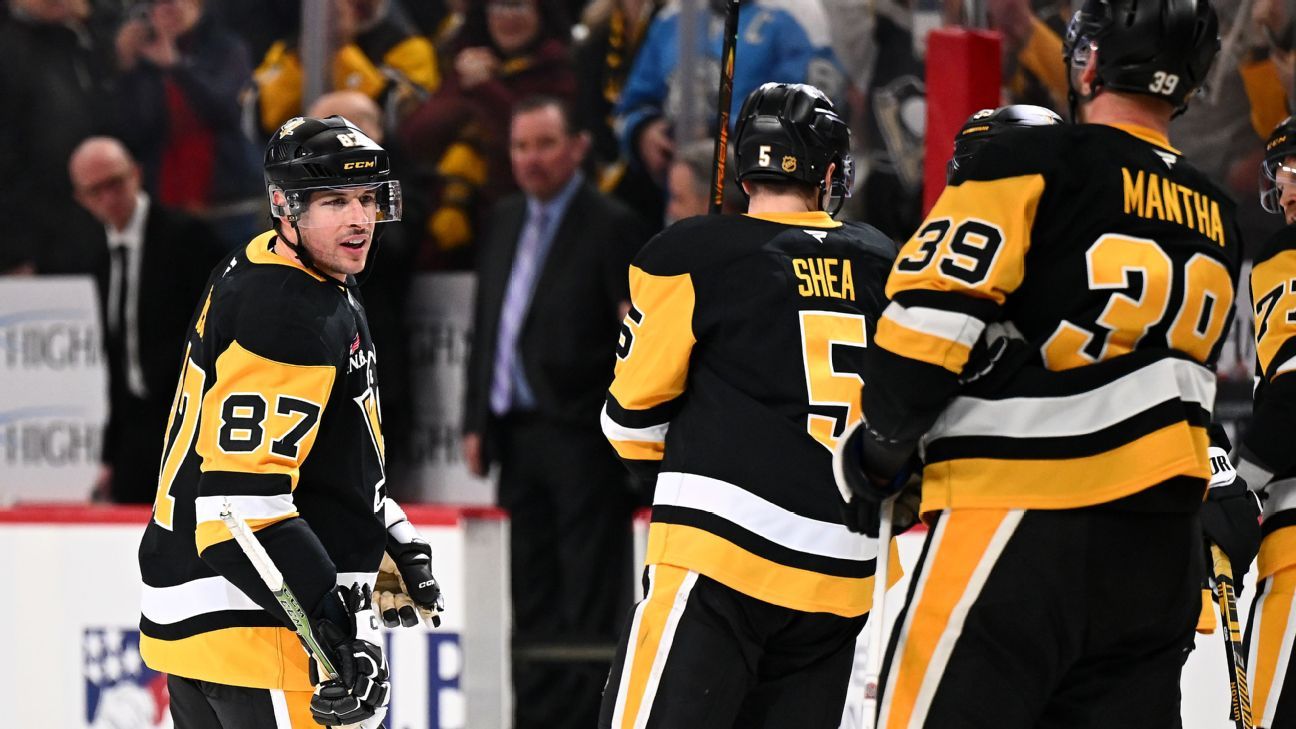
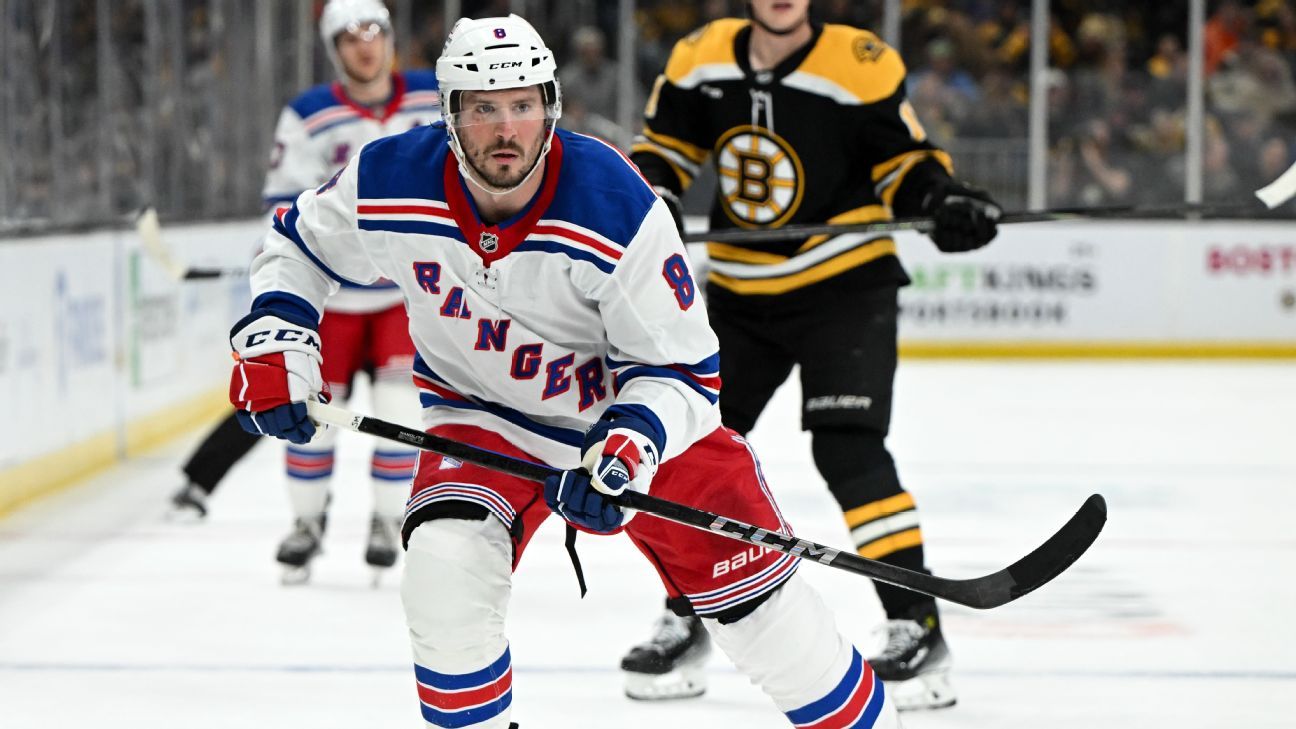
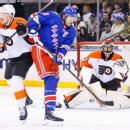
NASHVILLE, Tenn. — New York Rangers captain J.T. Miller will miss at least one game after getting injured Saturday and is not traveling with the team to Nashville.
Coach Mike Sullivan said Miller was still being evaluated back home for an upper-body injury and would not play Sunday night against the Predators.
Miller left the Rangers’ game against Philadelphia with about eight minutes left after taking a big hit from Flyers defenseman Nick Seeler and landing awkwardly. The 32-year-old forward appeared to be favoring his right arm or shoulder while in pain on the bench and skating off to go down the tunnel for medical attention.
“You don’t want to lose any teammates,” center Mika Zibanejad said. “When you see your captain go down and you don’t see him come back, that obviously becomes [a situation] for us to step up and everyone has to do a little more when a guy like that leaves. Just hoping everything is OK.”
Miller was named captain before training camp. He has 10 goals and 12 assists in 35 games this season and is believed to be in consideration for the U.S. Olympic team, though it’s unclear whether this injury could cloud that possibility.
-
 Sports2 years ago
Story injured on diving stop, exits Red Sox game
-
 Sports3 years ago
‘Storybook stuff’: Inside the night Bryce Harper sent the Phillies to the World Series
-
 Sports2 years ago
Game 1 of WS least-watched in recorded history
-
 Sports3 years ago
Button battles heat exhaustion in NASCAR debut
-
 Sports3 years ago
MLB Rank 2023: Ranking baseball’s top 100 players
-
Sports4 years ago
Team Europe easily wins 4th straight Laver Cup
-
 Environment3 years ago
Japan and South Korea have a lot at stake in a free and open South China Sea
-
 Environment1 year ago
Here are the best electric bikes you can buy at every price level in October 2024