

‘Send help’: The desperate pleas from Hurricane Melissa survivors

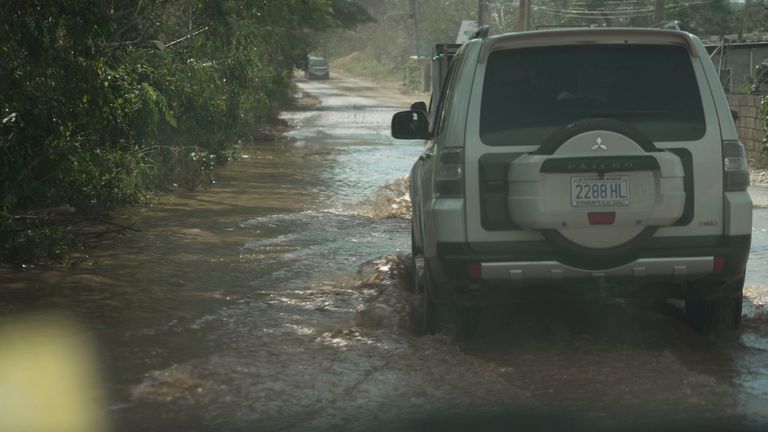
Driving through western Jamaica, it’s staggering how wide Hurricane Melissa’s field of destruction is.
Town after town, miles apart, where trees have been uprooted and roofs peeled back.
Some homes are now just a pile of rubble, and we still don’t know how deadly this storm has been, although authorities warn the death toll will likely rise.
A total of 49 people have died in Melissa’s charge across the Caribbean – 19 in Jamaica alone.
Roads are still flooded in Jamaica
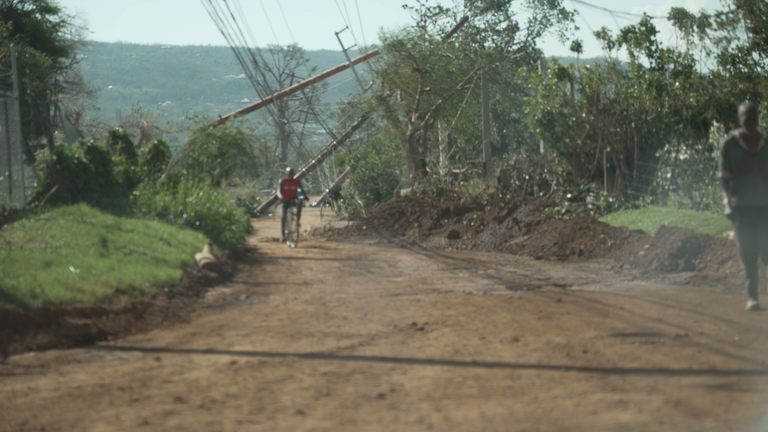
The storm has blown over telephone poles, which are blocking the roads
My team and I headed from Kingston airport, towards where the hurricane made landfall, referred to as “ground zero” of this crisis.
On the way, it’s clear that so many communities here have been brought to their knees and so many people are desperate for help.
We drive under a snarl of mangled power lines and over huge piles of rocks before reaching the town of Lacovia in Saint Elizabeth Parish.
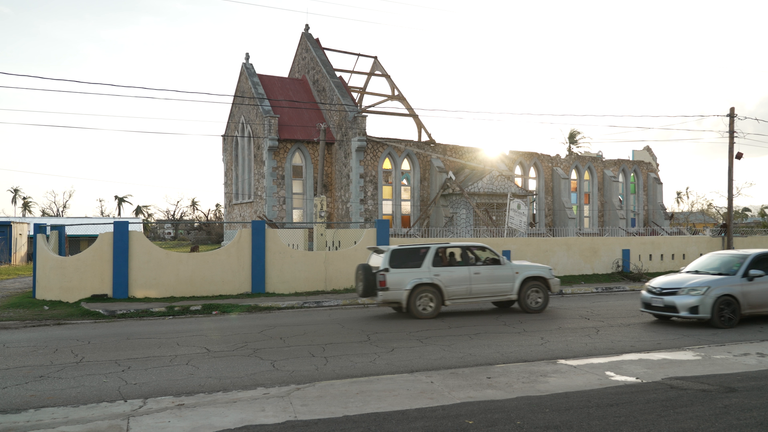
The hurricane stripped the entire roof off this church
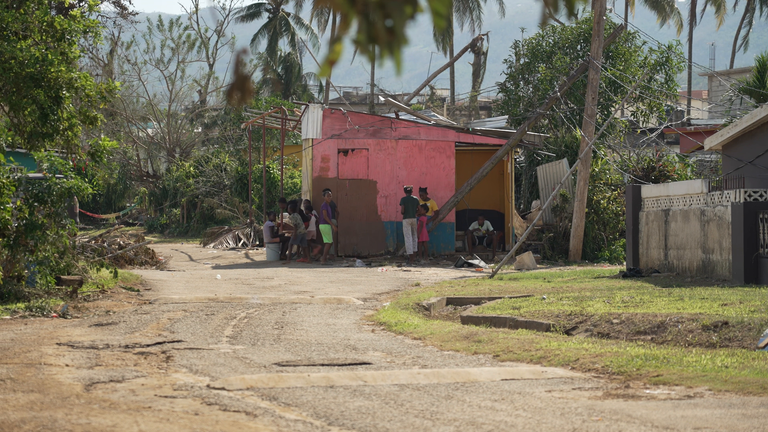
Many children live in homes with caved-in roofs
At the side of the road, beside a battered and sodden primary school, a woman wearing a red shirt and black tracksuit bottoms holds a handwritten sign in the direction of passing cars.
“Help needed at this shelter,” it says. The woman’s name is Sheree McLeod, and she is an admin assistant at the school.
She is in charge of a makeshift shelter in the school, a temporary home for at least 16 people between the ages of 14 and 86.
I stop and ask what she needs and almost immediately she begins to cry.
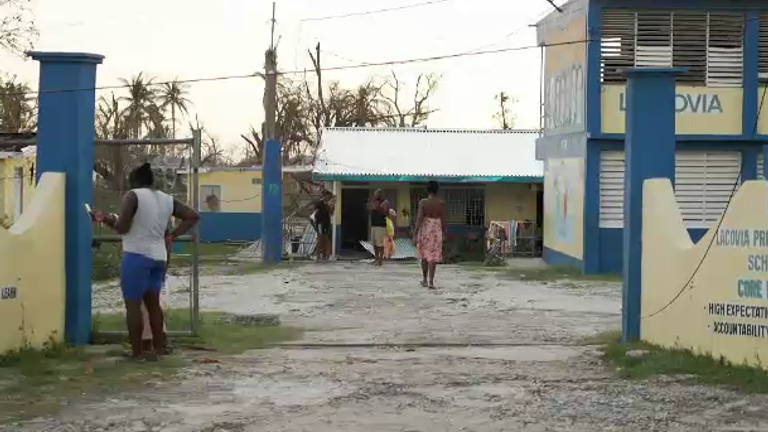
The primary school that has been housing those with no other place to stay
‘No emergency teams’
“I’ve never seen this in my entire life,” she says. “It’s heartbreaking, I never thought in a million years that I would be in the situation trying to get help and with literally no communication.
“We can’t reach any officials, there are no emergency teams. I’m hoping and praying that help can reach us soon.
“The task of a shelter manager is voluntary and the most I can do is just ask for help in whatever way possible.”
Read more:
Before and after images show hurricane’s destruction
What we know from the ground following the devastation
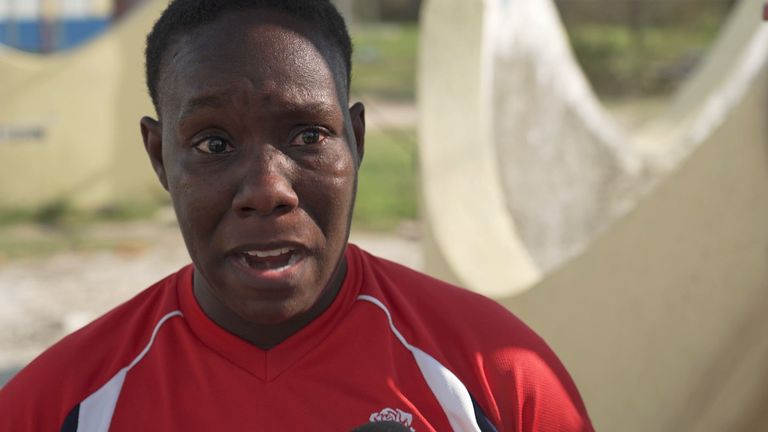
Sheree McLeod pleads for help for those sheltering at the school
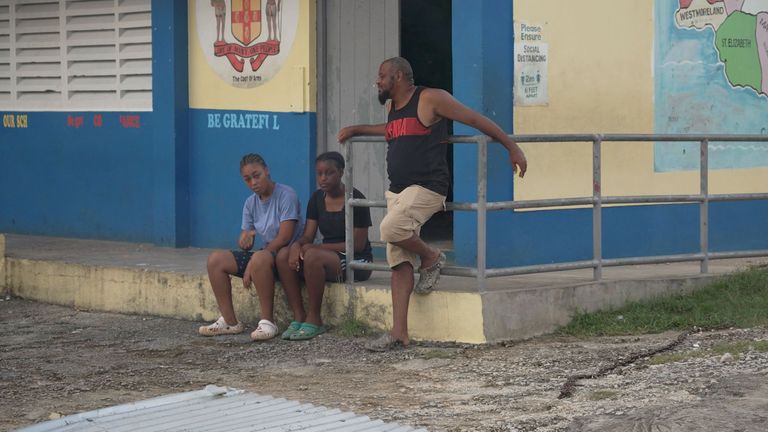
At least 16 people currently live at the school, which is being used as a temporary shelter
Sheree shows me the classroom where she and 15 other people rode out the hurricane which she says hung over the town for hours.
They had just a sheet of tarpaulin against the window shutters to try to repel gusts of more than 170mph and a deluge of rain.
They took a white board off the wall to try to get more shelter.
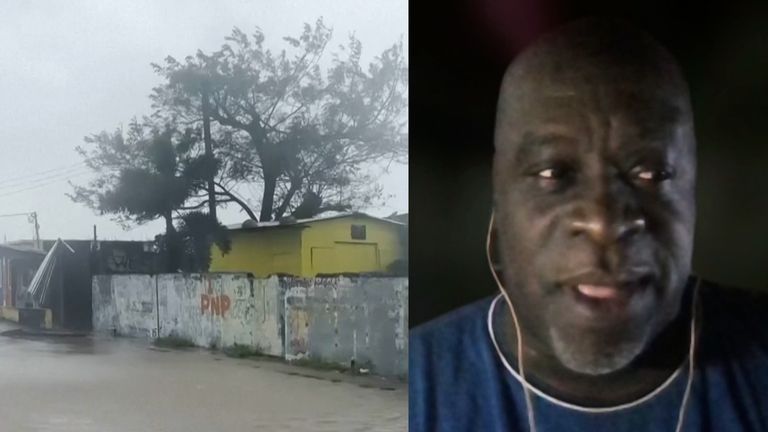
Hurricane Melissa was ‘traumatising’
“It was very terrible,” Sheree says. “We were given eight blankets for the shelter and that was it, but there were 16 people.
“Now all their clothes and blankets that they were provided with got damaged. Some people are sleeping in chairs and on wooden desks.”
Her plea for help is echoed across this part of Jamaica.
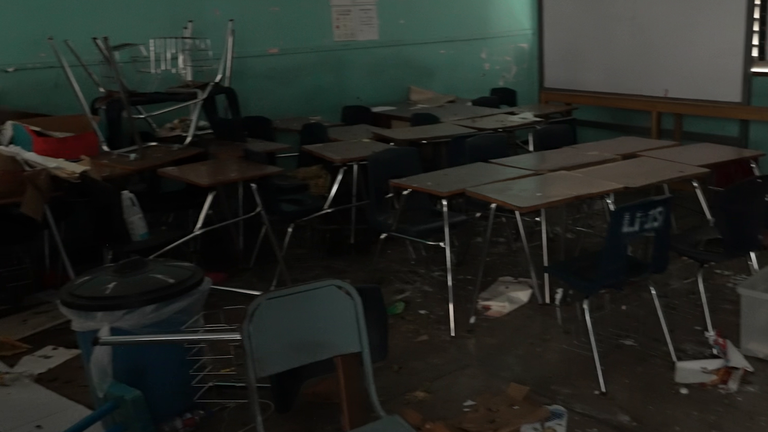
Toppled-over chairs and rubbish line a classroom in the school
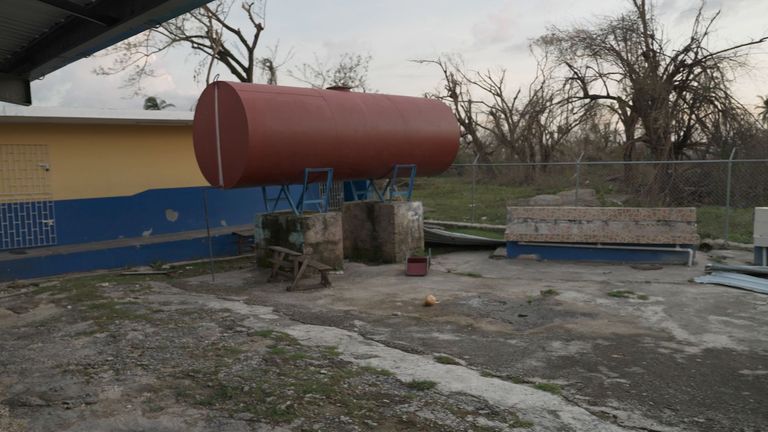
The water tank at the school has run out
As we’re filming a pile of wooden slats that used to be a house, a passing motorcyclist shouts: “Send help, Jamaica needs help now.”
The relief effort is intensifying. After I leave Sheree, a convoy of army vehicles speed past in the direction of Black River, the town at the epicentre of this disaster.

Listen to The World with Richard Engel and Yalda Hakim every Wednesday
Diggers work to clear debris from the road late into the night. Ambulance sirens also grow more regular as the day goes on.
Help is coming and for many here, it can’t come soon enough.

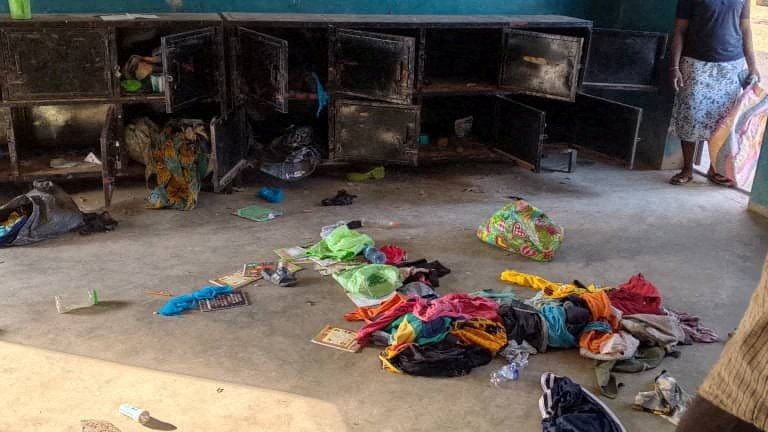
The remaining 130 schoolchildren and staff abducted by gunmen from a Catholic school in Nigeria last month have been freed.
They are among more than 300 pupils and 12 staff taken from St Mary’s Catholic boarding school in Niger State on 21 November.
Fifty children managed to escape at the time, the Christian Association of Nigeria previously said, while the government said on 8 December that it had rescued 100 of those abducted.
Belongings and clothes left behind at St Mary’s School after the kidnapping. Pic: Reuters
Now the last of the pupils have been released, a spokesman for President Bola Tinubu said, bringing a close to one of the country’s biggest mass kidnappings in recent years.
“The remaining 130 schoolchildren abducted by terrorists… have now been released,” wrote presidential spokesman Bayo Onanuga in a post on X.
“They are expected to arrive in Minna on Monday and rejoin their parents for the Christmas celebration.
“The freedom of the schoolchildren followed a military-intelligence driven operation.”
The abduction has fuelled outrage over worsening insecurity in northern Nigeria, where armed gangs frequently target schools for ransom.
School kidnappings surged after Boko Haram militants abducted 276 girls from Chibok in 2014.
Over a decade later, dozens of the girls taken on that occasion remain missing.
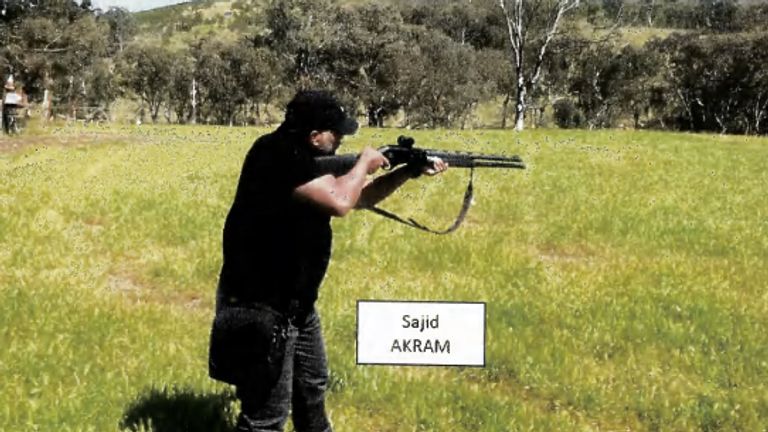
A man suspected of killing 15 people during a shooting in Bondi Beach “conducted firearms training” with his father before the attack on a Jewish event, Australian police have said.
Naveed Akram, 24, and his father, Sajid Akram, allegedly attacked people at a Hanukkah event at Bondi Beach on 14 December, killing victims aged 10 to 87 and injuring 40 others.
Fifty-year-old Sajid Akram was killed by police at the scene, while Naveed was injured and treated in hospital. He has since been charged with 59 offences, including a terror charge, and police transferred him to a prison on Monday.
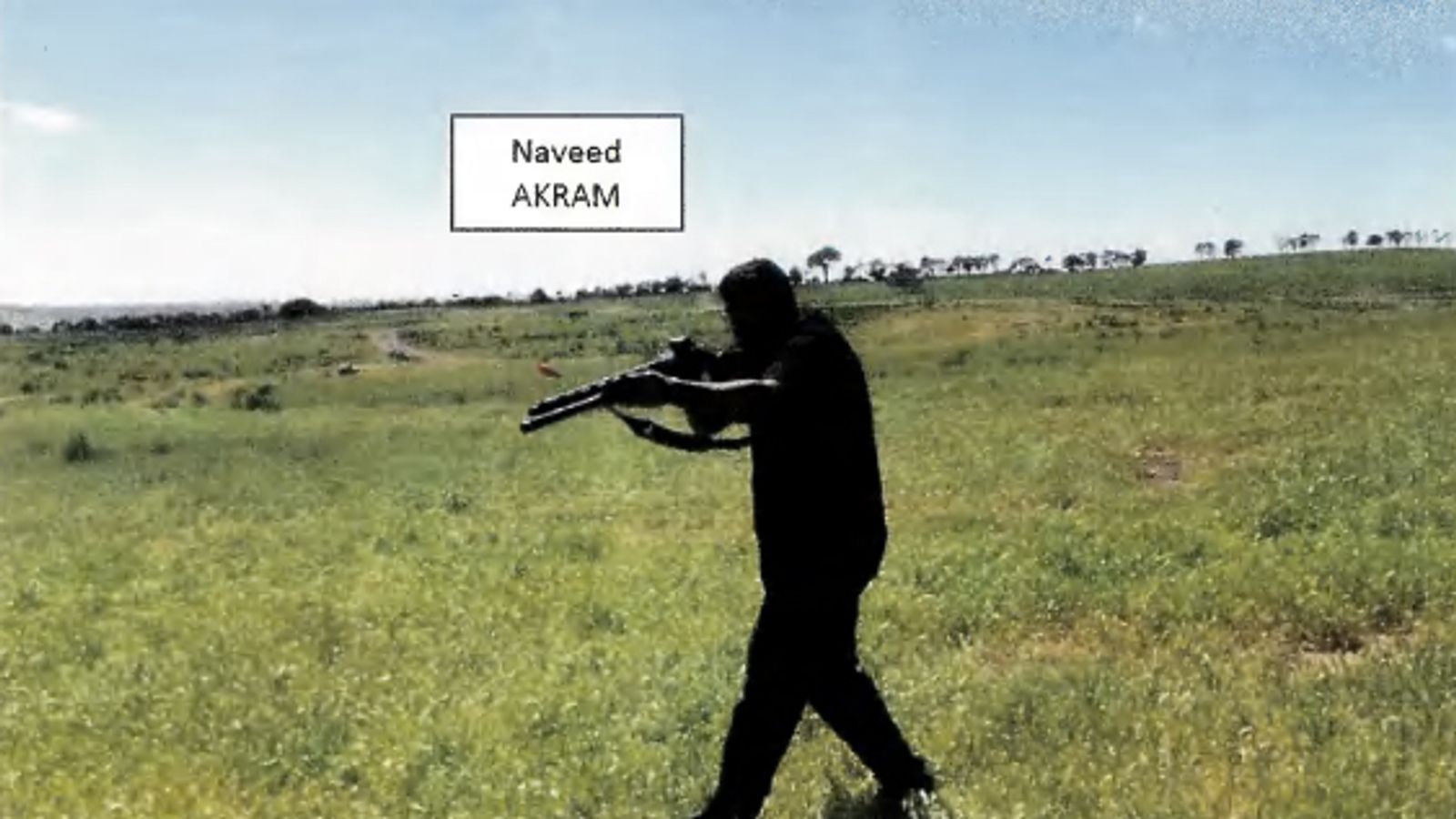
New South Wales Police have released pictures of Naveed Akram and his father holding guns, as they “conducted firearms training in a countryside location, suspected to be NSW” in late October, according to a police fact sheet seen by Sky News.
Suspected gunman Sajid Akram during the alleged firearms training with his son. Pic: NSW Police/NSW Local Court
“The accused and his father are seen throughout the video firing shotguns and moving in a tactical manner,” police said.
‘Homemade bombs’
On the day of the Bondi Beach attack, the pair allegedly threw homemade bombs and improvised explosive devices (IEDs) at the crowd of people at the gathering near the beach, but these did not detonate.
An analysis indicates that both were “viable” IEDs, according to the police file.
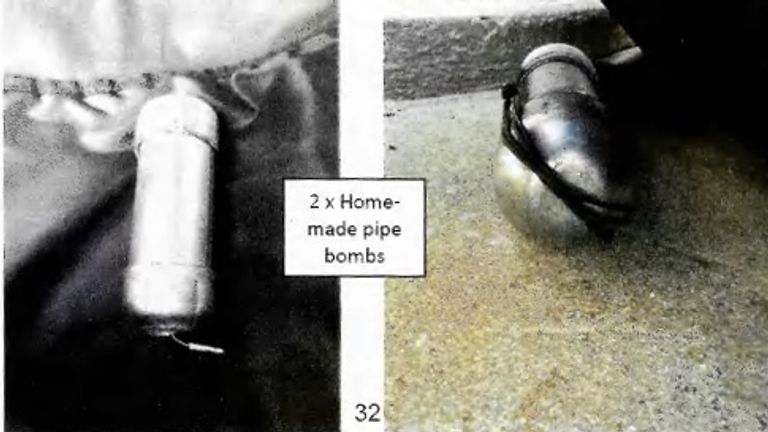
The suspected gunmen were allegedly armed with pipe bombs. Pic: NSW Police/NSW Local Court
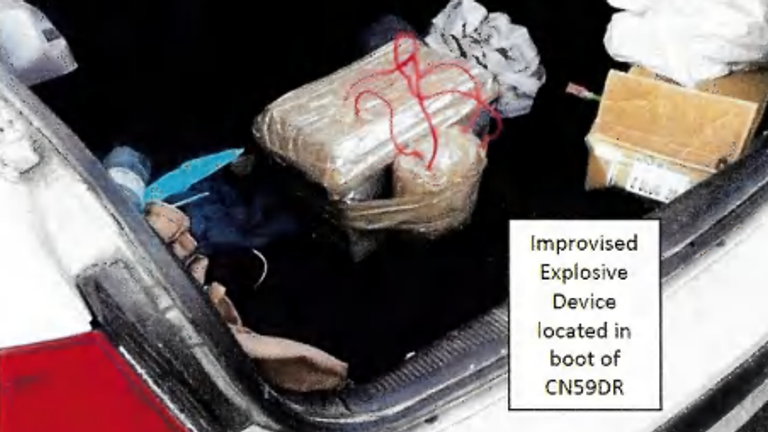
Police said they found an IED in the suspects’ car. Pic: NSW Police/NSW Local Court
The information on the fact sheet was released after a suppression order was lifted by an NSW court.
Police allege the men had stored the explosives – three pipe bombs, one tennis ball bomb and one large IED – in a silver Hyundai vehicle, alongside two single-barrel shotguns, a Beretta rifle and two Islamic State flags.
The Hyundai was parked near the scene of the shooting, with the Islamic State flags allegedly displayed in the front and rear windows.
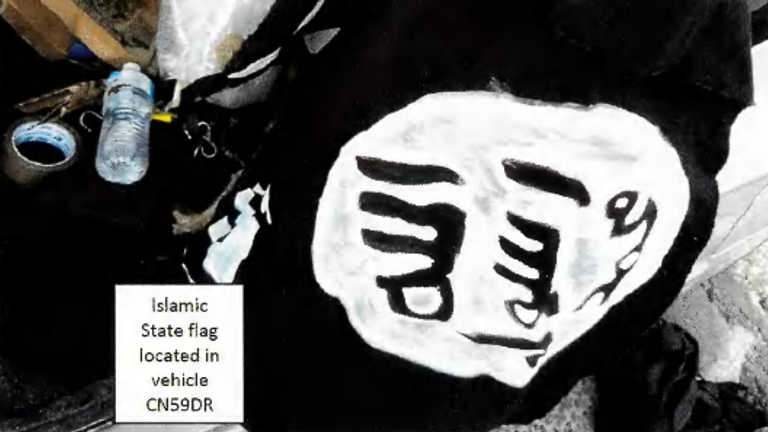
A homemade Islamic State flag was also found in the car, police said. Pic: NSW Police/NSW Local Court
‘Justification’ video found
A phone belonging to Naveed Akram was also found in the car, on which officers identified several videos, including the alleged firearms training video.
Another video shows Naveed Akram and his father sitting in front of an image of an Islamic State flag, with four long-arm guns with rounds attached seen in the background, police said.
The men “appear to summarise their justification for the Bondi terrorist attack” in the footage, according to the fact sheet.
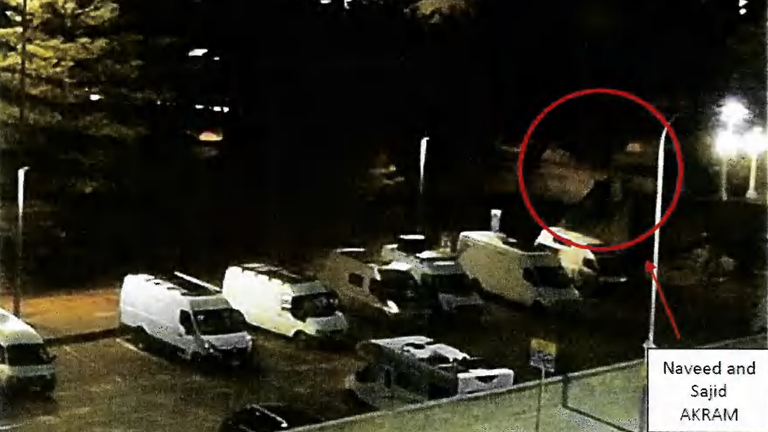
Police said the men walked on the footbridge from where they allegedly shot at crowds two days later. Pic: NSW Local Court
Their Hyundai was previously seen on CCTV entering the car park at Bondi Beach before Naveed Akram and his father walked around the area at around 10pm on 12 December – two days before the shooting.
Police allege that this is evidence of reconnaissance and planning of a terrorist act.
On the day of the shooting, CCTV showed the men leaving a rental house in the nearby suburb of Campsie at around 3pm before driving to Bondi at around 5pm, police said.
The pair were seen carrying bulky items wrapped in blankets, which officers allege were the rifles and homemade bombs.
In the room they rented throughout December, police said they later discovered a firearm scope, ammunition, a suspected IED, 3D-printed parts for a shotgun speed loader, a rifle, a shotgun, numerous firearms parts, bomb-making equipment and two copies of the Koran.
Police said Naveed Akram’s mother told officers that she believed her husband and son were on a fishing trip when they allegedly launched the attack. She said Naveed had been calling her every day from a public phone at around 10.30am.
New gun laws
Meanwhile, the NSW government announced new draft gun laws on Monday, which the state’s premier, Chris Minns, promised would be the toughest in Australia.
The new restrictions would include making Australian citizenship a condition of qualifying for a firearms licence.
But a law like this would have excluded Sajid Akram, who was an Indian citizen with a permanent resident visa for Australia.
Read more from Sky News:
On the ground in Venezuela as US threatens military intervention
NHS reported to police after ‘butcher surgeon’ evidence destroyed
He also legally owned six rifles and shotguns, which would be limited to a maximum of four guns under the new legal limit for recreational shooters.
This comes as Australia’s Prime Minister Anthony Albanese said on Monday that his government would introduce a new offence of adults trying to influence and radicalise children after already introducing legislation to criminalise hate speech and doxing.
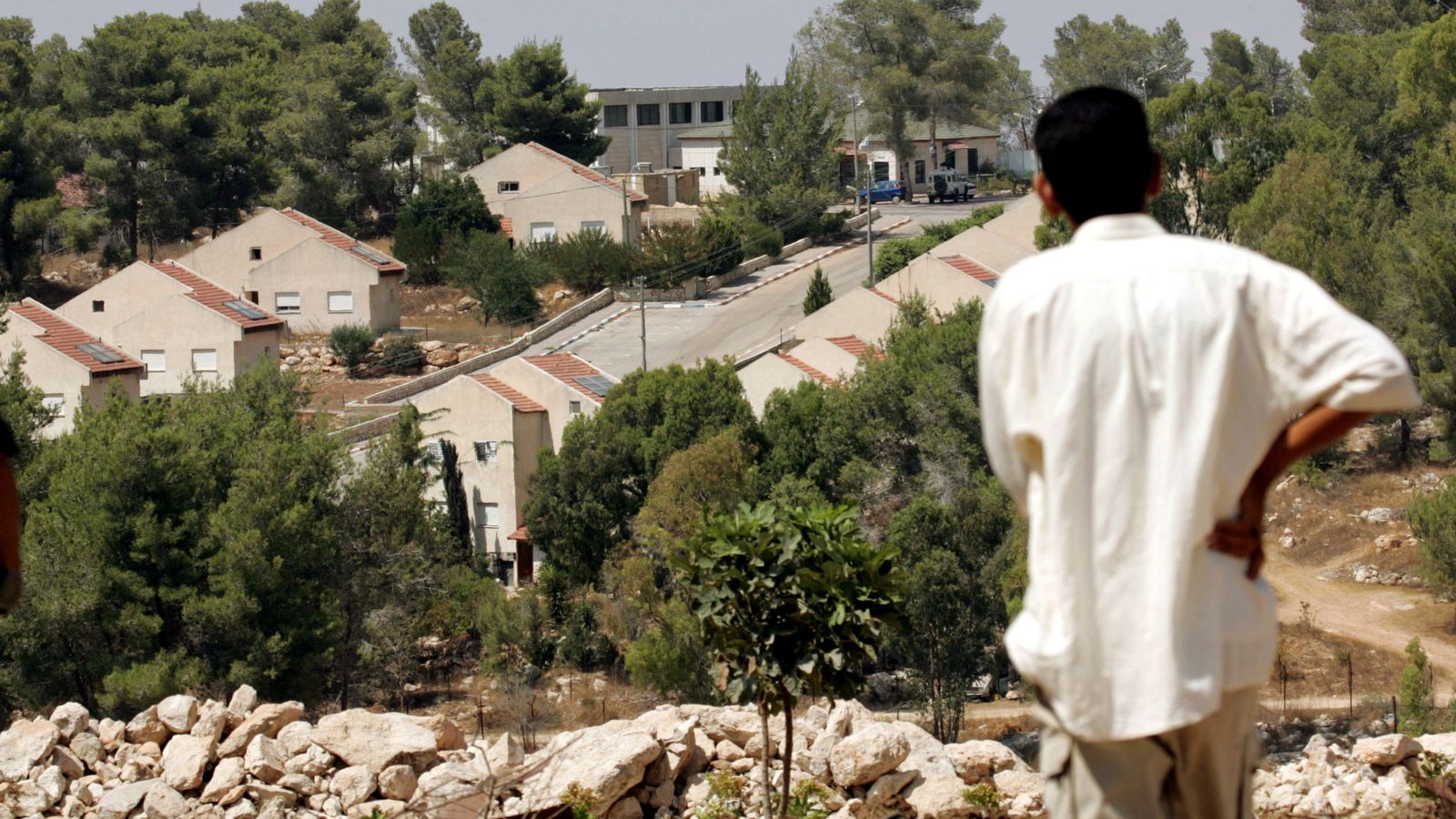
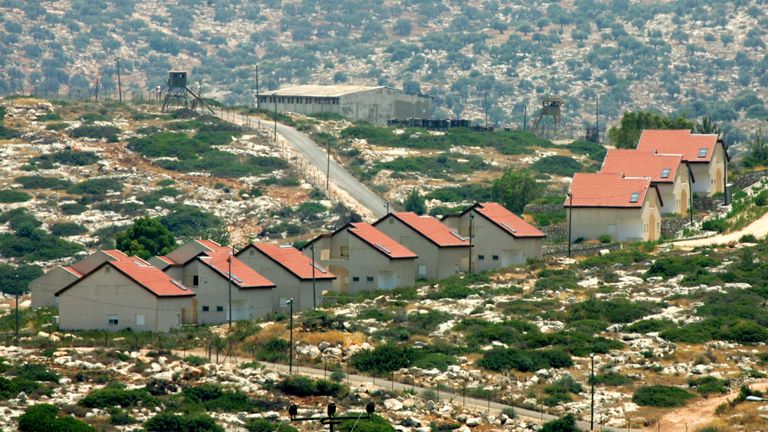
Israel has approved 19 new Jewish settlements in the occupied West Bank in a fresh blow to the possibility of a Palestinian state.
The move brings the number of new settlements over the past few years to 69, a new record, according to Israel‘s far-right finance minister Betzalel Smotrich.
Widely considered illegal under international law, the settlements have been criticised for fragmenting the territory of a future Palestinian state by confiscating land and displacing residents.
Ganim pictured in 2005. Pic: Reuters
Under Israel’s current government, figures show, the number of settlements in the West Bank has surged by nearly 50%, rising from 141 in 2022, to 210 with the new approvals, according to Peace Now, an anti-settlement watchdog.
The government’s latest action retroactively authorises some previously-established outposts or neighbourhoods of existing settlements, and the creation of settlements on land where Palestinians were evacuated.
It also approves Kadim and Ganim, two of the four settlements dismantled in 2005, and which Israelis were previously banned from re-entering as part of Israel’s withdrawal from the Gaza Strip.
Since Israel repealed the 2005 act in March 2023, there have been multiple attempts to resettle them.

Betzalel Smotrich is among prominent names backing the settlements. Pic: AP
The move comes amid mounting pressure from the US to move ahead with the second phase of the Gaza ceasefire, which took effect on 10 October.
Mr Smotrich is one of a number of figures now prominent in Israel’s government who back the settlements.
The West Bank, east Jerusalem, and Gaza are claimed by the Palestinians for their future state, but were captured by Israel in the 1967 war.
Read more:
Analysis: Gaza longs for normality, but quasi-anarchy reigns
Two brothers killed in Israeli drone strike on Gaza
Today over 500,000 Jews are settled in the West Bank, in addition to over 200,000 in contested east Jerusalem.
Settlements can range in size from a single dwelling to a collection of high-rises, and the occupied territories are also host to a number of unauthorised Israeli outposts.
-
 Sports2 years ago
Story injured on diving stop, exits Red Sox game
-
 Sports3 years ago
‘Storybook stuff’: Inside the night Bryce Harper sent the Phillies to the World Series
-
 Sports2 years ago
Game 1 of WS least-watched in recorded history
-
 Sports3 years ago
Button battles heat exhaustion in NASCAR debut
-
 Sports3 years ago
MLB Rank 2023: Ranking baseball’s top 100 players
-
Sports4 years ago
Team Europe easily wins 4th straight Laver Cup
-
 Environment3 years ago
Japan and South Korea have a lot at stake in a free and open South China Sea
-
 Environment1 year ago
Here are the best electric bikes you can buy at every price level in October 2024