
Orioles clinch playoff berth with ‘sense of relief’


-
Jorge Castillo, ESPN Staff Writer
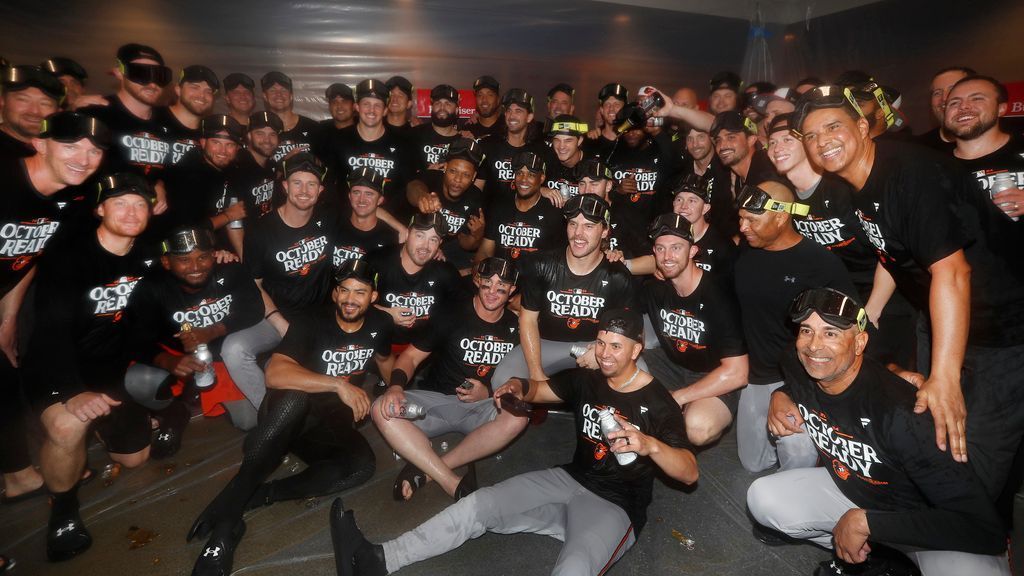
NEW YORK — At 10:35 p.m. ET Tuesday, 14 minutes after the Baltimore Orioles defeated the New York Yankees, a roar erupted inside the visiting clubhouse at Yankee Stadium. The Minnesota Twins had lost to the Miami Marlins, clinching a playoff spot for the Orioles for the second straight season.
It was time to party.
Players, coaches and support staff gathered in the middle of the room to bathe each other in champagne and beer. In one corner, members of the franchise’s ownership group celebrated the achievement. In another, a beverage station for 20-year-old rookie Jackson Holliday was set up with a small tub filled with ice, bottles of “Baby Bird Bath Water,” a toddler-sized No. 7 Holliday jersey and a letter board reading “Baby’s First Clinchmas 2024.”
“We’re so happy we’re going back,” Orioles All-Star right fielder Anthony Santander said with goggles atop his head and puddles of alcohol at his feet.
The road back was very different. Last year, the Orioles were an upstart club that defied projections to coast to 101 wins and the American League East title. This year, there was adversity to reach the playoffs in consecutive years for the first time since 1996 and 1997.
“I think today is a sense of relief,” Orioles general manager Mike Elias said.
Baltimore (87-70) began this season with high expectations and was meeting them, building a three-game division lead as late as July 9. Then came the midseason swoon. Injuries ravaged their roster — first with the starting rotation before spreading to other departments. Closer Craig Kimbrel‘s collapse destabilized the bullpen and led to his release. And the offense, despite teeming with talent that has made the Orioles the envy of other organizations, sputtered for stretches with Gunnar Henderson and Santander as the only steady contributors.
The result has been a mediocre 30-36 record since building that three-game cushion in July, while the Yankees have surged ahead.
“It’s been a tough few months, man,” Orioles manager Brandon Hyde said. “Every game that we win is [tough], it feels like. It just hasn’t come easy. And hopefully, that makes us adversity tested. With the injuries we’ve had, just bad luck a lot of nights too. We just haven’t caught a whole lot of breaks in the second half. And I feel like it can turn.”
The Orioles, even after Tuesday’s win, are just 9-11 in September. They’ve lost key players for the season — including infielder Jorge Mateo and starters John Means and Kyle Bradish. Grayson Rodriguez, another starter, might not pitch again this season as he continues dealing with a lat strain.
And yet the Orioles have become more whole in recent days than they have been in months. Since the start of the month, Baltimore has reinstated seven players from the injured list who are expected to play roles in October: Zach Eflin (shoulder), Ramon Urias (ankle), Heston Kjerstad (concussion), Jacob Webb (elbow), Ryan Mountcastle (wrist), Danny Coulombe (elbow) and All-Star Jordan Westburg (hand).
“We’re trying to get going, and this is great momentum for us,” said Adley Rutschman, an All-Star this season who is batting .183 with four home runs and a .557 OPS in 67 games since June 29.
Winning the division title is still mathematically possible. The Orioles need to win their final five games, while the Yankees need to lose theirs. Chances are that’s not going to happen. The Orioles know that. And they know firsthand it doesn’t matter.
That 101-win team last year didn’t win a game in the playoffs. They converted a bye from the wild-card round into an AL Division Series sweep at the hands of the Texas Rangers, the eventual World Series champions.
Having home-field advantage in the wild-card round, however, is very likely with a four-game edge on the next two teams in the standings. It’s something to play for over the final five days of the regular season. Next week, they’ll be playing for a lot more — again.
“Maybe we can come into the playoffs with a little more peaceful stage of mind,” Elias said, “given how we arrived there this year.”


-
Adam Rittenberg
Indiana is expected to finalize a new three-year contract with offensive coordinator Mike Shanahan, a source confirmed to ESPN on Thursday, as the school reinforces its commitment to coach Curt Cignetti’s staff.
The deal will keep Shanahan as Indiana’s offensive playcaller for the 2026 season and potentially through 2028. Shanahan has worked on Cignetti’s staffs since 2016, at IU-Pennsylvania, Elon and James Madison before coming to Indiana in 2024.
Indiana last week secured a new contract for defensive coordinator Bryant Haines that will make him among the nation’s highest-paid assistants. Cignetti lost only one assistant from the 2024 staff and will have at least his two primary coordinators back next fall.
The (Bloomington) Herald-Times first reported Shanahan’s new deal with the Hoosiers, who secured their first outright Big Ten title since 1945 and have the top seed entering the College Football Playoff. Indiana will face Oklahoma or Alabama on Jan. 1 in the College Football Playoff quarterfinal at the Rose Bowl presented by Prudential.
Led by Heisman Trophy-winning quarterback Fernando Mendoza, Indiana’s offense ranks third nationally in scoring (41.9 PPG) and rose to 10th in rushing (221 YPG), a significant increase from 2024. Since Shanahan’s arrival, Indiana leads the FBS in scoring at 41.6 points per game.
Shanahan, 35, is a former Pitt wide receiver who started his career at his alma mater before joining Cignetti.

-
Max Olson
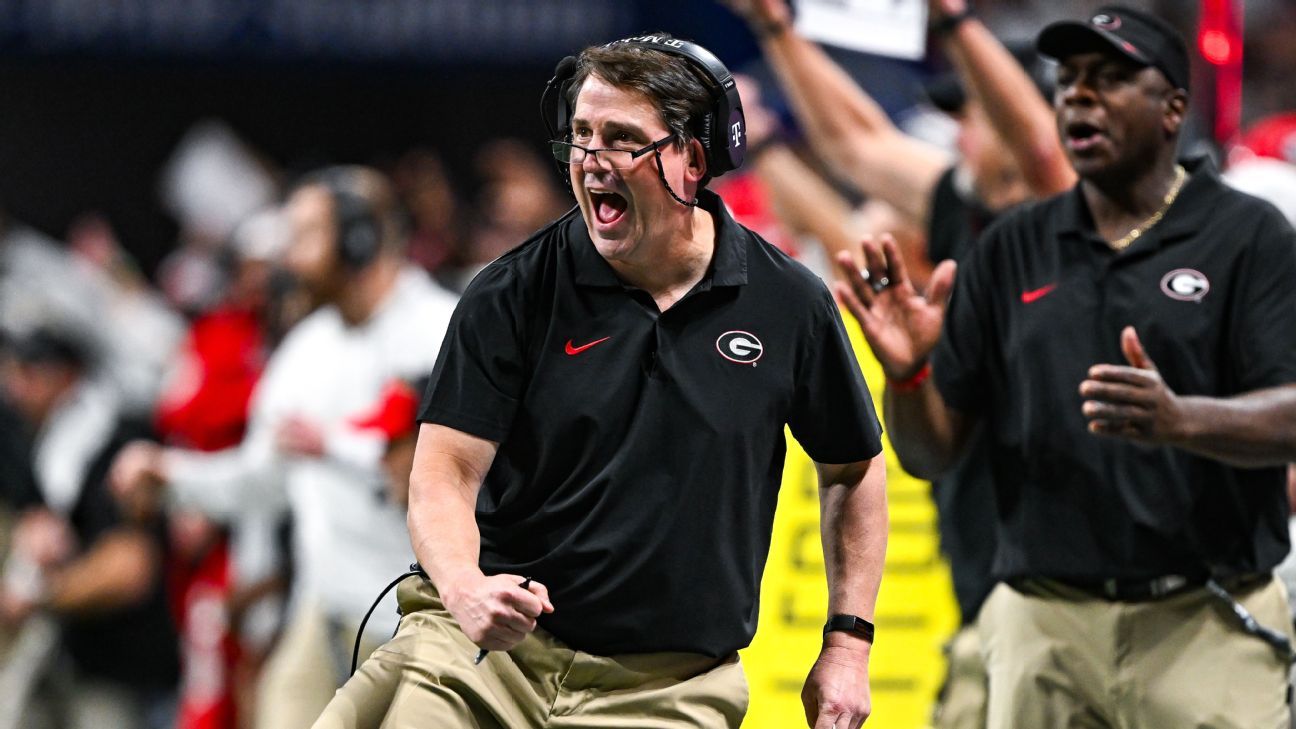
The Texas Longhorns are bringing back Will Muschamp to replace defensive coordinator Pete Kwiatkowski, who was fired along with defensive passing game coordinator Duane Akina on Thursday.
Longhorns coach Steve Sarkisian announced that he wasn’t bringing back Kwiatkowski, who had served as his defensive coordinator since 2021, and Akina in a major shakeup for a unit that didn’t meet expectations during a 9-3 season in which the preseason No. 1 failed to make the College Football Playoff.
Sarkisian is turning to Muschamp, who returns to Austin after serving as Texas’ defensive coordinator from 2008 to 2010 and was once the program’s head coach in waiting under Mack Brown.
“Having the opportunity to hire Will Muschamp provides us the leadership to take our defense to another level,” Sarkisian said in a statement. “Will is a guy I’ve known for a long time, always admired and is as good of a defensive mind and coach as I’ve ever coached against. His defenses are relentless; he absolutely gets the best out of his staff and players and is such an extremely well-respected coach.
“I know Longhorn Nation knows him well. He led some incredible defenses here on the Forty, and I’m so fired up to be bringing him back to Texas. He’ll be an awesome addition to our staff.”
In his previous stint at Texas, Muschamp helped the Longhorns get to the BCS national championship game in 2009 with a unit that ranked No. 1 against the run, on third downs and in takeaways. He was set to someday succeed Brown, but he instead departed after a 5-7 season in 2010 to become the head coach at Florida, succeeding Urban Meyer.
Muschamp went 56-51 as a head coach at Florida and South Carolina. He joined Kirby Smart’s staff at Georgia in 2021 and served as the Bulldogs’ co-defensive coordinator in 2022 and 2023 before transitioning to an analyst role in 2024 and then stepping away from coaching in 2025 to spend more time with his family.
Muschamp has done some advance scouting for Georgia during the season while spending most of his time in Tennessee, where his son, Whit, is a quarterback at Vanderbilt.
“This is an exciting day for the Muschamp family,” Muschamp said in a statement. “We loved our time in Austin and truly enjoyed everything about working with Texas Football. We’re thrilled to be coming back to a program with one of the richest and proudest histories and traditions in college football. With what Coach Sark has done in rebuilding this program — knowing there are even better days ahead — I was fired up for the opportunity.”
Texas’ defense was expected to be among the best in the country in 2025, with several returning All-SEC starters, but it gave up 29 points in a road loss to the Gators and allowed 30 or more points in four of its last five games, including a 35-10 loss at Georgia that effectively knocked the Longhorns out of the CFP race.
Kwiatkowski was a finalist for the Broyles Award as one of the top assistant coaches in college football in 2024, and the Longhorns finished with the No. 3 scoring defense in FBS during a 13-3 season that ended in the CFP semifinals against eventual national champion Ohio State. During his five years in Austin, Kwiatkowski helped Texas achieve back-to-back CFP appearances and top-four finishes, and developed 12 NFL draft picks on defense, including first-rounders Jahdae Barron and Byron Murphy II.
Akina, a former longtime Texas defensive backs coach, just finished his first year back with the program after stints at Stanford and Arizona. The Longhorns’ pass defense ranks No. 102 in the FBS this season.
The No. 13 Longhorns will finish their season against No. 18 Michigan in the Cheez-It Citrus Bowl on Dec. 31 (3 p.m. ET, ABC).


-
Andrea Adelson
CORAL GABLES, Fla. — Carson Beck remembers the first time he saw Malachi Toney making plays against the Miami defense in the spring. He was running routes like a veteran and making moves that Beck calls “inexplicable.”
Beck stood on the sideline, unable to throw while rehabbing an elbow injury, but he had seen enough to know the receiver would be a star. He asked Toney to watch game tape with him, so they could be on the same page once fall camp started. The two spent hours together inside the Miami facility: Beck, the sixth-year veteran; Toney, the 17-year-old true freshman who should have been preparing for his senior year of high school.
They watched tape of Georgia, where Beck played the previous season. He pointed out the way receiver Ladd McConkey, tight end Brock Bowers and running back Cash Jones ran option routes to perfection.
“I want you to do it this way,” Beck told him.
Toney listened and nodded.
“Sure enough, we go out to practice in the fall, and everything is identical.”
But the moment that Beck knew Toney was different came during Miami’s game against Florida State, in early October. Miami lined up to go for it on fourth-and-2 from the Florida State 40-yard line, hoping to build on its 14-3 lead. Toney lined up just behind the right tackle, and the Florida State defense showed a specific look the two went over in the summer.
When the play started, Toney ran around the right side of the tackle to an open spot beyond the first down marker as the Florida State defense lost track of him for a split second. That was long enough. Toney quickly turned around, Beck got him the ball and Toney made one juke move to get him racing past the defense and into the end zone for a touchdown.
Beck stood there, incredulous. Toney had remembered exactly what to do, months after they went over the play. What Beck did not know was that Toney had been waiting all season for that moment.
“I knew once I got that look, it’s a touchdown,” Toney said. “It was all like slow motion.”
Toney finished with seven catches for 107 yards and two touchdowns in the 28-22 win. He had a third score that was called back because of a penalty. Afterward, Toney deflected praise, instead thanking the coaches and his teammates for believing in him while crediting his mom for his work ethic. “Getting up early and staying late, that comes from watching my mom,” he said. “If she can do that, why can’t I?”
Early the next day, at around 3 a.m., Toney sent a message to his high school coach, Mike Smith. It included a picture from the state championship game his freshman year in 2022, when Toney fumbled as the team was driving for a game-tying score.
Toney wrote, “This changed my life forever.”
AS MIAMI PREPARES to play Texas A&M in the first round of the College Football Playoff on Saturday (noon, ABC), Toney has emerged as one of the most fascinating players in the 12-team field. The ACC Rookie of the Year, Toney had 84 catches for 970 yards and seven touchdowns, rushed for another and threw for two more, lining up at every position on offense minus the offensive line.
“Hell, he even might be able to do that,” Miami offensive coordinator Shannon Dawson says.
Texas A&M defensive coordinator Jay Bateman said this week that Toney is “maybe the best player we’ve played all year.” Beck heaps even bigger praise on Toney, saying he is already one of the best players he has played with in his entire career. “If he continues on the path he’s on,” Beck says, “he will be the best that I’ve ever played with.”
At 5-foot-11, 188 pounds, he is not the biggest player on the field. Nor is he the fastest. But Dawson says Toney’s football knowledge, capability, body control and peripheral vision set him apart now, just as they set him apart as a youth football player in South Florida.
The Toney legend grew early on, when he started playing quarterback at age 7 because his team needed one. On his 8U team, he scored a game-winning touchdown on a quarterback sweep that went 40 yards to get his team into the playoffs. One of his youth coaches dubbed him “Baby Jesus,” and the nickname took off from there — though the devout Toneys avoid using it themselves.
Once Toney arrived at American Heritage High in 2022, the plan was for him to play receiver. In his very first game, he had 100 yards.
Toney was a bona fide varsity star, and it was hard to keep him away from football. He’d plead with his coaches to play in junior varsity games, too. He spent all his extra time on the game. Then came the Florida Class 2M state championship game against Miami Central. American Heritage trailed 38-31 with two minutes left and started driving for the tying score.
Toney caught a pass in the flat, and he took off. But as he was getting hit, he fumbled at the 28-yard line. Future Miami teammate Rueben Bain Jr. recovered with 1:17 remaining to give Central the championship. Toney sobbed as he headed for the sideline, inconsolable, believing he had cost his team the game.
His mom still has a photo of him on the floor of the locker room, in tears.
“That feeling that you cost your team a great moment, like a moment that will never be remade, that was the turning point for me,” Toney said. “Knowing that feeling will never go away, that’s why I work so hard.”
His mom saw a different Malachi from that moment forward.
“That freshman season put something different inside of him,” Shatravia “Toni” Toney said.
Malachi Toney doubled down on the work. Every day during lunch, he would go on the Jugs machine and catch 200 balls. He watched game tape religiously, competing against Smith for most hours watched in a week. Once, he got up to 14 hours and told Smith, “I’m going to catch you.” Toney would often call Smith in the middle of the night with questions about coverages, and plays they should run.
“Malachi,” Smith would say. “Go to sleep.”
By the time his junior year rolled around, Toney decided to reclassify and leave high school one year early to play in college.
“I had some coaches ask me, ‘Do you think he’s ready? Is that a smart idea?'” Smith says. “For 99 percent of kids I would say, ‘No.’ But for Malachi? I knew that kid was ready. This is what he’s been wanting to do his whole life.”
American Heritage made the playoffs again, but Toney was out of the regional semifinal against Fort Lauderdale’s Dillard with a sprained ankle. By his own admission, Toney was hobbled and unable to run at full speed. But trailing 14-0, Smith felt a tap on his shoulder.
“Coach, can I go suit up?” Toney asked.
Smith held him off, but only for so long. Toni saw her son, in a walking boot, headed back to the locker room and ran after him, knowing he was getting ready to put on his uniform to play.
“Malachi, you can’t do that,” Toni said.
“I’ve got to try something,” he told her. “We can’t go out like this.”
Toney came out after halftime to play receiver, but a few plays into the second half, starting quarterback and Texas commit Dia Bell went down with an ankle injury of his own. Smith turned to Toney and told him he would have to go in at his old position: quarterback.
Coming in cold with literally zero quarterback reps in three years? Toney smiled at Smith, the way he always did. Toney used to joke around in practice that he was a human Jugs machine because he could deliver the ball with both speed and precision. He threw his first pass so hard that his receiver dropped it. No biggie. Toney proceeded to lead American Heritage to 24 unanswered points and the victory.
They rolled to wins in their next two games before meeting Orlando Jones in the state championship game — the moment Toney had waited on since his freshman year. Only this time, he had the ball in his hands as the quarterback. Toney threw one dime after another — starting the game 15-of-15 as American Heritage won its first state title since 2020.
“I feel like I repaid the program,” Toney said. “I stayed down ’til I came up.”
“When he came in as a freshman and they were like, ‘This is Baby Jesus,’ I’m like, ‘I am not calling that kid Baby Jesus,'” Smith said. “But by the end of his career, after the state championship, I said, ‘You know what? I will call you Baby Jesus now.'”
TONEY ENROLLED AT Miami in January. He took his work habits to a new level with the Hurricanes. Every minute of every day was dedicated to either football or class, with little time for anything else.
What Beck saw in those first practices is what the coaches saw: a player who was not only hard to cover, but fearless. Put him in a two-minute drill and watch him make every catch and score. Jump up for a catch, land with perfect balance, then keep going? Check. That is why Mario Cristobal said last March, after a handful of spring practices, “They keep calling him Baby Jesus. You guys know who I’m talking about, right?”
Everyone in South Florida knew exactly who Cristobal was talking about. The rest of the country would find out soon enough. Miami opened the season against Notre Dame, in a national spotlight prime-time game.
“It was easy for us to see this kid’s special,” Dawson said. “Then it went to: ‘Let’s don’t talk about it too much, because he’s never done it in a game.’ Then he just made plays against Notre Dame. The game was not too big for him. He had no fear of failure.”
Indeed, Toney had six catches for 82 yards and a touchdown against the Irish, finding ways to repeatedly get open against one of the best secondaries in the nation. Afterward, Cristobal lamented, “We tried to keep him a secret, but it didn’t take long.”
The word was out, and defenses adjusted. Toney saw more double teams. He heard more trash talk, as players yelled at him, “This isn’t high school anymore!” He got pushed more when he got tackled to the ground. Toney never said a word back.
Dawson got creative with the way he lined Toney up. Because he played quarterback, Toney has a unique ability to understand not only what everyone on offense should be doing, but what defenses are doing, too. That ability, matched with his desire to learn, gave Dawson more options.
“You move him around, it doesn’t faze him,” Dawson said. “If you show him something on a whiteboard, or you show him something that somebody did — and it may not be his position — but we’re going to line you up here, and you’re going to do this. Then you go out to the field, and it looks better than the damn kid that you showed him.”
That includes lining Toney up in the Wildcat position, or as Dawson has coined it, the “Malicat.” In the regular-season finale against Pitt, Toney lined up in the Malicat and took the snap. He dropped back to pass. His first read, a post route, was covered. So he threw a wheel route instead to Elija Lofton for the touchdown.
Cristobal has repeatedly praised Toney for carrying himself like an NFL veteran, pointing to his work ethic as exemplary.
Every morning, Toney wakes up at 4:55, the same time as his mother. He arrives at the facility 30 minutes before he is supposed to, then proceeds to get taped up and stretched before going to meet with coaches upstairs to go over the practice script and take notes.
After practice, he spends more time on the Jugs machine, gets in the cold tub, heads to class and comes back to the facility to watch more tape before going back home to do it all again the next day.
“I know what I had to do to get to this position, so I was willing to sacrifice things like sleep, not going to parties, missing out on time with my mom,” Toney says. “What you put in is what you’re going to get out, so that’s how I go about it. If I want to go out there and have a big game, I’ve got to put in the work.”
Once rivals, now teammates, Bain has watched Toney work since his arrival in January. When the offense has a 30-minute break between the end of practice and a lifting session, Bain sees Toney lead the receivers on the Jugs machine. “He’s the last guy to leave the building and the first guy to be in,” Bain says. “It’s a mindset for him, and it’s a way of life.”
He has not let Toney forget that fumble. This past Wednesday, after the first-team offense went against the first-team defense to close out practice, he went up to Toney and could not help but talk some trash, telling him, “I’ve got a play in your mind that will last the rest of your life.”
Toney played it off, but Bain is right.
Because every time he takes the field, Toney remembers the way he felt three years ago in the state title game. He channels that pain into action. He grips the football tight.
He has not fumbled since that night.
-
 Sports2 years ago
Story injured on diving stop, exits Red Sox game
-
 Sports3 years ago
‘Storybook stuff’: Inside the night Bryce Harper sent the Phillies to the World Series
-
 Sports2 years ago
Game 1 of WS least-watched in recorded history
-
 Sports3 years ago
Button battles heat exhaustion in NASCAR debut
-
 Sports3 years ago
MLB Rank 2023: Ranking baseball’s top 100 players
-
Sports4 years ago
Team Europe easily wins 4th straight Laver Cup
-
 Environment3 years ago
Japan and South Korea have a lot at stake in a free and open South China Sea
-
 Environment1 year ago
Here are the best electric bikes you can buy at every price level in October 2024